You've just been told to fill a night post by Friday, the site manager wants someone who can "handle anything," and the last job ad you copied lists patrols, CCTV and customer service without saying what good looks like. That vagueness creates problems fast. The officer starts without clear authority, the client expects police powers, and nobody can tell whether a missed round or a thin incident report counts as poor performance.
A strong Security Officer Work Description fixes that before the first shift. Treat it as an accountability document, not a recruitment filler. It should name the post, the duties, the standard for each duty, the licence needed, the award classification, and the point where the officer stops and escalates.
What a Security Officer Does Day to Day
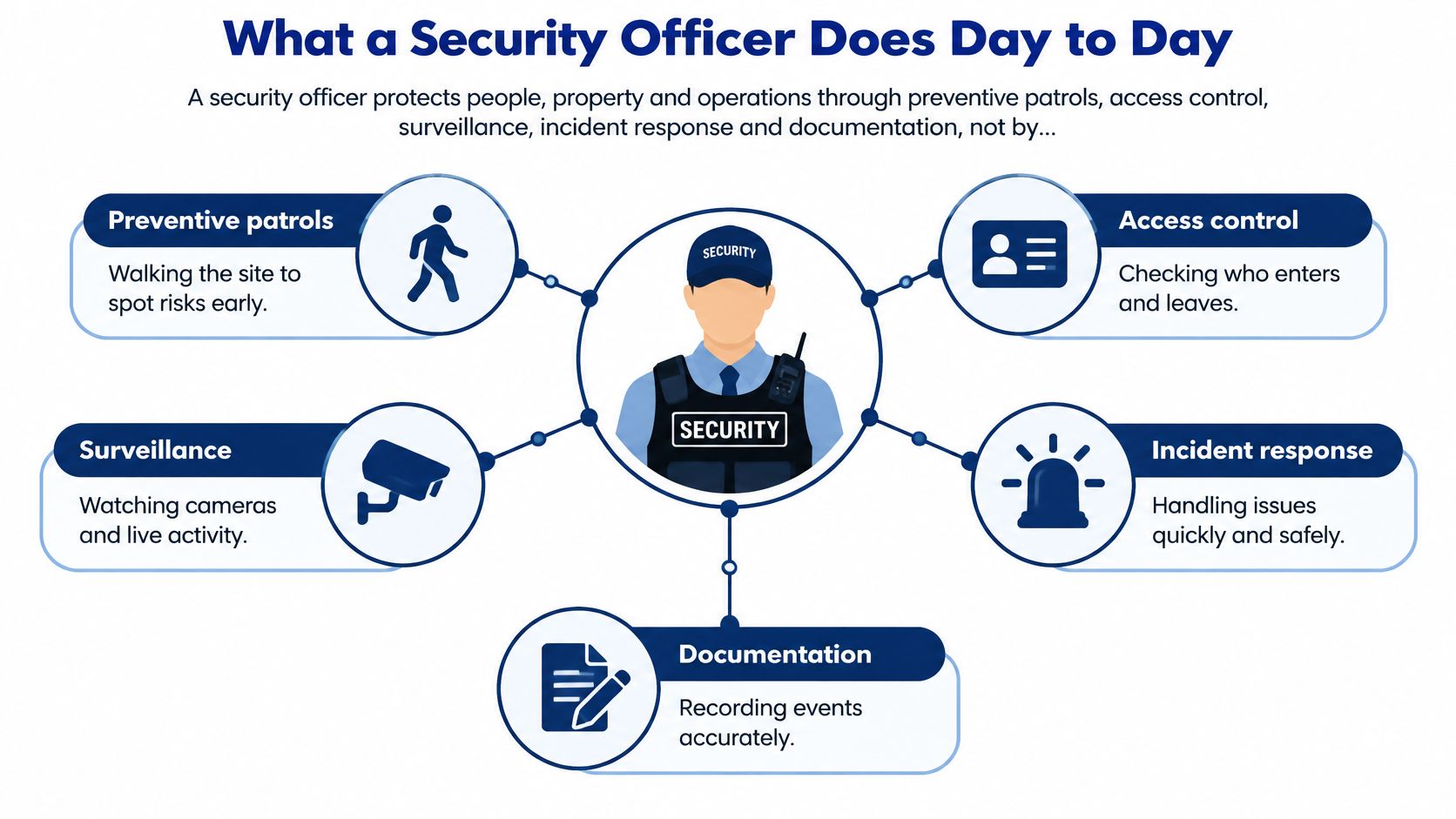
A security officer protects people, property and operations through preventive patrols, access control, surveillance, incident response and documentation, not by standing at a fixed post alone. That's the definition to put at the top of the description. Everything after it should prove how that protection happens on your specific site.
The Australian Bureau of Statistics occupation classification describes officers patrolling industrial and commercial property, checking doors, windows and gates for unauthorised entry, identifying hazards such as fires, equipment malfunctions and property damage, and operating CCTV and alarm systems. It also covers responding to alarms, investigating disturbances, recording incidents, reporting suspicious activity, enforcing site procedures, and controlling movement of people and vehicles, with registration or licensing possibly required depending on jurisdiction and assignment.
Core Duty Areas and the Standard to Write Into Each
| Duty area | Typical tasks | Measurable standard to write in |
|---|---|---|
| Patrols | Scheduled perimeter and internal checks; checking doors, windows and gates for unauthorised entry | Each round logged with times and any irregularities recorded |
| Access control | Verifying visitors, contractors and staff; issuing and checking passes | Every entry matched to an authorised list or pass |
| Surveillance and alarms | Operating CCTV; monitoring and escalating alarm activations | Alarm escalated to the stated contact within the time set in post orders |
| Incident response | Attending disturbances and hazards; contacting police, fire brigade or supervisors | Incident report completed before end of shift |
| Documentation | Occurrence books, handover notes and digital reports | Records complete, accurate and time-stamped |
| Crowd and movement control | Managing queues, crowds, foot and vehicle traffic at events and sites | Crowd duties performed only within the officer's current licence |
The standard column is what makes a duty testable. "Patrol the site" can't be checked at interview or in a review. "Complete each scheduled round, log the time at each checkpoint, and record any irregularity before handover" can be checked on night one.
Job boards show how generic listings drift. Comparing your draft against a live post, such as a HiredBySkill security guard listing, is useful only if you then replace generic phrases with your site standards. A Mobile Patrols officer, a concierge and a gatehouse officer shouldn't share one list, because each post weights these areas differently. Handover quality matters too, so link duty expectations to practical routines like construction shift handover protocols where changeover is a known risk point.
Practical rule: If you can't observe, time or file it, you haven't written a standard yet.
How to Write the Job Description Step by Step
Build the document in ten parts, in this order. Each part answers a question a candidate, supervisor or client will ask during the first week. Skip one and you'll answer it under pressure at 2am instead.
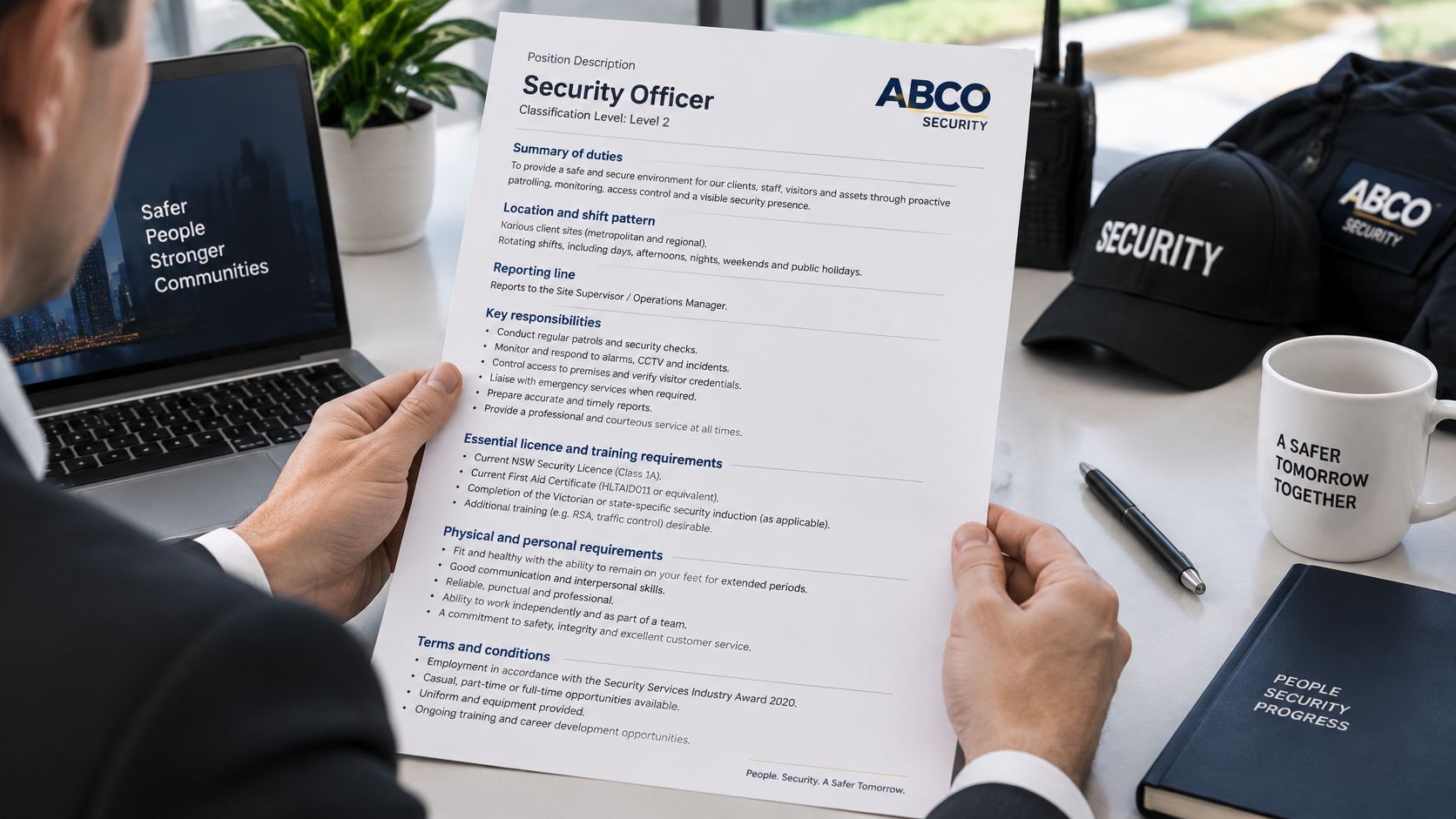
The Ten Parts in Order
- Role title and classification: Security Officer, Mobile Patrols, with the award level named. A control-room operator and a patrol officer need different titles.
- Purpose statement: The officer protects the site, occupants and assets by patrolling, controlling access, monitoring CCTV and alarms, responding to incidents and recording activity accurately.
- Reporting line: Patrol Supervisor by day, named on-call contact out of hours. Don't write "management."
- Site, shifts and conditions: Rotating day and night patrols, lone work, vehicle patrols and prolonged standing where they apply.
- Priority duties with standards: Complete scheduled rounds and log times, check access points, escalate alarms under post orders.
- Authority limits and escalation: Who to call, in what order, and what the officer must not do.
- Licence and first aid: Licence class for the activity, first-aid currency, and expiry dates checked before deployment.
- Equipment and digital skills: Two-way radio, CCTV viewing, patrol app and incident-reporting software.
- Performance expectations: Round completion, alarm response time in post orders, and report accuracy.
- Pay and hours: Named classification level under the Security Services Industry Award, plus rostered hours and penalties.
A Worked Example for Mobile Patrols
Role title is Security Officer, Mobile Patrols. Purpose is to protect multiple client sites by patrolling, checking access points, responding to alarms and recording every round. Reporting line is the Patrol Supervisor, with an on-call contact after hours. Shifts rotate across day and night with lone work as rostered.
Priority duties are scheduled rounds logged by time, checks of doors, windows and gates, and alarm escalation under post orders. Licence requirements name the current class and first-aid certificate, with expiry checked before deployment. Equipment is a two-way radio, patrol app and reporting software. Performance is judged on round completion, alarm response and report accuracy, and pay names the award classification level.
Wording also signals how your organisation treats people, which is why it's worth reading guidance on how to align job descriptions with company culture before you publish. For a Security Company Melbourne post or any other city post, the culture point is practical, not decorative. Candidates who value clear orders and fair rostering recognise themselves in a precise description.
My test is simple. Every duty should be specific enough to check at interview with one question. If you can't ask "show me how you'd do this," rewrite the line.
Sector Variations for Events, Retail, Construction and Concierge Sites
Security Guarding is the umbrella term. It doesn't describe a post. An event entrance, a shopping centre car park, a construction gate and a corporate lobby create different risks, so the description must name the sector and the competency that goes with it.
Duties, Competencies and Records by Sector
| Sector or service | Duties to write in | Competency to require | Record to keep |
|---|---|---|---|
| Event Security | Entrance and egress monitoring; queue and crowd management; first aid within training | Crowd-control licence; current first aid | Crowd count log and incident report |
| Shopping Centre Security | Mall and car park patrols; retail theft detection; cooperation with store staff and police | Certificate II in Security Operations; evidence handling; de-escalation | Patrol log and theft incident report |
| Retail Security | Store floor observation; loss prevention; CCTV review | Licence for the activity; CCTV viewing skills | Loss-prevention incident report |
| Construction Security | Site access; contractor sign-in; induction checks; theft and damage prevention | Site induction; hazard awareness; first aid | Site access register and hazard log |
| Concierge Security | Reception coverage; visitor passes; lobby monitoring; evacuation support | First aid; customer service; access control systems | Visitor register and handover log |
| Gatehouse Security | Vehicle and pedestrian checks; barrier control | Access procedure training; radio discipline | Gate and vehicle log |
| Mobile Patrols | Scheduled patrols; alarm attendance; after-hours checks across sites | Vehicle use; radio discipline; alarm response | Patrol and alarm response log |
Say you're staffing Event Security and Construction Security on the same weekend. Both officers log access. Only the event officer needs crowd-control licensing and first-aid readiness for queues, a surge at an entrance, or a patron who collapses before paramedics arrive. The construction officer needs induction checks, contractor sign-in discipline and hazard awareness around plant and deliveries.
A second contrast helps. A Shopping Centre Security officer patrolling a mall and car park needs conflict de-escalation, theft detection and evidence handling for police. A Gatehouse Security officer at a barrier focuses on vehicle checks, authorised lists and radio discipline. Both keep accurate logs, but the logs prove different things.
For front-of-house roles, compare duties against a dedicated concierge security guards service outline before you copy a static guarding template. Retail Security and Concierge Security are both public-facing, yet one prioritises loss prevention and the other prioritises visitor management and evacuation support. Name the post type on every sector line, or you'll recruit the wrong strengths.
Licences, Training and First Aid by State
An officer rostered for crowd control needs the licence and training for that activity, even if the post is usually quiet. A job description should name the required licence class, training and first-aid expectations, then make clear that the supervisor checks them before deployment.
In Victoria, applicants for a private security licence must be at least 18, have Australian residency or valid working rights, provide fingerprints, meet police-check requirements and satisfy the regulator that they are a fit and proper person. Training through an approved Registered Training Organisation must be valid within 12 months of application, according to Victoria Police private security eligibility and training guidance. The same guidance lists CPP20218 Certificate II in Security Operations, comprising 130 hours, for activities including unarmed guarding, crowd control and control-room operations.
Licence and Training Requirements by State
| State or territory | Licence and training requirement | Source |
|---|---|---|
| Victoria | Private security licence; approved RTO training; CPP20218 Certificate II in Security Operations (130 hours) valid within 12 months of application | Victorian regulator |
| Queensland | Confirm the licence class, training and first-aid requirements for the role with the state regulator before deployment | State regulator |
| Western Australia | Confirm the licence class, training and first-aid requirements for the role with the state regulator before deployment | State regulator |
| Northern Territory | Confirm the licence class, training and first-aid requirements for the role with the state regulator before deployment | State regulator |
| New South Wales | Confirm the licence class, training and first-aid requirements for the role with the state regulator before deployment | State regulator |
| South Australia | Confirm the licence class, training and first-aid requirements for the role with the state regulator before deployment | State regulator |
Requirements vary by licence class and activity. Before assigning a post in Melbourne, Sydney, Brisbane, Perth or elsewhere, confirm the applicable rules with that state or territory's regulator. Record the required licence class and expiry date in the job description, and state any first-aid qualification the site requires. Candidates who need help understanding the application pathway can read this guide to getting a security licence.
Check the licence class and expiry against the post before deployment. A photocopy alone does not confirm that the officer holds the right authority for the role.
Pay, Classification and Shift Terms Under the Award
Two officers on the same site can have different pay terms because classification, day of the week and shift timing affect their rates. State the classification, roster pattern and reporting line alongside the duties so candidates and roster supervisors can see what the role requires.
The Fair Work pay guide for the Security Services Industry Award lists five security-officer classifications, from Level 1 through Level 5. Ordinary hourly rates range from $28.42 to $31.20, Saturday rates from $42.63 to $46.80, Sunday rates from $56.84 to $62.40, and public-holiday rates from $71.05 to $78.00. These rates are before applicable penalties and allowances. Security guards and crowd controllers are among the employees covered by the award.
Security Services Industry Award Rate Ranges
| Pay element | Rate range | What the description should state |
|---|---|---|
| Ordinary hourly rate | $28.42 to $31.20 | Classification level and ordinary hours |
| Saturday rate | $42.63 to $46.80 | Weekend roster and applicable penalty |
| Sunday rate | $56.84 to $62.40 | Weekend roster and applicable penalty |
| Public-holiday rate | $71.05 to $78.00 | Holiday coverage and applicable penalty |
Night-work penalties apply under the award and are paid on top of the ordinary rate for overnight shifts.
A mobile patrol officer working alone overnight, a control-room operator monitoring alarms and an event security team leader supervising others have different responsibilities. Describe each post's duties and reporting line separately rather than treating the roles as interchangeable. State whether the roster includes weekend, public-holiday or overnight shifts before a candidate accepts.
Clear classification and shift terms support accurate budgeting and consistent rostering across commercial, retail and construction sites. Record the classification decision with the role details so the next supervisor can roster relief staff on the same basis.
Authority Limits and Escalation Boundaries
A security title doesn't grant police powers. That's the assumption most templates get wrong, and it's the one that creates legal risk. Write what the officer may do routinely, what needs site-specific authority, and what must go straight to police or emergency services.
This training image shows where those boundaries should be taught, before an officer faces them alone on site.
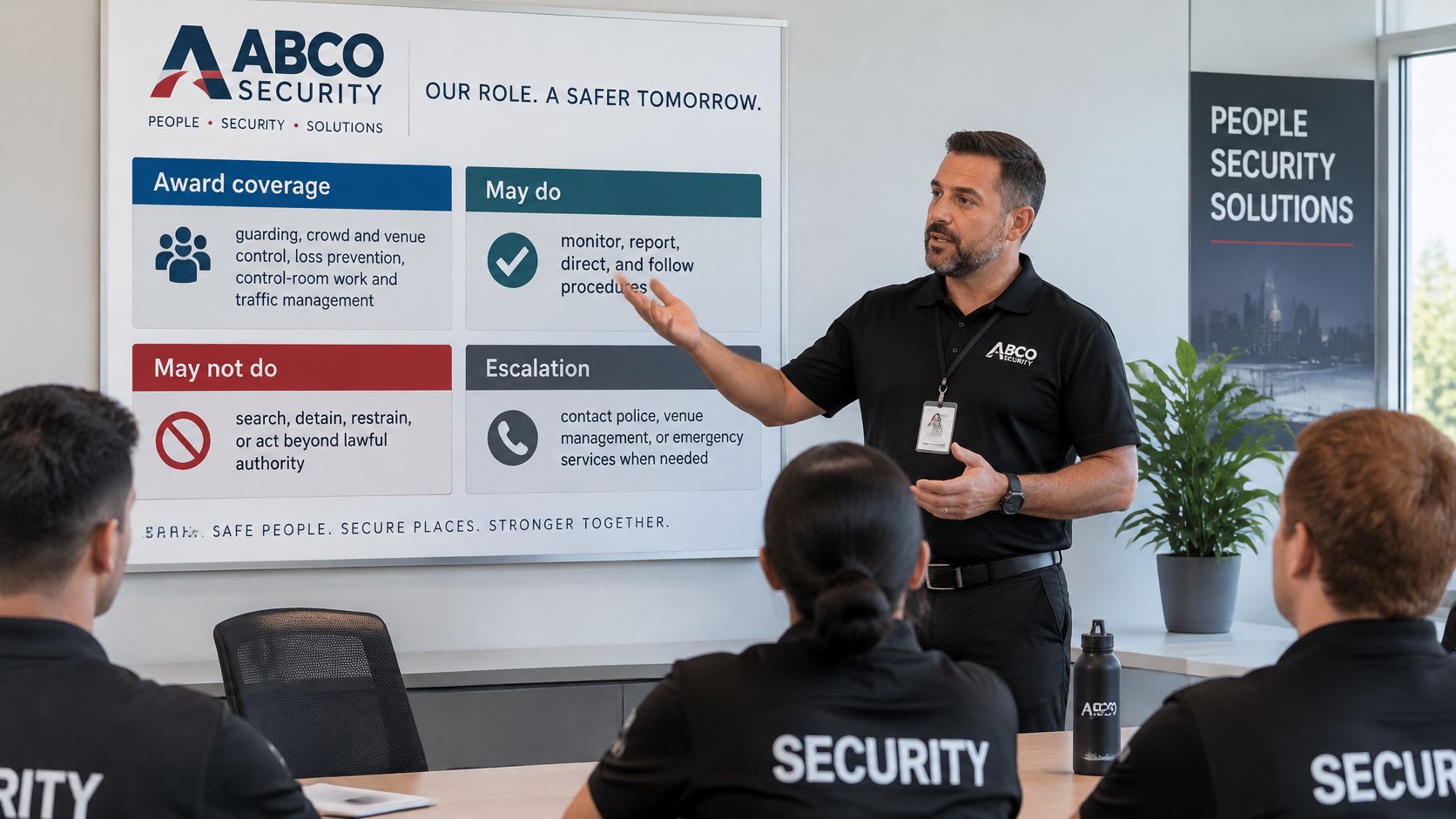
The Fair Work Ombudsman Security Services Industry Award summary covers physical and electronic guarding, crowd and venue control, loss prevention, control-room work and traffic control, but excludes employees installing, repairing or maintaining electronic alarms and monitoring systems. In practice, an officer monitors and escalates an alarm. A technician diagnoses and repairs the fault. Arrests are described only where authorised by law, while routine work includes controlling access, enforcing site procedures, assisting staff and visitors during emergencies, and recording disturbances.
What to Write Into Post Orders
- Verify, record and escalate: Check the alarm or report, log times and descriptions, then call the named supervisor.
- Call police or fire brigade: Escalate crimes, fires and serious hazards immediately under post orders.
- Preserve evidence: Protect CCTV, notes and the scene, and don't alter records after the event.
- Stay within role: Don't replace police, paramedics, investigators or electronic-security technicians.
Say a shopper is suspected of theft in a shopping centre. The officer observes from a safe position, records a description and times, notifies store staff and the supervisor, calls police where post orders require it, and preserves CCTV. The officer doesn't detain beyond lawful authority or turn a property matter into a physical confrontation. Calm communication matters here, and supervisors should train officers in de-escalation techniques rather than expect confidence alone to carry a tense encounter.
The short video below is useful for discussing how observation, communication and escalation work together in a live incident.
A clear escalation chain protects both the client and the officer. It gives the officer a defensible decision path and gives the client evidence that can stand up later.
Assessing Candidates Before You Hire
Turn the description into a hiring check. If a requirement matters on shift, test it before you offer the post. Start with documents, then test judgement, then set the measures you'll use after probation.
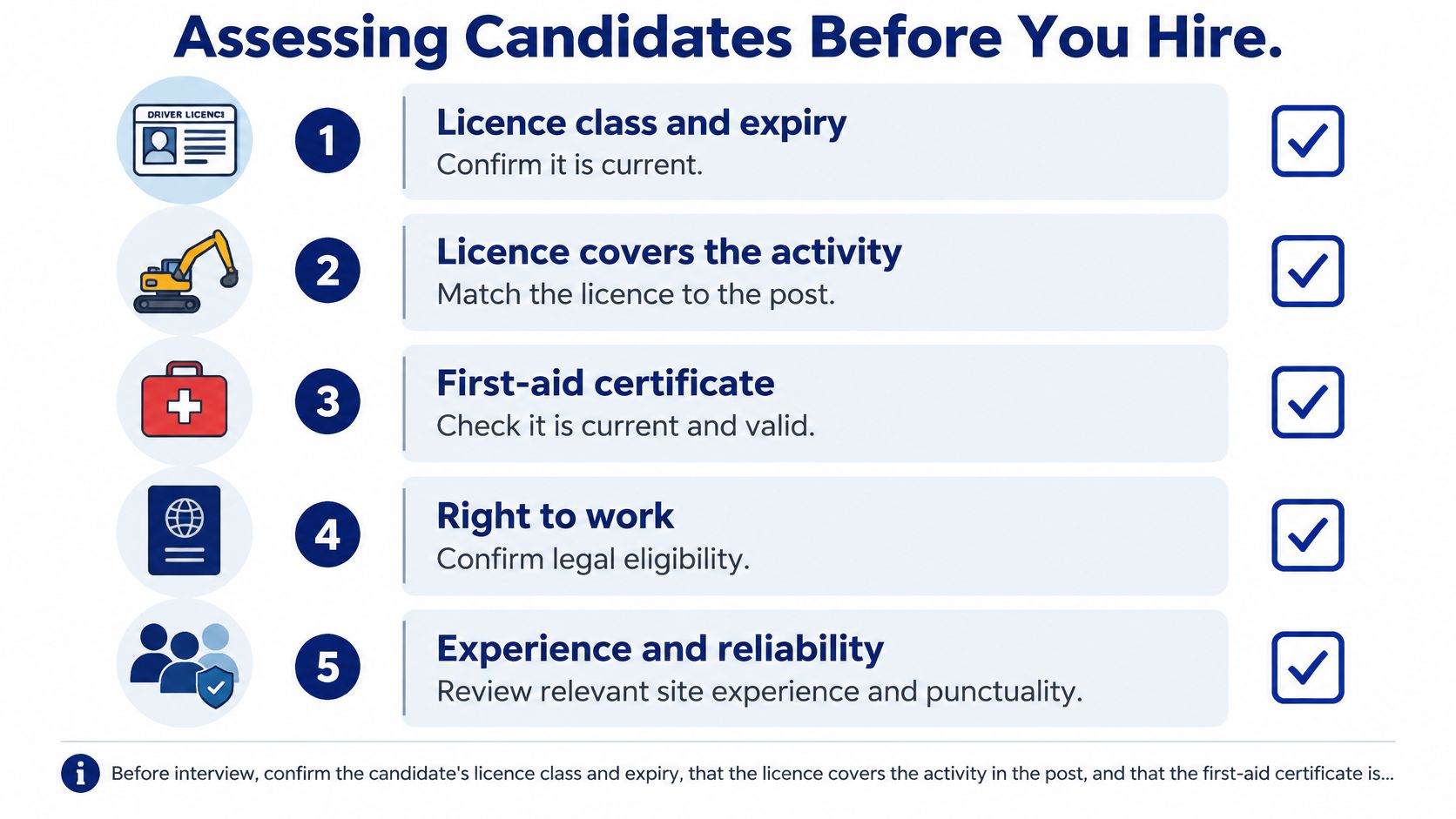
Before interview, confirm licence class and expiry, confirm the licence covers the activity, check first-aid currency, and verify right to work. Add relevant site experience and reliability, because a strong event officer may still be wrong for lone night patrols. For providers, compare those checks against published service delivery standards so the hiring test matches the standard promised to clients.
Three Scenarios That Reveal Judgement
An alarm activates at 2am with no staff on site. A strong answer verifies on CCTV where available, follows post orders, escalates to the supervisor, calls police or fire brigade as the situation requires, and logs every time. A weak answer jumps to entering alone or resetting the alarm without checking.
A queue surges at an event entrance. A strong answer calls the supervisor early, keeps egress clear, uses calm radio communication, gives short instructions to the crowd, and records the event. First aid readiness matters if someone falls or becomes unwell.
A visitor becomes aggressive at a concierge desk. A strong answer keeps distance, lowers the temperature with calm language, calls for help, protects staff and visitors, and stays within authority. ABCO Security Services Australia is one provider that offers concierge and reception coverage alongside guarding, patrols and event services, which illustrates why customer service and escalation both belong in that post description.
Write the performance measures into the offer: round completion rate, alarm response within the time in post orders, report accuracy and timeliness, correct escalation, and client feedback. Review them with the officer after the first roster cycle, while habits are still forming. That's how a description becomes a management tool, not a file nobody opens again.
If you're drafting or reviewing a Security Officer Work Description for a commercial, retail, construction, event or concierge site, compare your duties, licence checks and escalation terms against the services offered by ABCO Security Services Australia. Visit the site to discuss licensed guarding, mobile patrols, event coverage and electronic monitoring for your location, and get a post description that matches the work your officers will do.
about
avada factory
Sempery ultricies nibh at dolor cras urna eleifend nec. Atiam efficitur tempor.