The Australian Bureau of Statistics recorded crime victims release for 2024 recorded 595,660 victims of other theft nationally in 2024, an increase of 6%, or 34,706 victims, on 2023. That figure changes how you should think about Shopping Centre Security. You're not buying a guard for a doorway. You're building a system that protects profit, reassures shoppers and produces evidence your centre, your retailers and police can use.
Build the Program in Six Phases
Build your Shopping Centre Security program in six phases, in order. Skipping ahead to cameras or rosters is where most budgets go wrong, because each phase produces the evidence the next one depends on.
Australia's first national survey of crimes against businesses found shopping precincts and other "special business zones" were significantly more exposed to crime than businesses outside those areas, and 69% of sampled businesses where retail trading took place reported theft by customers, most commonly shoplifting. Theft is only part of that exposure. Burglary, vandalism and fraud sit in the same risk picture.
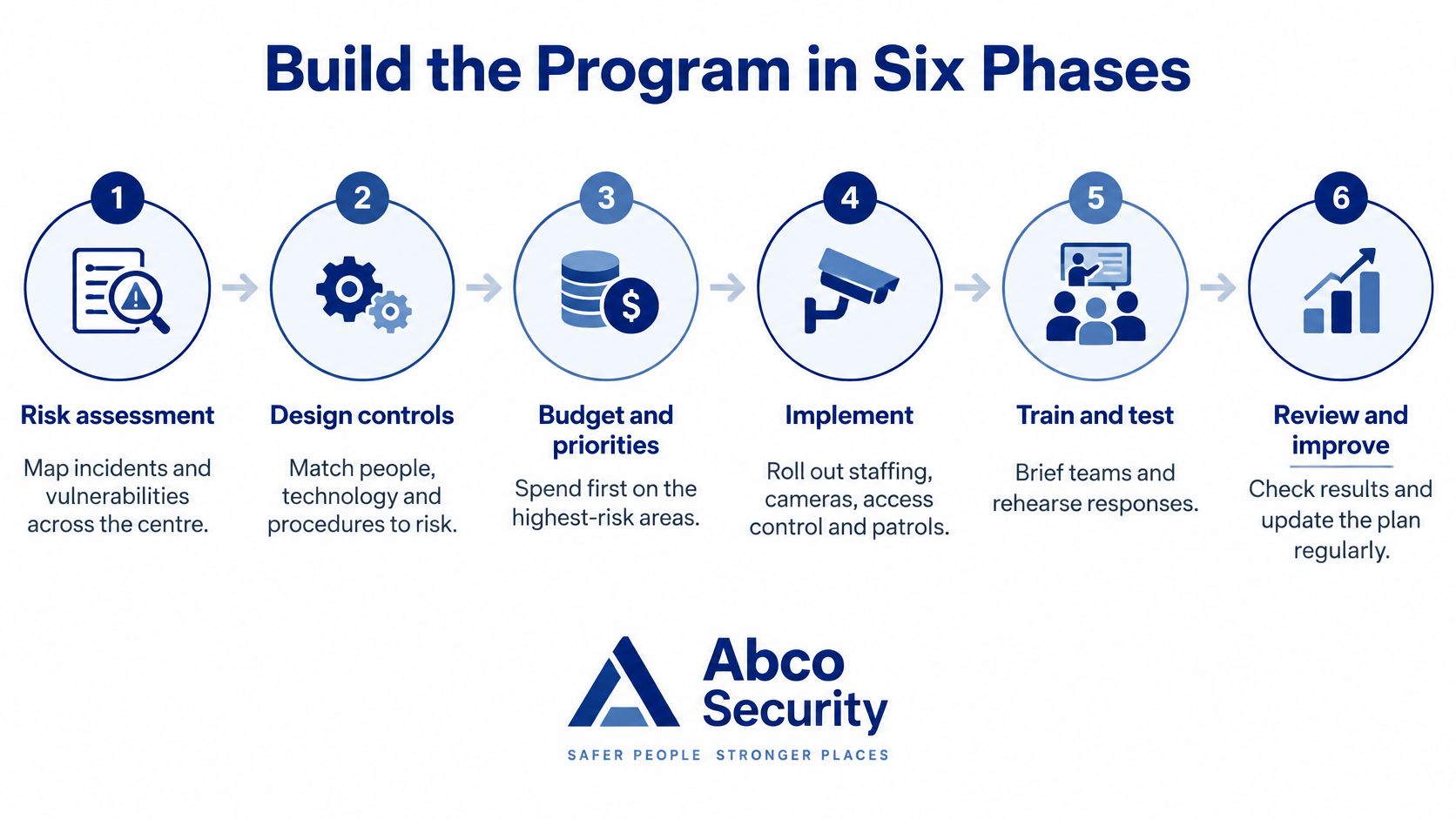
- Risk assessment: Map incidents, shopper perception and physical gaps by zone and hour.
- Control design: Decide what will deter, detect, delay and respond in each zone, and name an owner for each control.
- Tender and contract: Write post orders, response times and KPIs into the scope, then verify licences before award.
- Rollout and training: Train staff and officers on indicators, reporting and one signed escalation tree.
- Exercise and audit: Run tabletop exercises and a rehearsed evacuation, then log corrective actions.
- Measure and review: Report monthly and refresh the risk register every 12 months.
I would start before any tender goes out. Pull twelve months of incident, stock loss and complaint records into one spreadsheet. If you can't see your own pattern clearly, a provider can't price it properly either.
How to Assess Risk Across the Whole Centre
Ask two questions, not one. Where does harm happen, and where do shoppers feel unsafe? Those maps overlap, but they don't match, and the gap between them is where trust leaks away.
A 2025 Australian shopper study reported by Monash Lens found 75% of consumers felt safe in shopping centres, yet among those who felt unsafe, the leading locations were entrances and external areas (45%), car parks (43%) and food courts (43%). Shoppers reported witnessing loitering at 26%, and 83% recalled seeing security personnel in the previous three months. Visibility alone didn't remove anxiety.
Build the Evidence Base
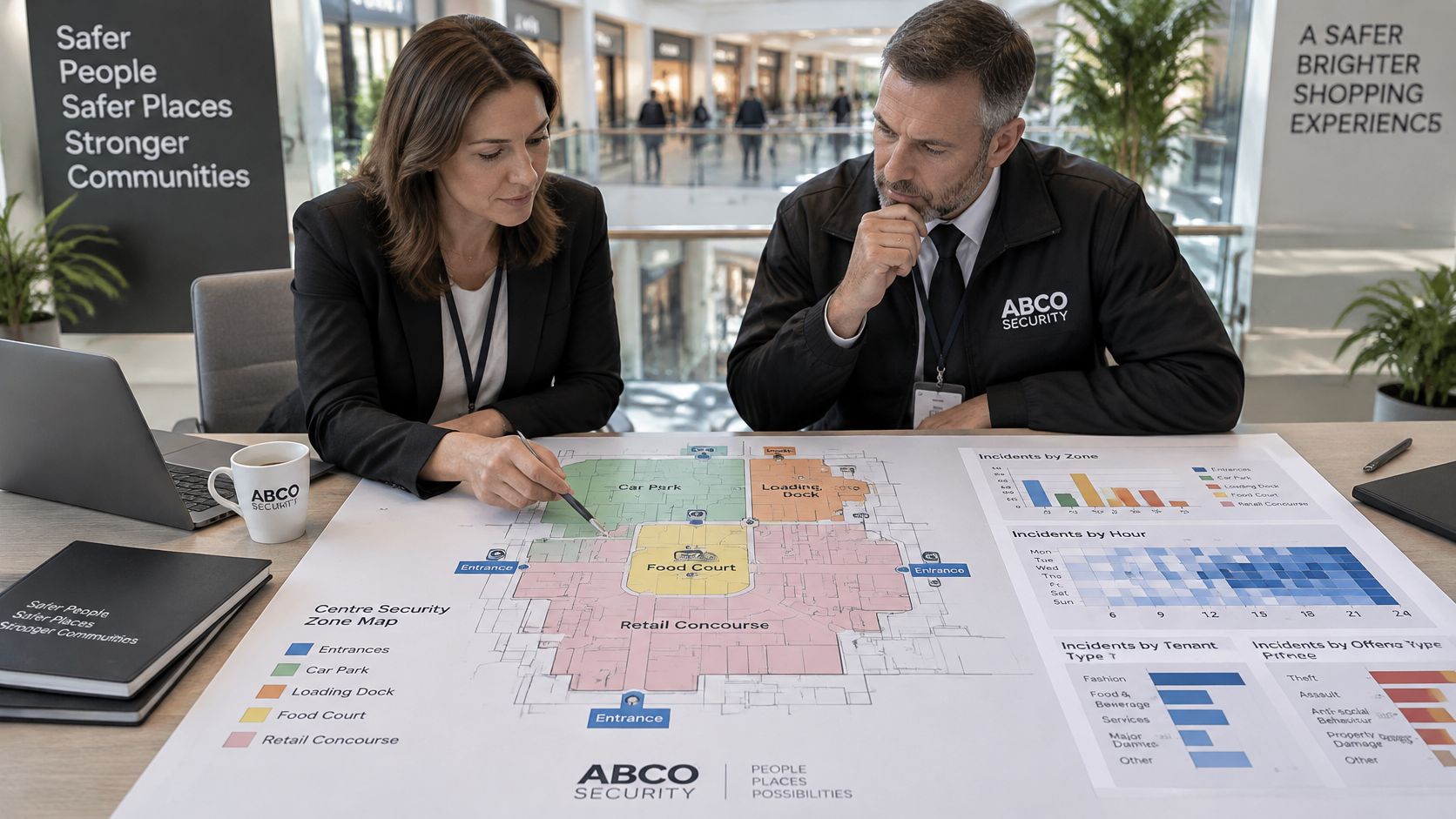
- Map incidents: Plot 12 to 24 months of centre logs, retailer reports and police data by zone, hour, tenant and offence type. Averages hide peaks. Hour by hour mapping shows whether your problem is school holidays, late night trading or dock deliveries.
- Survey perception: Run a short shopper and tenant survey asking where people feel unsafe and what they've seen. Keep it to locations and behaviours, not general satisfaction scores.
- Audit at night: Walk the centre after dark with a light meter and notepad. Check lighting levels, sightlines, blind corners, help point visibility and whether a shopper can see an exit or another person from where they're standing.
Score, Flag and Assign
- Score each zone: Rate likelihood and impact from 1 to 5. Flag every zone where perception and incident data disagree. Those disagreements drive your best spending decisions.
- List dependencies: Record lifts, loading docks, generators, communications and the cash office. A control that depends on a lift or a radio network fails if that asset fails.
- Name an owner: Give each high scoring zone an owner and review date. Unowned risks stay unfixed.
A car park with few recorded thefts, poor lighting and no visible help point can outrank a busy mall with strong coverage. Shoppers judge the walk to their car, not your incident spreadsheet.
Say your food court has moderate incidents but high reported unease around loitering and disruptive groups. Targeted, non-confrontational presence at peak meal times, better sightlines and clear wayfinding will usually reassure more people than adding uniformed officers everywhere. Blanket coverage spreads your budget thin and can make a welcoming centre feel tense.
Use a structured security risk assessment checklist to keep the walk-through consistent across zones and shifts. Your deliverable is a risk register listing zone, risk, evidence, existing control, gap and owner. That register becomes your tender brief, your patrol plan and your review tool. Without it, you're buying hours. With it, you're buying specific risk reduction you can test later.
Choosing the Right Mix of Guards, Patrols and Electronics
No single layer works alone. Security Guarding intervenes, Mobile Patrols cover ground, electronics watch continuously, and procedures connect them. Match each zone to the layer that suits its risk, then check the combined cost over identical hours.
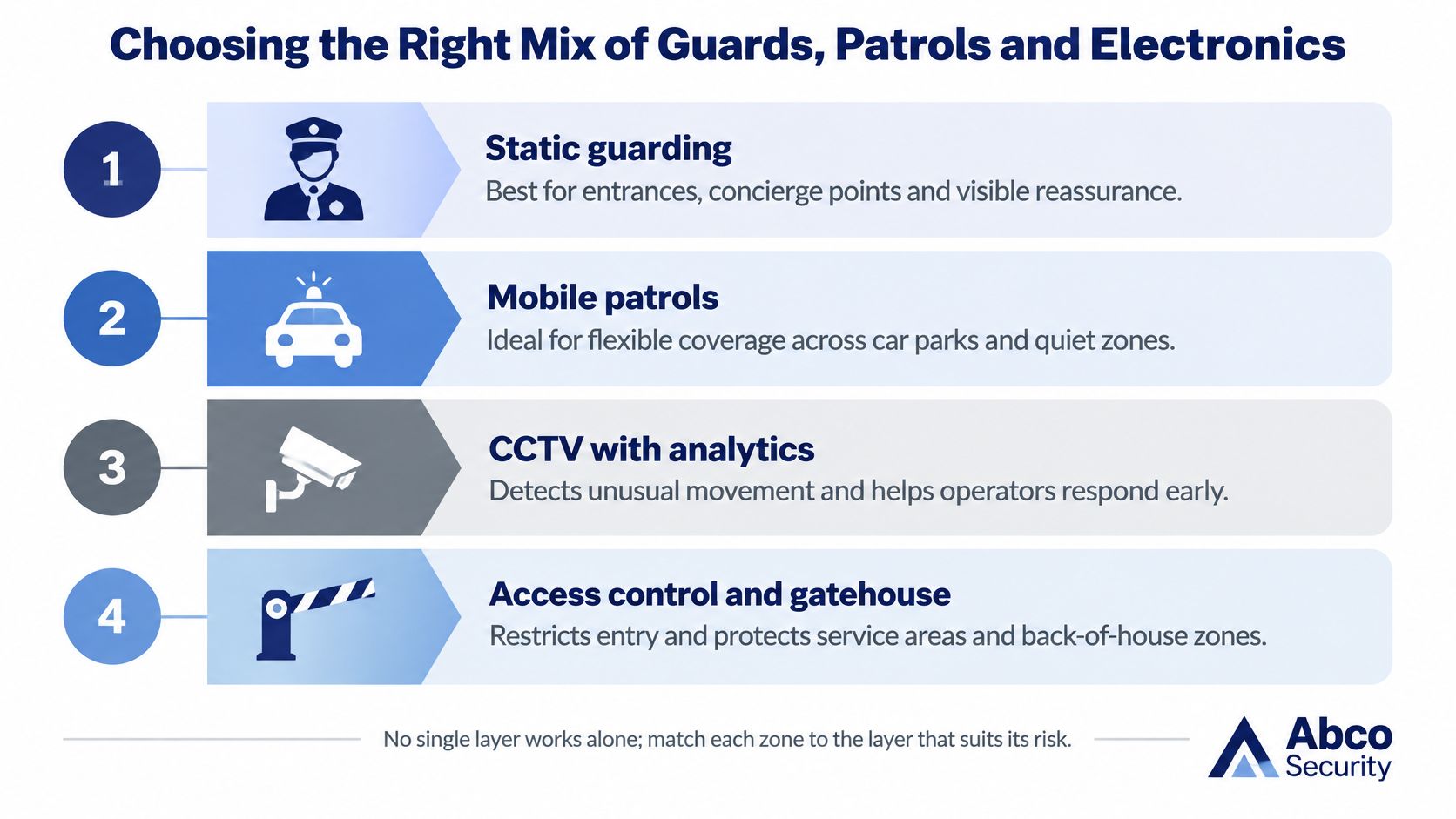
Security Layers Compared by Use, Limit and Cost Driver
| Layer | Best for | Main limit | Main cost driver |
|---|---|---|---|
| Static guarding | Entrances, gatehouses, customer service desks | Covers one location and is labour-intensive | Hours per post and 24/7 coverage |
| Mobile patrols | Car parks, loading docks, perimeter routes | Response depends on patrol timing | Vehicles, patrol frequency and route length |
| CCTV with analytics | Entrances, self-checkouts, high-value stock | Detects but does not intervene without monitoring | Camera count, storage and monitoring hours |
| Access control | Back-of-house, plant rooms, loading docks | Can be bypassed by tailgating | Hardware, system integration and maintenance |
| Gatehouse security | Car park entries and controlled service roads | Adds queue time if poorly designed | Staffing hours and barrier hardware |
| Concierge security | Office towers attached to the centre, visitor management | Limited to registered visitors | Staffing hours and visitor system |
Write Patrols That Officers Can Follow
A patrol plan needs timed checks, named locations and a nominated radio channel for escalation. Officers should record hazards and crowd build-up at set points, not just confirm they walked a route. Vary timing within an agreed window so the pattern isn't predictable, but keep checkpoints and reporting consistent enough to audit.
Test a practical starting mix for one quarter: a static post at the main entrance during peak hours, two timed patrol loops covering car parks and perimeter routes, and monitored CCTV on loading docks and high-value stock. Review incidents, response times and shopper complaints, then move hours to where the data points. I would not lock a full year roster before that first review.
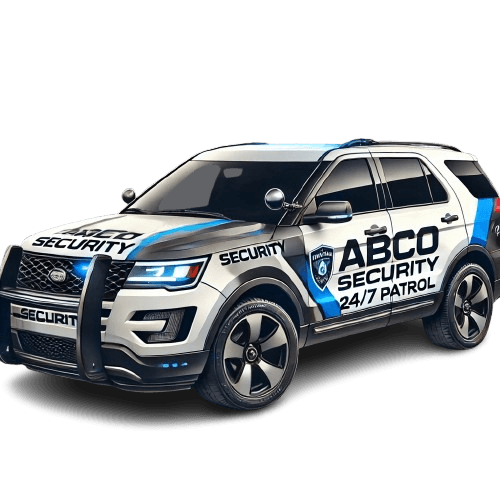
Gatehouse Security suits controlled service roads where you need vehicle checks without blocking shoppers. Concierge Security suits an attached office tower, where visitor registration and a calm first contact matter as much as deterrence. Providers such as ABCO Security Services Australia offer these layers alongside Retail Security, Event Security and Construction Security, which helps when one site needs several functions under one escalation tree.
Tailgating defeats access control faster than any technical fault. Pair controlled doors with staff presence at peak changeover times, brief cleaners and contractors, and audit door held open alarms weekly. A door that's propped open for deliveries needs a named person responsible for closing it.
Price with care. A static post is priced by hour, so continuous cover at a quiet service entry can cost more than a monitored camera plus mobile response for the same zone. Price both options over identical hours and response times, then compare totals before choosing. Ask what remote guarding services include, who speaks to an intruder, who dispatches a patrol and how quickly. If a quote won't state those steps, you can't compare it fairly against a staffed post.
Verify Licences and Choose a Provider
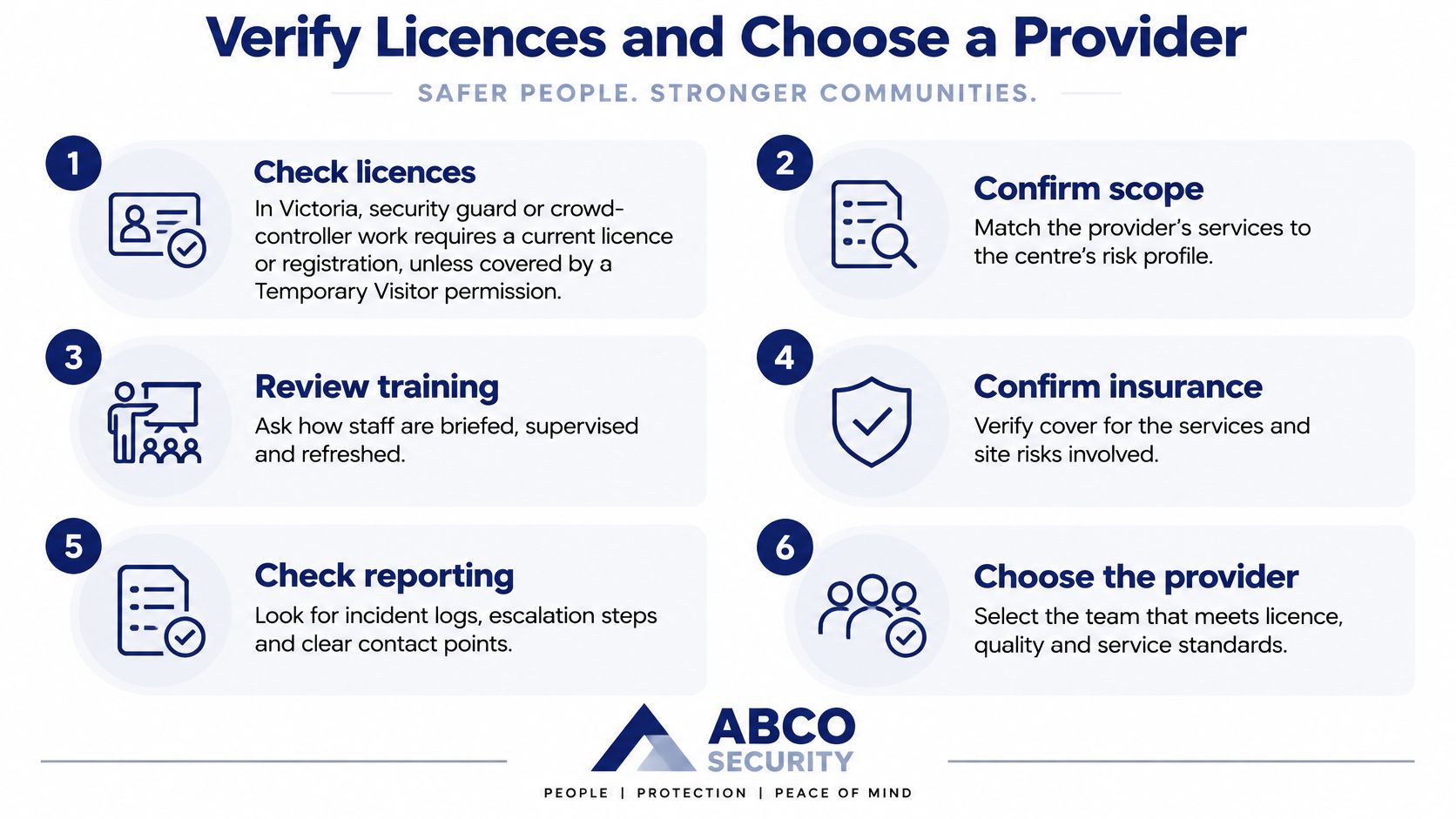
A compliant roster starts with checking each officer's authority for the work they will perform. Victoria Police private security requirements state that people performing private security activities, including security guard and crowd-controller work, must hold a current Victorian private security licence or registration, unless covered by a Temporary Visitor Permit. Applicants must be at least 18, have Australian residency or current visa work rights, provide fingerprints, satisfy identity and background-check requirements, and demonstrate approved competency training through a Registered Training Organisation. Training must be valid within 12 months of the application being received.
Licence and Capability Checklist
- Confirm role coverage: Match each officer's licence to their duties. An officer who monitors entrances, controls behaviour or removes a person from a public area may be performing crowd-controller duties and needs that authority.
- Check before rostering: Verify every licence through the relevant state or territory system, and keep a dated record. A company assurance does not replace individual checks.
- Request training evidence: Ask for dated records and refresher arrangements. Check how officers are briefed on the centre's expectations and the limits of their role.
- Demand site-specific documents: Require written post orders and an escalation tree designed for your entrances, docks and tenants. Compare them with a clear security officer work description to make duties, limits and reporting lines explicit.
- Check management systems: Ask for evidence of ISO 9001 quality management and ISO 31000 risk management practice, as well as supervisor visit frequency and sample incident reports. Logos alone prove nothing.
- Compare operational commitments: Put response times, patrol verification, reporting format and replacement cover for sick leave in writing.
- Take relevant references: Speak to centres with similar size and footfall. A warehouse client is not a retail substitute.
ASIAL, the Australian Security Industry Association Limited, can help you assess professional standing and sector practice. Treat membership as one signal, not a replacement for licence checks or reference calls.
For portfolios across Melbourne, Sydney, Brisbane, Perth and their surrounding regions, confirm licence records site by site. Requirements and authorisations differ by jurisdiction and role. A security company serving Melbourne shoppers and tenants still needs appropriately authorised officers for each interstate roster.
Compare the full operating cost, not just the hourly rate. Ask for the rate per post hour, patrol hours included, mobilisation fees, after-hours callout charges and what monitoring covers. A low rate can become expensive when supervision, reporting and response are added.
Retail Loss Prevention That Holds Up to Scrutiny
Theft hits profit far harder than sales. An Australian Institute of Criminology review on shoplifting reported shoplifting losses commonly equalled around 2 to 3% of retail sales, but could represent approximately 25% of profit because margins are narrower than turnover. That is why a small reduction in stock loss can fund a serious Retail Security program.
Scale matters too. In 2024 to 25, New South Wales recorded 29,552 retail theft incidents, a 5.1% increase over two years, according to a Commo report using Bureau of Crime Statistics and Research data. Recorded figures still capture detected and reported events only, so undetected theft and inconsistent retailer reporting hide part of the picture. Build your plan knowing the count is a floor, not a ceiling.
Apply the Situational Sequence
- Map first: Record incidents by tenant, product category, time, access point and offender method. Include response outcome, because a control that detects but never leads to recovery or exclusion isn't finishing the job.
- Validate the map: Compare incident logs with stock loss and police reporting data. If a store reports few incidents but loses high-value stock, you've found a reporting gap, not a safe store.
- Layer controls by product risk: Keep sightlines unobstructed with lower displays and wider aisles. Position CCTV at entrances, self-checkouts, high-value merchandise and loading routes. Use EAS, security keepers or spider wraps where product size, value and concealability justify the handling cost.
- Document escalation: Set one path from staff observation to centre security and police. Staff need to know what to observe, what not to challenge and who receives the call.
What Adoption Figures Do Not Prove
The 2022 Australia and New Zealand Retail Crime Study reported adoption among respondents as follows:
- CCTV: Used by 95% of respondents
- Alarm monitoring: Used by 90%
- EAS labels: Used by 70%
- Spider wraps or security keepers: Used by 50%
- Internal-theft analytics: Used by 45%
Those are prevalence rates, not success rates. High CCTV adoption doesn't show footage identifies offenders or that staff act on it promptly. High EAS use doesn't show stock loss fell. Pair every control with stock loss in the same zone before you call it effective, and review whether alarms produce a staffed response or just noise.
When reported incidents rise after reporting improves, don't punish the team that finally started recording properly. Compare reports with stock loss in the same stores before judging performance.
Practical detail matters. A patrol officer who notices repeated behaviour near high-value stock should notify centre management and preserve time, location, camera reference and witness details for internal investigation or police. Good loss prevention in retail stores depends on that evidence chain as much as on deterrence. Increase perceived detection, increase offender effort and reduce reward, then measure each zone.
Crowd, Event and Emergency Response Planning
A licensed event's crowd-control roster starts with the venue's legal baseline. Victorian guidance on security at licensed venues sets the minimum at two licensed crowd controllers for the first 100 customers, then one more for every further 100 customers or part thereof. Liquor licence conditions can require more staff and specify where they must stand.
Minimum Crowd Controllers at Victorian Licensed Venues
| Customers on site | Minimum crowd controllers | Planning note |
|---|---|---|
| 1 to 100 | 2 | Baseline for a licensed venue |
| 101 to 200 | 3 | One added for each further 100 customers or part thereof |
| 201 to 300 | 4 | Example: 230 customers needs four |
| 301 to 400 | 5 | One added for each further 100 customers or part thereof |
| 401 to 500 | 6 | Higher-risk events need a site-specific assessment |
Treat the minimum as a floor. Alcohol service, queues, isolated areas, emergency exits and crowd density near a stage can all require additional coverage. Check each officer's licence before deployment and assign specific posts, not just a headcount.
Write the Event and Emergency Plans
For outdoor events, Boroondara guidance on security and crowd management identifies a Security Management Plan, with a Crowd Management Plan for high-attendance or heightened-risk events. Cover capacity limits, entry and exit flows, queue management, density monitoring near stages or food areas, radio channels, wayfinding signs, emergency procedures and incident escalation. Apply that structure to forecourt activations, seasonal markets and entertainment precinct events, then confirm the specific council and venue conditions.
Shoppers judge an incident partly by how clearly staff communicate. Before the event, agree who approves public announcements, who contacts retailers and who calls emergency services. A resource on crisis communication planning for Jenks businesses can prompt teams to define internal and external messages. Adapt the sequence to your centre and rehearse it by radio.
- Identify routes and assembly areas: Mark evacuation routes, keep them clear and check that assembly points do not expose people to vehicle approaches.
- Train indicators and reporting: Brief staff and officers on suspicious behaviour, unattended items and the exact wording to use when reporting.
- Confirm first-aid cover: Roster suitably trained first-aid officers on every shift and place equipment where staff can reach it.
- Rehearse and record: Time the evacuation. Log radio clarity, contractor and tenant accountability, accessibility issues and whether assembly areas stayed clear.
Keep emergency response procedures aligned with tenant plans so a store alarm does not trigger conflicting instructions in the mall. One incident controller should direct decisions until emergency services take over.
Construction changes the event footprint. Install hoarding and screening before work starts, sign contractors in and out at one gate, log tool and material movements, and record out-of-hours patrol checks. Building zones create new access points, blind corners and after-hours value. Have event security and mobile patrols use the same incident log so a contractor access issue overnight is visible to the weekend event team.
Measure Results and Book Your Site Review
Measure response and process, not camera uptime alone. Australian Government active armed offender guidelines for crowded places support a documented cycle of staff training on indicators and reporting, suitably trained first-aid officers, pre-planned evacuation routes and rehearsed preparedness. Your measures should prove people can detect, communicate and act, not only that equipment is switched on.
Program Performance Measures
| Measure | What it shows | Direction to aim for |
|---|---|---|
| Detection-to-escalation time | How fast staff move from observation to action | Shorter, checked in exercises |
| Exercise completion rate | Whether drills and tabletop exercises happen as planned | 100% of scheduled exercises |
| Verified response time | Time from alarm or report to an officer on scene | Shorter, checked against logs |
| False-alarm rate | Share of alarms with no genuine incident | Lower, without missed incidents |
| Corrective actions closed | Whether exercise findings are fixed | Closed by agreed deadlines |
| Stock loss as a share of sales by zone | Whether theft falls where controls were added | Falling trend over 12 months |
Two pitfalls distort most reports. First, equipment uptime and camera coverage don't show that staff recognise suspicious behaviour, use radios correctly or evacuate safely. Test those behaviours through tabletop exercises and rehearsed evacuations, recording response time, accountability and assembly area control.
Second, raw incident counts can rise when reporting improves. Pair counts with stock loss and shopper perception in the same zone before you renew, reduce or expand coverage. A falling count with rising stock loss is a warning sign, not a success story.
Set baselines in the first quarter, review exercise results quarterly and send a one-page report to centre management and key retailers. Include actions closed, actions overdue and one decision needed. Use the same measures when you judge a provider at renewal, so incumbents and challengers face identical evidence.
Use your risk register as the brief for a site review before the next contract renewal, whether your internal team runs it or you bring in an external provider. Walk entrances, car parks, food courts, docks and back-of-house routes against the register, then price only the gaps you can name. That's how a review becomes a spending decision instead of a sales meeting.
If your centre needs a documented risk register, licensed officers matched to each post and a measurable mix of guarding, patrols and monitored electronics, talk to ABCO Security Services Australia about a site review for your Melbourne, Sydney, Brisbane or Perth property. Bring your incident and stock loss records, and you'll get a practical plan tied to zones, response times and review dates.
about
avada factory
Sempery ultricies nibh at dolor cras urna eleifend nec. Atiam efficitur tempor.