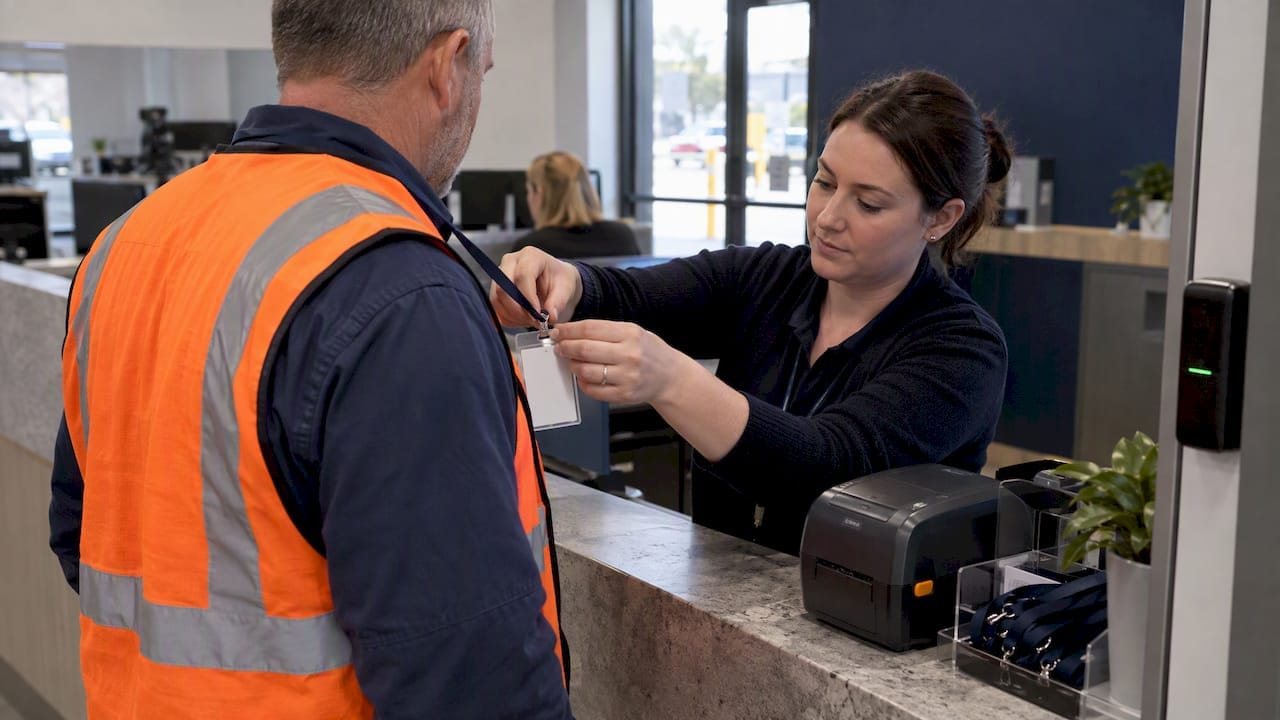
Require a visible, time-limited visitor badge that is linked to an auditable system and a privacy-first retention policy, following the best practices outlined in Credentials | Guard Select. This single rule covers most of what matters: it supports accurate emergency headcounts, satisfies the Australian Privacy Principles, and gives you a defensible audit trail. The checklist below turns that rule into steps you can action this week.
TL;DR:
- Using a digital visitor management system enhances badge expiry accuracy, automates sign-in and sign-out tracking, and creates an auditable event trail.
- Badges should display only essential information such as name, host, arrival time, expiry date, and a photo for higher-risk sites, printed on durable materials.
- Connection to access control, CCTV, and incident logs is critical to prevent unauthorized access and enable real-time monitoring during emergencies.
- Visitor data collection must comply with Australian Privacy Principles by limiting information, setting retention limits, and securing stored records.
- Staff training and clear signage are vital for enforcement, with pre-registration, quick badges, and escalation procedures to minimize friction and ensure compliance.
Table of Contents
- 1. The core visitor badge checklist for facility managers
- 2. What information a visitor badge should actually show
- 3. Connecting badges to your visitor management system and access control
- 4. Meeting your privacy obligations under the Australian Privacy Principles
- 5. Training staff to enforce the badge policy without friction
- 6. Rolling out a badge programme without the common mistakes
- 7. How badges improve evacuation accuracy during an emergency
- 8. Why ABCO Security’s operational experience backs this approach
- Balancing control with usability in your badge policy
- Where ABCO Security fits into your visitor badge programme
- FAQ
- Sources
1. The core visitor badge checklist for facility managers
Most badge programmes fail not because the rule is wrong, but because nobody writes it down as a sequence staff can follow. Start here and adjust each step to your site’s risk profile.
- Make badges mandatory and visible: every visitor, contractor and vendor wears a badge at chest height for the length of their visit, with clear escort rules for anyone without one.
- Use pre-registration and fast sign-in: invite expected visitors to register ahead of arrival so check-in takes seconds, not minutes, which is what actually drives compliance.
- Issue one badge per person, with an expiry: no shared or recycled badges, and add a photo where the site risk justifies it.
- Apply colour-coding and escort labels: a badge that says “escort required” at a glance removes any ambiguity for reception staff or site supervisors.
- Track badge in and badge out: this is the detail that turns a sign-in sheet into an accurate emergency plan asset.
- Integrate with access control, CCTV and incident logs: a badge that cannot trigger a door or appear in a camera timestamp is only half a system.
- Minimise data collection and set retention limits: collect what the visit requires and nothing more, in line with the Australian Privacy Principles.
- Review the policy against assessed risk: a construction site and a corporate lobby do not need the same rules, and neither should stay static for years.
Each of these steps is expanded in the sections that follow, with the specific design, technology and privacy detail you need to put them into practice.
2. What information a visitor badge should actually show
A badge only works if staff can read it in two seconds and a stranger cannot learn too much from it. The essential fields are the visitor’s name, the host or department they are visiting, the time of arrival and a clear expiry or visit date, with a photo added for higher-risk sites such as healthcare facilities or data centres.
- Full name and host name, printed large enough to read from a few metres away.
- Date and time of issue, so an expired badge is obvious without checking a system.
- A role or category label (“visitor”, “contractor”, “delivery”) rather than sensitive personal detail.
- An escort-required flag or colour block for restricted zones, separate from the personal data fields.
- A visible expiry cue, whether that is a colour that fades, a printed time or a watermark.
Construction sites need badges that survive dust, moisture and a full shift in a hi-vis pocket, so laminated or tamper-evident plastic outperforms paper. Healthcare settings favour a clean, high-contrast design that reads clearly under fluorescent lighting and signals restricted-area access without printing diagnosis-adjacent detail. Corporate offices generally need the least rugged badge but benefit most from consistent branding that staff learn to recognise instantly.
Pro Tip: Pick one accent colour per risk tier (general visitor, escort required, no unescorted access) and keep it consistent across every site so staff never have to think twice.
3. Connecting badges to your visitor management system and access control
Paper logbooks cannot pre-register a visitor, capture a photo, or produce an exportable audit trail, which is why most facility managers are moving to a visitor management system that handles badge printing or digital e-badges alongside the sign-in process. A digital system also automates the one thing paper never manages well: badge expiry.
Printed badges still make sense for short, low-frequency visits and for construction sites where a tablet at a muddy gate is impractical. In those cases, manage the risk with numbered, single-use badges that are logged against a visitor register and collected at sign-out.
Whichever route you choose, the badge system should connect to:
- Access control, so a badge that has expired or been flagged cannot open a door.
- CCTV, so a timestamped badge event can be matched against footage during an investigation.
- Alarm monitoring, so an after-hours badge scan triggers the same response protocol as any other access event.
- Evacuation dashboards, so incident commanders see who is on-site in real time rather than reconstructing a paper list.
When specifying a system, prioritise automated expiry, in/out tracking, role-based flags, and a secure API that exports audit logs without manual re-entry. A documented visitor policy that names these integration points makes the system easier to audit later, and a workplace safety guide is a useful reference when you are tying visitor records into broader incident investigation procedures.
4. Meeting your privacy obligations under the Australian Privacy Principles
Visitor data is personal information, and the Australian Privacy Principles set out what you can collect, how long you can keep it and what you must do when it is no longer needed. A privacy notice at the sign-in desk or screen, stating why you collect each field and how long you retain it, is the minimum starting point.
- Collect only the fields your business purpose actually requires: name, host and time are usually enough.
- Avoid sensitive information such as health details unless there is a specific, justified reason.
- Set a retention period and a destruction or de-identification process rather than keeping records indefinitely.
- Secure stored data with access controls, and check that any third-party cloud provider meets the same standard.
- Keep a documented breach response procedure and an audit trail of who accessed visitor records and when.
Organisations should take reasonable steps to destroy or de-identify personal information once it is no longer needed, a requirement set out in APP 11 guidance on security of personal information, including checking backups and third-party contracts for compliance. Facility managers who skip this step often end up holding years of visitor logs with no business reason to keep them, which is itself a compliance gap.
5. Training staff to enforce the badge policy without friction
A badge policy is only as strong as the person at the front desk who is willing to enforce it. Training should give staff a clear, non-confrontational script and an obvious escalation path.
- Script the first response: “I can’t see a badge, let’s get you checked in” is easier to say than an accusation.
- Make the compliant path faster: pre-registration and a quick-badge lane for regular contractors remove the incentive to skip sign-in.
- Post visual prompts: signage reminding staff and visitors that badges are mandatory reduces the need for verbal confrontation.
- Run spot checks and track simple metrics: compliance rate and average sign-in time tell you whether the policy is working.
- Give staff a safe exit: anyone who refuses to badge up should be escalated to a supervisor or security guard, never challenged alone in an isolated area.
Pro Tip: Treat the first thirty seconds of a visit as the whole programme: if sign-in is slow or confusing there, nothing downstream will fix the compliance gap.
6. Rolling out a badge programme without the common mistakes
Pilot the policy in one building or one site before rolling it out everywhere. Measure sign-in time, compliance rate and staff feedback for a few weeks, then adjust before scaling.
- Avoid collecting more data than the pilot shows you actually need.
- Don’t let sign-in take longer than a minute or two, or staff will start waving visitors through.
- Retire paper logs and reusable, unnumbered badges, which both undermine auditability.
- Budget for consumables such as badge stock, lanyards and printer maintenance, not just the software licence.
- Track compliance rate, average sign-in time and evacuation accuracy as your core success measures.
A tested visitor management rollout is a useful reference point for how a pilot-then-scale approach plays out against a paper-based system.
7. How badges improve evacuation accuracy during an emergency
Badge-in and badge-out tracking is described in industry guidance as the gold standard for accountability, because it gives incident commanders a real-time list rather than a static sign-in sheet from hours earlier, according to ASIS International. Automated dashboards can export an assembly-point list the moment an alarm triggers, and temporary badges should auto-expire or force a sign-out at the end of a scheduled visit to stop “phantom” visitors appearing on evacuation lists. Where a site holds sensitive meetings, include an emergency contact field so stranded visitors can be managed directly.
| Badge feature | Emergency benefit |
|---|---|
| Badge-in/badge-out tracking | Accurate real-time assembly list |
| Automated expiry | No phantom visitors on evacuation records |
| Dashboard export | Faster handover to incident commanders |
| Contact field on badge | Easier coordination for stranded visitors |
Safe Work Australia expects emergency plans to be reviewed regularly and to include assembly points and contact procedures, which a badge system should feed directly.
8. Why ABCO Security’s operational experience backs this approach
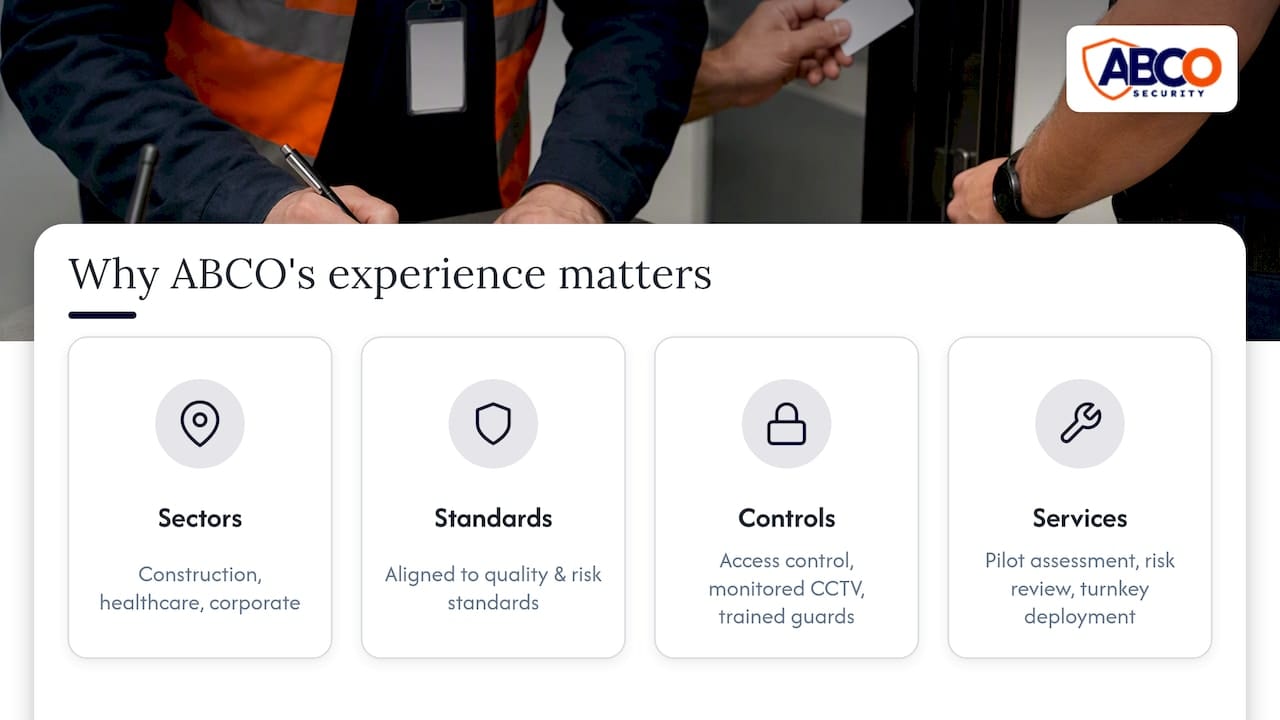
We have extensive experience building integrated security solutions across construction, healthcare and corporate sites, and our processes are aligned to recognized quality and risk management standards. That background shapes our view that a badge is only as good as the system and the staff behind it: electronic access control, monitored CCTV and trained guards each close a gap that a badge alone cannot. We work with facility teams on a pilot assessment, a risk review or a full turnkey deployment, depending on what the site needs.
Balancing control with usability in your badge policy
The most common mistake we see is a single badge rule applied to every zone regardless of risk, which either over-restricts low-risk areas or under-protects high-risk ones. Match the rule to the zone, keep the compliant path the easiest one, and set a review date so the policy doesn’t quietly go stale.
— Abco
Where ABCO Security fits into your visitor badge programme
If you need the enforcement side of a badge policy covered, not just the paperwork, our security guarding teams can staff reception points and escort duties in higher-risk zones, while our electronic security solutions connect badge systems to access control and alarm monitoring. For sites that need around-the-clock oversight, our A1 CCTV & alarm monitoring service and mobile patrol coverage work alongside a badge programme rather than replacing it, and construction sites can pair badge controls with our construction site security services.
Our Night Owl plans start from $5.45 per day for after-hours monitoring that supports a badge and access control rollout. Get in touch for a pilot assessment or risk review tailored to your site.
FAQ
What is the best practice for visitor badge colour-coding?
Assign one colour per risk tier, such as general visitor, escort-required and no-unescorted-access, and keep that mapping identical across every site so staff recognise it instantly. Avoid using colour alone to carry personal information; pair it with a short text label like “escort required.”
How long should we retain visitor sign-in records?
Retention periods should match your actual business purpose and be destroyed or de-identified once that purpose ends, as required under APP 11. There is no single mandated period for all sites, so document your own retention window and the reason behind it in your visitor policy.
Do visitor badges need to include a photo?
A photo is not mandatory for every site, but it is worth adding for healthcare facilities, data centres or other higher-risk environments where visual identity verification matters. For low-risk corporate visits, name, host and time are usually sufficient under a minimisation approach.
What should staff do if a visitor isn’t wearing a badge?
Staff should use a non-confrontational prompt to direct the person back to sign-in, and escalate to a supervisor or security guard if the person refuses, rather than challenging them alone, per ASIS International guidance. Clear signage and a fast compliant path reduce how often this situation arises.
How do visitor badges help during an emergency evacuation?
Badge-in and badge-out tracking gives incident commanders an accurate, real-time list of who is on-site, which is far more reliable than a paper sign-in sheet checked hours earlier. This supports the accurate accounting for all people on-site that Safe Work Australia expects in an effective emergency plan.
Sources
- Emergency plans and procedures | Safe Work Australia
- Australian Privacy Principles quick reference | Office of the Australian Information Commissioner
- 7 Tips to Improve Visitor and Contractor Management | ASIS International
Recommended
about
avada factory
Sempery ultricies nibh at dolor cras urna eleifend nec. Atiam efficitur tempor.