Workplace surveillance in New South Wales is lawful, but only within tight rules. Employers generally need to give written notice before monitoring starts, camera, computer and tracking surveillance are all specifically regulated, and covert surveillance is restricted to narrow cases that usually need a Magistrate’s authority. Signage and written policies carry their own separate obligations.
TL;DR:
- Employers must give written notice 14 days before monitoring, describing its type, operation, start date, schedule, and duration; new hires need notice before day one.
- Visible cameras require signs at every entrance; cameras outside an employee’s usual workplace may avoid advance notice, but signage and other camera rules still apply.
- Computer monitoring requires a policy employees understand, while tracking requires visible notice on the vehicle or item and clear limits on ownership and data use.
- Covert monitoring generally requires a Magistrate’s authority to investigate suspected unlawful activity by specific employees, with time limits, reporting duties, and record storage conditions.
- Employers should document each device’s purpose and intended data use, especially when cameras, microphones, or GPS systems may engage both surveillance statutes.
Table of Contents
- The NSW legal framework that governs workplace surveillance
- What written notice must include and when it’s due
- Camera surveillance rules: visibility, signage and special cases
- Computer and tracking surveillance: policy and remote-work traps
- When covert surveillance is lawful and how authorities work
- How the two surveillance statutes intersect
- ABCO Security’s practitioner checklist for turning law into controls
- Step-by-step process to draft a compliant surveillance policy
- Why transparency in surveillance reduces workplace disputes
- How we help NSW organisations run compliant surveillance
- FAQ
- Sources
The NSW legal framework that governs workplace surveillance
Two NSW statutes sit at the centre of this area. The Workplace Surveillance Act 2005 sets the notice, camera, computer and tracking rules specific to employment. The Surveillance Devices Act 2007 separately regulates listening, optical and tracking devices more broadly, with its own offences for unlawful use, possession or publication. The Workplace Surveillance Regulation 2022 fills in procedural detail and is subject to staged review, so policies drafted on an older version can fall out of date quietly.
Guidance sits with a few different bodies:
- The NSW Department of Justice administers the primary legislation.
- The Information and Privacy Commission publishes short practical guides on notice and records.
- The Fair Work Ombudsman offers best-practice privacy guidance that applies alongside state surveillance law.
What written notice must include and when it’s due
Section 10 of the Act sets a default notice period of at least 14 days before surveillance starts, and an email satisfies the written notice requirement. New hires joining a workplace where surveillance already operates must be told before their first day, not after.
A compliant notice generally needs to cover:
- The type of surveillance (camera, computer or tracking).
- How it will operate in practice.
- The date it starts or started.
- Whether it runs continuously or only at intervals.
- Whether it is time-limited or ongoing.
The 14-day default can be shortened where the employee agrees, but that agreement is worth recording in writing rather than assumed from silence. A verbal heads-up in a team meeting does not substitute for the written notice itself.
Camera surveillance rules: visibility, signage and special cases
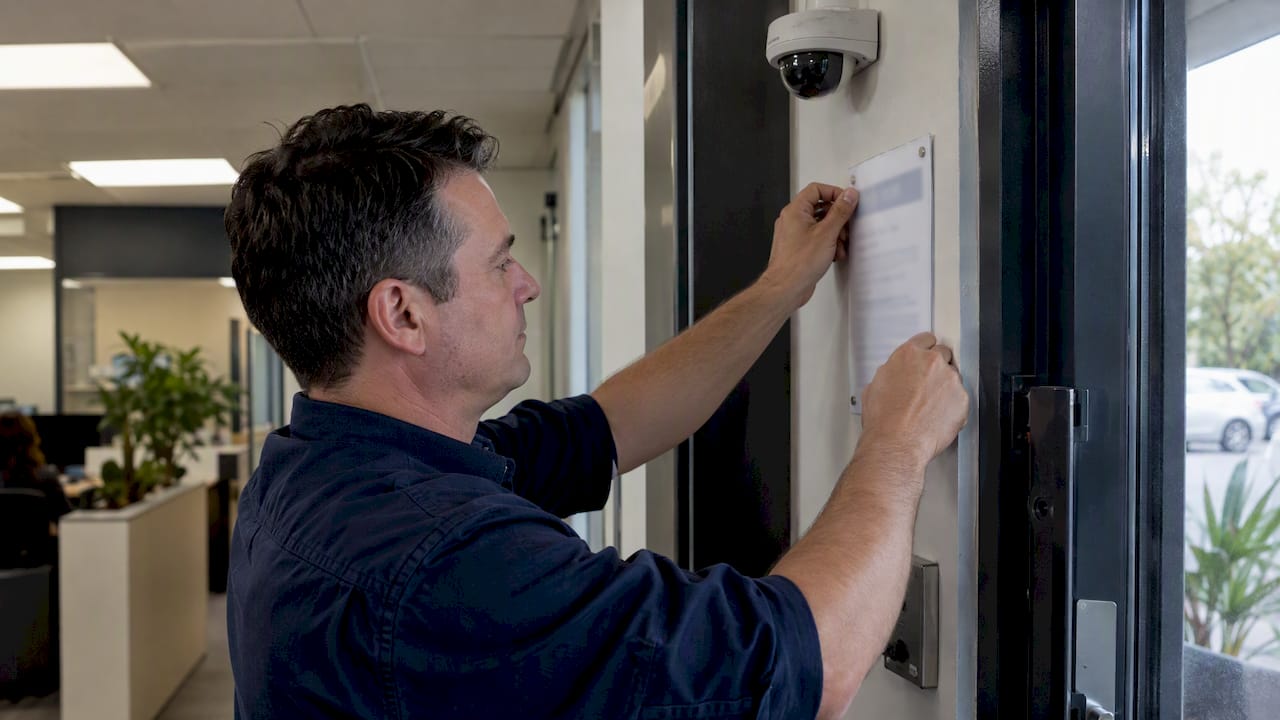
Cameras must be clearly visible, and signs notifying people they may be under surveillance are required at each entrance to the monitored area, a requirement set out directly in the Workplace Surveillance Act.
- Section 10 notice is not required for camera surveillance at a location that is not the employee’s usual workplace, but signage and the other camera obligations still apply.
- A camera that also captures audio, or a body-worn camera worn by guards or staff, can trigger extra obligations under the Surveillance Devices Act on top of the workplace-specific rules.
- Vehicle-mounted cameras and placement generally should follow recognised standards; our CCTV placement guide covers positioning against AS 4806, and our broader piece on CCTV laws across Australia covers the wider statutory picture.
- Microphones, analytics modules and facial recognition add-ons are treated as separate functions worth assessing individually rather than assumed to be covered by the same notice.
Computer and tracking surveillance: policy and remote-work traps
Computer monitoring is only lawful where it operates under an employer computer-surveillance policy and employees have been notified in a way that reasonably shows they are aware of it and understand it. A policy buried in an onboarding pack nobody reads is a weak defence if challenged.
- Tracking surveillance needs visible notice fitted to the tracked vehicle or item, and clarity over who owns the device and what tracking data can be used for.
- For hybrid and remote arrangements, policies should specify monitoring windows, whether the device is employer-owned or personal, and limits on monitoring outside rostered hours, an area that increasingly intersects with right-to-disconnect expectations.
- A GPS tracking policy template can help HR teams draft tracking notices and clauses without starting from a blank page.
When covert surveillance is lawful and how authorities work
Covert surveillance sits outside the normal notice regime and is deliberately hard to get right.
- A covert surveillance authority, issued by a Magistrate, is generally needed, and it is typically granted for investigating suspected unlawful activity by specific employees rather than general monitoring.
- Authorities are time-limited and come with their own reporting and record-storage conditions, so an open-ended covert camera is not how the system is meant to work.
- A workplace-security defence can sometimes apply in narrow circumstances, but given the offences involved, legal advice before acting is the sensible default rather than an afterthought.
How the two surveillance statutes intersect
Several common setups trigger both the Workplace Surveillance Act and the Surveillance Devices Act at once.
- CCTV fitted with a microphone needs to satisfy camera notice rules and the separate listening-device provisions.
- GPS units that also stream audio or live data feeds can trip both tracking rules and device-specific offences.
- The NSW Department of Justice, the Information and Privacy Commission and the Fair Work Commission each play a role depending on whether the dispute is about the device itself, privacy of records, or employment consequences.
- Clear documentation of why each device exists and what each data stream is used for tends to matter more in enforcement than the technology itself.
ABCO Security’s practitioner checklist for turning law into controls
Years of fitting out construction sites, healthcare facilities and corporate offices with monitoring systems have taught us that compliance breaks down at the device level, not the policy level.
- Audit every camera, computer tool and tracker, and write down the purpose of each data stream before using it for anything beyond its original reason.
- Refresh notice templates and computer-surveillance policies so wording matches current operations, not what was in place three years ago.
- Check that staff can show they “reasonably understand” the policy, through an acknowledgement step rather than a buried clause.
- Review signage, camera placement, retention schedules and access controls, and run staff through what the system does and does not capture.
- Escalate to a lawyer, or apply for a covert surveillance authority, only when the grounds are genuinely investigative rather than a shortcut around notice requirements.
Pro Tip: Treat routine technical logs, like backup files or system diagnostics, as separate from surveillance used to assess employee behaviour, and document that distinction for each tool.
Step-by-step process to draft a compliant surveillance policy
A workable policy pack can be built in a short, structured sequence.
- Audit every device and system that captures employee data, by location and function.
- Draft the essential clauses: scope, device types covered, permitted uses, who can access records, retention periods and a complaints pathway.
- Prepare notice templates for camera, computer and tracking surveillance, each matching the statutory content requirements.
- Build the onboarding step where new and existing staff acknowledge the policy in writing.
- Set a review timetable, with dated notice records kept as evidence the 14-day (or agreed shorter) period was met.
Our employee safety guide is a useful companion piece for balancing these controls against day-to-day welfare obligations.
Why transparency in surveillance reduces workplace disputes
Across construction, healthcare and corporate sites, the pattern repeats: disputes cluster around monitoring nobody explained properly, not monitoring itself. A notice that actually states purpose and scope, backed by signage people can see, heads off most arguments before they start. Clear documentation is cheaper than a grievance.
— Abco
How we help NSW organisations run compliant surveillance
Getting notice periods, signage and device policies right takes more than a legal read, it takes someone checking cameras, trackers and access points against the rulebook. We cover that ground through A1 CCTV & Alarm Monitoring for compliant camera coverage, Electronic Security Solutions for integrated system design, and Security Guarding and Mobile Patrol Services for sites that pair physical presence with electronic monitoring. For construction sites specifically, our Construction Site Security Services build surveillance into the broader site plan from the outset.
If your current setup predates the 2022 regulation update, or your notices have never been reviewed against section 10, reach out through our Night Owl monitoring plans page for a device-by-device review.

FAQ
What are the rules for security cameras in NSW?
Cameras must be clearly visible and signed at each entrance to the surveilled area under the Workplace Surveillance Act 2005. Cameras that also capture audio can trigger extra obligations under the Surveillance Devices Act on top of the workplace-specific signage rules.
Can my employer track my location on my work phone?
Yes, provided the tracking carries visible notice on the device and meets the Act’s requirements on ownership and permitted use. Tracking that is hidden or undisclosed falls outside these rules and risks being unlawful covert surveillance.
Can your boss watch you on camera at work?
Yes, within the notice, visibility and signage rules set out in the Workplace Surveillance Act, and never in change rooms or bathrooms, which are prohibited outright. Monitoring outside those bounds, or done covertly without an authority, falls outside what the law permits.
Sources
- Workplace Surveillance Act 2005 No 47 – NSW Legislation
- Workplace Surveillance Act 2005 – s12: Additional requirements for computer surveillance
- Fair Work Ombudsman — Workplace privacy best-practice guide
Recommended
about
avada factory
Sempery ultricies nibh at dolor cras urna eleifend nec. Atiam efficitur tempor.