
Replacing a static guard with cameras isn't automatically a smarter security decision. The useful question is whether someone can recognise the incident, make a defensible decision and get the right person to the site before the situation becomes unsafe.
Remote guarding services work best as a people-and-process service, not a camera subscription. For Australian property managers and operators, the strongest arrangement often combines remote monitoring, Mobile Patrols and on-site officers, with clear boundaries around what each team does.
When Remote Guarding Beats a Static Guard
Remote guarding services use licensed operators in a monitoring centre to watch camera alerts, alarms and access events, verify suspected incidents, then escalate to Mobile Patrols, the site manager, police or emergency services. It's similar to air-traffic control: one room oversees several locations, but someone still goes to the site when the job needs hands on the ground.
Which guarding model fits the situation
| Situation | Better model | Why it wins | Expected response |
|---|---|---|---|
| Vacant commercial floors after hours | Hybrid remote plus Mobile Patrols | Continuous watch without posting an officer all night | Operator verifies, then dispatches a patrol |
| Occupied lobby or gatehouse in business hours | Static Concierge Security or Gatehouse Security | Access decisions and welfare need a person present | On-site officer with remote backup |
| Multi-site retail after close | Remote with patrol response | One centre can cover several closed shops | Verified alarm, then a Retail Security patrol |
| Construction perimeter overnight | Hybrid | Plant theft and unsafe access span a large fence line | Analytics alert, voice-down, then patrol |
| Event ingress and crowd peaks | On-site Event Security with remote overview | Conflict and evacuation need immediate bodies | Crowd controllers respond while the control room watches density |
| Strata car parks and common areas | Remote with scheduled patrols | Low occupancy and privacy-sensitive neighbours | Event-based alerts, not blanket recording of homes |
The distinction between remote-only monitoring and remote monitoring with response matters. Remote-only arrangements can verify and notify, but they don't provide an attending officer unless that response is separately arranged. Compare monitored and self-monitored security arrangements before assuming an alert includes dispatch.
Put the required response ahead of price
A remote operator can't help someone who has fallen behind an unobserved loading bay. Nor can they physically separate an argument, search an evacuation route or stop an unauthorised driver entering a busy gatehouse.
Camera blind spots, poor lighting and long patrol journeys can make remote watch unsuitable even when the monthly monitoring charge looks attractive. An occupied site with conflict, welfare or evacuation responsibilities generally needs people already present.
Practical rule: Choose the response the incident requires first. Choose the technology and roster second.
Physical layout also affects what operators can see. In warehouses, tall stock and badly positioned shelving can hide doors or escape routes. Material Handling USA's resource lets facilities teams explore shelving and storage options when reviewing layouts, but any proposed arrangement still needs a site-specific sightline and access check.
Surveillance brings implementation responsibilities as well. The Australian Government's video-surveillance guidance recommends visible cameras, entrance signage, written staff notification and avoiding private areas such as toilets, change rooms, showers and fitting rooms.
Before requesting quotes, match incident type, occupancy and patrol travel time to a table row. If the required outcome is immediate physical intervention, don't remove the officer because the cameras can record what happens.
How a Remote Guarding Shift Actually Runs
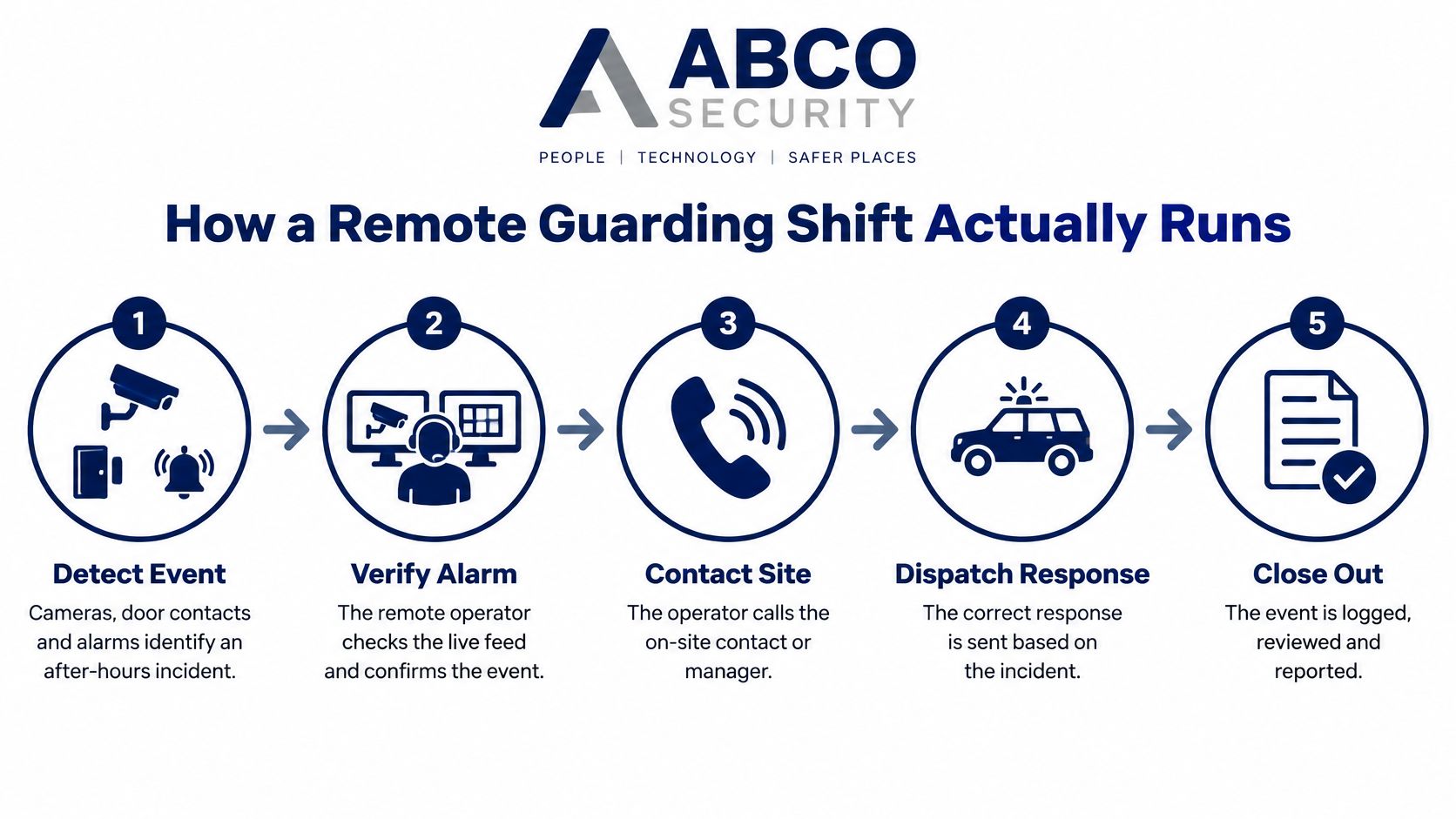
Say a closed warehouse generates an alert at a side door. A useful remote guarding service doesn't just forward that alert to the owner. The operator checks the event, applies the site's instructions and hands the incident to someone authorised to respond.
The process below shows the main handoffs.
From detection to a verified decision
Detect a defined event. A door contact signals an opening outside approved hours, or a camera detects someone crossing the perimeter. The event must relate to an agreed security risk. A camera that records continuously but never generates an actionable alert isn't performing the same function.
Filter and verify the alarm. Video analytics can help distinguish movement from a swaying branch, headlights or an animal. The operator then checks the live view and relevant footage. The failure point is treating an automated classification as a confirmed intruder without human review.
Assess the situation and contact the site. The operator compares what they can see with authorised access information and the written response threshold. Where speakers are installed, a voice warning may be appropriate. An approved contractor shouldn't trigger the same response as someone forcing a locked door.
Dispatch the correct response. The operator contacts a mobile patrol, site manager, police or emergency services according to the incident. Immediate danger mustn't sit in a routine callback queue. A patrol rostered too far away also breaks the process, however quickly the operator verifies the alarm.
Close out and preserve authorised evidence. The attending officer checks and secures the area within their role, then reports the result. The centre records the outcome and preserves relevant footage under the site's retention and incident-preservation rules. An unanswered dispatch message isn't a completed incident.
Electronic monitoring is security work
The Fair Work Ombudsman's Security Award summary includes watching or guarding people and property by physical or electronic means, along with operating a security control room or monitoring centre. That supports a staffing model combining CCTV monitoring, alarm verification and physical patrols rather than fixing every officer at a permanent post.
Employment coverage doesn't replace state licensing checks. Buyers still need to establish that the business and personnel are authorised for the work they're doing.
For the on-the-ground component, discuss Mobile Patrols and response arrangements with ABCO. Confirm who receives the dispatch, how they acknowledge it and what happens when the nearest patrol is already attending another incident.
This video provides another way to consider the monitoring and response arrangement.
A good shift log records the time, camera or alarm identifier, operator's decision, reason for escalation, who attended and the outcome. Without those details, the buyer can't distinguish effective intervention from a long list of notifications.
Where the Return Actually Comes From
Remote guarding isn't universally cheaper than a guard. Operating hours, site count, equipment condition, patrol distance and the required response all affect the comparison. A low monitoring fee can conceal expensive call-outs or leave essential duties uncovered.
The wider industry provides context, not proof of savings: the ASIAL Security 2030 report values Australia's broader security market at approximately AUD 11.22 billion in 2025. That includes systems and services beyond remote guarding, so it shouldn't be used as evidence that a particular site will save money.
Test the operating case
Consider a hypothetical comparison. A busy loading dock needs someone to manage drivers, challenge unsafe access and resolve disagreements throughout trading hours. A static officer may deliver better value because those duties would otherwise fall to warehouse staff.
A group of quiet warehouses overnight presents a different case. Remote watch with a nearby patrol may avoid maintaining an unused post at every address, provided the cameras cover the relevant approaches and the response remains practical.
Test these return drivers rather than accepting a headline saving:
- Shared coverage: Can the centre cover low-occupancy locations without neglecting simultaneous incidents?
- Verified dispatch: Does an operator close nuisance alerts before a patrol is sent?
- Earlier intervention: Can an appropriate voice warning interrupt unauthorised activity before damage occurs?
- Usable evidence: Can the organisation retrieve a clear incident record for police, insurers or internal review?
The main cost factors are shown below.
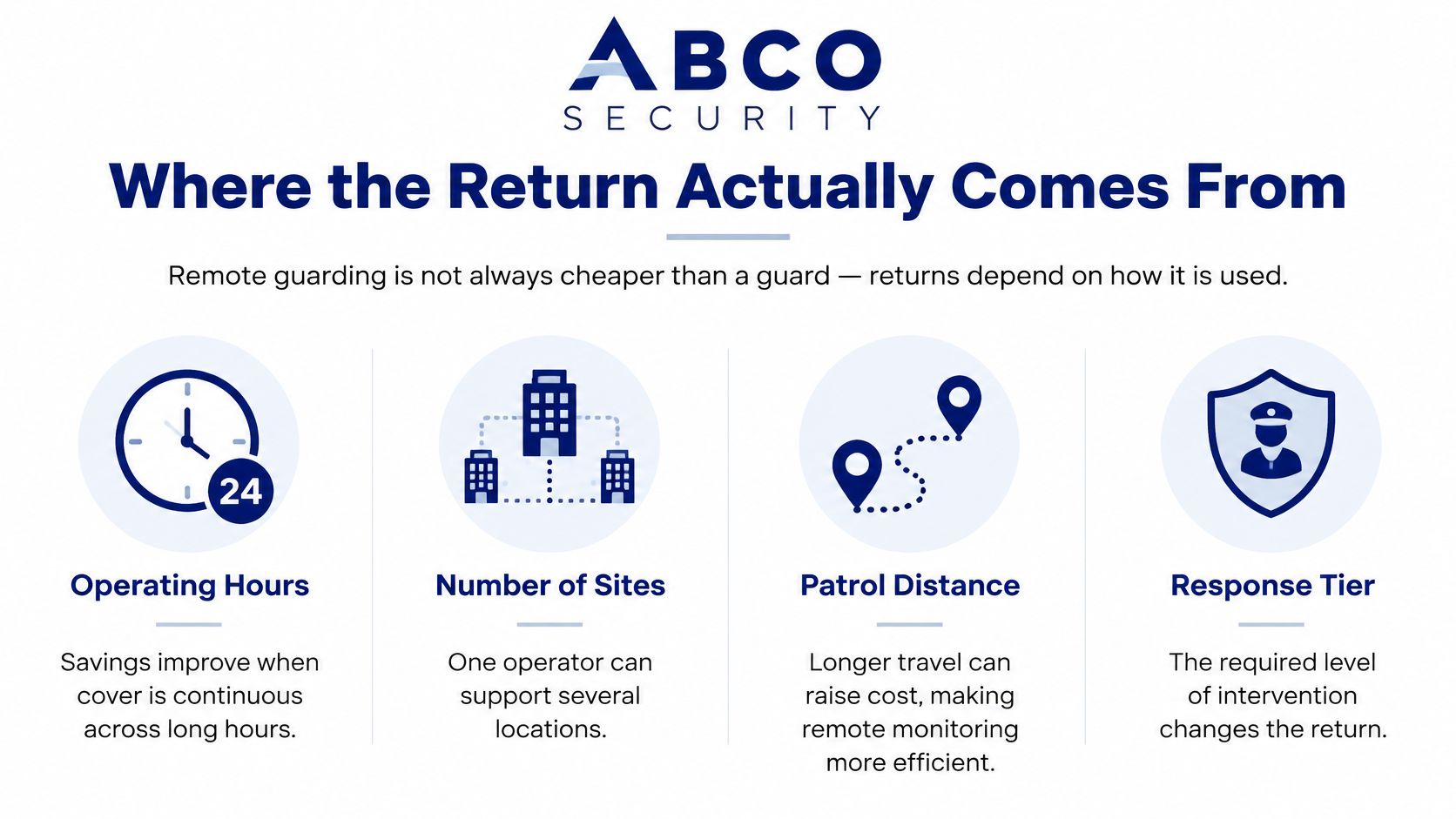
Request separate quote lines for operating hours, site count, analytics, camera maintenance, patrol kilometres per shift and response tier. Distinguish verify only, verify and patrol, and officer on site using the CCTV monitoring service pricing guide as a starting point for questions, not a substitute for a site quotation.
Proposed 90-day return measures
| Metric | What to record | Keep the saving if |
|---|---|---|
| Verified incidents | Operator-confirmed events per month | Verified events are acted on within the agreed threshold |
| False call-outs | Unnecessary dispatches, separately from alerts closed without action | Count falls after analytics tuning |
| Patrol kilometres | Distance driven per shift | Travel stays within the stated patrol radius |
| Loss or damage reports | Incidents reported by site or tenants | No rise after static hours are removed |
| Static hours removed | Officer hours cut | Cut only where the decision-table row allows it |
Treat the review period as a proposed trial, not a promised return. If travel time or camera blind spots erase the operational saving, keep the officer.
Sector Patterns from Sites to Strata
A commercial tower in Melbourne or Sydney can have different security needs before and after the concierge desk closes. During tenant hours, the officer handles visitors, deliveries and people needing assistance. After lock-up, the monitoring centre can watch defined access events while a patrol provides attendance.
The handover matters more than the building label. If tenants regularly work late, the site isn't vacant just because reception has closed. Discuss Concierge Security and after-hours coverage around actual occupancy.
Construction and event operations
On a Brisbane or Perth fringe construction site, the overnight concern might be someone entering near stored plant or copper. Perimeter analytics and speakers can support remote intervention, while Gatehouse Security manages deliveries and authorised access when crews are present.
Gold Coast and Mandurah projects still need a patrol within a practical response radius. A regional office address doesn't demonstrate that a vehicle will be nearby when the alarm arrives. Review construction-site security monitoring against changing fence lines, temporary power and moving stock.
Physical barriers remain important. FenceScape's guide to commercial security fencing in Ottawa offers useful prompts about gates and perimeter layout, although Australian projects need their own local design and compliance assessment.
At an event, the centre might notice a developing queue or a perimeter breach, but crowd controllers must manage doors, conflict and evacuation on the ground. Plan Event Security and control-room support around the busiest arrival and departure periods, not just the advertised performance time.
Retail and residential settings
In a shopping centre, floor officers deal with customers, incidents and staff assistance during trade. After closing, remote operators can focus on doors, service corridors, loading docks and other specified exceptions. Retail Security and Shopping Centre Security planning should define when responsibility passes between those teams.
A strata car park needs a narrower approach. Cameras should address entries, vehicle areas and relevant common property, while scheduled patrols check lock-up. An apartment window isn't a legitimate monitoring target because it sits behind the driveway.
Remote and on-site roles by sector
| Sector | Primary risk | Remote role | Stays on site |
|---|---|---|---|
| Commercial property | After-hours intrusion and tailgating | Alarm verification and after-hours watch | Concierge Security during tenant hours |
| Construction | Plant theft and unsafe access | Perimeter analytics and voice-down | Gatehouse Security while crews are on site |
| Events | Crowd harm and perimeter breach | Density and perimeter overview | Event Security on doors and evacuation |
| Retail and shopping centres | Shrink and after-close entry | Exception alerts on doors and docks | Retail Security on the floor in trade |
| Strata and gated communities | Car park and common-property incidents | Proportionate cameras and scheduled checks | Patrol lock-up, no viewing into homes |
Wollongong, Geelong and the Sunshine Coast are useful examples of the travel-time test, not automatic extensions of metropolitan coverage. The same applies to surrounding cities within a proposed 200km service area: a radius on a map isn't an arrival commitment.
A national roster still needs a local patrol close enough to affect the outcome. Pick the sector row that matches your busiest risk, not your building type alone.
Privacy, Surveillance Law and Standards That Bind Monitoring
A camera system can be secure and still monitor too much. Set its purpose and access rules before operators receive live feeds. The OAIC's security-camera guidance explains that recognisable CCTV images are personal information and that the Privacy Act 1988 covers organisations including most with annual turnover above AUD 3 million.
For covered organisations, notice, secure handling and eventual destruction or de-identification of footage should translate into controls a property manager can inspect, not just a privacy statement in a proposal.
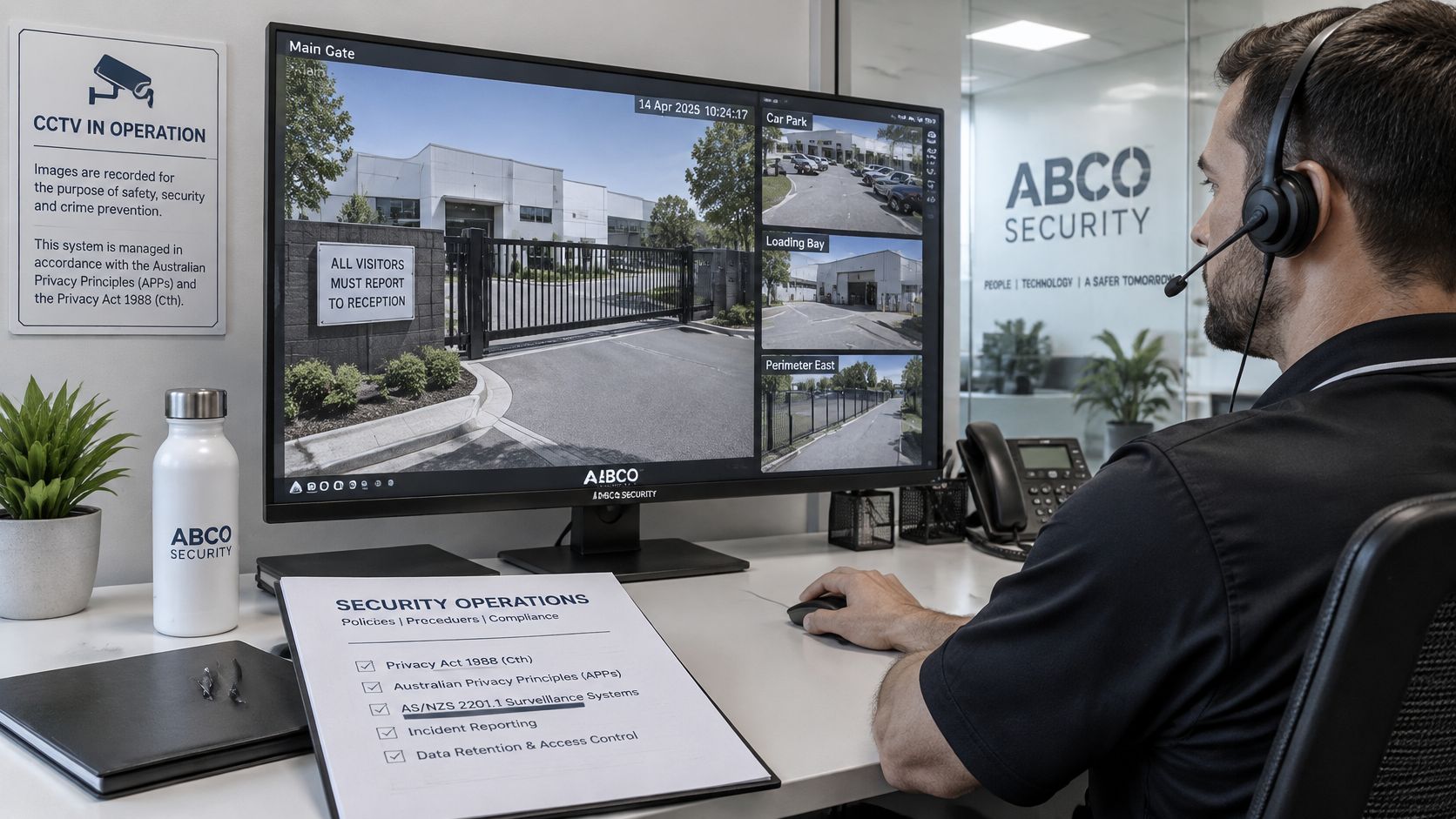
Turn privacy duties into operating controls
- Visible notice: Put surveillance signs at entries and monitored areas, and communicate the arrangement to staff and tenants.
- Written retention: State why footage is kept and when routine recordings are deleted.
- Role-based access: Set separate permissions for live viewing, playback, evidence export and system administration.
- Encryption: Protect footage in transit and storage, including operator connections.
- Audit logs: Record access, exports and administrative changes.
- Deletion workflow: Test routine deletion and release authorised incident holds when they are no longer needed.
Camera placement should match a defined security purpose. Aim cameras at relevant events, mask neighbouring homes and irrelevant workspaces where feasible, and exclude toilets, showers, change rooms and fitting rooms.
Before adding intrusive analytics, consider whether a less invasive measure would address the risk. The Australian Privacy Foundation's CCTV policy sets out a purpose-limitation and proportionality perspective, including defined retention and destruction practices.
Apply the law where the site operates
Australia has no single national workplace-surveillance regime. The OAIC's workplace-monitoring guidance describes jurisdictional differences, including NSW's Workplace Surveillance Act 2005 and Victoria's Surveillance Devices Act 1999.
Review camera placement, audio, employee notification and permitted use against the rules that apply at the site. Facial recognition or staff-conduct monitoring can increase privacy exposure without improving the security outcome.
A perimeter-security instruction should not become informal authority to investigate employees.
Route suspected misconduct through a separate documented process. Operators should not circulate clips because someone requests them.
Ask providers for evidence of quality processes aligned with ISO 9001 and risk-management practices informed by ISO 31000. Neither standard replaces legal compliance. The Australian CCTV laws guide can help frame questions for qualified advice.
Monitoring cameras and checking for covert devices are separate service categories. For example, counter surveillance services London describes covert-device checks, not an Australian legal authority.
The practical test is clear: who can view live and recorded feeds, for how long, and under what notice to staff, contractors, visitors and tenants?
How to Choose a Remote Guarding Provider
A control room can look impressive while leaving a site without a clear response when an alert comes in. Choose a provider by tracing responsibility from the monitoring desk to any Mobile Patrols or on-site officers: ask which legal entity supplies each service and which licences authorise the work.
In NSW, security work requires a current licence, and Class 1 applicants must be at least 18, fit and proper, and appropriately trained, according to the NSW security licence requirements. Queensland requires a security-firm licence for paid services, including subcontracted supply, with personnel licensed for their work, as outlined in the Queensland security-firm licensing guidance.
A licence for work in Melbourne does not establish compliance in Brisbane. Request the licence details and authorised activities that apply to your site, rather than relying on a general assurance that a company is licensed nationally.
Score operational evidence
| Selection area | Evidence to request |
|---|---|
| Control-room staffing | Coverage for your required hours, supervisor arrangements and backup procedures |
| Local patrol capacity | Actual patrol base, dispatch arrangements and address-specific travel assessment |
| Escalation | Written verification thresholds, emergency exceptions and contact hierarchy |
| Privacy | Access matrix, retention schedule, export controls and deletion procedure |
| Assurance | Insurance documents, quality-system evidence and sample incident reports |
For Melbourne, Sydney, Brisbane, Perth and nearby centres, assess coverage at the specific address. Congestion, locked gates, overlapping incidents and shift changes can affect attendance, so ask how the provider accounts for each.
A fallback plan matters. If the preferred patrol is unavailable, the provider should explain the next response step; leaving a message for the property manager may not meet the service's purpose.
Questions for the proposal and pilot
- Licence coverage: Which states and licence classes cover the site and attending officers?
- Verification: What must the operator confirm before dispatch?
- Attendance: What arrival commitment applies to this address, and what exceptions apply?
- Video access: Who can view, export and disclose footage?
- Retention: How is footage deleted, and who authorises preservation?
- Staff incidents: How are suspected misconduct reports separated from external intrusion alerts?
- Demonstration: Will you run a paid pilot drill before the contract term begins?
ABCO is one national option offering licensed officers, A1-grade monitoring and electronic security, with offices in Melbourne, Sydney, Adelaide, Perth and Brisbane, according to ABCO's company information. Buyers searching for a Security Company Melbourne should apply the same evidence test to ABCO as to any other provider.
Put agreed duties, response commitments and exceptions in writing using the security service contract terms guide. Choose the provider whose drill shows that monitoring, patrols and any on-site response work together as required, not just the one with the lowest monthly fee.
How to Put Remote Guarding Live on a Site
Give the project manager a deployment checklist with an owner and a filed record for each task. Don't let equipment installation become the acceptance test for the whole service.
The visual checklist provides a high-level deployment sequence.
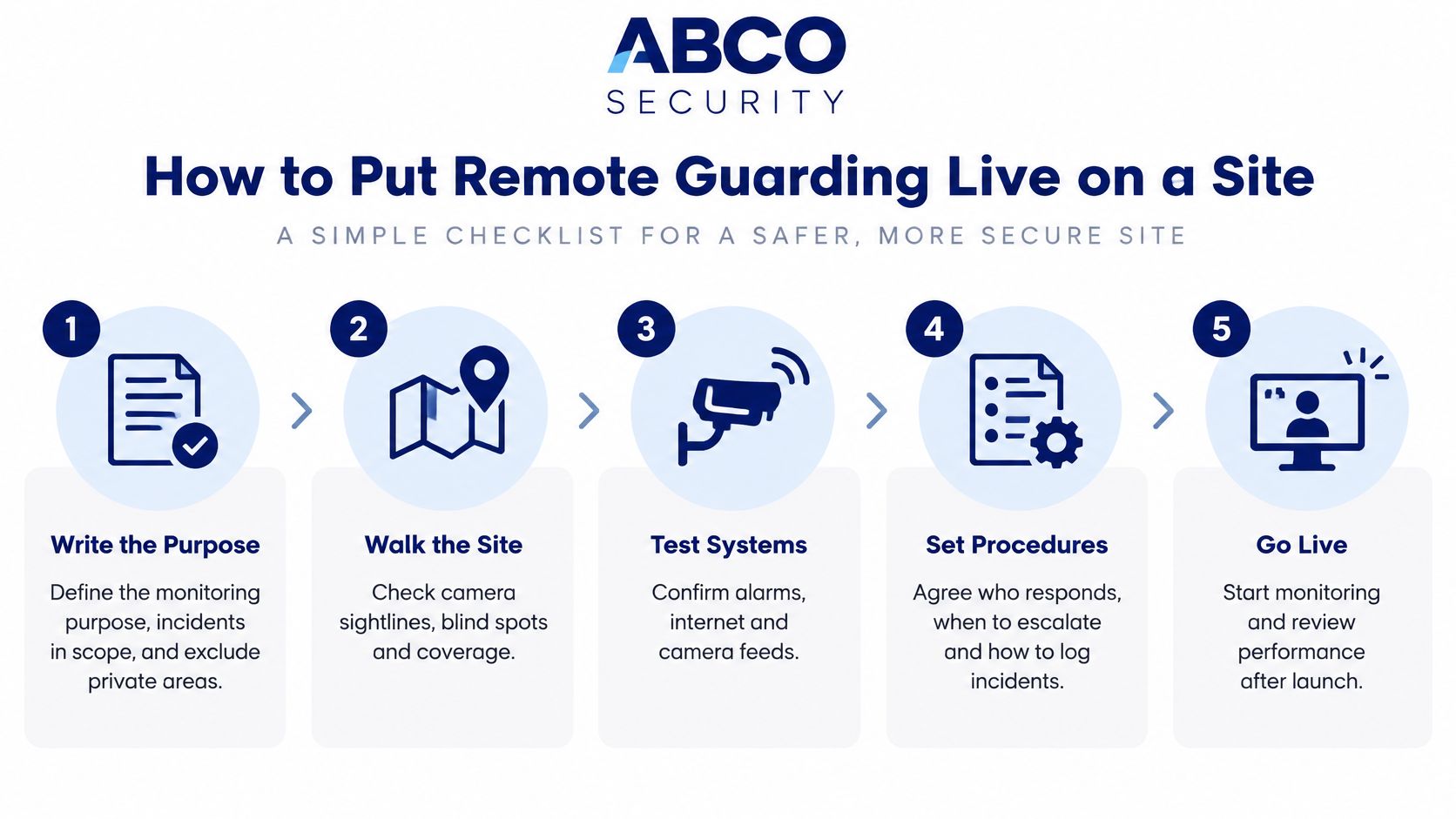
Establish the purpose and prove coverage
Write the monitoring purpose. Name the incidents in scope and explicitly exclude private areas and unrelated employee observation. File an approved purpose statement so later changes can be assessed against it.
Walk the site. Check camera sightlines, night lighting, speaker audibility and blind spots. Mark neighbouring homes requiring masking. Keep an annotated plan and nighttime test images, not just the installer's daytime photographs.
Configure and test the system. Set analytics for the agreed events and test nuisance sources over several nights before relying on alerts. Include camera obstruction, communications failure and loss of power. File the test results and outstanding defects.
Agree response thresholds. Identify who is called first, what triggers dispatch and the maximum acceptable patrol travel time. Record emergency exceptions so an operator doesn't delay urgent help while following an ordinary contact list.
Confirm authority and rehearse attendance
Complete privacy controls. Confirm signage, staff and tenant notices, retention, access rights and deletion. File approved notices, permission records and the retention configuration rather than a checkbox saying privacy complete.
Check personnel and business evidence. Verify each officer's state licence, authorised activity, training and first-aid status where applicable, together with public-liability insurance and site procedures. Victoria's private security licence application guidance identifies training, operating-procedure and public-liability documentation requirements. Check additional jurisdictional requirements separately, including ACT workplace-rights training and first-aid requirements for relevant subclasses.
Run a live drill. Arrange an authorised test event and measure operator verification, dispatch acknowledgement and patrol arrival. Check that the attending officer can find the correct entrance and access the required area. File the complete incident log and assign corrective actions.
Schedule a post-launch review. A proposed review after the first month should compare actual alerts with the written purpose. Remove or adjust cameras and rules that don't serve it, and record the reason for every material change.
Go-live standard: Don't start routine paid monitoring until the drill log shows a verified decision and a realistic arrival time.
If a defect prevents that result, retain interim protection while it's corrected. An operational camera feed alone doesn't demonstrate an operational response service.
Arrange a Remote Guarding Assessment
Start with the single risk that concerns you most: after-hours intrusion, plant theft, retail doors, event crowds or a strata car park. Choose whether that risk needs remote observation, a hybrid response or someone already on site, then write down the patrol travel time you're prepared to accept.
That gives the assessment a decision to resolve. Without it, a discussion can drift towards camera quantities and package prices before anyone establishes what a successful response looks like.
Prepare the information that changes the recommendation
- Site layout: Bring a simple plan or camera list showing entrances, vulnerable areas and the proposed patrol access point.
- Empty hours: Identify when the site is unoccupied, including cleaners, contractors and late-working tenants.
- Privacy limits: Mark neighbouring homes, staff areas and other spaces that must remain outside monitoring.
A useful assessment checks sightlines, false-alarm sources, licence coverage for the state and whether an officer is still needed for access, welfare or conflict. It should also test whether the proposed patrol can arrive in time to do something useful, rather than merely document the aftermath.
Property managers, builders, event organisers, retailers and strata committees in Melbourne, Sydney, Brisbane, Perth and surrounding cities should expect a written recommendation. That recommendation should identify the operating model, response threshold and what won't be monitored.
The standard of a good outcome is practical: fewer unverified call-outs, a person on site when the incident needs one, and a footage process the organisation can defend.
ABCO Security Services Australia offers remote CCTV and alarm monitoring, Mobile Patrols and on-site security personnel that can be combined around your site's risks. Visit ABCO Security Services Australia to arrange a remote guarding assessment and request a written recommendation covering response thresholds, local attendance and monitoring exclusions.
about
avada factory
Sempery ultricies nibh at dolor cras urna eleifend nec. Atiam efficitur tempor.