
A client arrives early, a courier needs a signature, and a maintenance contractor wants access to a restricted floor. Your receptionist is already on the phone. In that moment, the lobby isn't just a welcome area, it's the point where someone must decide what happens next.
A corporate concierge service can bring order to that pressure, but only if its responsibilities match the building's risks. A welcoming desk, a licensed security post and a reliable response arrangement do different jobs. Property managers need to know which they're buying.
What a Corporate Concierge Service Is
On a weekday morning in Melbourne or Sydney, visitors, contractors and couriers can arrive together. The person behind the counter becomes the bridge between the street and the workplace, often before the building manager knows there's a problem.
A corporate concierge service is staffed front-of-house coverage that welcomes people, establishes their purpose, coordinates authorised access and directs building or security problems to the appropriate responder. In an office building, its purpose is workplace coordination rather than the personal arrangements commonly associated with a hotel concierge.
Hospitality and security are different functions
The Australian Bureau of Statistics' 2024 occupation classification places Concierge (Hospitality) in occupation group 471999, Hospitality Workers not elsewhere classified, at skill level 5. That's an occupational classification, not permission to perform licensed protective work.
The classification doesn't publish a separate national employment total for corporate-building concierge personnel. It also shouldn't be used to determine award coverage or security licensing, which require their own assessment.
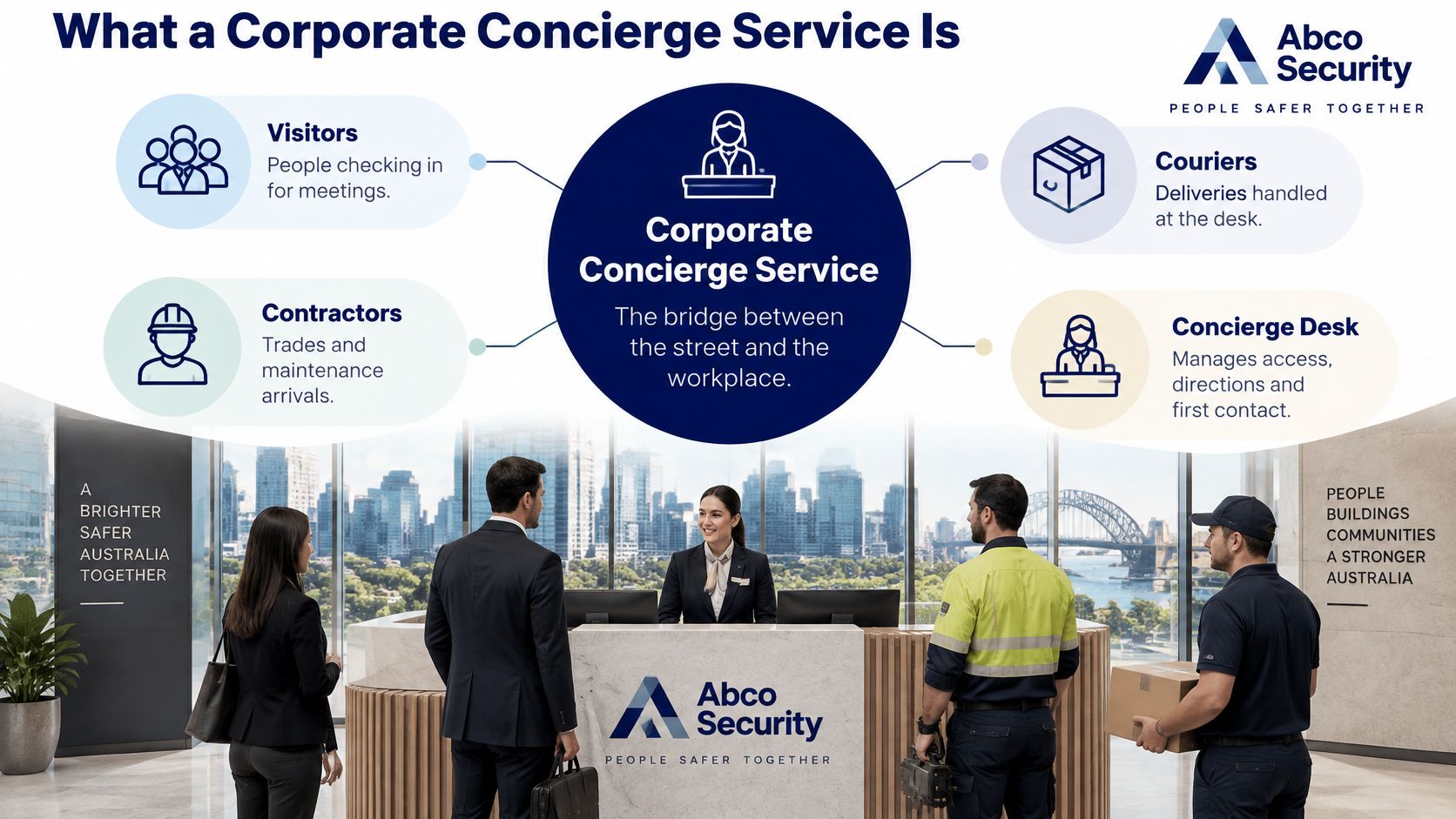
Managers often buy a blend of capabilities:
- Hospitality support provides a calm welcome, clear directions and practical tenant assistance.
- Building coordination connects occupants with facilities staff and other responders.
- Concierge Security adds appropriately licensed personnel where the work includes protective duties.
A security licence doesn't give an officer general police powers. The officer still needs lawful authority, relevant training and site instructions for the task, including any refusal of entry.
Choose the function before the title
Say a tenant wants the desk to welcome clients but also confront an unwanted visitor. Those aren't interchangeable expectations. The first is a service task; the second needs a clear protective response arrangement.
Practical rule: Decide whether you need coordination alone, or coordination supported by a licensed control. Don't let a polished uniform hide an undefined job.
Security Guarding can support the concierge without replacing the hospitality approach. The important distinction is who carries each responsibility, not what the provider calls the post.
Staffing Models and Daily Duties
Corporate concierge staffing models
| Model | Best suited to | Typical coverage | Licence position |
|---|---|---|---|
| Hospitality concierge only | Low-risk offices focused on tenant experience | Business hours | Hospitality role; no security powers |
| Blended concierge and licensed officer | Corporate towers with controlled floors | Extended or business hours | Security tasks done by a licensed officer |
| Concierge plus mobile patrols | Multi-site or after-hours portfolios | Desk by day, patrols overnight | Protective patrol response requires an appropriate guard licence |
| Gatehouse security | Campuses, estates and logistics entries | Often continuous coverage | Protective entry control commonly requires licensing |
| Event security overlay | Functions and venue hire | Event duration only | Relevant security or crowd-control licensing applies to protective work |
Match the model to the pressure point
A hospitality-only desk suits an office where exceptions can safely wait for a manager. The concierge can communicate an approved entry policy, but shouldn't be expected to physically enforce it or detain someone.
A blended desk suits a tower where access disputes need an immediate response. Name the licensed officer authorised to handle protective decisions, rather than assuming every person behind the counter holds the same role.
Concierge coverage with Mobile Patrols can suit a portfolio with quiet evenings. Its weakness is the gap between calling for assistance and its arrival, so a patrol arrangement shouldn't be presented as an immediately available on-site officer.
Gatehouse Security suits vehicle-heavy entries where drivers need clear stopping points and safe waiting areas. An Event Security overlay addresses a temporary change in attendance, without turning a short function into a permanent staffing commitment.
For each model, identify who may communicate a refusal, who may enforce the site's lawful access conditions, and who takes over if someone resists. Never instruct an unlicensed receptionist to detain a visitor.
Define the desk's daily work
Write the ordinary duties into the post instructions:
- Visitor registration: Record the arrival and obtain host approval before issuing a pass.
- Temporary credentials: Allocate the correct access and arrange expiry or return.
- Mail and deliveries: Log receipt and identify the responsible recipient.
- Tenant assistance: Handle meeting-room requests and agreed building enquiries.
- Incident notes: Make a factual, time-stamped record without speculation.
- Shift handover: Transfer outstanding issues in writing to the incoming worker.
Align visitor management systems with those instructions. Software shouldn't introduce an approval shortcut that the written procedure prohibits.
Roster options might include a business-hours officer, split coverage with a supervisor on call, or a continuous roster. Every option needs meal relief and trained leave cover.
When allocating employment responsibilities, workers compensation advice for employers from ABS Insurance Brokers Pty Ltd can support a separate insurance review. Insurance isn't a substitute for safe staffing.
A tenant's receptionist isn't automatically a contracted building concierge with an escalation pathway. Choose coverage against foot traffic and after-hours exposure, not a job title.
Why the Desk Is a Safety Control
The concierge desk can control the transition from public space to workplace space. That makes its position useful for prevention, provided staff have a safe workstation, clear authority and someone capable of responding.
The Safe Work Australia report on work-related violence and aggression reports more than 1 million work-related violence incidents over its lifetime reference period, including 176,100 occurring in workplaces during the previous 10 years; its compensation dataset records 53,139 accepted claims for assault by a person or persons and 12,721 for exposure to workplace or occupational violence. These are broad Australian findings, not corporate-office incident totals.
Interrupt the pathway to harm
The report identifies clients and customers as the most common source of work-related violence. Angry or hostile behaviour, shouting, swearing, intimidation and insults are among the reported behaviours, making first contact an important intervention point.
A practical control arrangement should:
- Establish a boundary: Keep unrestricted reception space separate from employee areas.
- Recognise escalation: Train staff to notice threatening behaviour without provoking confrontation.
- Provide safe withdrawal: Give the worker somewhere to move and a reliable way to summon help.
- Assign the response: Identify who takes charge when a visitor becomes aggressive.
Say an upset visitor demands access to a manager. The concierge shouldn't have to choose between appeasing them with access and attempting a physical confrontation. The building needs a safe waiting arrangement, a responder and a trigger for emergency assistance.
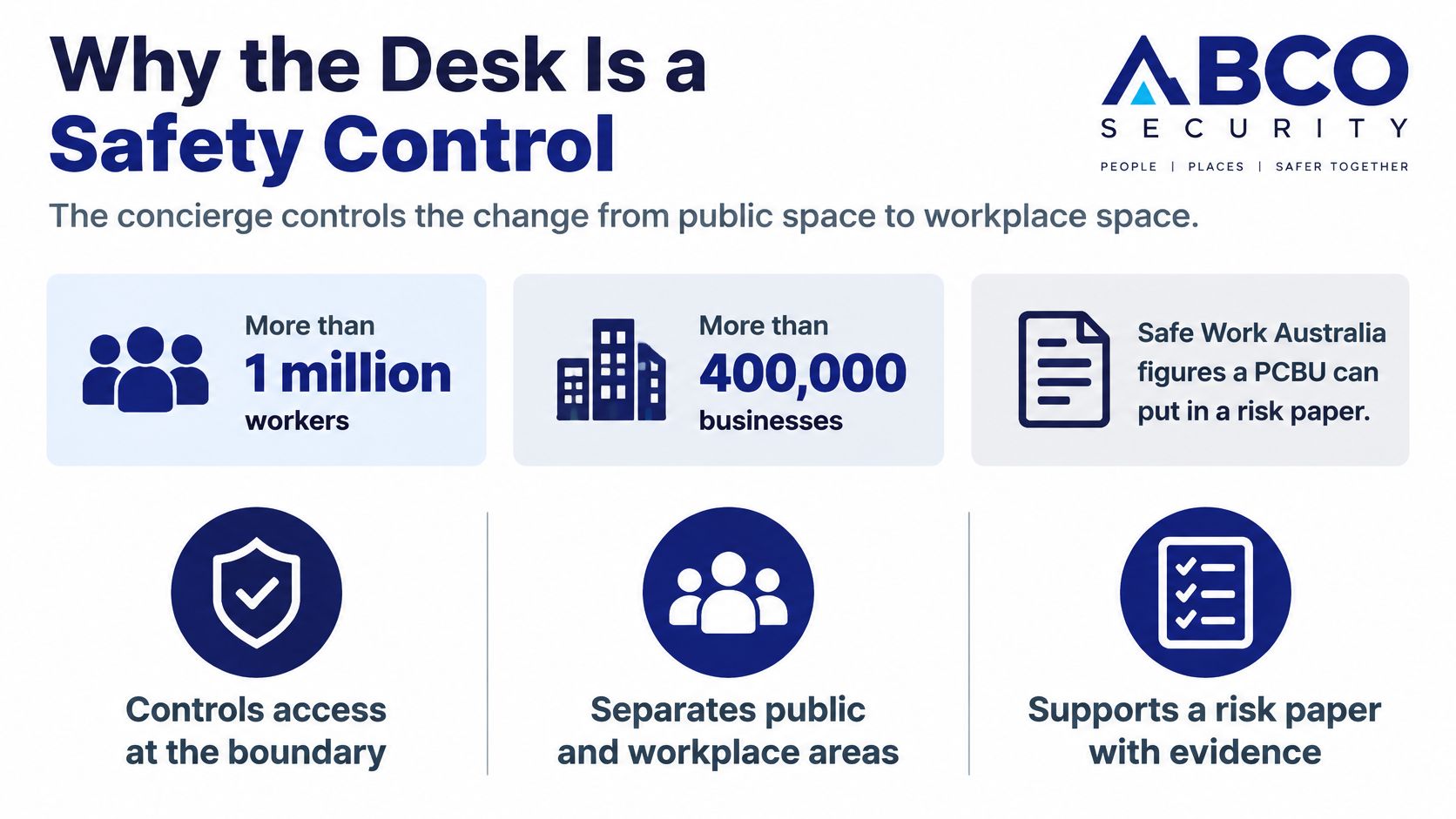
Use the report's incident and claims measures for risk documentation, rather than treating any graphic as an office-specific estimate.
A polite desk isn't a complete control
A person conducting a business or undertaking, or PCBU, should include reception arrangements in its assessment of physical and psychosocial hazards. Installing a counter doesn't transfer that responsibility to the worker sitting behind it.
A properly designed service can reduce unmanaged arrivals, provide a shared operational record and maintain coordination while the building manager is off site. Those are practical benefits, not promises that incidents won't occur.
A sign-in sheet records a decision. It doesn't make an unsafe entry safe.
Poor training, unclear refusal authority and unsupported lone working can leave both reception staff and occupants exposed. Build the desk into a corporate office security plan, with attention to the worker's safety as well as the people beyond the lobby.
Linking the Desk to Cameras and Access Control
Integration means that people, doors and response arrangements operate as a connected process. Buying a visitor tablet, cameras and a card reader separately doesn't establish that process.
Start with an approved arrival. The access system should apply the correct destination and expiry, while CCTV gives an authorised operator a useful view of the counter and relevant entry. A duress alert must reach a responder who understands the location and required action.
Test the complete entry chain
Run a practical test with an unfamiliar contractor. Check whether the person can find reception, whether the desk can reach the responsible contact, and whether the issued credential opens only the intended route.
Then test an exception, such as a host who can't be contacted. The procedure should specify:
- Decision authority: Who can reject an access request or suspend a credential.
- Response triggers: When to contact a supervisor, patrol or emergency services.
- Record handling: Who may retrieve camera footage and access events, and how they're preserved.
- System failure: What staff do when the network, reader or communications device stops working.
Put these decisions into usable communication protocols. Keep emergency instructions available without requiring a worker to go through several software screens.
A pass-controlled door that people routinely tailgate through isn't delivering effective access control. Address door behaviour, sightlines and exception handling before adding another device.
Treat biometric check-in as a privacy decision
The Office of the Australian Information Commissioner's facial-recognition guidance explains that biometric templates and facial images used for automated identification are sensitive information under the Privacy Act, with collection generally requiring consent or a specific exception.
A facial-recognition system can collect information about everyone scanned, not just someone who matches a watchlist. A convenient entrance can therefore create a much broader collection activity than a manager expects.
Before a trial, complete a privacy impact assessment. Define the purpose, assess necessity and proportionality, and compare less intrusive alternatives.
- Notice and choice: Explain collection before people enter the scanning area.
- Retention: Specify deletion arrangements and justify any continuing storage.
- Vendor access: Restrict administrative permissions and assess subcontractor involvement.
- Human-assisted alternatives: Offer an appropriate photo-identification, temporary-pass or QR-registration pathway.
Don't assume that walking towards reception amounts to informed consent. The most technical-looking lobby can create avoidable legal and reputational exposure if the organisation can't explain why the technology is necessary.
How to Appoint and Roll Out Coverage
Give competing providers the same operating scope. Otherwise, a cheaper proposal may exclude relief, supervision, or the response capability another provider has included.
Build a scope that can be tested
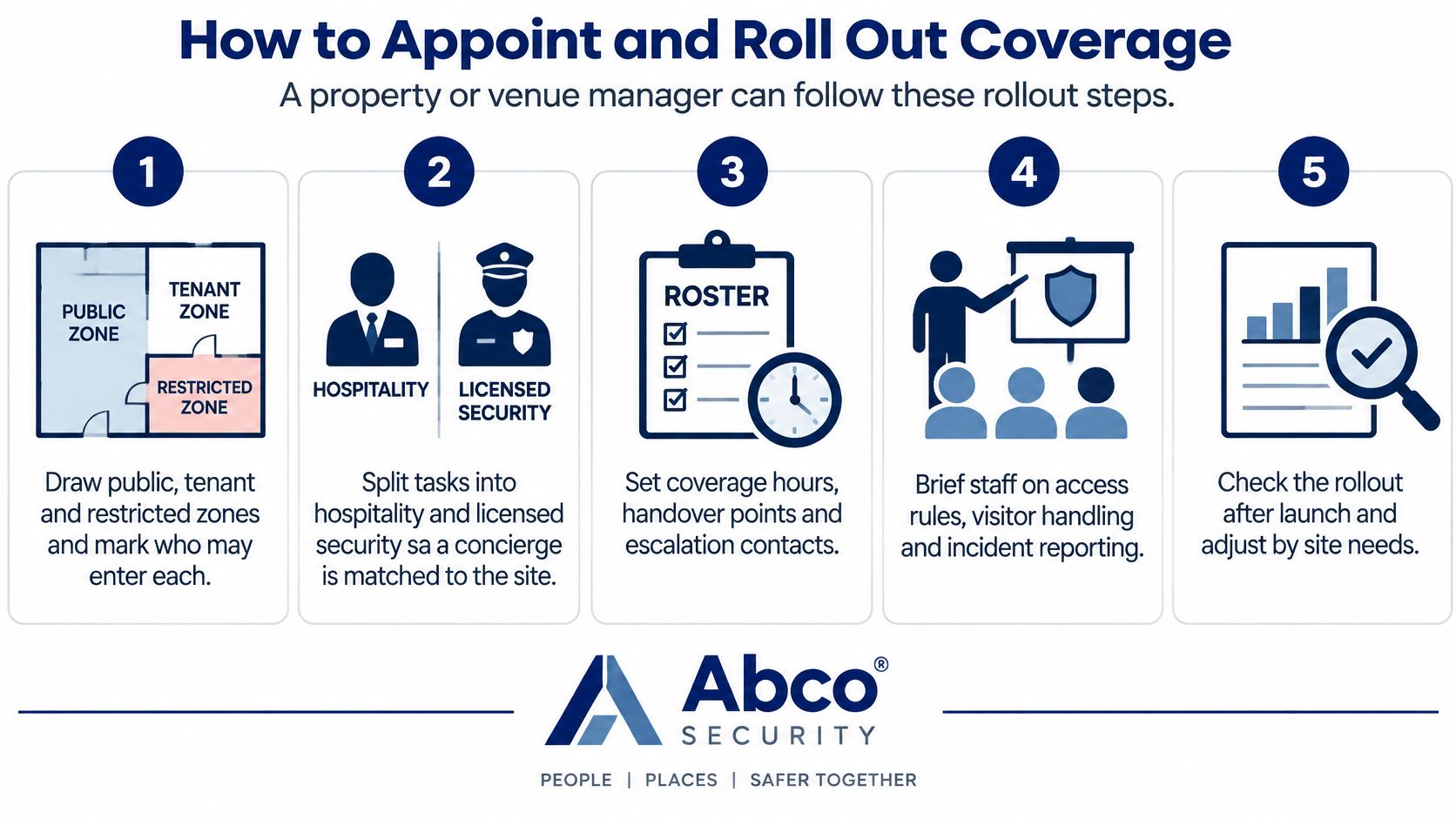
Draw the zones. Mark public, tenant and restricted areas on a floor plan. Identify permitted users and any shared routes, including loading docks and service lifts.
Separate the roles. Allocate hospitality work and protective duties explicitly. Require the provider to explain relevant licence categories and nominate the people responsible for regulated tasks.
Write the escalation pathway. Connect the desk to the on-site officer, patrol service, building manager and police as appropriate. Include a backup when the first contact doesn't answer.
Review technology and privacy. Assess camera coverage, access permissions and any proposed biometric collection. Require a workable non-biometric alternative before deployment.
Require operational records. Specify incident documentation, handover arrangements and post-incident review ownership. Make corrective actions traceable to a responsible person.
Close roster gaps. Set operating hours, meal relief, absence cover and replacement arrangements. Ask who stays responsible while a replacement travels to site.
Check comparable experience. Request relevant references in Melbourne, Sydney, Brisbane, Perth or surrounding centres within about 200 kilometres of the proposed operation. For retail assets, ask specifically about Retail Security and Shopping Centre Security experience rather than accepting an unrelated office reference.
Agree on acceptance measures. Put response triggers, reporting requirements and review arrangements into the contract before commencement. Require practical testing before treating the service as established.
Evaluate the provider, not the brochure
ABCO Security is one integrated option for managers seeking concierge coverage, licensed guarding and electronic security through offices in Melbourne, Sydney, Brisbane and Perth. Apply the same checklist to it as to any other bidder.
When comparing a Security Company Melbourne property teams can supervise locally with a national arrangement, examine replacement capacity and escalation ownership. A local versus national security company comparison can help frame those questions.
Ask for ISO 9001-style document control, including approved versions, named owners and withdrawal of outdated instructions. That supports consistent handovers; it doesn't guarantee safe decisions.
For a multinational property team, a parallel exercise to compare IT support in NYC through RDE Technologies may help identify the overseas owner of shared visitor-system infrastructure. Keep that IT responsibility separate from Australian security response.
Where licensed officers are proposed, require an applicable Fair Work award check. Use the award figures below to test the labour assumptions.
Award Rates and Service Measures
The officer's minimum wage and the client's service fee aren't the same number. The wage is an employment obligation; the service fee must also fund applicable employment costs and delivery overheads.
The Fair Work Ombudsman's Security Award summary lists ordinary-hour minima of $28.42 per hour for Security Officer Level 1 and $31.20 for Level 5, with Level 1 rates of $34.59 for weekday night-span work, $42.63 on Saturdays, $56.84 on Sundays and $71.05 on public holidays. Check the current operative award and the actual classification before approving a roster.
Read the wage floor correctly
These published figures apply within the award's coverage and conditions. They aren't universal reception rates, and an occupational title alone doesn't settle award coverage.
Keep the assigned classification, ordinary hours, weekends, public holidays, allowances and overtime assumptions on file. Ask the provider to explain how its proposed roster accommodates them.
Superannuation, leave, relief, supervision, uniforms, equipment and margin also affect the client fee. No sell-price range is published here because site risk, hours and technology change the service being purchased.
For a hypothetical round-the-clock desk, the costing sequence is:
- Ordinary-hour award floor: Apply the correct classification to eligible ordinary hours.
- Non-standard hours: Apply the relevant night, weekend and public-holiday provisions, plus any overtime or allowances.
- Delivery costs: Add employment on-costs and the resources needed to maintain coverage.
- Client rate: Obtain an itemised proposal. A sourced sell-price range isn't available, so guessing would mislead.
Concierge and guarding measures to contract
| Measure | Healthy reading | What a miss suggests |
|---|---|---|
| Identity checks completed | Every visitor or contractor checked before a pass | Tailgating or informal entry |
| Unauthorised entry attempts | Logged with time and outcome | Weak door control or unclear refusal authority |
| Incident acknowledgement | Desk responds within the agreed minutes | No duress path or a single officer overloaded |
| Escalation time | Patrol, supervisor or police called on the written trigger | Escalation left to individual judgement |
| File closure | Note, evidence and review completed | Incidents disappear after handover |
Set targets from the site's risk assessment rather than borrowing arbitrary response promises. Define when each timing starts and stops, including whether acknowledgement means a call answered or a responder dispatched.
Audit response-time percentiles and unresolved access anomalies as well as averages. A satisfactory average can conceal delayed responses during the periods that matter most.
Use written service delivery standards to make review meetings evidence-based.
Procurement check: A cheap roster that ignores applicable penalties is a compliance risk, not a saving.
That applies to corporate towers, Shopping Centre Security and overnight patrols alike. Price comparisons only become meaningful when the labour obligations and service scope are equivalent.
How the Service Changes by Site
The right corporate concierge service changes with the entrance, occupants and activity. These scenarios show why the same uniform and counter can't solve every site's problem.
A corporate tower with a shared lobby
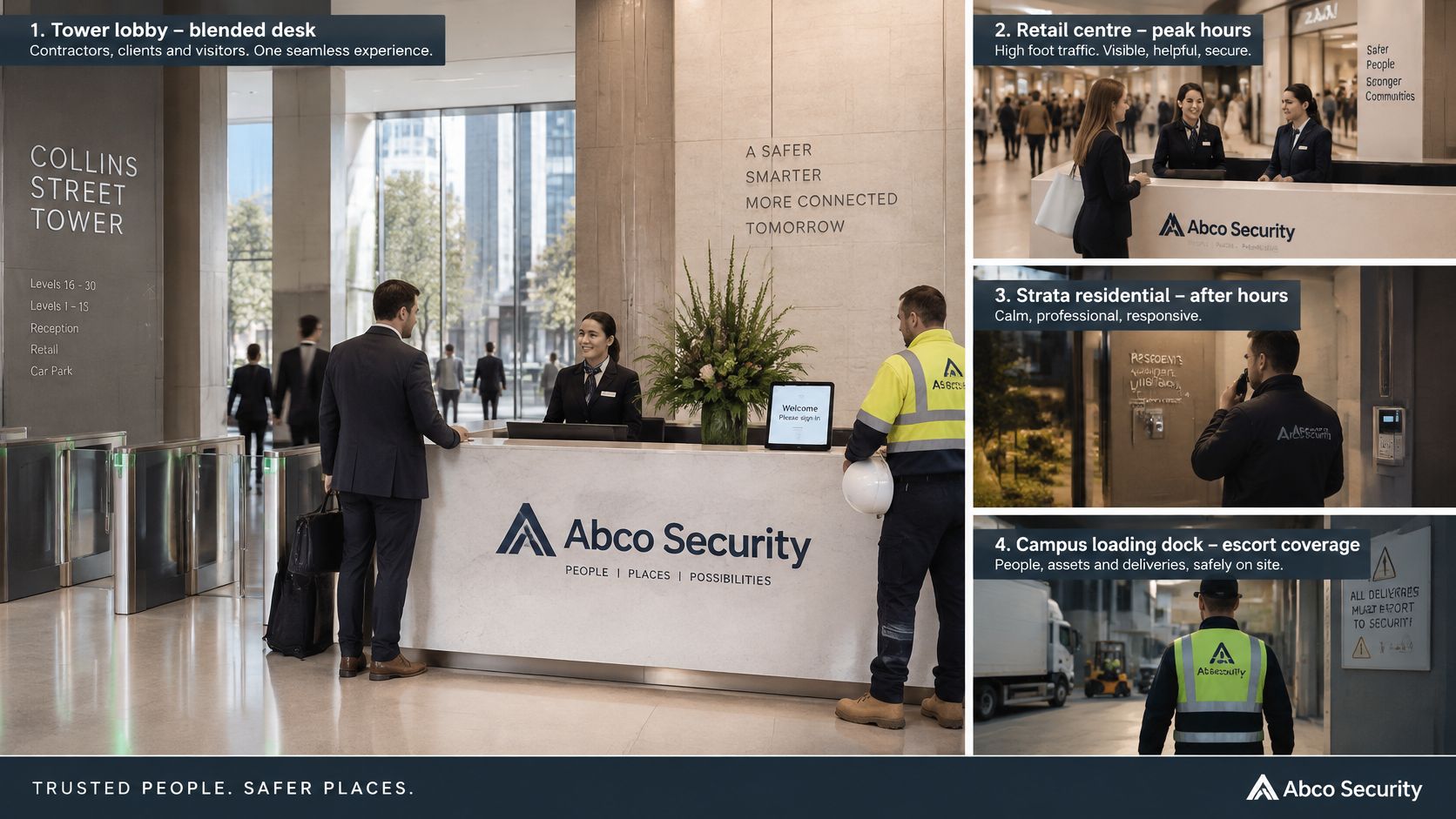
At a Collins Street or Martin Place tower, client meetings and maintenance arrivals use the same entrance. A blended business-hours desk provides a professional welcome, with licensed support available when an access dispute becomes a protective matter.
The mistake is sending the control-post worker away on hotel-style personal errands. If the lobby needs continuous oversight, tenant convenience tasks mustn't remove that coverage.
A shopping centre with public enquiries
At a Brisbane or Perth centre, the information point helps shoppers with directions and accessibility enquiries. Retail Security or Shopping Centre Security responds to protective incidents elsewhere on the floor.
Don't leave the information officer to manage a fight while continuing to assist customers. Separate customer assistance from the incident response and give both workers a clear way to communicate.
A venue hosting a product launch
A venue's usual concierge can help arriving guests find the function. A temporary Event Security deployment addresses the altered entry conditions and crowd-related risks during the session.
The purchasing mistake is treating a short-lived requirement as a permanent post. Define the event's start, pack-down and return to normal operations, including who controls access while equipment leaves.
A commercial estate with vehicle access
At an estate outside Melbourne, Sydney or another capital, Gatehouse Security manages the vehicle interface. Mobile Patrols can inspect agreed perimeter points after the gatehouse closes, with a response procedure for an open gate or damaged barrier.
Don't assume a fence line remains secure because it was intact at closing. Specify what the patrol checks and who can arrange urgent repairs.
For your own site, write a single operating sentence: who enters, through which boundary, and what risk that entry creates. Choose the closest scenario, then adjust the coverage around the differences rather than copying the whole model.
Scope Decisions and Common Questions
Choose between hospitality coverage, a blended concierge and protective service, and separate specialist posts. A desk focused on assistance may need only hospitality staff; a protective post needs the appropriate licensed capability; crowds, retail floors and construction interfaces may need distinct resources.
Don't let a broad contract label blur those choices. Assess the actual duties, local licensing requirements and response arrangements.
Does a concierge need a security licence?
Not because the job title contains concierge. The duties determine whether security licensing is required, and the relevant state or territory rules must be checked.
Routine assistance isn't automatically guarding. Equally, describing protective work as customer service doesn't remove licensing obligations.
Can a visitor refuse biometric check-in?
A visitor can decline to participate, but the organisation must decide how lawful access will then be handled. Provide an appropriate human-assisted alternative rather than making the concierge improvise a privacy decision at the counter.
The alternative must preserve the site's access requirements. It shouldn't become an unverified bypass.
Who covers after-hours residential or strata entries?
Appoint a named after-hours responder and document lone-worker and duress arrangements. Where patrol checks are used, agree on their timing, inspection scope and exception process.
A telephone number alone isn't coverage. Confirm who answers, what they can do and what happens if they're unavailable.
How should a venue staff a function?
Use event-specific resources for the changed conditions, including arrivals and pack-down. Return to the normal arrangement when the event risks have ended, not merely when the last speech finishes.
What changes at a construction interface?
Construction Security must support physical site controls rather than substitute for them. The WorkSafe Victoria guide for small construction businesses and subcontractors identifies suitable temporary fencing at least 1.8 metres high, securely connected, stable and difficult to climb as the preferred control, with security-personnel surveillance generally considered only for short periods when suitable fencing isn't reasonably practicable.
Keep office visitors away from construction hazards and assign the contractor interface to a properly scoped post.
What should managers send to providers?
Send a zone plan, proposed hours, role boundaries and escalation requirements. Compare the replies against applicable award obligations and the agreed service measures, not just the total fee.
ABCO Security Services Australia offers corporate concierge coverage, licensed security personnel and electronic security that can be combined around a building's entry risks. Bring your zone plan, coverage hours and response requirements to ABCO Security Services Australia to discuss a defined operating scope for Melbourne, Sydney, Brisbane, Perth or nearby centres.
about
avada factory
Sempery ultricies nibh at dolor cras urna eleifend nec. Atiam efficitur tempor.