Your night team has cameras, access cards and an alarm panel, but a maintenance job has left a rear door alarm isolated. A vehicle arrives without a confirmed booking. The guard needs to know who can approve entry, who checks the alarm isolation and where to record the decision.
That's the practical test of data centre security. Guarding, electronic monitoring, environmental sensors and incident reporting need to operate as one evidence chain, not as separate services with separate instructions.
What Data Centre Security Protects Against
Consider a night guard at a Melbourne facility who notices a van idling beside the loading dock. The rear door alarm has been silenced for maintenance, and there's no written rule covering that combination. Neither observation proves an attack, but together they justify verification before anyone opens the dock.
Data centre security protects people, hardware, data and dependent services from unauthorised entry, interference and disruption. Its scope includes the server hall, but also delivery areas, communications connections, plant rooms and the people authorised to work there.
Build a threat list around consequences
Australia had 306 data centres at the start of 2024, according to Cloudscene, as reported in this Australian data-centre physical-security overview. Operators share broad threat categories, although each facility needs controls matched to its layout and dependencies.
Use these categories as a working checklist:
- Unauthorised entry and tailgating: Someone follows a technician through a secure door without presenting a credential.
- Insider misuse: An approved contractor enters a customer cage outside the authorised work scope.
- Vehicle attack: A vehicle approaches a vulnerable entrance without passing an effective vehicle barrier.
- Hardware theft: A removed drive leaves through the loading dock without an approved asset-release record.
- Supply failure: A telecommunications fault or cooling interruption disrupts services despite an intact perimeter.
- Environmental hazards: Stormwater enters a cable route, or heat affects equipment serving a critical room.
- Cyber-enabled disruption: A compromised account changes building-management settings or interferes with access control.
Decide what needs immediate verification
For the loading-dock scenario, the guard should confirm the vehicle booking, identify the maintenance supervisor and check the authorised alarm-isolation record. If those checks fail, keep the entry closed and escalate through the site's approved procedure.
Don't treat an access card, branded vehicle or familiar face as proof of permission for the current task. Keep the threat list in the site risk register, with a prevention control, a detection method and a response owner against each entry.
Layered Physical and Electronic Controls Explained
A castle doesn't rely on one wall. It uses an outer wall, a gatehouse, an inner keep and locked stores, with each barrier buying time for defenders to respond.
The same principle applies to data centres, but additional barriers aren't automatically useful. A barrier that delays maintenance without improving detection or response can create workarounds, including propped doors and borrowed credentials.
The diagram shows the layered principle.
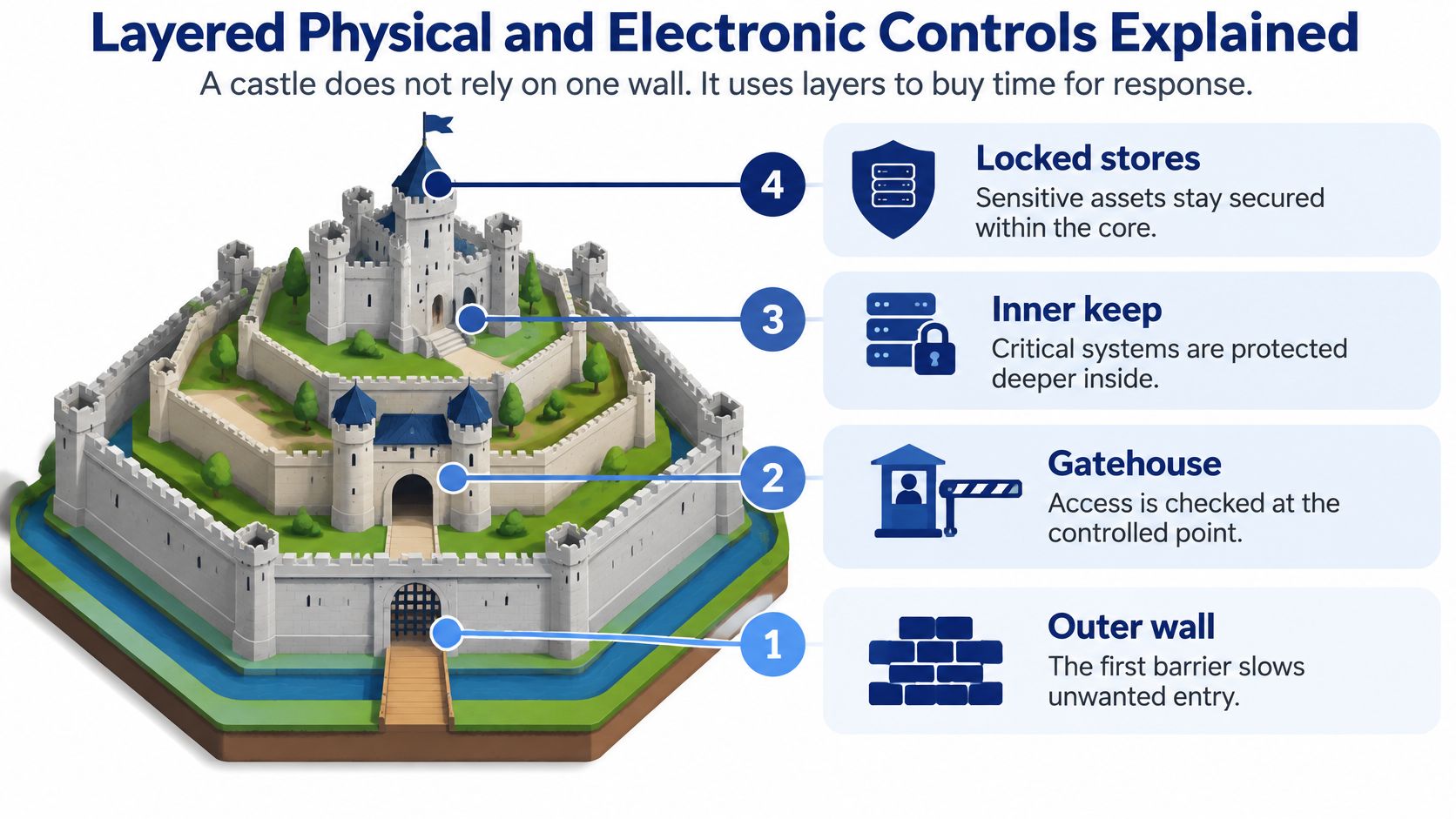
Security layers, controls and the threats they address
The core access layers need an environmental and operational overlay.
| Layer | Typical controls | Main threat addressed |
|---|---|---|
| Perimeter | Fencing, bollards, vehicle barriers, lighting, CCTV, patrols | Forced entry and vehicle attack |
| Building and room | Mantraps, card and PIN or biometric readers, sensors, CCTV | Unauthorised entry and tailgating |
| Rack and cage | Locked cages, cabinet alarms, logged access | Insider access to hardware |
| Electronic and network | Network segmentation, multi-factor authentication, audit logging | Account compromise and remote control of systems |
| Environmental and operations | Power, cooling, water and smoke sensors with monitored alarms | Outages, overheating and water damage |
Trace a contractor's visit through those controls. A Gatehouse Security officer verifies the vehicle and work order, the monitoring operator confirms building entry on CCTV, and the contractor uses a card and PIN at the hall door. Access to the customer cage remains separately authorised and logged.
Overlapping controls matter at failure points. If a card reader fails, the officer still verifies identity through an approved contingency process. If someone obscures a camera, a separate perimeter sensor should still generate an actionable event.
Protect the supporting systems
The Cyber and Infrastructure Security Centre's sector risk assessment warns that attackers may target supporting nodes and connectivity services rather than the data centre itself. Map power, cooling, telecommunications, building-management systems and maintenance access alongside doors and fences.
Physical access to a network switch can undermine logical protections through cable changes, device replacement or unauthorised connections. Keep communications cabinets secured, including those outside the main hall.
Practical rule: A detection layer only buys useful time when someone receives the alarm, understands it and has authority to act.
Use documented security communication protocols to connect each control to its responder. Mark which layers exist, which depend on a single device or person, and where an attacker could bypass several controls through one shared dependency.
Access Control, CCTV and Video Analytics in Practice
An access controller checks a card, PIN or biometric against permission for a particular area and time window. Record both granted and denied events, then make sure operators can retrieve them without specialist assistance.
This illustrates a controlled entry point.
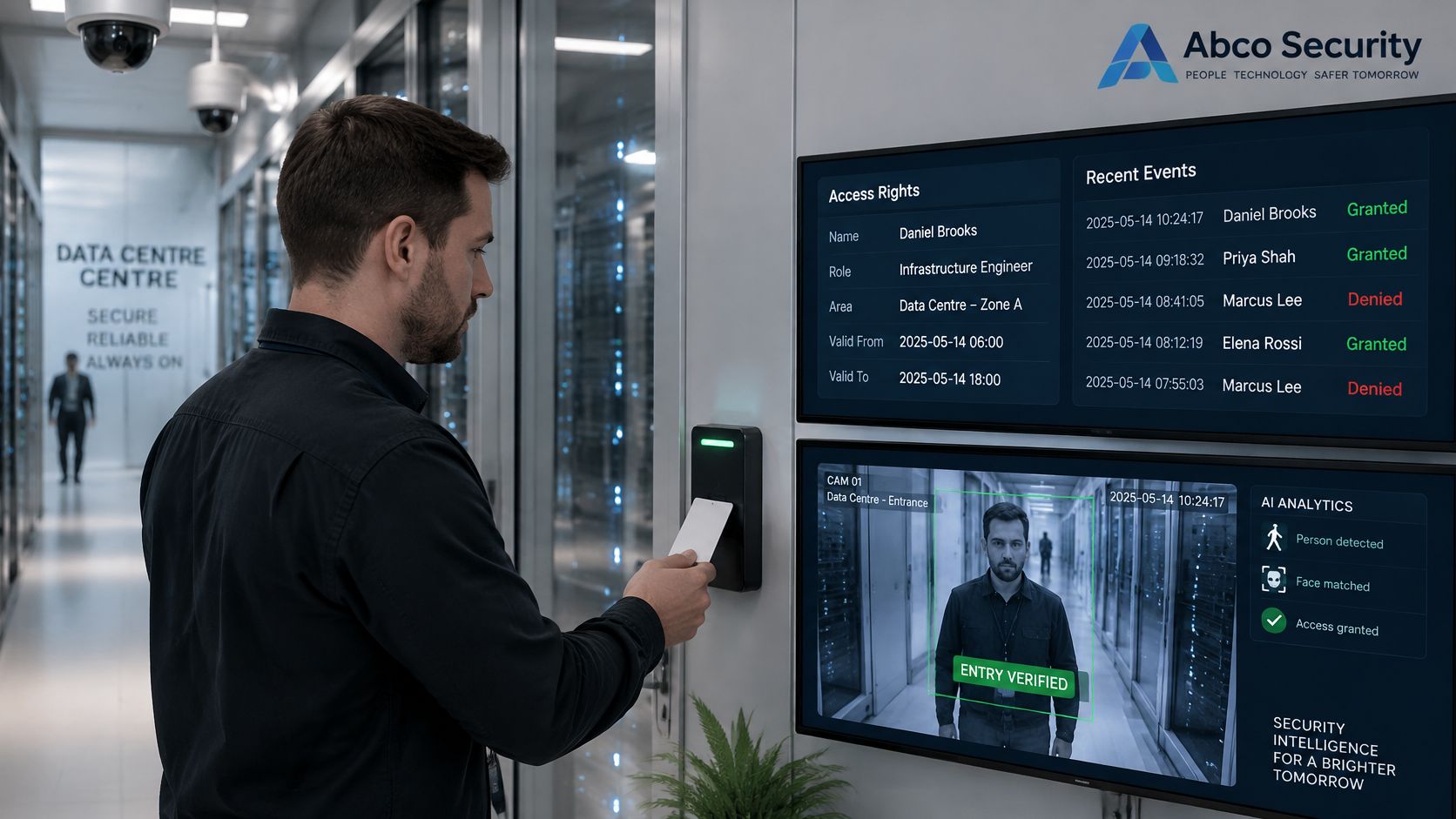
Make permissions enforceable
- Expire access automatically: Tie contractor permissions to approved work, not an assumed return date.
- Use paired attendance where justified: Apply a two-person rule to sensitive work without compromising emergency egress.
- Review permissions monthly: Reconcile access lists against employment changes and contractor schedules.
Position CCTV to capture useful identification at entries, loading bays and secure zones, rather than collecting distant images of movement. Set retention through privacy, contractual and incident-response requirements; a hypothetical 30 to 90-day setting is a design choice, not a universal Australian requirement.
Tune line-crossing, loitering, after-hours motion and tailgating analytics against actual conditions. Wildlife, blowing debris and headlight glare shouldn't repeatedly divert the operator.
The video provides additional context for electronic monitoring.
For example, a 3 am tailgating alert should prompt screen verification and, if warranted, patrol dispatch. Specify CCTV, access control and response together when discussing electronic security and monitoring options, rather than procuring disconnected systems.
Environmental Monitoring and Alarm Thresholds
A cooling alarm belongs in the security workflow because the cause may be equipment failure, accidental interference or deliberate tampering. Facilities staff diagnose the plant; security staff verify access activity, protect the affected area and record observations.
Monitor rack intake temperature, relative humidity or dew point, underfloor water, UPS load, generator fuel and running status, smoke detection, fire-suppression status and containment airflow. Room averages alone can conceal a local problem at a rack inlet.
Set warning and critical actions
Thresholds must come from the installed equipment, approved engineering design and commissioning records. Don't copy a temperature from another facility without checking equipment class, sensor placement and the response time available.
The numerical settings below are hypothetical commissioning examples, not verified ASHRAE limits or universal operating requirements.
Environmental sensor thresholds and actions
| Sensor | Reference or threshold | Action |
|---|---|---|
| Intake temperature | Example only: warning at 25°C; critical at 27°C, subject to equipment approval | Warning prompts a rack and airflow check; critical alerts facilities on-call and security together |
| Dew point | Site-approved envelope; example investigation point above 15°C dew point | Investigate humidity trend above the approved limit and check for condensation risk |
| Water leak under floor | Any detection | Immediate dispatch and isolation of the affected zone where safe |
| UPS load | Example only: alarm at 80% of rated capacity, subject to engineering approval | Review load and plan capacity before adding racks |
| Generator fuel | Low-fuel alarm per generator specification | Refuel and confirm supply contract |
| Smoke or fire suppression | Any detection or abnormal suppression-system condition | Initiate the emergency procedure, check evacuation requirements and contact fire services as appropriate |
Separate smoke detection from suppression faults in the alarm interface. A detector activation and an isolated suppression component require different assessments, even though both need prompt attention.
Follow the trend, not just the reading
In a hypothetical cooling exercise, intake temperature climbs from 24°C to 30°C over 40 minutes. Using the illustrative settings above, the warning prompts a rack check, while the critical event reaches facilities and security together.
The operator records the affected sensor, trend, nearby work and responder acknowledgement. If the maintenance team finds an open containment door, security can establish who entered and whether the opening was authorised.
A silent sensor isn't evidence of a healthy environment unless someone has proved that the sensor and its alarm path work.
Schedule tests that confirm detection, transmission, acknowledgement and escalation. Test safely with facilities approval, and record any bypass so the next shift doesn't mistake an isolated device for active protection.
Personnel, Contractors and Operational Discipline
An authorised person doing unplanned work can create a serious access incident without forcing a door. An unescorted technician, shared login or incomplete handover can defeat expensive hardware.
Start with access tiers that supervisors and guards can apply without improvising.
Contractor and personnel access tiers
| Access tier | Who | Required controls |
|---|---|---|
| Tier 1 visitors | Vendors and visitors on short calls | Pre-booked, photo ID checked, escorted at all times |
| Tier 2 scheduled contractors | Maintenance crews on work orders | Badge matched to work order, time-limited, supervised in the hall |
| Tier 3 privileged access | Engineers with rack, network or system access | Lawful and proportionate background check, dual authorisation, session logging |
| Tier 4 emergency call-out | After-hours responders | On-call verification, identity check at gate, access reconciled to incident log |
| Guards and patrol staff | Licensed security personnel | Individual licence verified, site induction, patrol and handover logs |
Make supervision a real duty
An escort must stay with the visitor in the controlled area, not sign them in and return to reception. Close permissions when the work finishes and reconcile departures against the work order.
Apply background checks only where lawful, relevant and proportionate. Document who approves exceptions, particularly when an urgent repair involves an unfamiliar subcontractor.
Security Guarding, Gatehouse Security and Mobile Patrols carry different duties. One officer can't continuously staff a gatehouse, conduct an external patrol and attend a plant alarm at the same time. Set minimum staffing and patrol frequency around those competing tasks, travel distances and relief arrangements.
Verify licences and vendor access
ASIAL's security licensing guidance explains that most Australian jurisdictions require appropriate licensing or registration for both the security business and individual workers. Verify both in writing with the relevant regulator, including the categories required for the assigned work.
Remote-monitoring providers, facilities vendors and remotely connected platforms also form part of the security perimeter. Require vendors to:
- Disclose subcontractors: Identify who may receive site or system access.
- Use named accounts: Prohibit shared credentials and limit remote-session duration.
- Log sessions: Record approval, connection times, work performed and disconnection.
- Commit to escalation: Put alarm response and platform-vulnerability notification timeframes in the contract.
The report on changing Australian critical-infrastructure risks identifies third-party dependence and staffing shortages as relevant exposures. A vendor contract needs an operational response schedule, not a promise to maintain security.
Use security awareness training to rehearse challenge procedures and handovers. Finish with a one-page site instruction naming who escorts, who approves and who verifies after hours, including open alarms and contractors still on site.
Compliance Obligations and Reporting Deadlines
When does a facility become a regulated asset? The answer depends on its services and statutory circumstances, not whether the building contains servers.
Under the Security of Critical Infrastructure Act framework, some data-storage or processing assets may be covered, with obligations involving registration, incident reporting and risk management. Obtain legal or regulatory advice on the facility's classification and responsible entity before treating a generic checklist as a compliance determination.
Core obligations and reference benchmarks
The Australian data-centre regulatory guide sets out notification within 12 hours of becoming aware for incidents significantly affecting availability, directly or indirectly, and generally 72 hours for other relevant incidents.
| Obligation or benchmark | Applies to | Timing or requirement |
|---|---|---|
| Register of critical infrastructure assets | Responsible entity of a covered asset | Provide operational and ownership information when required |
| Critical infrastructure risk management program | Covered data storage or processing assets subject to the requirement | Written program covering cyber, physical and natural hazards |
| Significant availability incident | Covered data storage or processing assets | Notify the Australian Cyber Security Centre within 12 hours of becoming aware |
| Other relevant incidents | Covered entities | Notification generally within 72 hours of becoming aware |
Voluntary benchmarks such as ISO/IEC 27001 for information-security management and ISO 22301 for business continuity can support governance. They don't replace statutory duties, determine asset coverage or remove notification responsibilities.
Turn an observation into reportable evidence
Say a guard reports a forced door at 22:40. The operator confirms the damaged entrance on CCTV, checks access events and alerts the incident lead to assess whether systems or service availability have been affected.
The forced door alone doesn't automatically establish the applicable reporting category. Equally, the organisation shouldn't wait for a complete forensic explanation before assessing its obligations. Preserve the original awareness time and document the classification decision as information develops.
Maintain tamper-resistant records, synchronised clocks and a named escalation chain. Connect guard notes, alarm events, visitor records and infrastructure alerts through a common incident reference, with access restricted to authorised responders.
Compliance boundary: Security personnel gather and escalate evidence. The responsible entity remains accountable for determining and meeting its legal obligations.
Align data privacy and security measures with evidence handling, including controlled exports and disclosure records. Confirm current requirements with the Cyber and Infrastructure Security Centre and obtain advice where classification, awareness or reporting scope is uncertain.
How to Respond to a Data Centre Security Incident
During the first hour, a slow severity decision or missing recording can be more damaging than a shortage of equipment. The response procedure should make the next decision obvious while preserving safe escape, responder access and service continuity.
Use a single incident lead to coordinate facilities, security and cyber teams. That doesn't mean the lead performs every task; it means someone tracks decisions and prevents conflicting instructions.
Follow a documented response sequence
- Detect and verify. Check the alarm or guard report against CCTV and access events promptly, without delaying emergency action where people are at risk.
- Contain. Restrict the affected zone and direct people to safe locations, preserving emergency egress and avoiding uncontrolled shutdowns.
- Classify severity. Assess effects on availability, integrity and confidentiality using pre-agreed criteria, recording uncertainty rather than assuming the event is minor.
- Start the clock. Record when the organisation became aware and preserve earlier relevant observations for the compliance lead's assessment.
- Preserve evidence. Export relevant CCTV, protect access logs and capture visitor records, alarm history and responder notes.
- Notify. Alert facilities on-call, the cyber team and compliance lead, with regulatory notification handled through the authorised process.
- Recover and review. Restore controls through approved change procedures, assign corrective actions and update the threat register.
The infographic provides a concise operational reminder, while the written procedure should retain the full decision sequence.
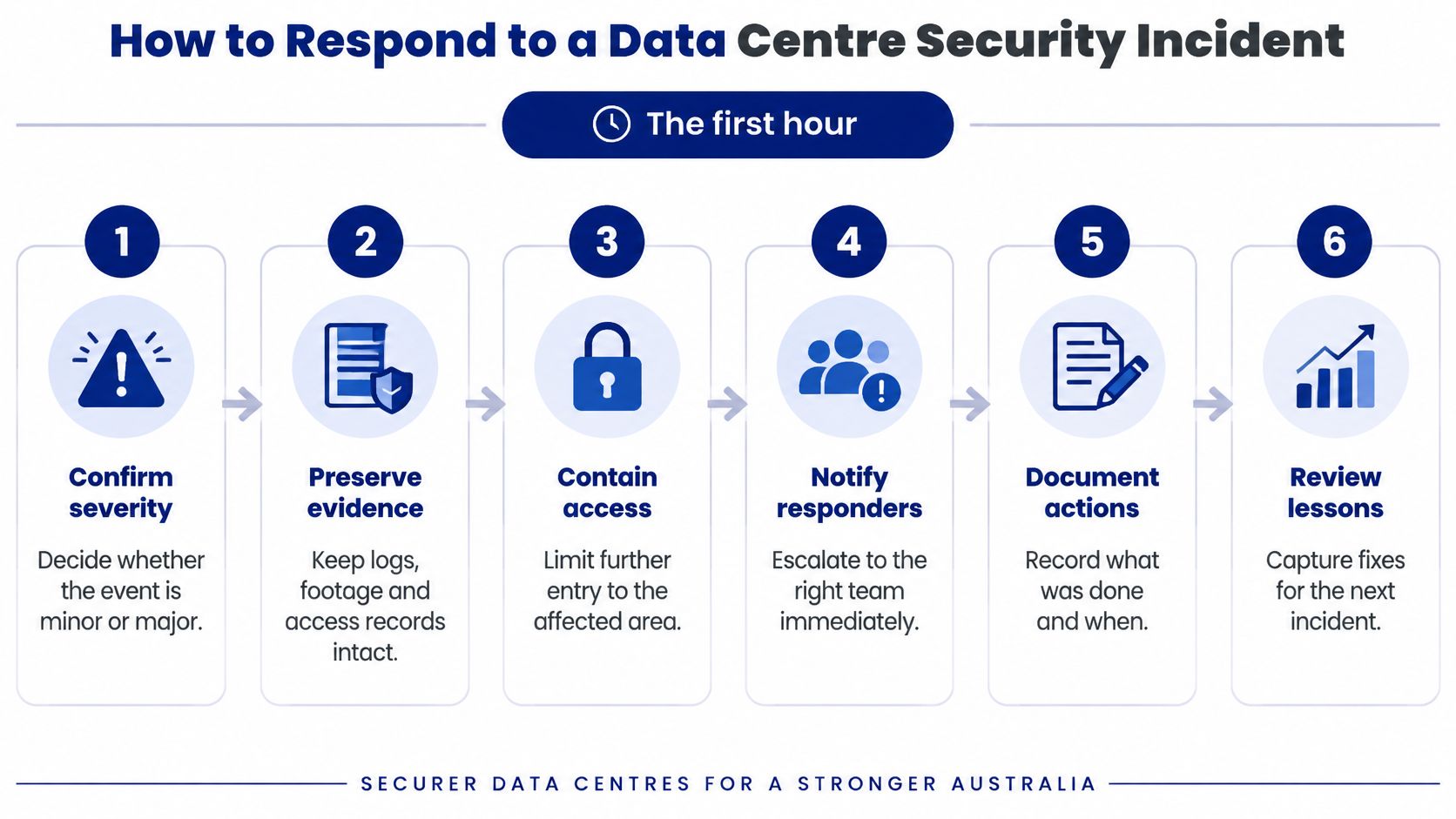
Close the common response gaps
Unsynchronised clocks make it difficult to establish whether a badge event preceded a door alarm. Record system time offsets if synchronisation fails, and don't alter original evidence to make the timeline look tidy.
Guard observations need facts: location, direction of travel, vehicle description, spoken instructions and actions taken. Separate what the guard observed from what they inferred.
After-hours severity decisions need a backup decision-maker. An unanswered phone should trigger the next contact, not leave the monitoring operator waiting indefinitely.
A security incident response plan template can organise responsibilities, but site-specific contacts, isolation permissions and evidence-export instructions still need validation.
I would set a 72-hour internal debrief target and rehearse a combined forced-entry and cyber scenario quarterly as management choices, not statutory requirements. Test the after-hours chain from monitoring operator to duty manager, facilities lead, cyber responder and compliance lead, including what happens when the primary contact is unavailable.
Run a Risk Assessment Before Your Next Audit
An audit can expose a gap between a written procedure and what staff can demonstrate. Ask an operator to run a denied-access search, show how an environmental alarm is acknowledged, and locate the approval for a current contractor.
The Commonwealth Cyber Security Posture report found that 75% of Australian Government entities reported having a cyber-security strategy in 2024, while only 15% reached overall Essential Eight Maturity Level 2. The report's findings concern government entities, but the assurance lesson applies to site reviews: a documented strategy does not prove that a control works in practice.
Use a working audit checklist
- Asset coverage: Have potentially covered sites been identified and referred for a classification decision?
- Access permissions: Do temporary rights expire, and are continuing permissions reviewed monthly?
- Evidence quality: Are CCTV and access logs synchronised and retained under an approved schedule?
- Environmental alarms: Do sensors report to a monitored location and pass scheduled tests?
- Contractor supervision: Are access tiers and escort duties explicit?
- Overnight coverage: Is minimum staffing documented against simultaneous tasks?
- Licensing: Are business and individual authorities verified in writing?
- Escalation: Are named primary and backup contacts available around the clock?
- Exercises: Has a combined incident exercise been completed within the past year?
- Suppliers: Do contracts define security response and notification timeframes?
Use this checklist to structure the initial walk-through. For each item, capture the evidence reviewed and any gap found, so the result can be assigned and tracked.
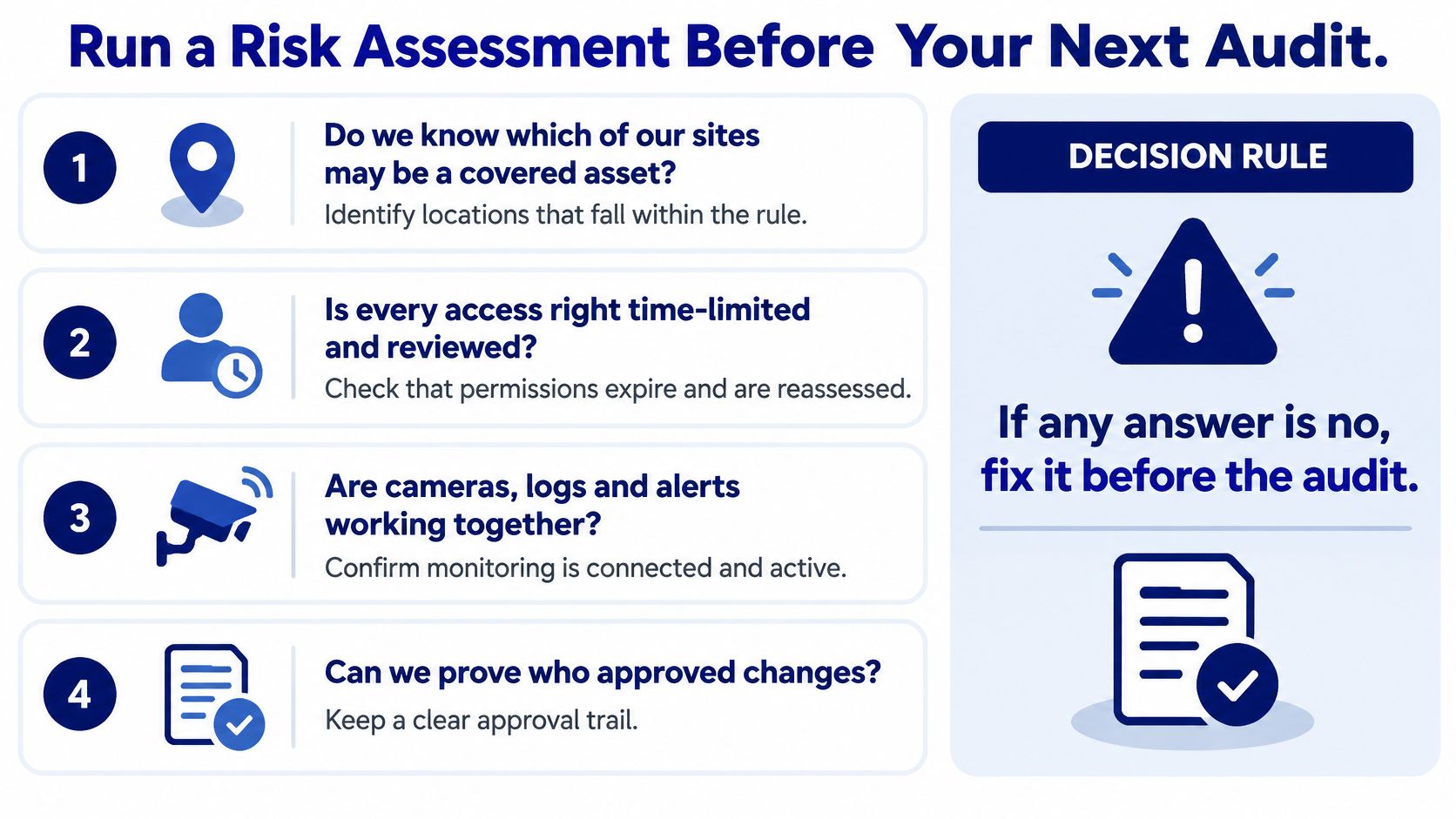
Assign owners before buying equipment
Give every failed check a named owner, corrective action and completion evidence. A security risk assessment template can help separate equipment defects from procedural gaps and unresolved legal questions.
As a practical triage rule, three or more failed checks justify an integrated review of guarding, electronic systems and reporting. A single high-consequence failure, such as an unmonitored critical alarm, may require immediate action regardless of the score.
For a Security Company Melbourne procurement, test local response arrangements rather than accepting a generic national coverage statement. In each city where the site or responders are located, confirm travel times, relief personnel and escalation coverage. Construction security may suit expansion works, while operating halls need an access and evidence model suited to live operations. Compare providers by their documented procedures and response capability, not guard numbers or camera counts.
ABCO Security Services Australia provides guarding, electronic security and monitoring for facilities that need coordinated protection of access, infrastructure and operations. To discuss a site-specific review, bring the access plan, alarm schedule and after-hours escalation procedure so the assessment can identify practical gaps.
about
avada factory
Sempery ultricies nibh at dolor cras urna eleifend nec. Atiam efficitur tempor.