
74.5% of students who experienced sexual assault did not seek help from their university, and one institution's records show how wide the blind spot gets: Griffith University logged 6 reports in 2021, while survey prevalence applied to its reported enrolment of 49,220 students pointed to an estimated 1,033 incidents, according to a submission to the Australian Government's End Rape on Campus inquiry. Records understate risk. That single fact should change how a campus buys security.
A guard on the front gate does nothing for a first-year living in a residential college, an open day crowd of 6,000, or an after-hours alarm in a lab nobody patrols. The job is visibility, response and documentation across every zone, and only then the headcount and hardware that make those three things happen.
Education sites aren't offices. They hold minors, identity records, residences that run overnight, and event calendars that concentrate thousands of people in one place. Security decisions sit beside child-safety duties, privacy law and emergency management. The programs that hold up run all of it as one system rather than four separate purchases.
Education Security Services at a Glance
Buy coverage by zone and hour, not by a generic guard count. A campus runs several risk profiles at once: public entries in the morning, residences after dark, event crowds on set dates, and empty labs or server rooms overnight. Each service below has a distinct job, and the value comes from how it feeds one response and one record.
| Service | What it covers | Typical education use |
|---|---|---|
| Static security guarding | Licensed officers at fixed posts, reception and lobby control | Main entries, reception, night security in administration buildings |
| Mobile patrols | Scheduled and random checks of grounds, car parks and buildings | Campus perimeter, car parks, after-hours checks |
| CCTV and alarm monitoring | Camera systems, alarm monitoring and escalation | Libraries, labs, sports facilities and unstaffed buildings |
| Access control | Card, key and visitor management for controlled areas | Residences, staff-only zones, server rooms |
| Event security | Crowd control, ID checks, wristbands and alcohol compliance | Open days, orientation, graduations, sporting events |
| Gatehouse security | Staffed vehicle and pedestrian entry control | Controlled campus entries and staff car parks |
| Construction security | After-hours guarding, gate management and temporary CCTV | New buildings and refurbishment works |
| Emergency response | Rapid response and documented escalation | Alarms, lockdown support and after-hours incidents |
A university with three residential colleges, a library open until midnight and a term-start open day usually needs most of that list. A standalone administration building that locks at 5pm may need monitored alarms and card access to the server room, and nothing more. The mix follows site layout, timetable and where the provider must produce records.
The strongest setups connect physical and digital response. An access-control alarm in a server room can be a facilities issue, an IT incident and a safeguarding record at the same time. Patrol attendance, camera review, welfare escalation and the duty manager handoff should land in the same incident log, with times and actions clear enough to audit later.
Two combinations come up constantly. Residences need after-hours patrols, controlled entry and a reporting channel students trust. Event days need visible staff, ID and wristband control, alcohol compliance and a documented incident route from the gate to the duty manager.
Buying rule: price the zones first, then services and officer numbers. Treat any figure before a site walk and an agreed officer count as an estimate.
Static guarding should cover fixed posts, concierge and reception duties and after-hours coverage where the timetable justifies it. ABCO Security Services Australia delivers the full range across Australia for schools, colleges and training facilities, including mobile patrols, gatehouse, event and construction security.
Threats That Shape Education Security Needs
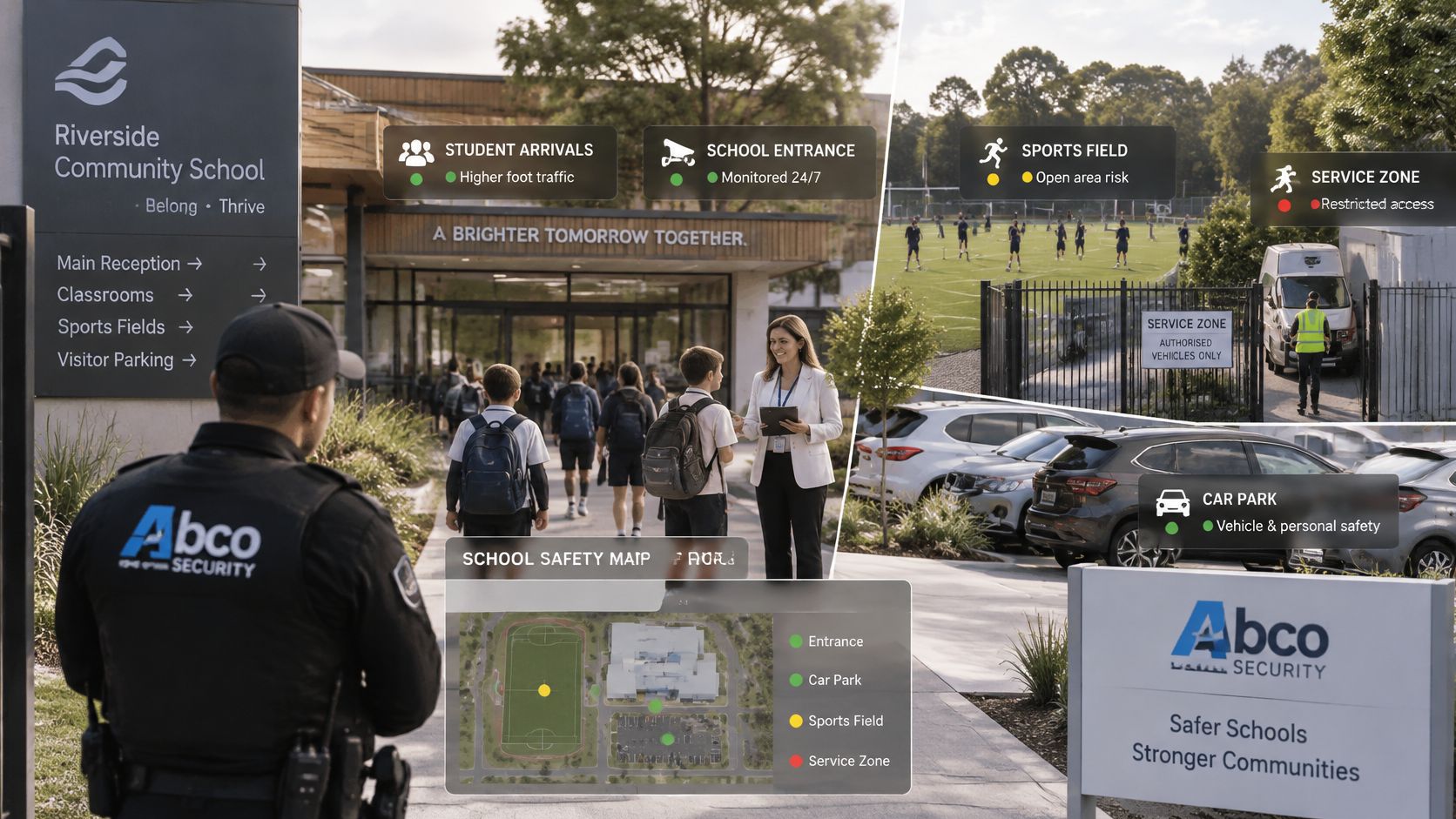
The scale is the first thing to hold in view. Australia's 2021 National Student Safety Survey found that 1.1% of the roughly 1.3 million university students experienced sexual assault in a university context during the preceding 12 months, an estimated 14,300 incidents a year, or about 275 a week. Risk concentrates where students live and gather: 16% of students living in student accommodation or residences reported sexual assault in a university context over the same period, against 0.8% of students living with parents, guardians, family or others. Campus clubs, societies and event spaces were where the most impactful incident happened for 25.8% of affected students, with student accommodation at 25.3% (National Student Safety Survey submission). The survey drew on 43,819 students with an 11.6% completion rate, so treat the numbers as an indicator of scale and location.
That ranking sets the order of work. Residences and event spaces come first, perimeter fencing much later. An assault in a residence is also a welfare emergency, so the response needs a documented escalation route into counselling and student support, with the guard's role written down in advance. The visitor process behind an open day matters as much as the officers on the gate, which is why school visitor management belongs in the security design rather than the front office.
For a school or training provider the threat list is broader. The recurring categories are:
- After-hours unauthorised access, often through doors propped for cleaners or contractors.
- Theft of IT, tools and copper cable from car parks, temporary buildings and stores.
- Aggressive behaviour from visitors and separated parents, which usually arrives at reception, not the perimeter.
- Alarms that fire for steam, wildlife or a loose door contact, wearing down response discipline.
- Contractor access during works, where the site layout changes weekly.
- Welfare incidents, from intoxication at events to a student in distress, where the right outcome is a handover to support staff.
- Emergencies, from bushfire and storm to lockdown.
Every item on that list produces records: incident reports, alarm logs, contractor sign-ins and escalation notes. A provider that cannot show you those records cannot show you the response either.
Raw incident totals mislead in both directions. Western Australian public schools recorded 1,327 lockdowns in 2025, including 1,103 attributed to threats of violence, according to reporting on state parliamentary data. Read any single-year figure as a register entry: classification rules and counting methods differ between jurisdictions and shift over time, so a higher headline total does not automatically mean more incidents on the ground.
Campuses also hold recorded material: lectures, induction modules, incident footage and training videos. Treat a leaked recording of a student or staff member as a welfare incident, and protect the library itself using encryption and DRM for training videos instead of relying on a login screen.
Five Steps to Assess Your Site Security Needs
Work through these in order. Skipping to step four is how campuses end up with cameras pointed at the wrong gate.
Map every zone. List buildings, residences, car parks, sports grounds, event spaces and building works, then mark each as public, controlled or staff-only. The map is what you'll price against, and it's the document that exposes a residence block with no controlled entry at all.
Review three years of incident records, including near misses, welfare concerns and after-hours alarms. Sort them into a fixed taxonomy so trends separate prevention failures from response failures. NSW government schools classify reportable incidents across violence, weapons, criminal activity, technology, drugs, welfare and emergencies such as bushfires, floods and severe storms, which is a workable model for a site register (NSW Education incident reports). Keep the categories stable, because a register that changes definitions every year tells you nothing.
Rate each risk by likelihood and consequence. Rare, severe events such as lockdowns, evacuations and a missing student still need a documented plan even when the register shows no recent occurrence. Before you price anything, check whether staff or student credentials are already circulating. A dark web monitoring risk assessment guide shows how to run that check without collecting more personal data than the site needs.
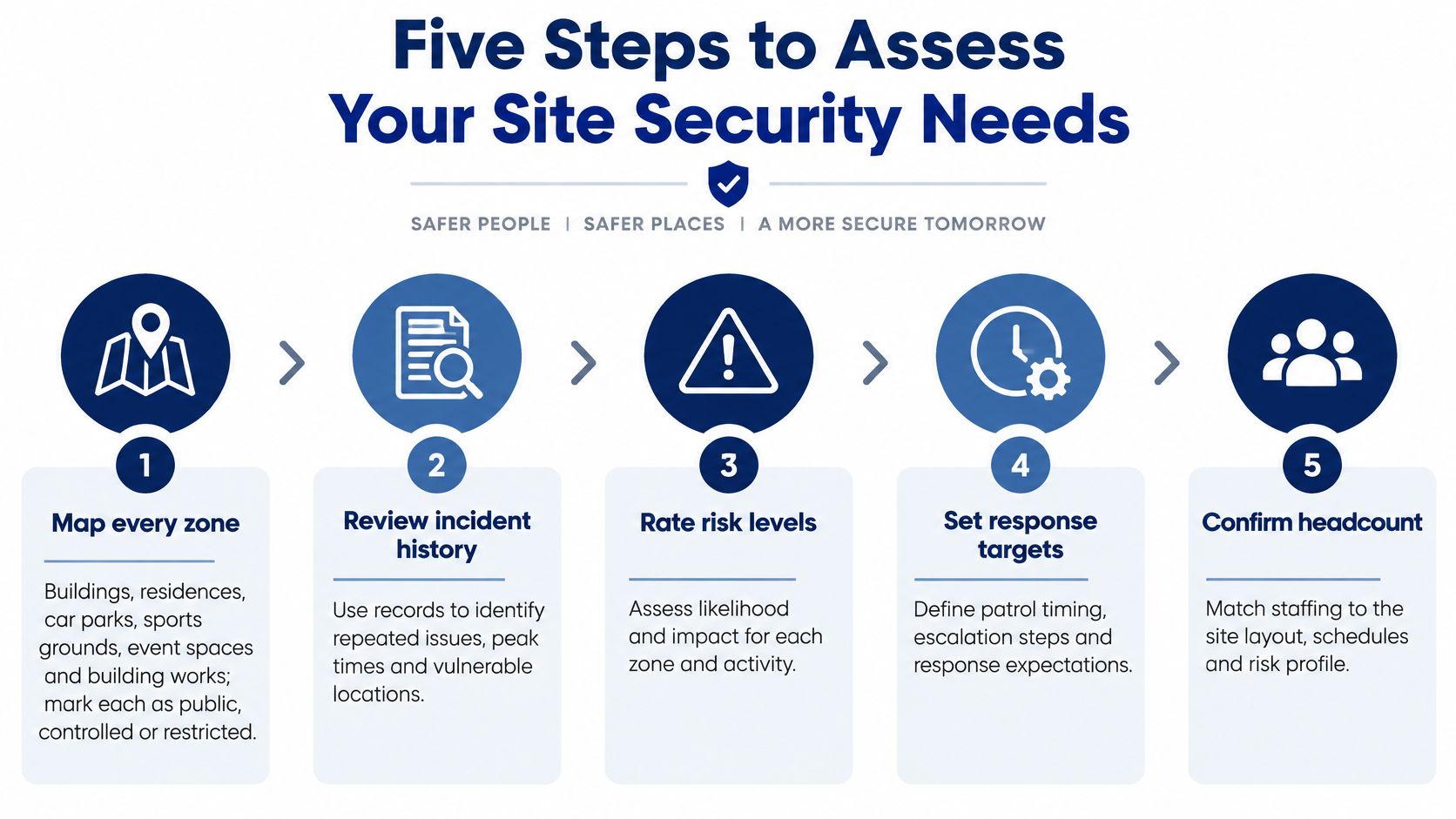
Match controls to zones, not to budget lines. A staffed post suits one busy entry. Patrols suit spread-out grounds and distant car parks. CCTV plus monitored alarms suit unstaffed buildings outside hours. Card access suits restricted rooms. Adding a second control to a zone that already has one is usually worth less than covering a zone with none.
Set response-time targets and operating hours, then confirm the headcount. Decide what "response" means for an alarm at 2am versus a radio call at 10am, and write the numbers down. Then count officers per post and per patrol, allowing for breaks, handover and leave. Our booking form asks for the number of security officers required for exactly this reason, and bringing that figure to the conversation saves a week of back and forth.
A worked example. A Melbourne university with three residences, a library and a term-start open day might land on overnight patrols across the residences, a staffed gatehouse from 6pm, and event security with ID checks and wristband control on open day. The incident records decide the rest, and a security risk assessment checklist keeps the scope comparable when you put it out to three providers.
Compliance Duties Education Providers Must Meet
Compliance isn't paperwork that sits behind the operation. It changes what an officer does at 8.15am on a Tuesday.
Child safety shapes the routine work
The Department of Education's Child Safe Policy states that staff must provide a safe environment for children and manage risks arising from day-to-day work, giving effect to the Commonwealth Child Safe Framework and the National Principles for Child Safe Organisations (Child Safe Policy). On site, that means privacy, appropriate conduct and controlled access, not just visible deterrence.
A gatehouse officer checking in a contractor uses the approved visitor process, directs the contractor to reception, avoids unnecessary contact with students and records the access event accurately. Patrol routes and camera views get defined permissions, escalation rules and record-handling requirements.
Incident records and how long to keep them
A critical-incident policy should name the action to be taken, immediate welfare arrangements, required follow-up, record retention and who gets notified, including police and parents (Standard 5 guidance for younger overseas students). For providers enrolling younger overseas students, records must be kept for at least two years after the student ceases to be an accepted student. That rule is scoped to those providers, so don't lift it as a general standard for a day school.
Escalation has a clock on it too. Schools are expected to make reasonable efforts to begin responding to reported bullying and other harmful behaviour within two school days of becoming aware of it, with an initial response that may include immediate safety action, wellbeing support, contact with parents or carers and referral to police (National Framework for Addressing Bullying in Australian Schools). Urgent threats need immediate protective action; the two-day figure is the administrative floor, not the target for a weapon on site.
Licensing sits underneath all of it. Every officer on site holds a current licence under the relevant state or territory regulations, and checks sit with the regulator that issued it. All ABCO security guards are fully licensed under relevant Australian state regulations and receive ongoing training in conflict resolution, first aid, OH&S, customer service and emergency response. ASIAL is the industry body worth naming in a tender, and workplace health and safety is our number one operational priority.
Any patrol or camera arrangement needs defined access permissions and record-handling rules, and the CCTV laws in Australia overview is where to check signage, retention and footage-release requirements before a camera goes up.
Records to request from any provider: licence register, training matrix, incident report template, retention schedule, and the rules covering who can view CCTV footage and visitor logs.
Note one boundary. The Department of Education policy binds departmental settings, so independent, Catholic and university providers should map the same National Principles for Child Safe Organisations onto their own policies and evidence the mapping.
Joining Physical and Cyber Incident Response
A delayed patch becomes a safeguarding incident. Victoria's student-information breach happened when an attacker exploited a critical vulnerability after patching was delayed, and the state privacy investigation found inadequate departmental guidance for planning and preparing for a major cyber incident (iTnews report).
An access-control system is a database with a door attached. Compromise the account that manages the cardholder list and gates can be opened, permissions rewritten, or the entry record itself corrupted. Nobody has to climb a fence. Most security plans never answer the operational question that follows: who disables the credentials, who changes the permissions, who protects a vulnerable student named in the exposed file, who preserves the evidence, who notifies families, and who keeps the site safe to teach in on Monday.
Practical rule: if a cyber alert can change who gets through a door, it belongs in the security operations log, not only in the IT queue.
Three elements hold a joint response together. One incident command structure with named roles for IT, facilities, leadership and the security provider. Escalation thresholds that move an alert from an IT ticket to a physical response without a meeting. Exercises that test ransomware and on-campus disruption in the same session, because the second is how you discover the first.
The digital and physical sides should share a picture. CCTV integrated with a mobile patrol network and remote viewing lets a supervisor see what the alarm refers to before an officer is dispatched, and lets an officer on the ground confirm what the camera can't reach. Electronic security work covers surveillance, access control, video analytics and remote viewing as one build for that reason.
An NSW Audit Office review recorded 517 cybersecurity incidents during its audit period, of which 31 met the department's threshold for a data breach and were referred to Legal Services (Security and Privacy of Student Information). That's an observed referral proportion of about 6.0% inside one department and one period, not a sector-wide probability. The controls it points to are ordinary: vendor risk assessments, least-privilege administration, multifactor authentication, encrypted transmission, retention limits, audit logs and a tested breach workflow. Apply them to the camera platform and visitor system, not only the student database.
| Incident | First action | Lead role |
|---|---|---|
| Compromised staff account | Disable credentials, review access permissions, preserve logs | IT lead with security supervisor |
| Access system fault or tampered door controller | Switch approved entries to manual control and patrol the gaps | Facilities manager with security supervisor |
| Student data breach | Preserve evidence, secure records, brief leadership, notify as policy requires | Privacy officer with incident commander |
| Credible threat to students or staff | Protective action, lockdown under the plan, call emergency services | Principal or site leader |
| Ransomware affecting communications | Activate backup communications and confirm safety of people on site | Incident commander |
| Unauthorised person on site | Confirm identity, separate the person, file a time-stamped report, call police if needed | Security supervisor |
An incident response plan is the document that table lives inside. How to build an incident response plan covers the structure; the education version adds something most templates miss, which is a line for what the security supervisor does at each threshold. Rehearse it alongside your lockdown procedures for schools, so a credential alert and a physical lockdown get tested in the same hour.
Before the next exercise, name one owner for each row. Not a team. A person, with a mobile number.
Choosing a Provider and Reading the Contract
Compare providers against a written list, and score the answers rather than the sales meeting.
- Licensing and training. Ask for the officer register and spot-check two names against the state regulator's public register. Weak answer: "all our staff are fully licensed" with no names attached.
- Education references. Ask for two schools, colleges or universities of similar size and one that runs residences. Generic commercial references tell you nothing about a 3pm parent dispute.
- Sample incident report and escalation procedure. You're testing whether the report is time-stamped, categorised and readable by a duty manager at 2am.
- Written procedures against your structure. The national framework expects policies and processes to be visible, transparent and accessible, with clear instructions for reporting, escalation steps and available support (National Framework for Addressing Bullying in Australian Schools). Ask who authorises a lockdown, which staff member receives a patrol officer's report, how visitor access is suspended, and when police are called. If a provider can't describe their place in that chain, they'll improvise on the day.
- Coverage and response. Confirm operating hours, patrol frequency, the alarm escalation ladder and the realistic travel time to your worst-located campus.
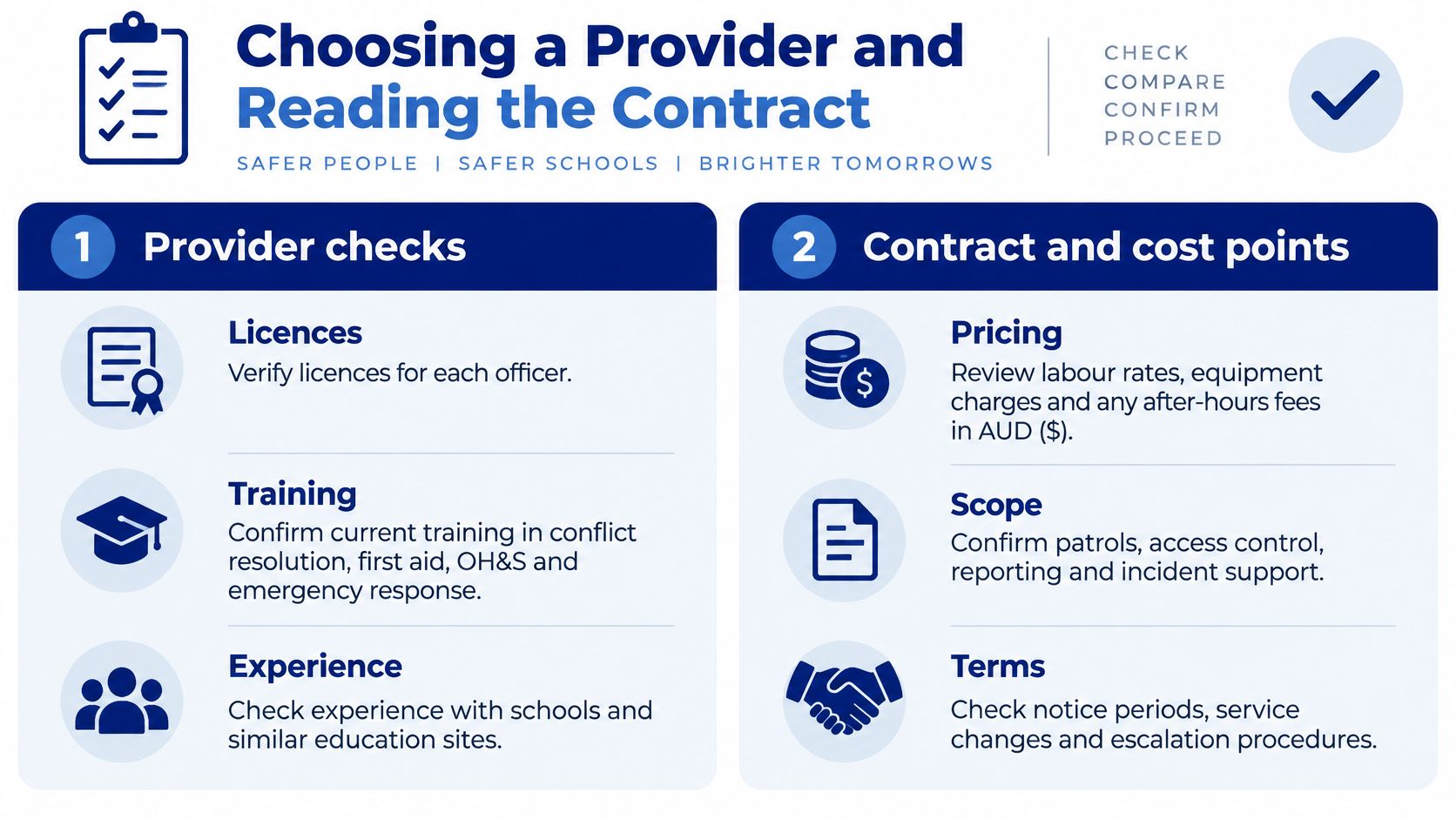
Cost needs the same discipline. Expect estimates, not binding quotes; we provide estimates only, and every amount stated or written is exclusive of GST, so add 10% before comparing. Compare at least three estimates built on identical scope, expressed as officers, hours and posts. Ask for itemised rates across event work, after-hours loading, monitoring and patrol fees, equipment, and add-ons such as parking and traffic management. A single lump sum hides which service was never priced.
Event staffing deserves its own line. Our event security officers are RSA-qualified and crowd-control-licensed, and that combination is what allows one team to manage entry, ID verification, wristbands, alcohol compliance and incident reporting without splitting the brief.
Then read the contract. Term length, notice period, exit terms, insurance and liability limits, and how CCTV footage and visitor records are stored, shared and destroyed. The security service contract terms page shows how those clauses read in practice, so you know what to ask about before signing. Our services are delivered with the duty of care and skill reasonably expected of a professional security provider, following commonly accepted industry practice, and that clause should be legible in any contract you sign.
The lowest estimate isn't the cheapest service when the scope is missing three zones.
Book a Site Security Review Before Your Next Term
Seven weeks is enough time to review a site properly, provided the work runs in order.
- Weeks 1 and 2. Map zones and pull the last three years of incident records.
- Weeks 3 and 4. Rate risks, set response-time targets and confirm the officer headcount.
- Weeks 5 and 6. Request estimates on the same scope and check licences, insurance and references.
- Week 7. Approve the incident command structure and escalation matrix, with one named owner per incident type and welfare and cyber incidents sitting on the same matrix as physical alarms.
- Before term starts. Run a lockdown exercise and a cyber-physical scenario with IT and leadership in the same room.
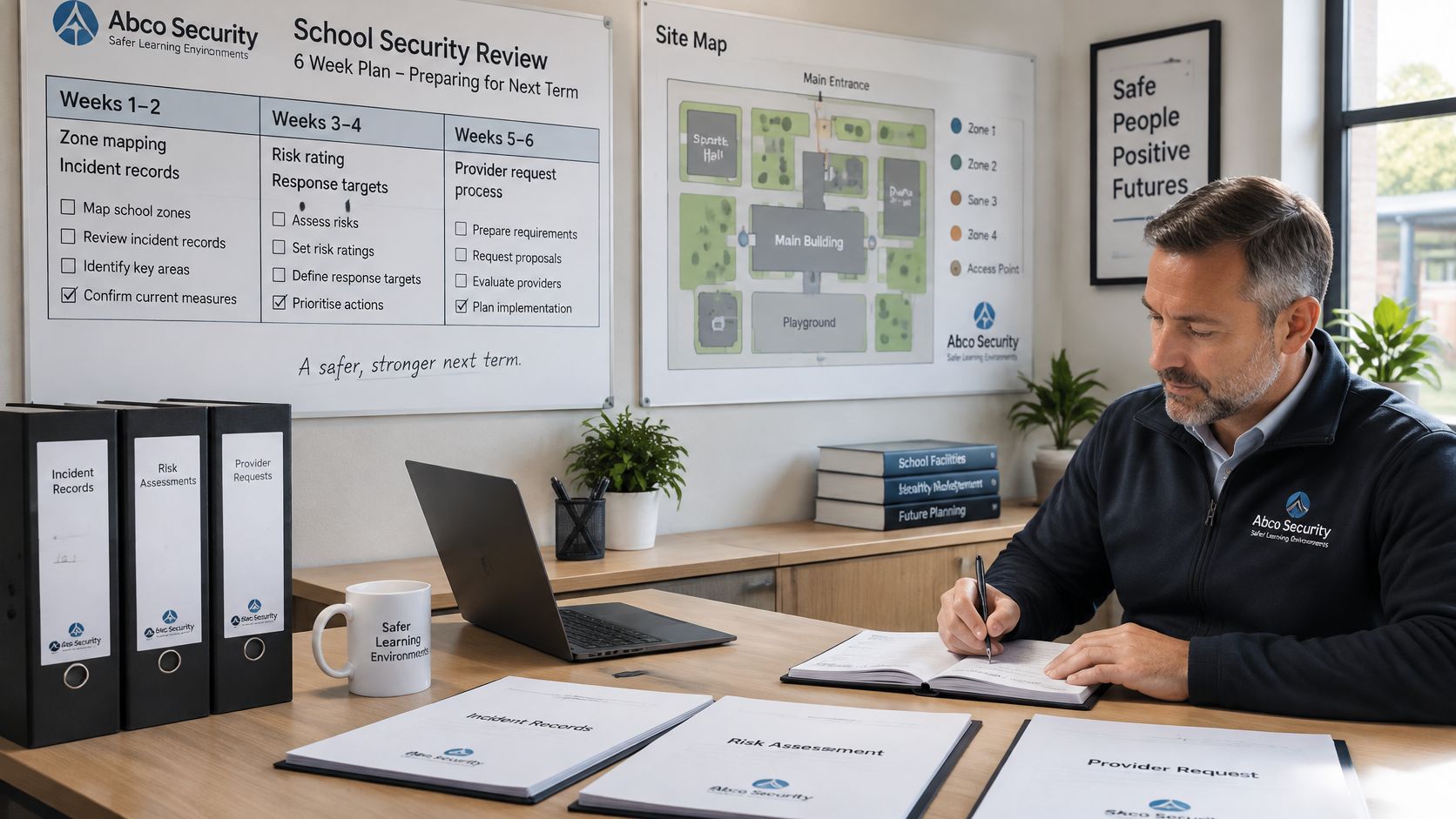
A review built this way treats guarding as one layer of the response. The zone map that positions officers and cameras should also show who takes a welfare escalation at 2 a.m. and where a network outage and a forced-door alarm land in the same incident log. That record is what leadership, insurers and auditors ask for after the fact. Start this week by pulling the incident register and marking residences and event spaces on the site map.
ABCO Security Services Australia runs 24/7 security operations across Australia and brings more than 15 years of industry experience to a review like this. Expect a written estimate rather than a fixed quotation, and expect the booking process to ask how many officers your site requires.
ABCO Security Services Australia provides licensed guarding, mobile patrols, gatehouse, event and construction security, plus monitored CCTV and access control, for schools, colleges, TAFEs and student housing across Melbourne, Sydney, Brisbane, Adelaide, Perth and surrounding regions. The team can review your zones against your incident records and recommend a mix that fits the timetable and the budget, with after-hours coverage delivered through mobile patrols backed by CCTV monitoring. Request a site security review by visiting ABCO Security Services Australia.
about
avada factory
Sempery ultricies nibh at dolor cras urna eleifend nec. Atiam efficitur tempor.