The most repeated advice in home security is also the least accurate: buy an alarm that calls the police, and police will come. In Australia, no residential panel dials a police station. It signals a monitoring centre, an operator reads the event, and a person decides whether it justifies asking for officers.
That gap between what a system is sold as and what it does matters more than any app feature. A home security system that calls police is really a notification chain with a verification step in the middle, and every link in that chain can break.
The rules also change at the state border. Victoria runs a formal authorisation process, Queensland police don't monitor alarms at all, and false activations carry real costs in commercial and strata buildings. Getting this right is an operational decision, not a shopping decision.
How a Home Alarm Reaches the Police
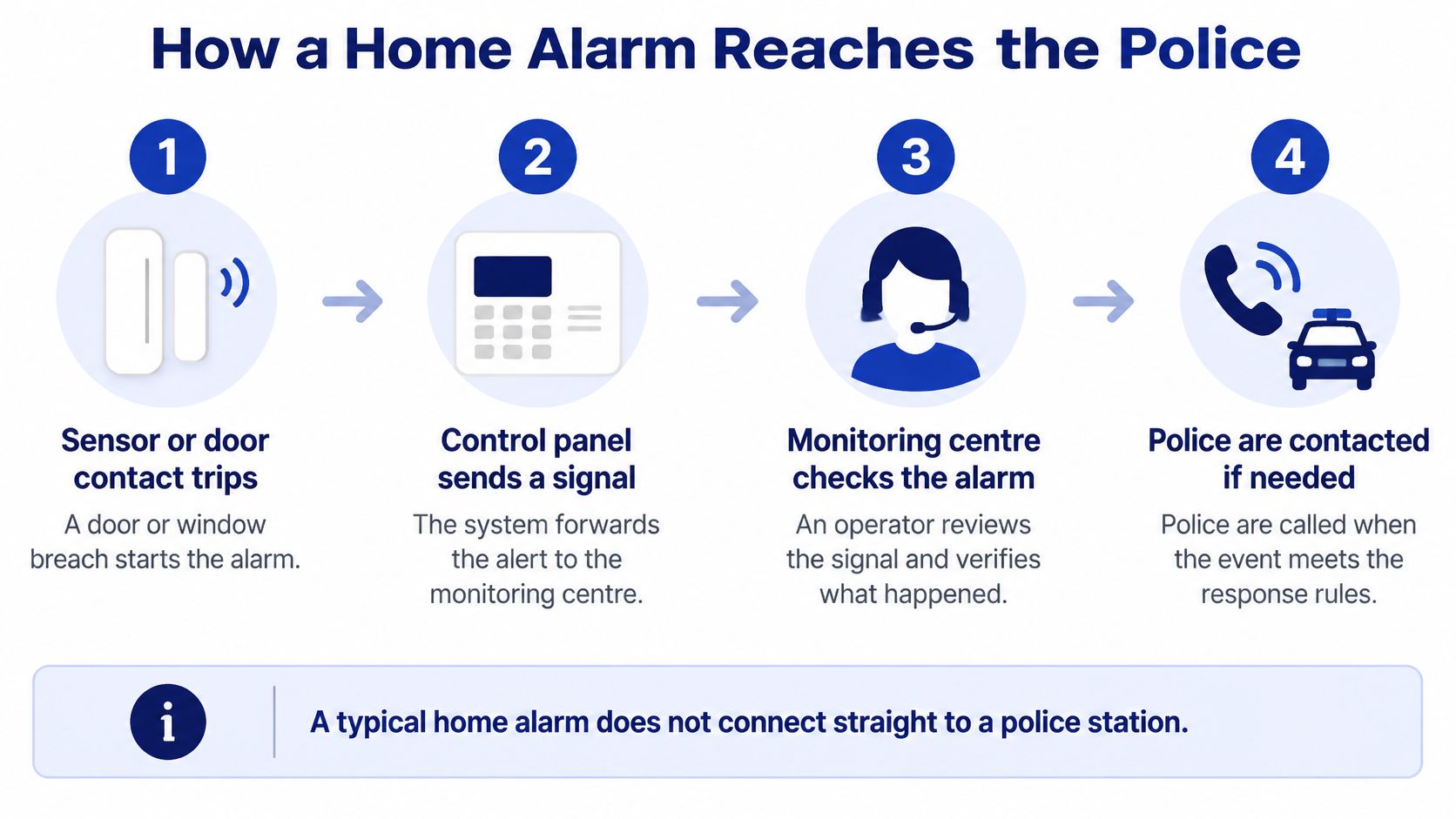
A residential alarm doesn't connect to a police station. It signals a monitoring centre, and the centre decides whether police are involved. Tasmania Police documents this architecture in its residential burglary prevention booklet, noting that monitored back-to-base systems can produce faster responses because the monitoring company is alerted the moment the panel trips, rather than waiting for a resident or neighbour to interpret a siren.
The chain runs in a fixed order:
- A sensor trips. A door contact, passive infrared detector or glass-break sensor registers an event, and the control panel starts its entry sequence.
- The panel signals out. The alert travels over a phone line, internet connection or cellular link. Dual-path systems send it two ways at once.
- An operator opens an incident log. The centre records the zone, time and account, then compares the event against what the site should be doing at that hour.
- Verification happens. Where cameras or two-way audio cover the zone, the operator looks or listens before escalating. Where they don't, the operator works from panel data and calls the nominated keyholder.
- Police are contacted only if the event meets that state's criteria. The operator calls Triple Zero with account details and whatever authorisation the jurisdiction requires.
- Police decide attendance. Officers assign the job by priority, which is why a verified break and an unverified siren get different treatment.
A worked example makes the value of step four obvious. A back door contact trips at 2am. The camera covering that door shows a cat on the step. The operator closes the event with a note, logs the clip and doesn't wake the keyholder. Without that camera and that decision, the same activation becomes a 2am phone call, a tired drive across town, or a police request for an animal.
The distinction between monitored and self-monitored alarms sits exactly here, in who reviews the signal and what they're authorised to do next. A self-monitoring app notifies you. A monitored system notifies a trained third party with a procedure to follow.
Practical rule: before you choose hardware, write down three names. Who verifies the event, who calls police, and who attends the property safely.
If you can't answer all three in writing, the system isn't finished.
Police Response Rules in Each State
Police attendance sits with the state, so the useful question is who may request officers, what evidence they need, and which failures rule a job out before Triple Zero is dialled.
| State | Who Receives the Signal | Police Role | What to Confirm |
|---|---|---|---|
| Victoria | Licensed, graded monitoring company holding a current Alpha Code | Police may attend eligible Category A alarms after the monitoring company calls Triple Zero | Outage check, dedicated duress button for Category A, current Alpha Code |
| Queensland | Private monitoring centre or nominated contacts | QPS does not monitor alarms, so activation alone creates no automatic dispatch | Who verifies, who calls police, current contact details |
| Tasmania | Monitoring company or nominated contacts | Escalation follows the documented response criteria for that account | Dual-path communications, battery backup, written escalation order |
| New South Wales | Private monitoring centre or nominated contacts | Attendance is a priority decision rather than an automatic result of activation | Dispatch criteria with NSW Police, plus the provider's NSW licence and registration |
Victoria's Alpha Code
Victoria has the most defined process in the country. Victoria Police Alpha Code guidance makes the request channel narrow: only a licensed and graded monitoring company holding a current Alpha Code may seek police assistance for eligible Category A alarms. That group covers holdup alarms, fixed duress alarms, high-risk-premises alarms, and multi-sector or multi-break alarms. The operator decides police help is required, calls Triple Zero, supplies the code, then leaves deployment to police.
Two details trip people up. Category A duress alarms require a dedicated duress button installed at the premises, so a panic feature on a phone app is not the same thing. The monitoring company must also check whether a power, telephone or broadband outage caused the activation before calling Triple Zero, because alarms attributable solely to those failures fall outside the response path.
Queensland declines the dispatch role
Queensland runs a different model. Queensland Police alarm-monitoring policy is blunt: QPS does not monitor electronic security alarms. A residential activation therefore goes to a private monitoring centre or to nominated contacts, with no automatic police dispatch built into the signal itself.
That changes what a Brisbane household is buying: professional assessment and a phone call, not a guaranteed officer at the gate. Keep contact details current, train every authorised user, test on the provider's schedule, and use two-zone activation or CCTV where the risk justifies it. In strata and commercial sites, put that authority in writing before an activation, because a committee that cannot name its verifying party usually assigns the cost and the blame only after repeated attendances.
Tasmania and New South Wales leave less in public
Tasmania and New South Wales give buyers less consolidated public criteria than Victoria, so the monitoring centre's documented escalation becomes the operative rulebook. For Tasmania, ask how the account reaches an operator during power or broadband failure: dual-path signalling and battery backup decide whether an event is assessed at all. For New South Wales, confirm attendance criteria directly with NSW Police, ask the provider for its NSW licence details, and check them against the state regulator's register. The written question stays the same across both: which alarm categories will your operators escalate to police, and on what evidence?
Why Police Limit Response to False Alarms
Police restrict attendance because unverified activations consume officer time that other emergencies need. The scale of the problem in Australia is documented, and it's old enough to be structural rather than seasonal.
A Victorian metropolitan survey run from 18 to 24 March 1984 recorded 776 silent-alarm calls. Only 20, or 2.6%, were genuine, while 756, or 97.4%, were false, according to an Australian Institute of Criminology seminar paper. Those calls committed 1,001 attending units, 1,963 police personnel, 5,534 person-hours and 5,557 kilometres of travel. The same paper records that Victoria Police's Communications Section received about 40,000 alarm activations in 1983, rising to about 47,000 by 1987.
The dates are historical. The behaviour isn't. A street with one badly placed sensor that trips three times in a month produces exactly this ledger: officers pulled off patrol, a keyholder woken three times, and neighbours who stop looking out the window when the siren sounds again.
Frequent false alarms don't just waste police time. They train everyone nearby to ignore the alarm, which is the opposite of what a security system is for.
Two forces keep the pattern alive. Equipment ages, and detectors in airflow, near curtains or facing a window collect heat and light that look like movement. Installation quality matters as much as the panel: a sensor aimed at a corridor of afternoon sun will trigger on schedule every sunny day.
Verification, maintenance and correct installation aren't administrative extras. They protect the response capacity that genuine emergencies depend on, which is why the jurisdictions that restrict attendance also spell out what a monitoring company must check first.
Causes of False Dispatches and How to Cut Them
Almost every false dispatch traces back to a short, well-documented list. Victoria Police's guidance on alarm responses names the recurring causes: pets, insects, power events, telecommunications failures, poor installation, storms, maintenance problems, unsuitable or ageing equipment, sensor obstruction, airflow and user error. Each cause fails differently, so each one needs a different fix.
| Cause | How It Shows Up | Fix |
|---|---|---|
| Pets, insects or airflow | Repeat triggers in the same zone, often overnight | Reposition detectors, fit pet-immune sensors, add camera verification |
| Power or telecommunications failure | Alarm and monitoring link drop at the same moment | Battery backup, dual-path signalling, confirm the outage before escalation |
| User error | Entry without disarming, wrong codes, users missing from the call list | Train every authorised user, test codes, review contacts quarterly |
| Poor detector placement or obstruction | A blocked lens or a detector covering movement it should ignore | Re-aim or relocate sensors, clear obstructions, re-walk the coverage map |
| Faulty or ageing equipment | Random faults, low-battery warnings, tamper alerts | Scheduled servicing and planned replacement before devices fail |
| Storms and environmental conditions | Triggers clustered around weather events | Check seals and detection range, retest after every major storm |
Three measures that cut wasted dispatches
Two-zone confirmation requires a second sensor to agree before the panel escalates. A single motion trigger in a hallway is logged. A motion trigger plus a door contact becomes a dispatch. The delay is measured in seconds, a fair price on a site that already generates nuisance calls.
Video verification gives the operator something to look at. A camera covering the trigger zone turns a guess into a decision, and it shortens the call to police because the operator can describe what is happening rather than report a zone number. On smaller premises, a door camera often carries most of that verification load; browse ranked video doorbells to compare the market before you buy.
A servicing schedule with records catches the slow failures: a detector losing sensitivity, a backup battery that no longer holds charge, a communicator that drops out under load. Keep the test log. It is the first document an insurer or a police liaison officer asks for after a disputed activation.
Split the list by who can act on it. Verification problems sit with the monitoring centre: confirming an outage, checking a camera feed, calling the premises before dispatch. Equipment and user problems sit with the owner, and they scale with headcount. On a strata building or commercial site, every cleaner, tenant and contractor holding a code is another entry in the user-error column, which is why the cause list grows faster than the alarm budget.
A living-room motion sensor that the household cat crosses at night can generate three or four activations a week. Moving the detector above pet height and pairing the zone with a camera removes most of those events while keeping the room covered. The fix was cheap: reposition one detector, add one camera.
No measure removes every false alarm. The practical target is fewer wasted dispatches and a genuine activation that still carries weight with the operator and, if it reaches them, with police. Our false alarm reduction service follows the same sequence: audit the last six months of events, sort each one by cause, and fix the top two causes before touching anything else.
Responsibilities for Strata and Commercial Sites
The decision that has to be made before anything else is who responds. Frequent false alarms teach neighbours and staff to treat genuine activations as background noise, and an employee or volunteer who attends alone can end up confronting an intruder. Decide in advance whether a professional monitoring firm handles attendance or nominated keyholders do, and write a risk-management plan covering that choice when no security firm is engaged.
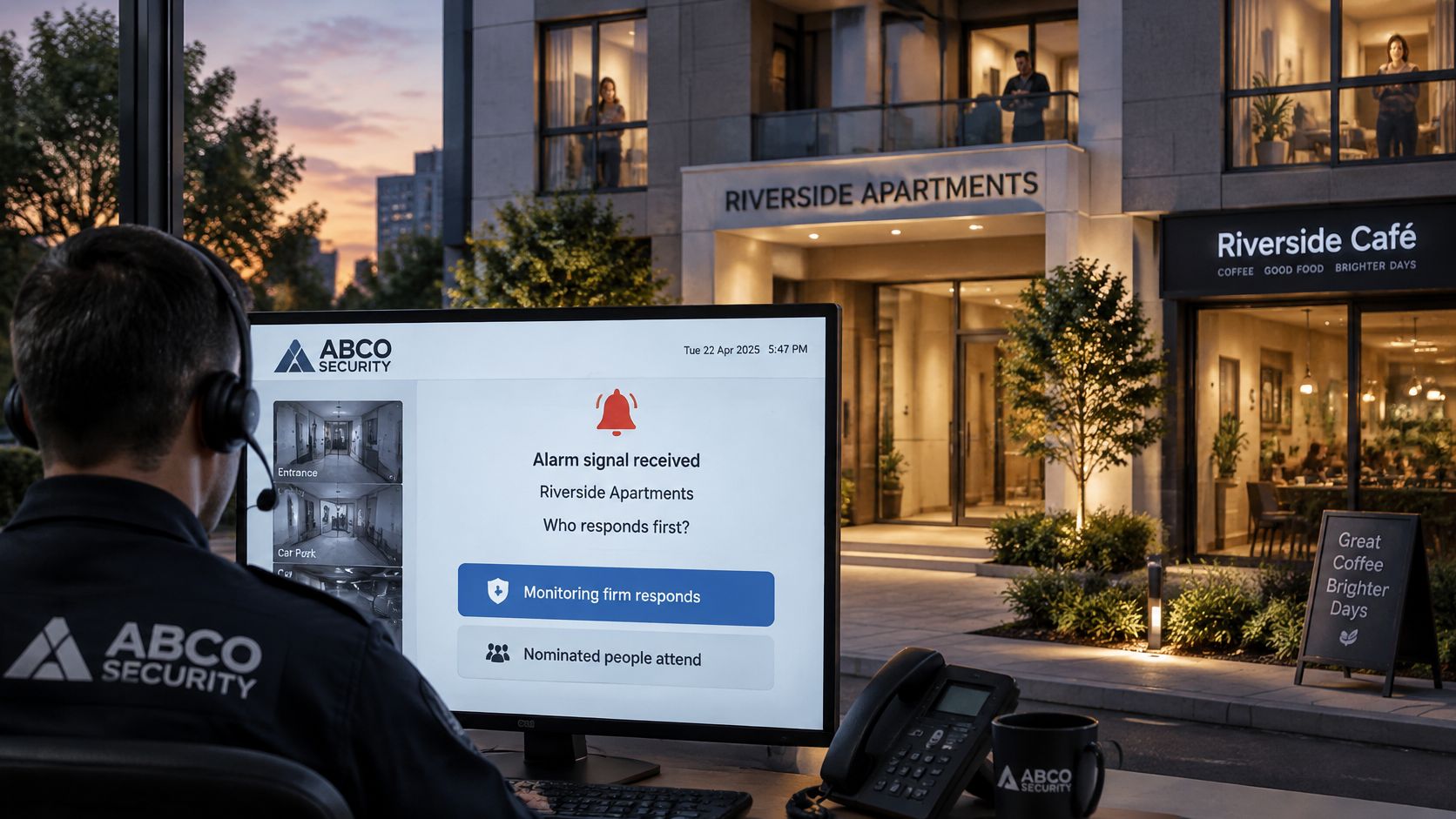
The written plan records an ordered keyholder list, access instructions, vulnerable occupants, pets, alarm zones, gate codes and emergency contacts. A responder who arrives without a gate code or a zone map loses the first ten minutes of every attendance, and on a commercial site ten minutes decides whether an intruder is still inside.
What a missed plan costs
Costs stack quickly on commercial premises. Fire Rescue Victoria's false alarms guidance sets a charge of $675 per truck per 15 minutes for preventable false-alarm attendance in the 2026-27 financial year, with cooking, steam and smoking among the common triggers. NSW separately limits how long a building intruder alarm may sound, with penalties that grow the longer it keeps ringing.
Those charges land on an owners corporation or a facilities budget, not on the installer who positioned the detector. Establishing who pays for strata building security before a nuisance-alarm pattern develops saves an argument later, because the levy notice is a poor time to discover the response plan was never written.
An after-hours activation at a shopping centre shows the plan working. Gatehouse staff verify the zone on camera, confirm a cleaner is inside the tenancy, and close the event. Nobody drives to the site, and the next genuine break gets a faster response because the centre's false-alarm history is clean.
That verification step only exists because someone wrote it into the plan. On strata and commercial sites, the owners corporation or facilities manager owns the document: updating the keyholder list when tenancies change, reviewing it after every activation, and reconciling the callout log against the invoices that arrive. A plan nobody maintains is a plan nobody follows.
Mobile Patrols and Concierge Response
Police dispatch is one of three response paths, and it is not the right one for every activation. Set them side by side.
Police attendance applies to Category A events in states that define them, and it depends on the monitoring company's authorisation and the evidence behind the call. Monitored response with a keyholder covers routine alarms: the operator calls the person on the list, and that person decides whether to attend. Mobile patrols and staffed positions put a licensed officer or a building staff member on site instead, on a contracted fee rather than a place in a police priority queue.
- Mobile Patrols: a marked, GPS-tracked vehicle attends, verifies the alarm, checks doors and windows, secures the site and files an incident report with photo evidence. Patrol runs can also cover locking routines and random perimeter checks between alarms.
- Concierge and reception coverage: a staffed desk combines access control with client service in office towers, corporate parks and apartment buildings, giving after-hours alarms a human verifier already on site.
ABCO Security Services Australia provides Mobile Patrols and corporate concierge and reception coverage, with offices in Melbourne, Sydney, Adelaide, Perth and Brisbane. Its patrol units run 24/7 in GPS-logged vehicles that record every site visit, and the comparison of mobile patrols and static guards sets out when each option suits after-hours coverage. Patrols serve residential areas, commercial sites, construction zones, industrial estates and retail precincts on the same model.
A Perth townhouse complex shows the distinction in practice. Repeated gate sensor triggers were sending the same alert to the same keyholder every week. A patrol now checks the perimeter within minutes, resets the gate and logs the cause. Police requests stay reserved for events that look like a break-in, the site's alarm history stays clean, and the owners corporation holds a written record of every trigger rather than a string of unanswered call-outs.
Weigh the three paths against your own risk. Police attendance is the narrowest and most conditional. A patrol is broader, contracted and costed. A keyholder costs nothing until the night it matters.
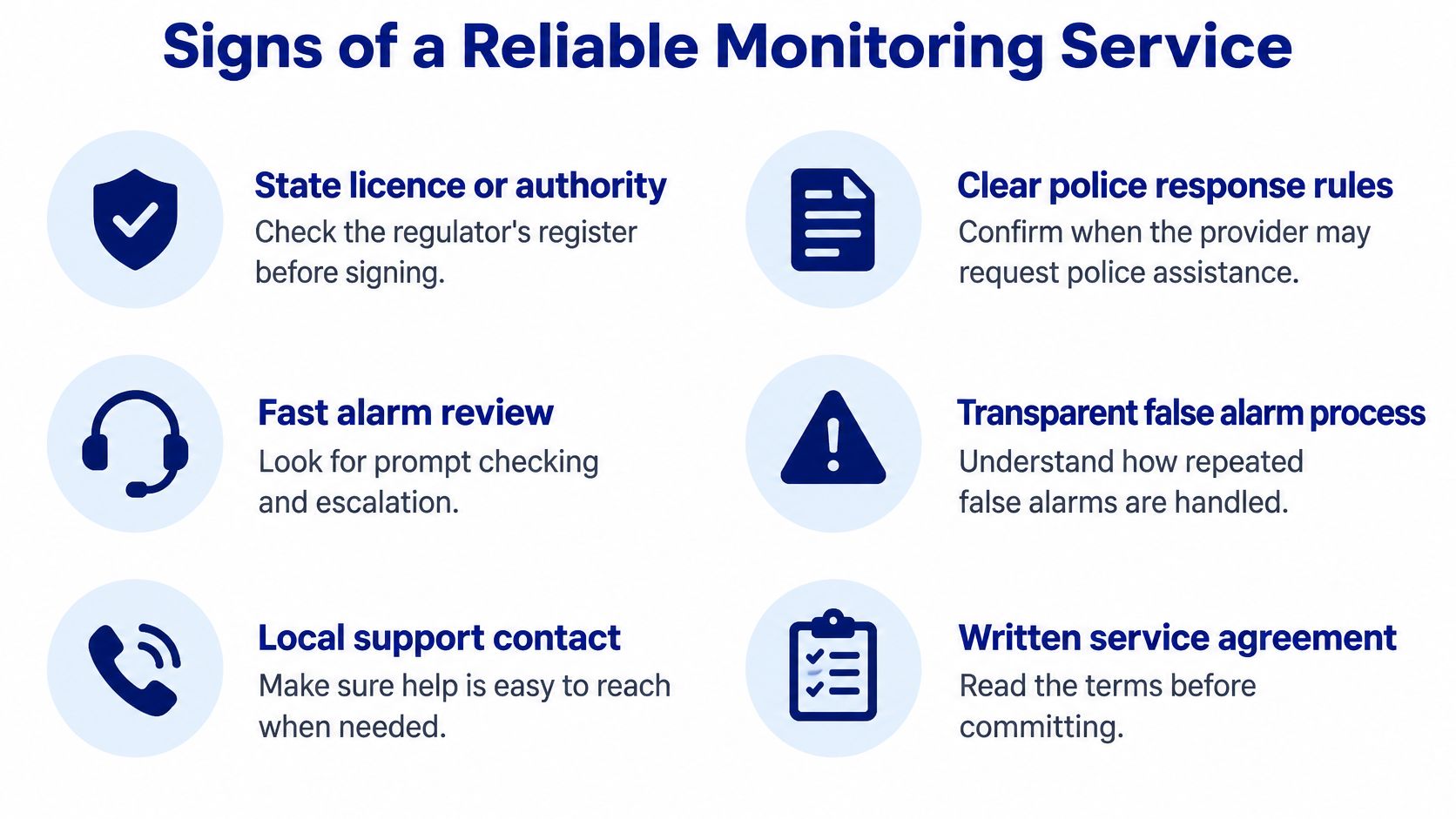
Signs of a Reliable Monitoring Service
Use this checklist before signing or renewing, and verify rather than accept assurances.
- A state licence or authority to request police assistance. In Victoria that means checking Alpha Code status on the regulator's register.
- 24/7 staffed monitoring with a written escalation procedure. Ask for the document, not a verbal summary.
- Verification before dispatch. Video, two-way audio or multi-sensor confirmation should be available and switched on.
- Outage detection and battery backup. The system should know the difference between a break-in and a blackout.
- Dual-path communications where the site supports it, so one cut cable doesn't silence the account.
- A 24-hour channel between site supervisors, officers and the operations centre. ABCO maintains 24-hour communication channels between site supervisors, security officers and its operations centre, which is the standard to ask any provider to match.
- Real-time reporting and digital incident logs showing who acted and when. ABCO uses real-time reporting tools, patrol tracking systems and digital incident logs to keep guard accountability visible.
- Testing and maintenance records covering detectors, batteries and communications.
- A current keyholder list, reviewed quarterly rather than at renewal.
How to test each item
Ask for last quarter's incident log and check that every false alarm is recorded with a cause and the fix applied. Ask for the escalation procedure in writing and read the part about who authorises a police request. Ask for the licence number and look it up yourself.
Installation alone tells you very little. An Australian Bureau of Statistics survey found that an estimated 216,000 Western Australian households, or 27%, had a security alarm installed, and among those with an alarm, 52% used monitoring by a security company or telephone-modem system while 43% had an unmonitored alarm, according to the ABS household security data. A siren on the wall is not a monitored system.
ASIAL, the Australian Security Industry Association Limited, publishes industry guidance on licensing and standards and is a useful reference when you're assessing a provider's claims. ISO 9001 certification shows process discipline but doesn't replace any of the nine checks above.
Pricing deserves the same scrutiny. Our alarm monitoring cost breakdown explains what sits inside a monthly fee and what gets billed separately, which is the question a per-visit pricing model never answers well.
Confirm Your Response Plan Before You Buy
Close the loop before you commit to hardware or renew a contract. Four steps, in order.
- List every event that should reach police and map each one to the response category your state assigns to it.
- Name the verifier, the caller and the attendee. If the attendee is an untrained staff member, replace that role with a contracted patrol or guard response.
- Lock in the keyholder order and access details, including gate codes, pets, vulnerable occupants and zone maps.
- Pressure-test the written escalation procedure against the nine-point checklist and keep a copy with the contract.
The sequence matters because police attendance sits at the end of a chain, and every weak link ahead of it slows or breaks the response. In states where repeated false alarms lead to deprioritised or refused dispatch, each unverified call-out also erodes the priority your premises hold.
Keep the limit in view. Security services are a deterrent and cannot guarantee the prevention of all theft, loss or damage, and no monitoring arrangement changes that. A good plan ensures the events that matter get a credible, fast, verified response.
Our Night Owl plan covers homes from $167.25 per month, with unlimited 24/7 CCTV monitoring, patrol response, property securing checks and emergency call-outs, and no per-visit billing. Designed for homes and small businesses 365 nights a year, it is still worth confirming pricing and inclusions at quote so the scope matches your site.
For a site-specific review, ABCO's team in Melbourne, Sydney, Brisbane, Adelaide and Perth can walk the property, test the zones and write the escalation plan with you.
ABCO Security Services Australia builds alarm response around a written escalation plan, combining monitored alarms, video verification, mobile patrols and Night Owl home coverage with 24/7 monitoring and digital incident logs. The team works across strata, retail, construction, event and commercial sites, with offices in Melbourne, Sydney, Adelaide, Perth and Brisbane. Visit ABCO Security Services Australia to have your current response plan reviewed before your next renewal.
about
avada factory
Sempery ultricies nibh at dolor cras urna eleifend nec. Atiam efficitur tempor.