Professional alarm monitoring costs about AUD 30 to 60 a month for homes and AUD 60 to 90 a month for commercial sites, according to the Castle Security pricing guide. Treat that subscription as the first line of the budget. Hardware, maintenance, false-alarm charges and patrol attendance can add to the total, so compare what each service does when an alarm is triggered.
Recorded theft figures have risen, making monitoring worth considering for sites where an alarm needs a response. A siren alerts people nearby, while a monitored service can contact nominated people, check available footage or arrange a patrol. The monthly fee matters, but so does knowing who acts next.
Alarm Monitoring Cost Ranges for 2026
Commercial monitoring typically costs AUD 60 to 90 per month, or AUD 720 to 1,080 per year, before installation and incident-related charges, according to the Castle Security pricing guide. The same guide places residential monitoring at AUD 30 to 60 per month, annual maintenance at AUD 150 to 300, and alarm response call-outs at AUD 50 to 180 per attendance.
Australian Alarm Monitoring Cost Bands for 2026
| Arrangement | Monthly fee (AUD) | Annual subscription (AUD) | Usually extra |
|---|---|---|---|
| Self monitoring | 0 subscription | 0 | Communicator, SIM or data, cloud features, equipment |
| Residential professional monitoring | 30 to 60 | 360 to 720 | Hardware often 350 to 1,200 or more; maintenance |
| Commercial professional monitoring | 60 to 90 | 720 to 1,080 | Multi-zone escalation; call-out often 50 to 180; maintenance 150 to 300 a year |
| Higher assurance with response | 80 to 130 | 960 to 1,560 | Redundant control room; patrol or guard attendance often separate |
The subscription is only the first line of the budget. Hardware, maintenance and attendance can add more, so compare what each quote includes before weighing the monthly fees.
For a commercial site at the midpoint, annual monitoring is about AUD 900. Add midpoint maintenance of AUD 225 and one midpoint call-out of AUD 115, and the indicative total reaches AUD 1,240. That is before cameras, extra sensors or a second attendance in the same year.
What Self Monitoring Really Costs
Self monitoring has no monitoring subscription, but equipment, a communicator, SIM or data service and cloud features may still cost money. The site also relies on someone receiving and acting on alerts.
That arrangement may suit an occupied home where someone reliably sees notifications. A vacant retail tenancy or warehouse may need a response plan for alerts outside staffed hours.
Planning rule: Treat these bands as market planning figures from industry guides, not regulated tariffs or a firm quotation for your premises.
Hardware is a separate, mostly upfront cost. Basic alarm hardware can add hundreds of dollars before monitoring begins; larger sites may need zones, expanders and detectors as well.
A low residential price may not cover a business's documented escalation, multiple premises or response coordination. Compare the scope, not just the fee. If you are also pricing cameras, review the CCTV monitoring service price guide separately so video review is not hidden inside an alarm fee.
Pricing Models Behind the Monthly Fee
Think of monitoring as three linked parts. The panel is the sensor on the door, the monitoring centre is the person who answers, and the response plan is who gets in the car or makes the next call.
The diagram below shows that chain from detection to response.
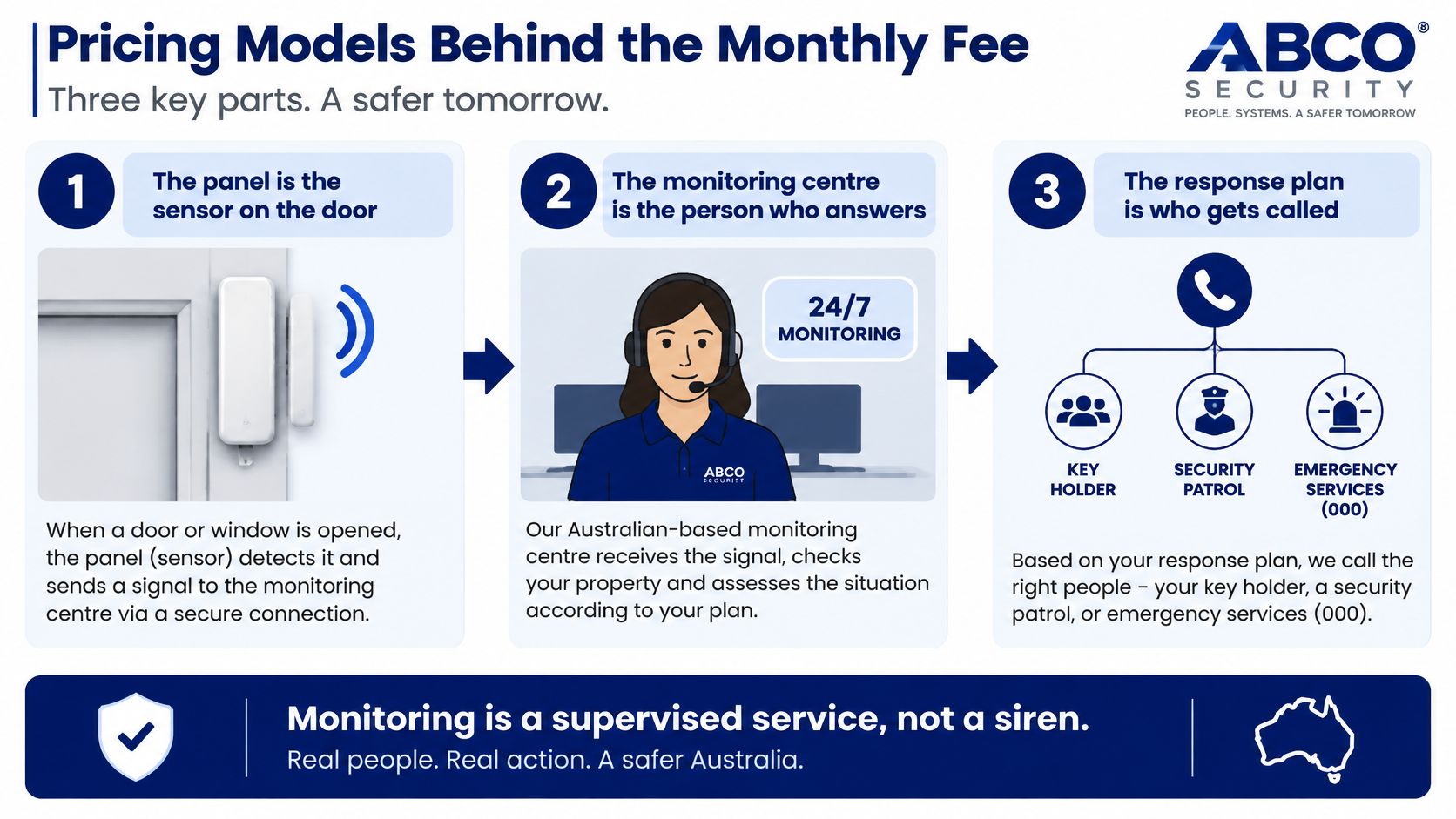
Say a small shop has one entry, a storeroom and an office. A basic tier might only receive the signal and phone the owner, while a higher tier checks camera footage, follows an escalation tree and dispatches a patrol if the owner doesn't answer.
Four Ways Providers Price the Monitoring Fee
| Pricing model | How the fee is set | Typical fit |
|---|---|---|
| Per site | One monthly fee for a defined premises and set zone count | Shop or small strata building |
| Per zone or device | Fee rises with extra doors, PIRs, duress buttons or lifts | Multi zone office or warehouse |
| Per user | Charged per app or access control login | Portfolios with many remote viewers |
| Tiered plan | Basic signal receipt, video verified or response inclusive cover | Sites that need a person, not a text message |
Per site pricing is easiest to budget because the premises and included zones are fixed. Trouble starts when a fit out adds doors and detectors but the contract still describes the old layout.
Per zone pricing follows growth more closely. Each extra PIR, reed switch, duress button or lift interface adds hardware, programming and signals someone must assess.
Per user pricing appears where managers want app access and remote viewing. Ten logins across a portfolio can cost more than one facilities manager expects, so name who needs access.
The short video below is useful if you're weighing professional supervision against handling alerts yourself.
Tier names vary, so read inclusions rather than labels. Check hours of cover, included zones, video verification, keyholding and whether Mobile Patrols are included or billed per attendance.
Labour based services sit outside an alarm subscription. Event Security, Concierge Security and Gatehouse Security are rostered people doing entry, crowd and reception tasks, not features you activate in a monitoring tier.
If you're still deciding who should answer alerts, the comparison of monitored and self monitored systems sets out that choice plainly. Then ask three questions. What counts as one site, what happens above the included zone count, and which tier triggers a person rather than a text message?
Cost Drivers That Move a Quote
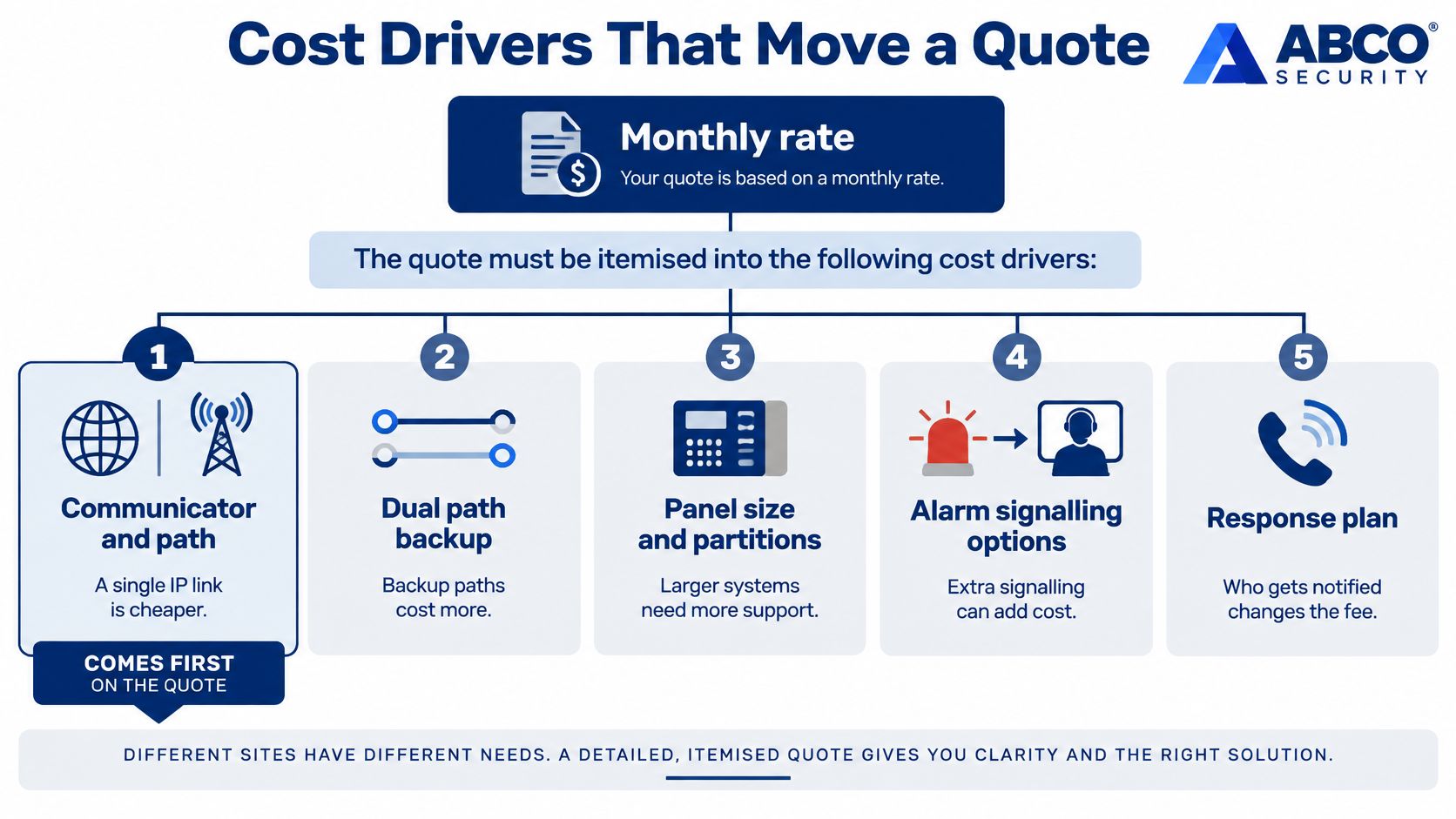
A monthly rate is incomplete until the schedule is itemised. The drivers below follow the order they usually appear on a quote, from communications through to people.
The hierarchy diagram below shows why the communicator and path come first.
Communications and the Control Room
A single IP link is cheaper, but it can fail when a router, power supply or internet service drops. Dual path IP and cellular signalling costs more because the backup path keeps sending during that outage.
Control room grade, redundancy and the service level agreement set how a signal is actioned and whether a backup centre exists. You're paying for supervised receipt and documented escalation, not just for a phone number.
Ask how the provider detects a communications failure and who gets told. A silent path failure can leave a site unmonitored while invoices continue, which is why clear communication protocols matter in the contract.
Cameras, Sensors and Maintenance
CCTV verification adds camera licences, storage and operator review time. It can still save money when an operator sees a cleaner or a loose banner and avoids sending a patrol.
Extra sensors, wireless expanders and access control integration add hardware and programming. Maintenance then covers battery tests, detector cleaning and fault checks that keep those devices trustworthy.
Why People Cost More Than Signals
The largest jump is labour. The Fair Work Commission Security Services Industry Award pay guide lists a full time Security Officer Level 1 minimum ordinary rate of $28.42 an hour, rising to $34.59 for night work, $42.63 on Saturdays, $56.84 on Sundays and $71.05 on public holidays. Level 5 starts at $31.20 ordinary and reaches $78.00 on public holidays.
| Classification | Ordinary (AUD/hr) | Night (AUD/hr) | Saturday (AUD/hr) | Sunday (AUD/hr) | Public holiday (AUD/hr) |
|---|---|---|---|---|---|
| Security Officer Level 1 | 28.42 | 34.59 | 42.63 | 56.84 | 71.05 |
| Security Officer Level 5 | 31.20 | 37.97 | 46.80 | 62.40 | 78.00 |
Those minimums explain why keyholding, patrol verification and after hours attendance cost more than a text alert. Travel, reporting and penalty rates sit on top of the time spent at your door.
For commercial property, construction, mining and manufacturing sites, compare annual cost per protected site. Stress test that figure against several activations, a communications failure and planned maintenance before you sign.
Request one itemised list from every provider. It should cover installation, communicator hardware, SIM or data, monitoring, verification, escalation, patrol attendance, after hours call outs and maintenance.
Sample Budgets for Real Australian Sites
Local exposure changes what sensible cover looks like. The ABS state burglary victim figures for 2024 recorded 32,914 burglary victims in New South Wales, 45,893 in Victoria, 45,275 in Queensland and 16,605 in Western Australia. Use the budgets below as spreadsheet starting points, then adjust for layout, occupancy and who attends.
Indicative Annual Alarm Budgets by Site
| Site | Plan used | Annual monitoring (AUD) | Add before you sign |
|---|---|---|---|
| Strata or home | $45 a month professional | 540 | Hardware once; patrol only if the lot is vacant |
| Retail shop | $75 a month commercial | 900 | Maintenance and at least one attendance |
| Construction compound | $110 a month higher assurance | 1,320 | Temporary cellular path plus weekend patrol labour |
| Shopping centre or event overnight | Commercial alarm for the closed building only | 720 to 1,080 | Guarding, gatehouse and crowd hours quoted separately |
Strata or Home on the Melbourne Fringe
At $45 a month, professional monitoring is $540 a year. Hardware belongs in year one as a one off line, not repeated every year unless you're replacing devices.
A vacant lot changes the question from notification to attendance. An occasional patrol is priced from the call out band, not from the subscription, so the deciding question is who attends.
Retail Shop in Sydney or Brisbane
Say a shop pays $75 a month, which is $900 a year. Add $225 for maintenance and one $115 attendance, and the working budget is about $1,240 before cameras.
Retail Security during trading hours is a separate guarding decision. For the alarm quote, ask whether the fee covers signal receipt only or also a video check, contact escalation and a written incident record, because that answer changes the value of the $75.
Construction Compound in Perth or a Regional Site
A higher assurance plan at $110 a month is $1,320 a year. A compound then adds temporary cellular communications, perimeter zones that move as work progresses and scheduled patrols.
Weekend labour quickly becomes the story. Even a short Saturday attendance is built around award labour rather than app notifications, which is why Construction Security budgets should price patrol frequency explicitly. The deciding question here is how many zones need verification as the site changes.
Shopping Centre or Ticketed Event
Don't force a centre or event into an alarm tier. Shopping Centre Security and Event Security add crowd management, gate checks, lock up and incident response during occupied hours, all quoted as guarding hours.
The alarm still has a job after close. It protects the empty building, while rostered staff protect people and operations when doors are open.
A staffed office sits between those patterns. Access control alerts matter by day, and alarm escalation matters after hours, so the quote should name both modes instead of assuming one fee covers every hour the same way.
When False Alarms Blow the Budget
In 2025, about 98% of the approximately 58,000 automatic fire alarm activations reported by Fire and Rescue NSW were classified as unwanted alarms. Those responses made up around 40% of all FRNSW responses.
The infographic below shows why a monitoring subscription is only one part of the bill.
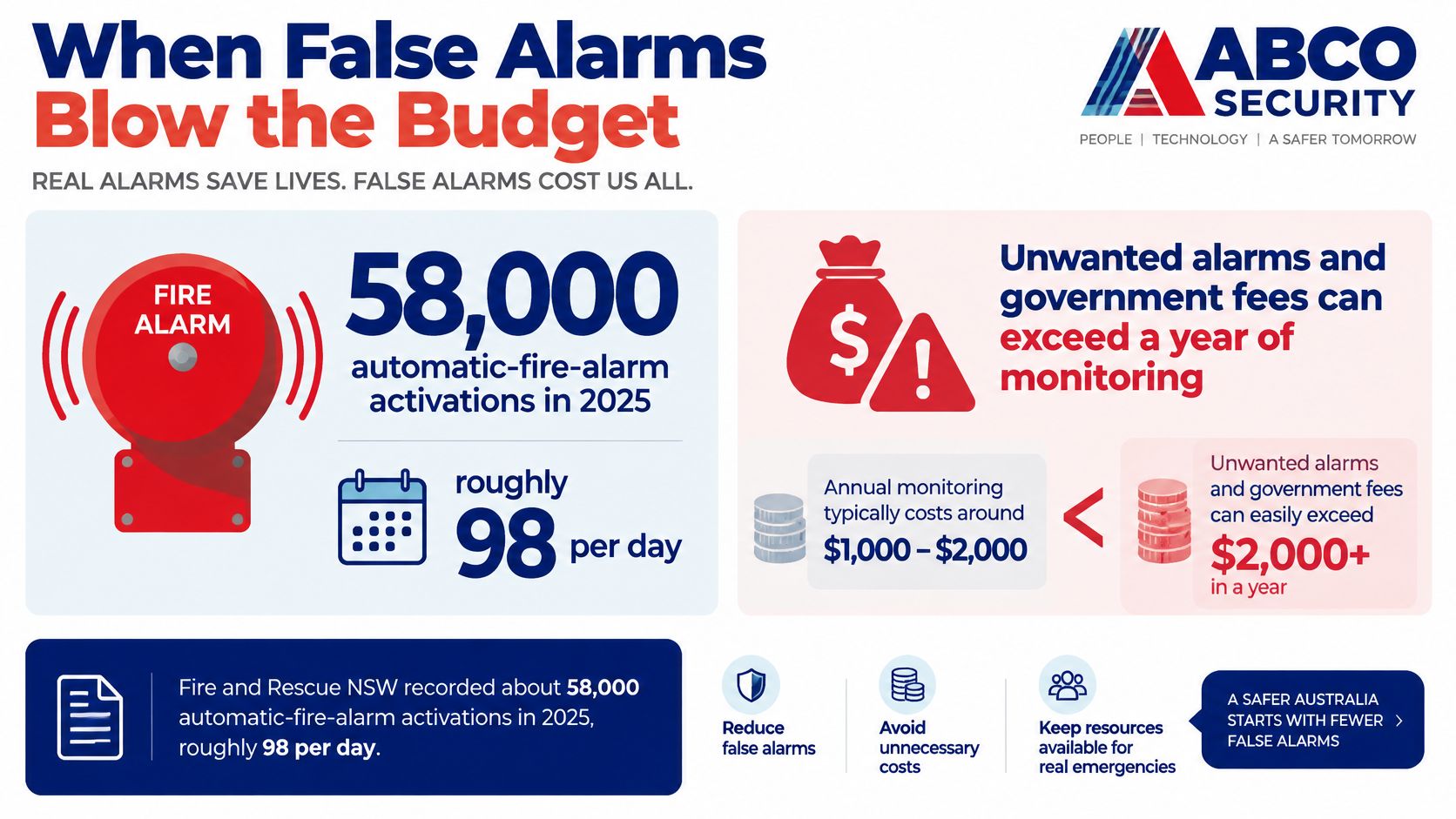
Repeat or preventable false alarm attendances can attract fees under state rules. Rates vary between states and can change over time, so a building's total cost may include an attendance charge on top of its monitoring subscription. Even one invoice can outweigh the annual saving from choosing the cheapest plan.
How a Small Fault Becomes an Invoice
Dust, steam, cooking heat, poor detector placement or a door left on an alarm zone can trigger a signal. If verification is weak, a truck or patrol may be sent, adding labour and attendance costs to the bill.
Shopping centres, hospitals, schools and multi-storey strata buildings can face repeat alarms when a detector serves a busy area. A log of repeat zones helps identify which device needs cleaning, repositioning or replacement.
Verification can cost less than a repeat attendance.
Multi-sensor or video verification, documented escalation, user training, scheduled detector cleaning and trend analysis can help interrupt the chain. A practical false alarm reduction plan can help organise these controls.
Check that the contract states who pays for government attendance fees, private patrol call-outs, testing and corrective maintenance. It should also distinguish emergency dispatch from technical alarms, so the subscription price does not obscure the cost of responding.
Check the Contract Before You Compare Fees
A low monthly fee can hide larger costs in old hardware, commissioning and call-out rules. Check what the contract includes before comparing quotes.
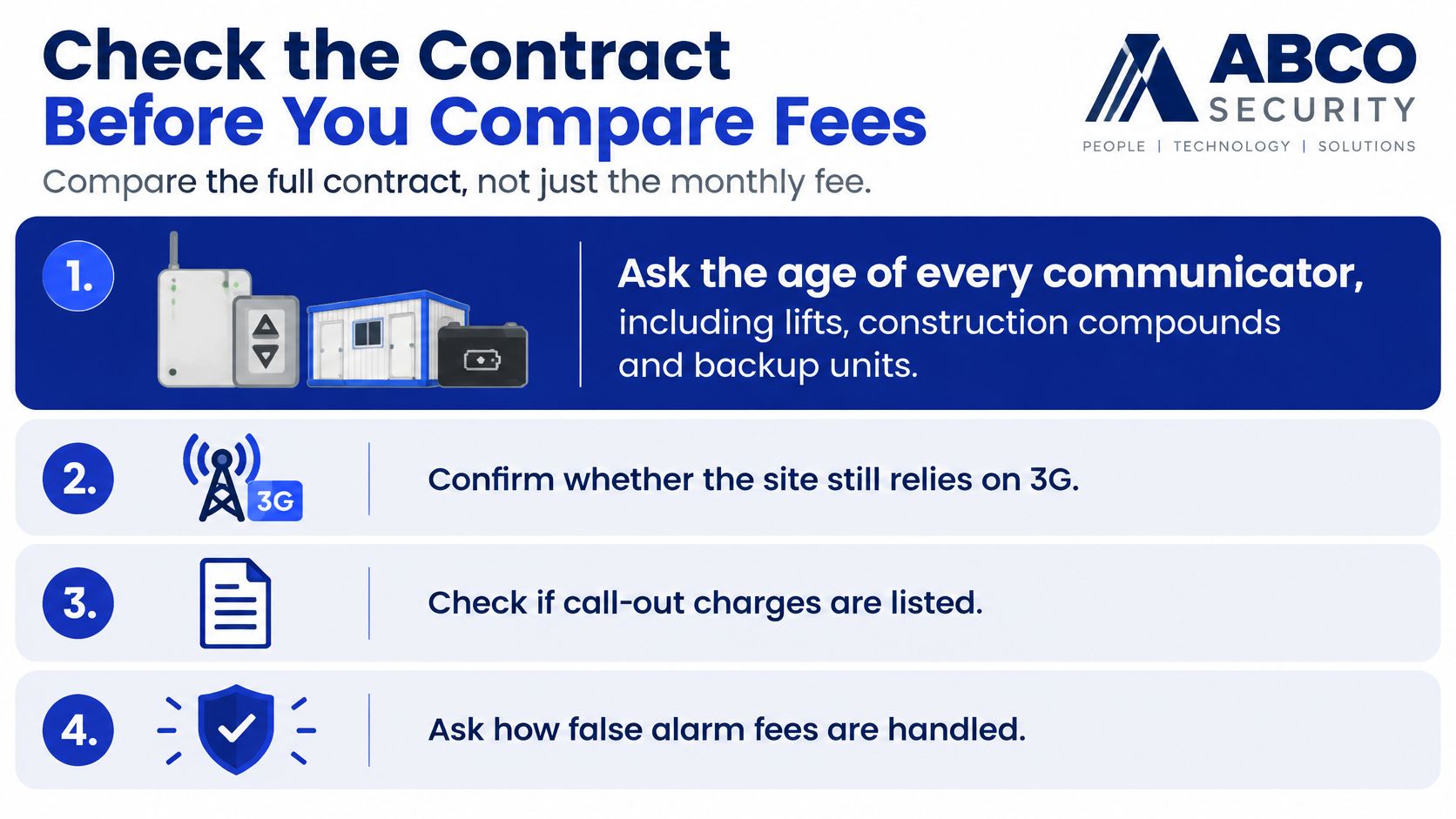
Six Checks Before You Sign
- Ask the age of every communicator: Include equipment serving lifts, construction compounds and backup systems. An older unit may need replacement before it can reliably report alarms.
- Confirm the network path: The Access Communications guide to Australia's 3G shutdown lists shutdown dates for Telstra, Optus and Vodafone. Check whether each communicator uses a network that remains available. A 3G device generally cannot be upgraded through software alone.
- Separate one-off charges: Ask the provider to list registration, functional acceptance retesting and monthly monitoring fees separately. This makes it easier to compare the ongoing subscription with setup and compliance costs.
- Read the commercial terms: Check the contract length, price-rise clauses, exit fees and responsibility for after-hours call-outs. Use these security service contract terms as a comparison point.
- Confirm licensing and escalation: In Victoria, ask about the provider's licence and how staff escalate a verified alarm. Monitoring does not guarantee police attendance for every activation.
- Require test proof: Ask for evidence that a test signal reached the monitoring centre over both the primary and backup paths.
Replacement 4G or 5G hardware, installation and commissioning can add a substantial upfront cost. They are migration costs, not part of the old monthly fee, so ask whether the quote includes them.
You can lower costs without reducing cover. Clean detectors and fix repeat zones to limit avoidable signals. Reserve dual-path communications for vacant or high-value sites, and set a cap on patrol call-outs rather than accepting open-ended charges.
Compare the full cost, not just the subscription. A cheaper plan may cost more overall if it leaves you paying separately for commissioning, patrols, repairs or repeated attendances.
Alarm Monitoring Cost FAQs
Who Pays for Monitoring on Strata Common Property
Usually the owners corporation pays through the levy budget. Check the bylaws and whether costs are shared by lot entitlement before requesting quotes, because that affects approvals and how the fee is explained to owners.
How Should a Property Manager Structure a Multi Site Portfolio
Request one account per site, with user logins priced per user. That structure lets tenancies, contacts and escalation lists change without reopening the whole contract each time.
It also keeps reporting clean. You can see activations, faults and attendances by site instead of arguing over one blended invoice.
What Term Suits a Temporary Event or Closed Site Alarm
Ask for month to month cover or a term that matches the event calendar. Guarding hours should be quoted per shift, with no lock in beyond the hire period.
For a closed site, confirm what happens at handover. You need a clear end date for monitoring, patrols and keyholding so charges don't roll on after the risk ends.
How Often Should a Construction Manager Reassess the Alarm
Review it at each stage of temporary power, fit out and handover. Devices, communications paths and zone counts change as the site develops, so last month's layout may not protect this month's stored materials.
How Often Should a Strata or Property Manager Re Tender
Re tender every 12 months, or whenever the zone count, tier or communications path changes. A short annual check catches price rises, obsolete communicators and contacts who no longer work at the site.
Confirm the Right Monitoring Plan
Start with the option that fits your site, then list any people-based security separately. Security guarding, gatehouse coverage, concierge duties and event security should have their own hours and costs, so you can compare them with the alarm fee.
Ask each provider for an itemised 12-month schedule covering installation, communicator, SIM or data, monitoring, verification, patrol attendance and maintenance. Compare the annual site cost with the possible cost of a false alarm and an after-hours attendance. The monthly fee is only the first line; patrol labour and equipment changes can add substantially to the total.
Check the provider's licence details, alarm verification steps and who responds to an activation. Ask for the same schedule from every operator you consider, including those serving Melbourne, Sydney, Brisbane, Perth, Adelaide and nearby regional centres.
ABCO Security Services Australia provides alarm and CCTV monitoring, mobile patrols and security guarding across these cities. Contact ABCO to discuss your zones, response needs and contract terms, and request an itemised quote that separates monitoring, patrol and guarding costs.
about
avada factory
Sempery ultricies nibh at dolor cras urna eleifend nec. Atiam efficitur tempor.