A delivery driver is waiting outside, a resident's remote has stopped working, and a contractor wants access before the site manager arrives. Your gate needs to handle all of them without leaving someone to guess who entered, who approved it or whether the gate closed afterwards.
Gate access control systems should leave evidence, not just open a barrier. Judge the credential check, the mechanical restraint and the monitoring response together. If any part fails without a usable record, you've bought convenience rather than dependable perimeter security.
Which Gate Access Technology Fits Your Site
A driver, resident and contractor can use the same entrance but need different permissions. The driver needs approval for a delivery, the resident needs recurring access, and the contractor needs access tied to an authorised work period.
A gate access control system combines a credential check, a controlled opening and an event log. Choose the technology by what it can verify and record, not how quickly it opens.
Gate access technologies compared by site fit and limits
| Technology | Best suited to | Main strength | Main limitation | Privacy or compliance note |
|---|---|---|---|---|
| Keypad (PIN code) | Low-traffic pedestrian side gates and staff vehicle gates | Low cost and quick code changes | Shared codes weaken accountability unless individually assigned and logged | Low privacy impact, but protect identifiable access records |
| RFID or proximity card | Commercial car parks, construction sites and residential estates | Per-person credentials that can be revoked quickly | Lent cards bypass identity checks; older formats can be copied | Store credential IDs rather than unnecessary personal images |
| Intercom with remote release | Residential estates, strata communities and visitor-heavy offices | Visual check before opening when paired with video | Relies on the approving person; admissions may be poorly recorded | Visitor footage needs signage and a retention policy |
| Biometric (fingerprint or face) | Staff-only areas and high-security perimeters | No cards to lose and a strong identity match | Sensitive biometric templates; accuracy differs across users and conditions | Assess necessity and proportionality; provide a non-biometric alternative |
| ANPR (number-plate recognition) | Car parks, shopping centres and vehicle-only estate access | Hands-free entry and vehicle movement records | Obscured or unregistered plates need a fallback | Apply collection notices, signage and retention limits to plate images |
Choose by risk rather than convenience
For a lightly used side gate, individually assigned PINs with event logging may be sufficient. A shared code written on the gatehouse wall isn't an identity check, even if the keypad itself works perfectly.
Vehicle-heavy properties benefit from RFID or ANPR, provided the reading zone identifies the approaching vehicle rather than another vehicle in an adjacent lane. Neither method proves who is driving, so high-risk deliveries may still need an officer's approval.
Biometrics warrant a stronger justification than avoiding replacement cards. Test whether cards, vehicle credentials or staffed checks can achieve the same objective with less intrusion.
In a historical study of 2,003 Australian residential builders, the Australian Institute of Criminology found 35% used security fencing or lockable gates against theft and vandalism. That supports perimeter controls as an established practice, not evidence that a gate alone prevents incidents.
Use the comparison of access control system types to narrow the options, then answer these operational questions:
- Traffic demand: How many people or vehicles pass during the busiest hour?
- Identification: Must you identify a person, a vehicle or an approving officer?
- Revocation: How quickly must a lost, lent or withdrawn credential stop working?
Practical rule: Buy the credential method that produces the evidence your site needs, not the one with the most impressive reader.
How a Gate Access Control System Works
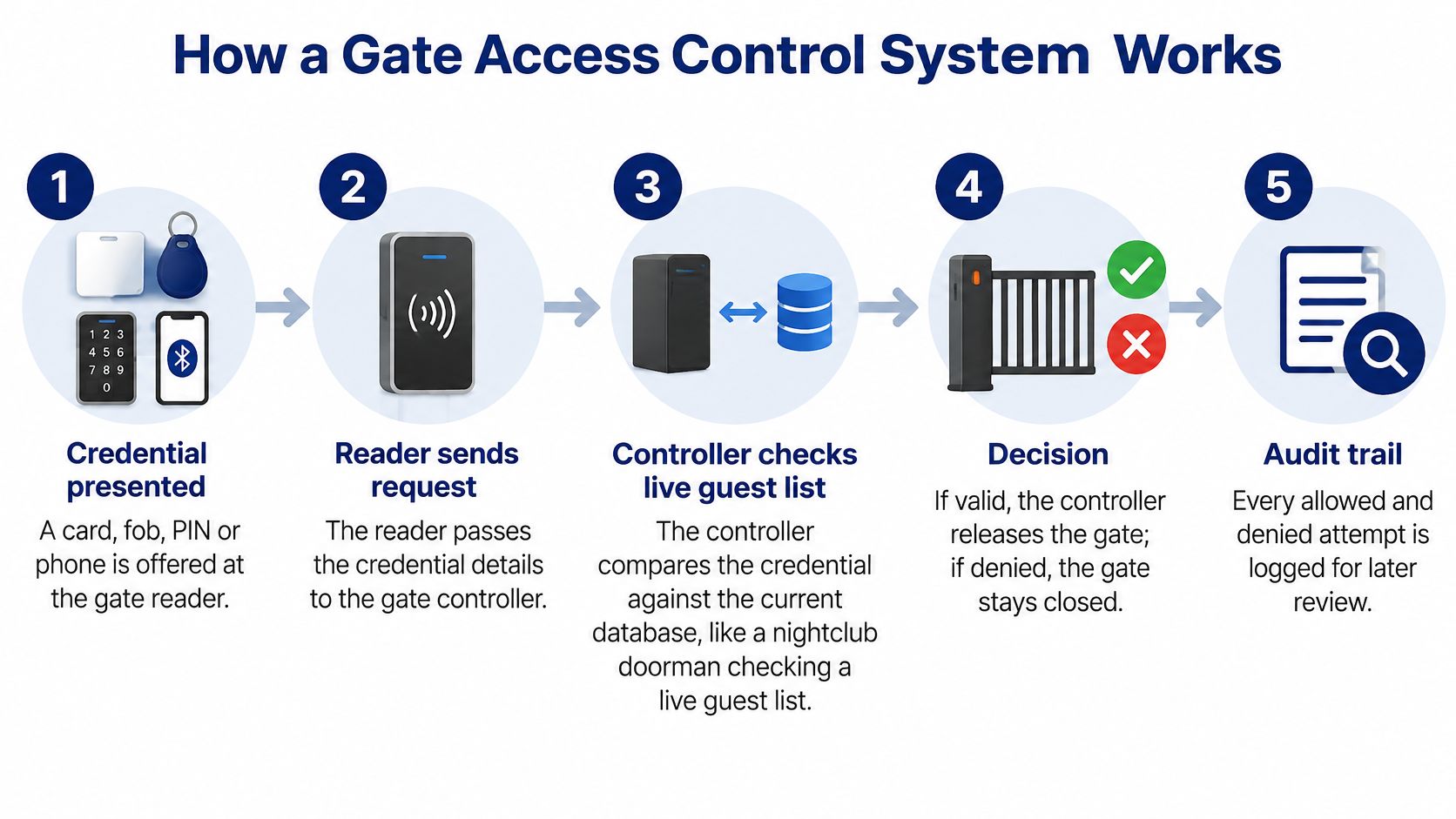
A gate controller works like a nightclub doorman with a live guest list. It checks the presented credential against current permissions before allowing entry, rather than accepting everyone who knows where the entrance is.
The components work in sequence: reader or intercom, controller and permissions database, electric lock or strike, mechanical gate assembly, and event log. Motorised gates also need properly commissioned movement controls and safety devices.
The process should remain traceable from presentation to decision.
Follow the credential through the opening
- Present the credential. The user offers a card, PIN, plate or biometric. Reader placement must suit the approach without encouraging drivers to leave vehicles in a traffic lane.
- The controller checks the credential against active permissions, including access schedules and permitted areas. An enrolled contractor shouldn't automatically have unrestricted access.
- An authorised request releases the lock or signals the motor. A denied request leaves the entrance secured and records the decision.
- Confirm movement and closure. Gate-position sensors establish whether the opening occurred and whether the gate returned to its secured position. Entry and exit records require suitable readers or detection, not assumptions based on an opening command.
- Sensors and configured analytics flag forced movement, prolonged opening or suspected tailgating. Tailgating detection requires appropriate equipment; it isn't an automatic feature of every controller.
Check the barrier and the network
A successful credential check doesn't compensate for weak hinges or a displaced latch. The TasNetworks Security Fences and Gates Standard requires mechanical interlocks at the hinge or across the opening to restrict outward movement; Snowy Hydro's infrastructure requirements likewise call for mechanical interlocks.
Treat the interlock as physical restraint, distinct from electronic authorisation. Check the leaf, frame, foundations, hinge protection and latch-side alignment under realistic loading, with emergency release and safe movement included in commissioning.
The controller is also a network device. The Australian Cyber Security Centre's physical security guidance.pdf) supports restricting access to network equipment, console ports and factory-reset controls.
Use named administrator accounts, segment gate controllers from general business networks and secure remote administration. Test local permissions, locking and buffered logging during a communications outage.
For daily checks, compare active permissions with the current resident, staff and contractor list. Confirm that test denials and forced-open conditions appear correctly in the event log.
Linking Gate Access to CCTV, Alarms and Monitoring
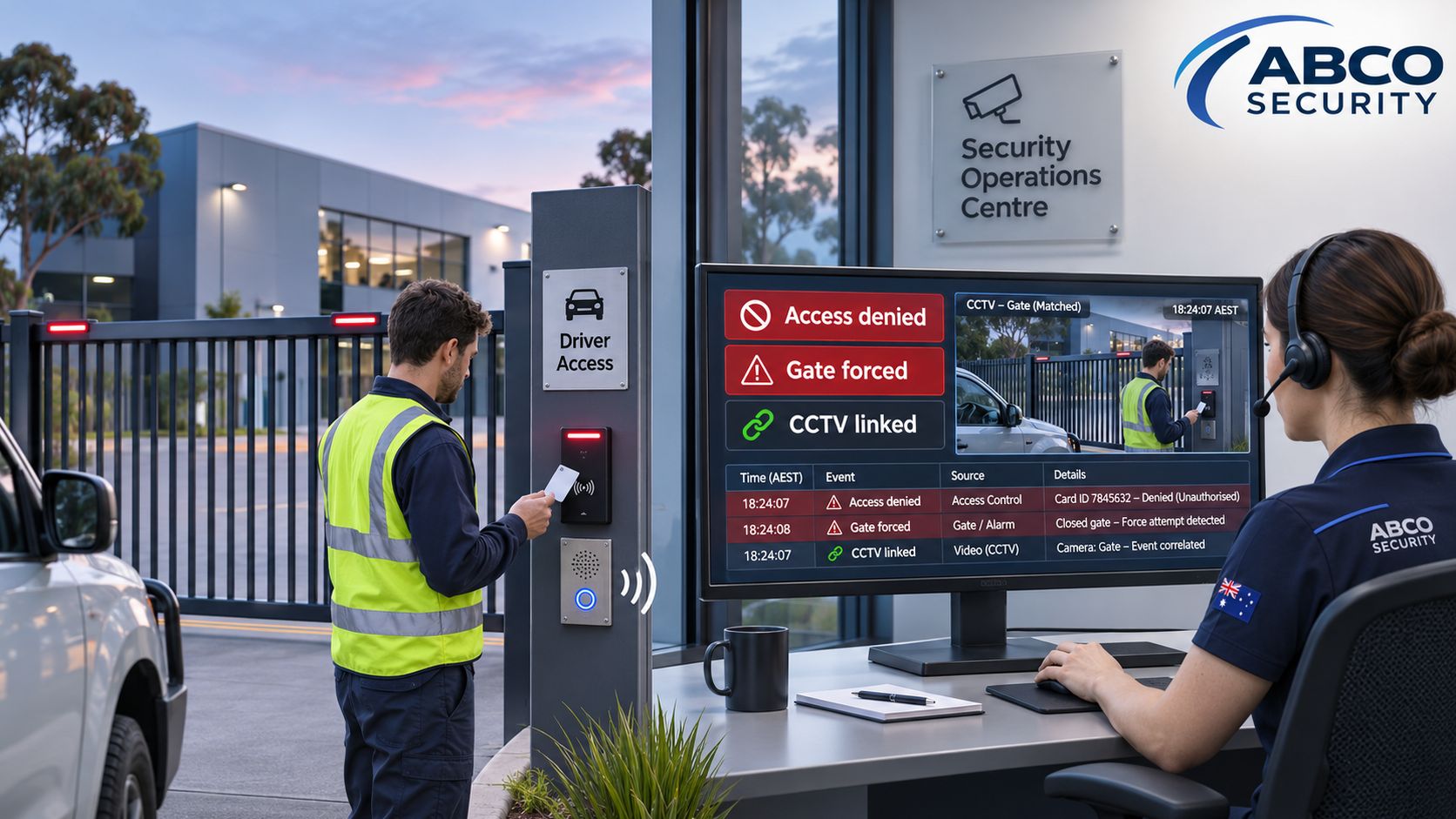
A forced gate that activates only a local buzzer may remain uninvestigated after everyone leaves. Integration closes that gap by giving an operator the access event, matching footage and a defined response.
The useful question isn't whether the gate has a camera nearby. It's whether someone can connect the alarm to the right view and act on it.
A monitored entrance brings credential handling and visual verification together.
Verify the integration points
Configure denied credentials, forced openings, suspected tailgating and prolonged-open conditions so operators can assess them with the relevant camera feed. Use alarm priorities and repeat-denial thresholds to avoid burying serious events among routine user errors.
- Controller to recorder: Match time-stamped access events to searchable video, with clocks synchronised.
- Intercom to camera: Give the approving person a clear live view before remote release.
- Vehicle recognition to gatehouse: Display the recognised plate and permission result where officers make entry decisions.
- Alarm panel to monitoring centre: Confirm the correct site, gate, alarm description and escalation instructions reach the operator.
Camera placement should capture plates, driver approach areas and pedestrian entrances without unnecessary views into private spaces. Test views with headlights, shadows and delivery vehicles present, not just an empty lane in daylight.
For properties considering cloud-managed cameras, the Splash Access guide to Meraki cameras provides useful platform context. Still require a demonstration of event retrieval and compatibility with your proposed controller.
Make the response auditable
A workable response sequence is verify, escalate, attend where needed, and record the outcome. The operator reviews footage, contacts the nominated person or dispatches Mobile Patrols, then closes the incident with an explanation rather than clearing the alarm.
Say a contractor leaves a gate open after hours. The operator confirms the situation on camera, contacts the responsible person, arranges attendance if needed and records who secured the entrance.
This video offers additional context for electronic access control.
Our electronic security work includes end-to-end setup and integration of surveillance, access control, video analytics and remote viewing. Our CCTV and alarm monitoring centre provides immediate escalation and can dispatch patrols when an alarm needs a physical check, allowing the access control integrations to be designed around an actual response process.
An alarm isn't resolved when someone acknowledges it. It's resolved when the outcome is verified and recorded.
Standards, Licensing and Privacy Rules in Australia
A standard-compliant reader doesn't establish that the whole entrance is suitable. Procurement must address system performance, the people operating it and the information collected at the boundary.
According to ASIAL's electronic security standards guidance, AS/NZS IEC 60839.11.1:2019 covers minimum functionality, performance requirements, test methods and security grades for electronic access-control systems. Select the grade by the consequences of unauthorised entry, not by treating a corporate car park like a utility compound.
Turn compliance into acceptance requirements
Require documented grade compliance, credential-management functions, event logging, alarm handling and defined behaviour during power or communications loss. The commissioning record should identify the test, expected result, actual result and person accepting it.
For staffed entrances, check the work rather than relying on the job title. Victoria Police's private security licence activities guidance identifies guarding property and electronic monitoring as regulated activities, meaning vehicle checks, CCTV monitoring and alarm response may require the appropriate security-guard authorisation.
Crowd-control duties have their own licensing scope. Reception, security guarding and crowd screening aren't interchangeable just because the same person sits at the entrance.
Check the client and provider obligations
- Risk management plan: Under sections 136A and 136B of the Private Security Act 2004, the client must give the relevant licence holder a completed plan at least one day before the activity begins, according to Victoria Police's guidance on private security changes. Address aggressive visitors, unauthorised vehicles, emergency access, lone workers and escalation.
- Labour-hire status: Where the arrangement falls within the scheme, hosts must use licensed providers; the Victorian Labour Hire Authority warns corporate penalties may exceed $660,000. Checking only the individual guard's licence isn't sufficient.
- Surveillance notices: Australian Government business guidance on video surveillance calls for visible cameras, entrance signage and written notification to staff and new employees. Keep cameras out of private areas.
Facial recognition requires more than a camera notice. The Office of the Australian Information Commissioner's facial-recognition privacy guide calls for necessity, proportionality and transparency, generally with consent or an applicable exception.
Provide a workable alternative and document retention, access restrictions and breach response. Use the Australian CCTV laws overview as a starting point, then check the requirements applying to your jurisdiction and organisation.
Designing Gate Access by Sector, With Worked Examples
Sector changes the access problem. An office needs accountable contractor entry, a building site must keep the public away from hazards, and an event must screen arrivals without obstructing escape.
Gate access priorities by sector
| Sector | Main risk | Core access controls | Compliance point |
|---|---|---|---|
| Commercial offices and corporate parks, including Concierge Security and Gatehouse Security | Lobby and car park tailgating; after-hours entry | Card readers, visitor passes and gatehouse entry logs | Entry-checking and monitoring duties may require a Victorian private security licence |
| Construction sites, including Construction Security | Unauthorised access to hazards; portable-equipment theft | Lockable gates, contractor log-in, ID checks and patrols | Controls must support WHS duties to prevent unauthorised access |
| Residential estates and strata communities | Following residents through gates; shared codes | Video intercom, RFID remotes and ANPR for registered vehicles | Body corporate policies, CCTV signage and privacy notices |
| Events, including Event Security | Crowd surges, wristband fraud and backstage intrusion | Staged lanes, ticket or wristband scanning and staffed checkpoints | Victorian crowd controllers need the appropriate licence |
| Retail and shopping centres, including Retail Security and Shopping Centre Security | Car park misuse, loading-dock intrusion and tailgating | ANPR, boom gates and mobile patrols | Visible cameras, entrance signage and footage retention limits |
The major design decisions are which entrances to fund, how visitors are authorised and what continues operating during an outage. Don't distribute the budget evenly across entrances if the service dock presents a greater exposure than the staff car park.
Melbourne office tower with contractor traffic
Consider a Melbourne tower where tenants enter by card but contractors arrive for unrelated maintenance jobs. The weakness is treating every contractor with a valid card as currently approved to work.
Use a card-controlled boom gate with a gatehouse officer checking the contractor's host, work authority and permitted destination. Issue visitor permissions that expire with the approved visit, and keep pedestrian movement separate from vehicle queues.
Watch for a delivery driver using another contractor's booking or following an authorised vehicle. A boom gate controls vehicle movement but doesn't provide a secure pedestrian perimeter.
The lesson: Fund the verification point, not just the barrier. When evaluating a security company in Melbourne, ask who reconciles contractor arrivals with the work approval and who handles an unexpected arrival.
Perth construction site with changing boundaries
A Perth site may move its delivery entrance as excavation, scaffolding and storage areas change. Yesterday's access procedure can become unsafe even though the lock still works.
Specify lockable gates, contractor log-in, ID checks and after-hours patrols, with a named person responsible for boundary changes. Keep visitor waiting areas outside active plant routes and document how deliveries are admitted when the supervisor is elsewhere.
WorkSafe Western Australia's construction-site security report records 227 improvement notices following 702 workplace inspections during its project between March and September 2024. Those counts demonstrate enforcement activity, not a precise percentage of workplaces receiving notices, because notices and workplaces aren't necessarily equivalent.
The practical obligation is to prevent unauthorised access and isolate hazards where access can't be prevented. A construction site access control procedure should therefore identify temporary openings, lock-up responsibility and escalation for damaged fencing.
The lesson: Review the boundary whenever the construction sequence changes, not only when equipment is stolen.
Brisbane estate with shared or missing remotes
For a Brisbane estate, residents need reliable recurring entry while visitors need an approval path that doesn't require permanent credentials. Use video intercom, individually registered RFID remotes and a visitor list managed by the body corporate manager.
If a remote is lent or suspected of being cloned, revoke its identifier and issue a replacement through an authorised process. Schedule a monthly permissions review as an operating practice, matching active credentials to current occupiers.
Watch for an outage design that either locks residents out without assistance or leaves the entrance permanently open. Test local credential storage, backup power where specified and a controlled manual-release procedure.
The lesson: Resident convenience relies on disciplined administration, especially during move-ins, move-outs and lost-credential replacements.
Sydney shopping centre with mixed vehicle access
A Sydney centre might use ANPR for registered staff and tenants, a boom gate for vehicle control, a gatehouse officer for visitors and an intercom at the service dock. The challenge is keeping routine traffic moving without sending unknown vehicles straight into delivery areas.
Provide a safe waiting or diversion point for unregistered vehicles. Test obscured plates, changed fleet vehicles and deliveries arriving outside bookings, then assign an operator to resolve exceptions.
For delivery-heavy centres, AY Automate's discussion of logistics automation provides context for connecting scheduling and vehicle workflows. A delivery booking should still be checked against access permissions rather than automatically treated as entry approval.
The lesson: Fast recognition is useful only when exceptions have somewhere safe to go and someone authorised to decide.
Events with temporary entry lanes
For an event, use staged arrival lanes, ticket or wristband scanning and staffed checkpoints. Separate public admission from backstage permissions so a valid attendee wristband doesn't become an all-access credential.
Watch queue growth, repeat scans, damaged wristbands and visitors approaching service gates. Maintain a clearly identified exit route, and never use an access-control setting that traps people during an emergency.
Design judgement: The sector changes the controls, but every site still needs a documented access procedure with a named decision-maker.
ABCO's operating sectors include healthcare, construction and industrial sites, retail centres, corporate offices, events and residential estates. The local assessment should reflect the site's hazards and jurisdiction, rather than copying a design from another property.
Budget and Verify Before You Buy a Gate System
Lifecycle cost categories and what drives them
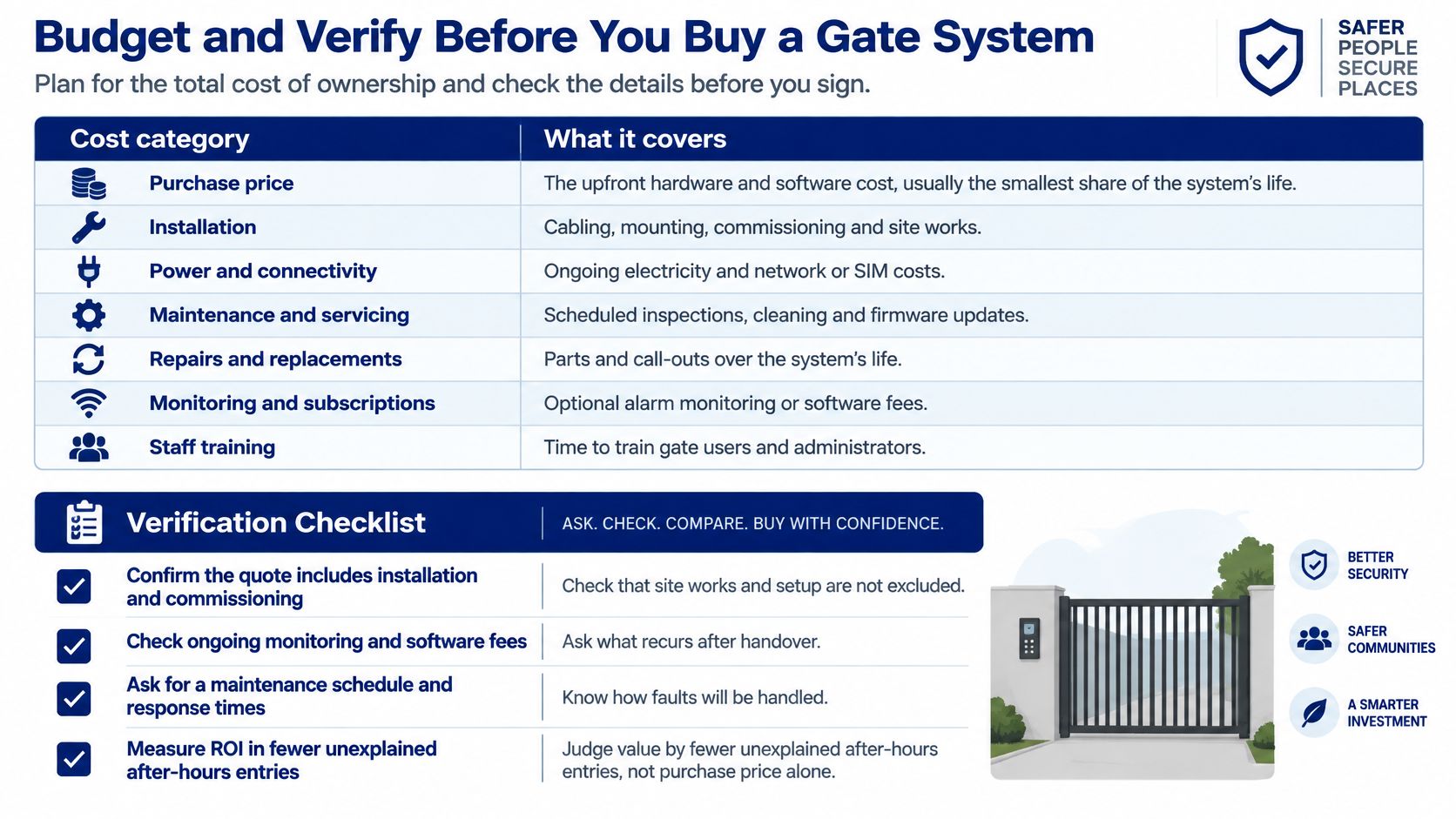
Two quotes for the same gate can differ widely for reasons that have little to do with hardware: one prices the installation, the other prices the system across its working life. Judge each proposal by what it includes in every category below.
| Cost category | What drives it | Timing |
|---|---|---|
| Hardware and locks | Gate type, security grade and entry points | Purchase |
| Installation and civil works | Footings, interlocks, power and cabling | Purchase |
| Integration with CCTV and alarms | Interface complexity and monitoring connections | Purchase |
| Software, licences and monitoring fees | Users, sites and response level | Annual, subject to contract |
| Scheduled maintenance | Traffic, weather exposure and interlock testing | Annual budget, with service frequency specified |
| Credential administration and upgrades | Turnover, firmware and standards changes | Ongoing |
The purchase price is only the first line of the invoice. Software licences, monitoring fees and scheduled servicing keep accumulating for as long as the gate operates, and credential administration grows with staff and contractor turnover. Request itemised costs and exclusions using the Australian access control cost guide to frame the scope, and ask each supplier to state what happens to licences and monitoring when the contract ends.
For construction procurement, Exayard construction estimating software is a relevant resource for organising estimating work. Keep specialist gate engineering, integration and acceptance testing explicit in the tender rather than hiding them inside a general allowance.
The sequence below pairs the cost categories with the verification steps so proposals can be compared on the same basis.
Procurement and handover checklist
- Specify the security grade against the applicable electronic access-control standard.
- Function-test the mechanical interlock under load.
- Give the owner administrator control and set contractor-account expiry dates.
- Confirm controller hardening, network segmentation and secured remote administration.
- Test communications failure and the specified backup-power behaviour. A controller that retains credentials offline still needs an energy supply to drive the lock.
- Define log retention, review responsibility and export access.
- Verify worker authorisations and provider licensing, including applicable labour-hire status.
- Confirm delivery of the required risk management plan before work starts.
- Check CCTV signage, collection notices and privacy arrangements.
Measure value through fewer unexplained entries, faster verification, fewer access disputes and better incident evidence. The reliable signal is the record the system leaves behind: every denied credential, forced entry and manual override should appear in the logs and have a named reviewer. Compare routine checking effort before and after commissioning rather than assuming staff savings.
After collision or settlement, inspect alignment and interlocks immediately. Reconcile permissions with current occupiers and workers, and schedule a full-system function test, including outage behaviour, as an annual baseline alongside manufacturer-required servicing.
ABCO Security Services Australia offers gatehouse, construction, event and electronic security, including temporary guarding, ongoing patrols and complete surveillance systems, and readers can contact ABCO Security Services Australia about their site, with offices in Melbourne, Sydney, Adelaide, Perth and Brisbane.
about
avada factory
Sempery ultricies nibh at dolor cras urna eleifend nec. Atiam efficitur tempor.