Approximately one-third of Australians would face hardship or major inconvenience if cash became inaccessible, according to the Reserve Bank of Australia's Consumer Payments Survey findings discussed in its Bulletin coverage. For property managers, retailers and event operators, that makes cash logistics a payment-continuity issue, not just a question of booking a secure vehicle.
Good cash in transit solutions connect secure collection with deposit reconciliation, emergency replenishment and clear authority during an outage. The practical question isn't just who moves the money. It's how your business keeps trading without exposing staff, customers or takings to unnecessary risk.
What Cash-in-Transit Solutions Include
Cash-in-transit solutions are the secure movement, handling and storage of cash and valuables between sites, banks, cash depots and ATMs, delivered by appropriately licensed crews using controlled vehicles. They're a service bundle, not a single van.
The Reserve Bank of Australia's cash-in-transit industry paper explains that CIT companies largely move and process banknotes between the Reserve Bank, depots, bank branches, ATMs and retailers, and reports that around 95% of Australians lived within approximately five kilometres of a cash-access point in 2020. That distributed network requires coordination between transport, secure holding and processing.
Cash-in-transit service components
| Component | What It Covers | Typical User |
|---|---|---|
| Armoured transport | Purpose-built armoured vehicles for high-value bulk movements | Banks, large retailers, cash depots |
| Soft-skin transport | Non-armoured vehicles for lower-value or lower-risk collections | Small retailers, hospitality venues |
| Escorted transfers | Guards accompanying cash between points on foot or by vehicle | Event operators, shopping centres |
| ATM replenishment | Loading and servicing ATMs at banks, malls and commercial premises | Banks, mall operators |
| Cash depot and logistics | Holding, sorting and distributing cash between depots and branches | Financial institutions, CIT companies |
| Cash handling and counting | Counting, bagging and sealed-container chain of custody | Retail, event and venue operators |
| CIT personnel | Appropriately licensed, trained crews, including escorts and crew leaders | All sectors |
| Tracking and CCTV | GPS tracking, vehicle and crew cameras, and monitored alerts | Commercial property, retail and event operators |
A small hospitality venue might need sealed-bag collection and deposit confirmation rather than bulk armoured transport. A shopping centre with ATMs and multiple cash-heavy tenants may require replenishment, consolidated collections and coordinated loading-bay access.
Vehicle choice must follow the assessed exposure, not just the cash amount. A lower-value collection across a public pavement can present a different problem from a larger transfer through a controlled loading dock.
Most sites need a combination of components rather than the entire catalogue. Select the mix around cash volume, maximum value held, collection location and the consequences of a missed service.
How a Cash Pickup Moves from Site to Deposit
A collection should produce an unbroken record from the person releasing the cash to the person accepting it at the destination. The workflow below separates custody, physical security and financial reconciliation so nobody mistakes a pickup receipt for a completed bank deposit.
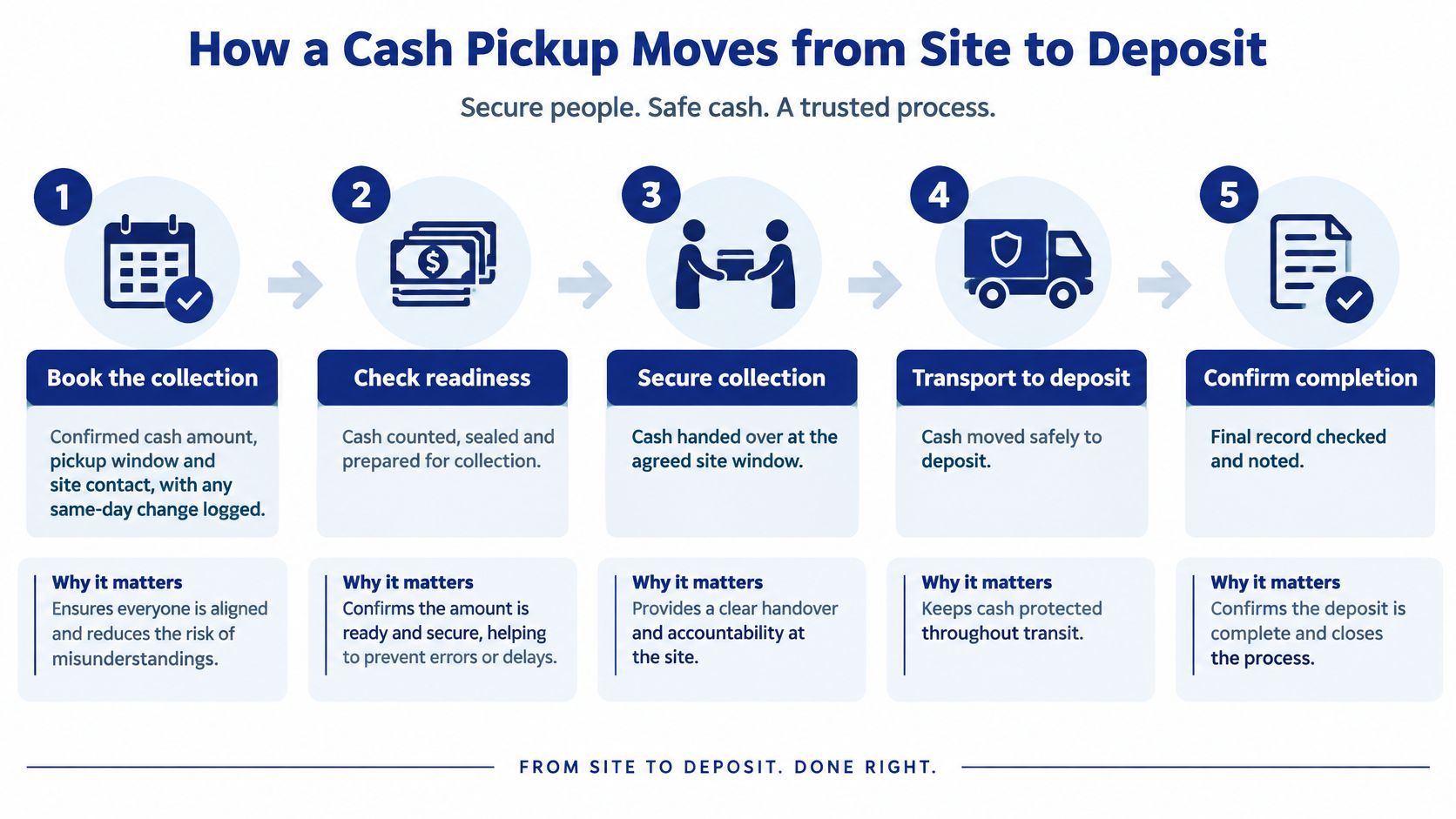
The operating sequence
Book the collection. Confirm the declared cash amount, pickup window, authorised site contact and receiving destination, and record any same-day change through the agreed channel. This prevents an informal phone call or unfamiliar substitute from becoming authority to release cash.
Check readiness before departure. The crew checks the vehicle, communications, GPS tracking and CCTV while site staff prepare the counted, sealed consignment. A failed tracking device or unfinished cash-up should be resolved before it creates a delay at the loading point.
Approve the route and arrival window. Operations selects an assessed route and avoids an observable fixed pattern, particularly for morning ATM work. Changes must remain visible to the control room rather than becoming unrecorded driver improvisations.
Control arrival and parking. The receiving contact confirms access to the nominated bay before the crew begins unloading. Clear access keeps the vehicle from waiting while staff find keys, remove parked cars or locate the authorised manager.
Complete the sealed handover. Both parties verify the container count, seal identifiers and declared amount against the manifest, without reopening cash in public. Their acknowledgement records custody of the sealed consignment, not necessarily independent verification of its contents.
Reconcile at the destination. The authorised receiving team checks the seals and confirms the contents through its controlled counting process. Finance then matches the receiving record and eventual bank credit against the original manifest.
Escalate exceptions immediately. Report late arrivals, unplanned stops, damaged seals and count discrepancies to the control room and nominated client contact. Each exception needs an owner, a recorded decision and a resolution trail rather than a verbal promise to investigate later.
Build these responsibilities into your cash handling procedures, including who can reject a handover. Staff shouldn't have to negotiate an unfamiliar situation while a crew waits outside.
Practical rule: Match seal identifiers against the manifest at both ends. A signature without that check leaves a gap in the custody record.
Where Cash Risk Concentrates and How to Control Each Handover
ATM deliveries, morning servicing and vehicle stops need particular attention. The aim is to reduce predictable routines and unnecessary dwell time, then manage the handover through clear roles, communications and controlled access.
The Australian Institute of Criminology's historical study recorded 89 armed CIT robberies over a twenty-year period, analysed 61 incidents from 2000 to 2008, and reported 18 incidents in 2007 and 11 in 2008. It found that 52% involved ATM deliveries, while 22% occurred between 6:00 a.m. and 9:00 a.m. and 34% between 9:00 a.m. and 11:59 a.m. These historical findings are not a current incident forecast for an individual site.
A parliamentary research document on cash-in-transit transport reports that 80% of robberies or attempted robberies occur when vehicles stop to restock ATMs or service commercial premises. Arrival, parking, unloading and departure deserve the same planning attention as the journey.
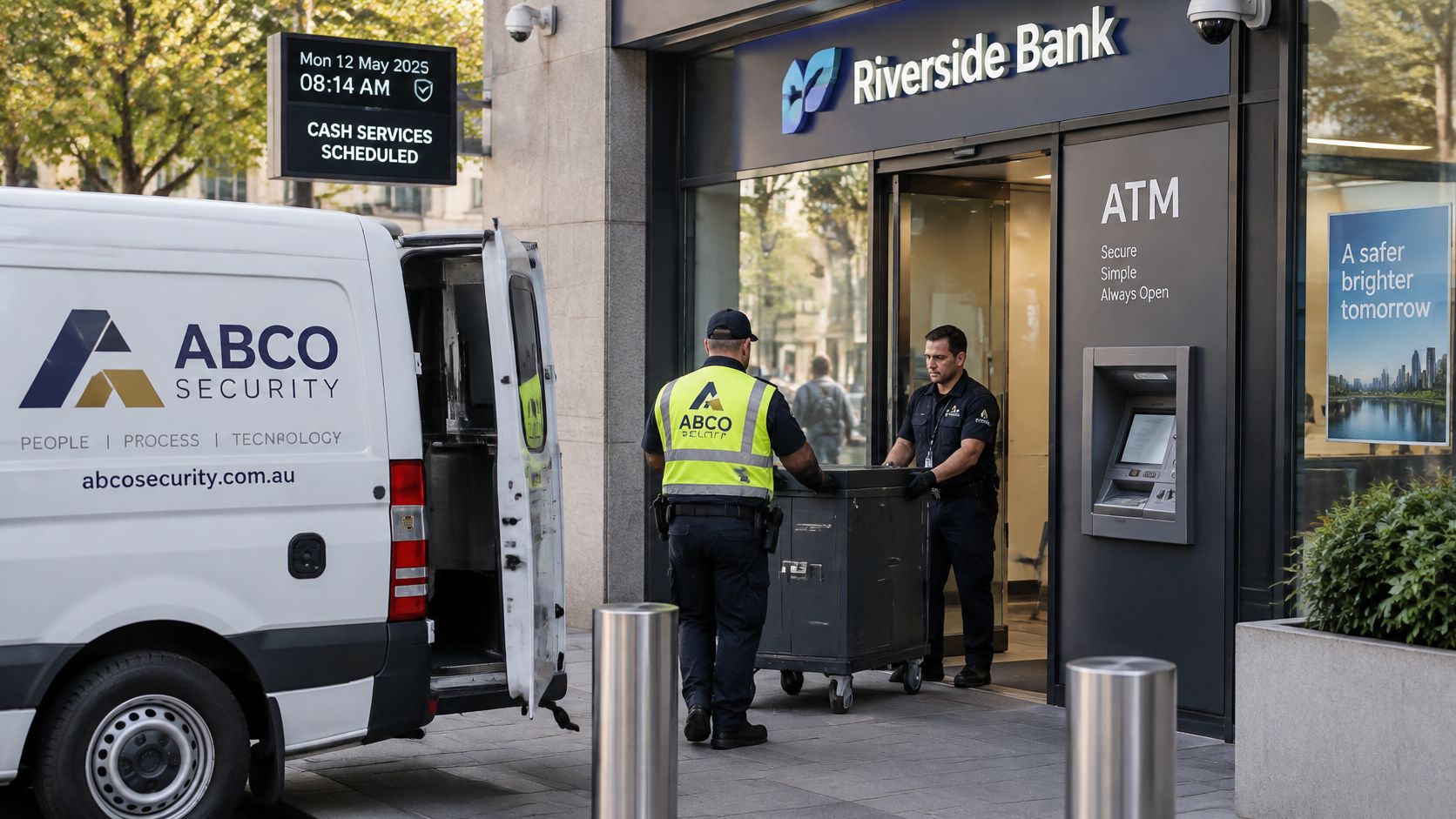
Controls by handover point
| Handover Point | Control | Risk It Reduces |
|---|---|---|
| Pre-departure | Vary approved routes, times and vehicles | Fixed patterns that can be observed |
| Arrival and parking | Controlled bay and pre-planned arrival | Unnecessary time and uncontrolled access at the stop |
| Unloading | Dual verification of seals and container counts, out of public view | Tampering and handover errors |
| On-site holding | Hold only the operational amount needed and count away from customers | Cash exposed at any one time |
| Departure | Monitored route with alerts for unplanned stops | Delayed escalation after an incident |
Varying routines requires control, not improvisation. The dispatcher should approve alternatives and know which route the crew is using. Avoid circulating a fixed collection timetable broadly among tenants; predictable schedules can undermine route variation, even when the vehicle is secure.
A controlled bay only works if someone keeps it available. Delivery pallets can push a crew into a public area, while a locked service door can prolong the stop. Assign building operations to confirm access before the service window.
During unloading, distinguish container count from cash count. The site manager can confirm that the correct sealed bags changed hands without a public recount. If a seal does not match, pause and follow the agreed exception procedure rather than accepting the discrepancy to keep the schedule moving.
On-site holding requires a separate decision about working cash. Retailers need change available for trading, while takings awaiting collection need restricted storage and a documented release process. Set who can authorise changes to the cash held or restocked, and include those decisions in the site's outage playbook.
Departure monitoring must prompt action. Vehicle tracking records position, but it supports an immediate response only when someone reviews exceptions and knows whom to alert.
What works at an exposed transfer point
WorkSafe Victoria's cash-transfer guidance recommends changing transfer routines, concealing deposit bags, counting away from customers and using a specialist security transport organisation where large amounts are involved. Its robbery guidance prioritises personal safety, following instructions, calling emergency services when safe and preserving evidence.
For a retail tenancy, prepare the consignment before the crew arrives and clear a screened route to the service entrance. Adding another guard will not fix a cash room that opens directly onto a crowded public corridor.
Shopping centres should assign separate owners to physical cash custody and electronic payment reconciliation. Retailers handling the electronic stream can refer to payment settlement guidance for local retailers. Keep that reconciliation separate from the CIT custody record so an electronic settlement issue is not treated as a transport exception.
Layer people and technology around the stop
A workable layered model gives each team a defined task:
- Crew and Security Guarding: The transport crew controls the consignment while site officers manage the immediate environment.
- Mobile Patrols and rapid response: Patrol resources support an assessed escort or response plan, rather than acting as automatic substitutes for a CIT crew.
- Gatehouse Security or Concierge Security: Entry staff authenticate arrivals, manage service access and keep unrelated visitors away.
- CCTV, alarms and access control: Operators record the transfer area, identify access exceptions and escalate incidents through a named control room.
Each layer should cover a gap left by another. Cameras cannot clear an obstruction, reception staff do not verify cash contents, and the crew should not have to leave the consignment to manage passing pedestrians.
Plan the stop, not just the drive. A secure vehicle cannot compensate for an uncontrolled handover outside it.
Document these interfaces in the site's cash handling security arrangements. The outage playbook should also set out when cash is held, when it is restocked and who can authorise a change. This keeps custody decisions distinct from electronic payment reconciliation when service interruptions affect normal operations.
Compliance, Awards and Insurance Requirements
Award classification follows the actual work, not the job title. Calling an employee a patrol officer or static guard doesn't settle the classification when regular cash transport forms a substantive part of their duties.
The Fair Work Ombudsman's Transport (Cash in Transit) Award summary identifies the Transport (Cash in Transit) Award 2020 as covering the industry, including classifications for escorts, armoured-vehicle operators, crew leaders and non-armoured vehicle operators. Its scope includes transporting cash and other valuables.
The Security Services Industry Award summary explains that cash-in-transit work is generally excluded unless it is only a minor or incidental part of an employee's duties. A general guarding contract therefore shouldn't be used as a shortcut around a duties-based assessment.
Requirements by case
| Requirement | Applies When | What to Verify |
|---|---|---|
| Security licence, state or territory | Every guard or crew member assigned to licensed work | Current licence and appropriate class for each jurisdiction |
| Transport (Cash in Transit) Award 2020 | Transporting cash or valuables is a substantive part of the role | Coverage, classification, pay rates and rostering |
| Security Services Industry Award | Cash transport is only a minor or incidental duty | Actual duties support that coverage assessment |
| Cash-in-transit and theft insurance | Any cash movement being contracted | Limits, excesses, exclusions and cover during transit |
| Work health and safety duties | Staff handle cash on site | Written procedures, risk controls and incident reporting |
Security licensing is state-based. Verify the provider's business authorisations and the relevant personnel licence classes for every state or territory where the assignment operates. An interstate contract needs more than confirmation that the company has an office nearby.
Insurance deserves equally careful scrutiny. Ask where cover begins and ends, including temporary holding, transfers across public areas, subcontracted movements and cash awaiting deposit. Don't assume a general public liability certificate proves that the money itself is insured.
Documents to obtain before deployment
- Licence evidence: Current business and personnel authorisations applicable to the assignment.
- Award assessment: Written classification tied to the proposed duties and roster.
- Insurance evidence: Certificates of currency and confirmation that policy terms match the maximum cash exposure.
- Operating documents: The handover procedure, incident-reporting process and responsibilities for subcontractors.
Use a regulatory compliance documentation checklist to keep these records together. Where coverage or policy wording is unclear, obtain specialist employment or insurance advice before signing, rather than relying on an account manager's verbal assurance.
Business Benefits and Return on Investment
Use a transparent calculation:
ROI = (annual loss avoided + internal cost saved − annual service cost) ÷ annual service cost.
Treat it as a decision model, not a promise of future savings. In particular, estimated losses avoided are uncertain, and staff hours only become a cash saving if staffing costs fall.
An illustrative shopping centre tenant
Assume a suburban tenant sends staff to bank takings daily, with unplanned stops along the way. For this hypothetical example, two staff each spend three hours per day, across 260 days, at a $35 loaded hourly cost, producing $54,600 in annual staff time.
All amounts and returns below are illustrative assumptions, not market quotes or observed results. Substitute your own payroll records, insurer discussions and provider proposals.
| Illustrative Scenario | Annual Service Cost | Estimated Annual Loss Avoided | Annual Staff Time Value | Calculated ROI |
|---|---|---|---|---|
| Current volume | $48,000 | $30,000 | $54,600 | Approximately 76% |
| Peak trading | $58,000 | $42,000 | $54,600 | Approximately 67% |
| Low volume, with fewer runs | $26,000 | $12,000 | $18,000 | Approximately 15% |
In the current-volume example, the calculation is ($30,000 + $54,600 − $48,000) ÷ $48,000, giving approximately 76%. The low-volume case produces the weakest return, which is why copying a peak-trading collection schedule into quieter periods can be poor value.
Separate financial savings from operational benefits
- Lower theft exposure: Remove routine banking journeys from untrained employees.
- Freed staff time: Return staff to customers, stock control or venue operations.
- Audit-ready custody: Give finance a traceable record for investigating discrepancies.
- Payment continuity: Maintain an assessed route for emergency replenishment.
- Better insurance discussions: Present documented controls, without assuming a premium reduction.
When comparing collection costs with changes to payment acceptance, payment insights from Vendmoore Enterprises provide a complementary cashless-payment perspective. Keep payment-processing costs and physical transport costs separate in the model.
Ask providers to price current trading, peak demand and a lower-volume operating pattern. Frequency, distance, declared value and site access all affect the service design, and the strongest case is generally where cash exposure and staff banking effort are both substantial.
Implementing Cash Logistics Across Property, Retail and Events
The right operating model changes with the site. A corporate building needs discreet access and tenant coordination; an event needs a plan that still works when trading ends and crowds begin leaving.
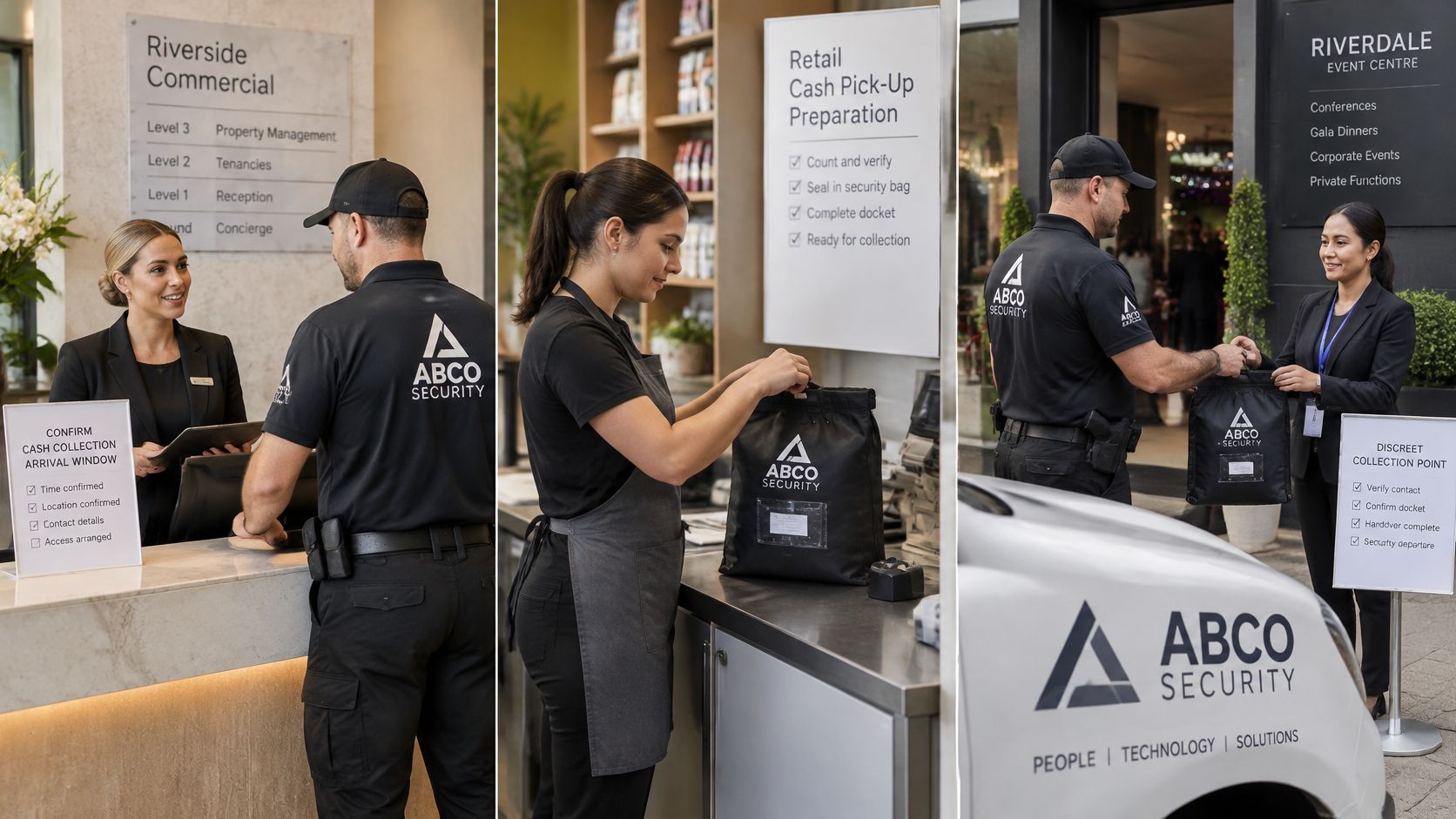
Match the plan to the operator
- Commercial property managers: Coordinate tenant and ATM collections through reception or Concierge Security. Nominate an escalation contact who can authorise access changes without disclosing consignment details across the building.
- Shopping centres: Align collections with trading demand and Shopping Centre Security coverage. Where feasible, assess alternatives to exposed morning ATM servicing, but don't move the task into a less controlled environment to change the time.
- Retail operators: Set till limits, secure drops and cash-room responsibilities. Retail Security should support store procedures without allowing customer-facing staff to become informal couriers.
- Event operators: Plan cash-up before gates open, including who remains after trading ends. Event Security and patrol resources should keep transfer routes clear while the authorised team consolidates takings.
- Construction and mining operators: Justify why cash is needed on site, restrict access to storage and define approved uses. Construction Security should protect the perimeter without becoming the default custodian of undocumented cash.
For example, an event organiser shouldn't schedule final collection at the same moment contractors remove barriers and staff surrender radios. Retain the access controls, communications and authorised cash-room contact until the consignment has left.
Write the outage playbook before it's needed
The RBA's Consumer Payments Survey findings report that cash represented about 15% of consumer payments by transaction count in 2025, with roughly half of Australians using cash during a typical week. Cash remains relevant even where electronic payments handle most everyday trade.
Define the conditions under which the business holds emergency change, requests replenishment or suspends cash acceptance because storage capacity has been reached. Specify deposit and withdrawal triggers, who authorises a change, and the recovery-time target for restoring till floats.
Continuity test: Can the duty manager activate the plan without finding an unavailable finance director or improvising a collection?
Coordinate the playbook with supply chain security arrangements, including alternate access and destination options. Cash won't solve every payment outage, but a prepared business can use it without creating an uncontrolled storage or transport problem.
Confirm Your Provider Before Your Next Peak
Test the provider's operating model against your busiest credible trading period. A low collection price is poor value if the crew cannot enter the property, the deposit destination is unclear, or no one owns an after-hours exception.
Questions that need written answers
- Jurisdiction and licence scope: Are the company and assigned personnel authorised for the work in every area served?
- Crew classification: What award and classification apply to the proposed transport duties?
- Insurance fit: Do cash limits and policy conditions match your maximum consignment and temporary holding arrangements?
- Monitoring arrangements: Who receives GPS, CCTV and unplanned-stop alerts, and what happens if communications fail?
- Escalation ownership: Which control room answers, what response commitments apply, and who contacts your duty manager?
- Custody records: Will you receive seal-level manifests, receipt records, exception reports and an incident-report template?
- Geographic reach: Can the provider confirm coverage for your address and the surrounding locations you need, rather than relying on a general claim of metropolitan coverage?
- Quality management: What commitments, such as ISO 9001, apply, and does any claimed certification cover the relevant operation?
Request the provider's workers' compensation evidence. A WorkCover certificate of currency is useful to review, but it does not replace theft or cash-in-transit insurance.
Assess the scope, not just the brand
For a Security Company Melbourne buyer, ABCO is one option to assess for licensed security guarding, mobile patrols, rapid response, and CCTV and alarm monitoring with immediate escalation. Confirm service areas, licence classes, transport capability and any subcontracting directly with the provider. General guarding services do not establish that specialist cash-in-transit transport is included.
Give prospective providers a site plan, cash-flow profile, access restrictions and outage requirements. Ask who owns each handover between your staff, the crew, the control room and the receiving bank or depot.
A useful proposal distinguishes routine collection from emergency replenishment and explains what changes during peak trading. It should also set out cancellation charges, unsuccessful collection arrangements and responsibility when the site is not ready.
Keep sensitive operational details within the authorised team. Do not circulate full routes or collection instructions through general tenant communications. The nominated duty manager should be able to run the agreed process safely when the usual contact is absent.
ABCO Security Services Australia offers security personnel, patrol response and electronic monitoring that can support controlled cash handovers and site continuity planning. Before your next peak trading or event period, visit ABCO Security Services Australia to request a site review, and confirm the licences, insurance and specialist transport scope your operation requires.
about
avada factory
Sempery ultricies nibh at dolor cras urna eleifend nec. Atiam efficitur tempor.