Construction accounted for 45 worker fatalities in 2023, representing 23% of all Australian worker fatalities that year, according to Safe Work Australia's national WHS statistics. That was 36% above the industry's five-year average of 33. These aren't theft statistics. They explain why a construction site security plan template must help keep people out of hazardous areas, not just protect equipment.
A useful plan connects physical controls, authorised entry, incident response and evidence of completed checks. It must also change when the site changes. A signed checklist doesn't prove much if the fence, delivery route or excavation shown on it no longer matches the ground.
Template Structure at a Glance
Treat the security plan as part of workplace health and safety management, with clear responsibilities shared between the principal contractor, site supervisor, WHS manager and security personnel. At ABCO Security Services Australia, workplace health and safety is our number one operational priority.
The same document structure can support a Melbourne tower, Sydney subdivision, Brisbane warehouse or Perth civil project. The controls won't be identical, but each project needs records showing what was protected, who could enter and how defects were resolved.
Template sections, core records and compliance anchors
| Template section | Core records | Example entry | Compliance anchor |
|---|---|---|---|
| Site risk assessment | Hazards, asset register, scope of work | Unfenced excavation beside a laydown area | WHS risk management cycle |
| Perimeter controls | Fence and gate specification, inspection log | Gap under a gate after a delivery | WorkSafe Victoria fencing guidance |
| Access control | Visitor and contractor sign-in, authorised-access list | Visitor held at gate pending host approval | Principal contractor duties |
| CCTV and alarm placement | Camera coverage map, alarm zones, footage retention rules | Blind spot behind the material cage | Auditable records supporting WHS duties |
| Staffing and rosters | Guard posts, patrol times, escalation contacts | Night patrol missed on a Sunday | Incident response protocol |
| Emergency response | Notification thresholds, emergency contacts, lone-worker rule | Trespasser found near live plant | Emergency services notification |
| Contractor management | SWMS check, induction records, coordination plan | Subcontractor without a current SWMS | SWMS and coordination plan requirements |
| Reporting and review | Incident log, change triggers, sign-off block | Fence damaged after a storm, not reported | Review after each change |
Each row becomes a tab or page in an editable document. Keep supporting maps, photographs and registers attached to the relevant page rather than scattered across email accounts.
Practical rule: Every control needs an owner, a check method and evidence that the check happened.
The compliance column is a reference point, not a declaration that a completed form satisfies every legal duty. Copy these section names into your file before starting the site risk assessment, then replace the example entries with actual site conditions.
How to Assess Site Risks and Close Down Safely
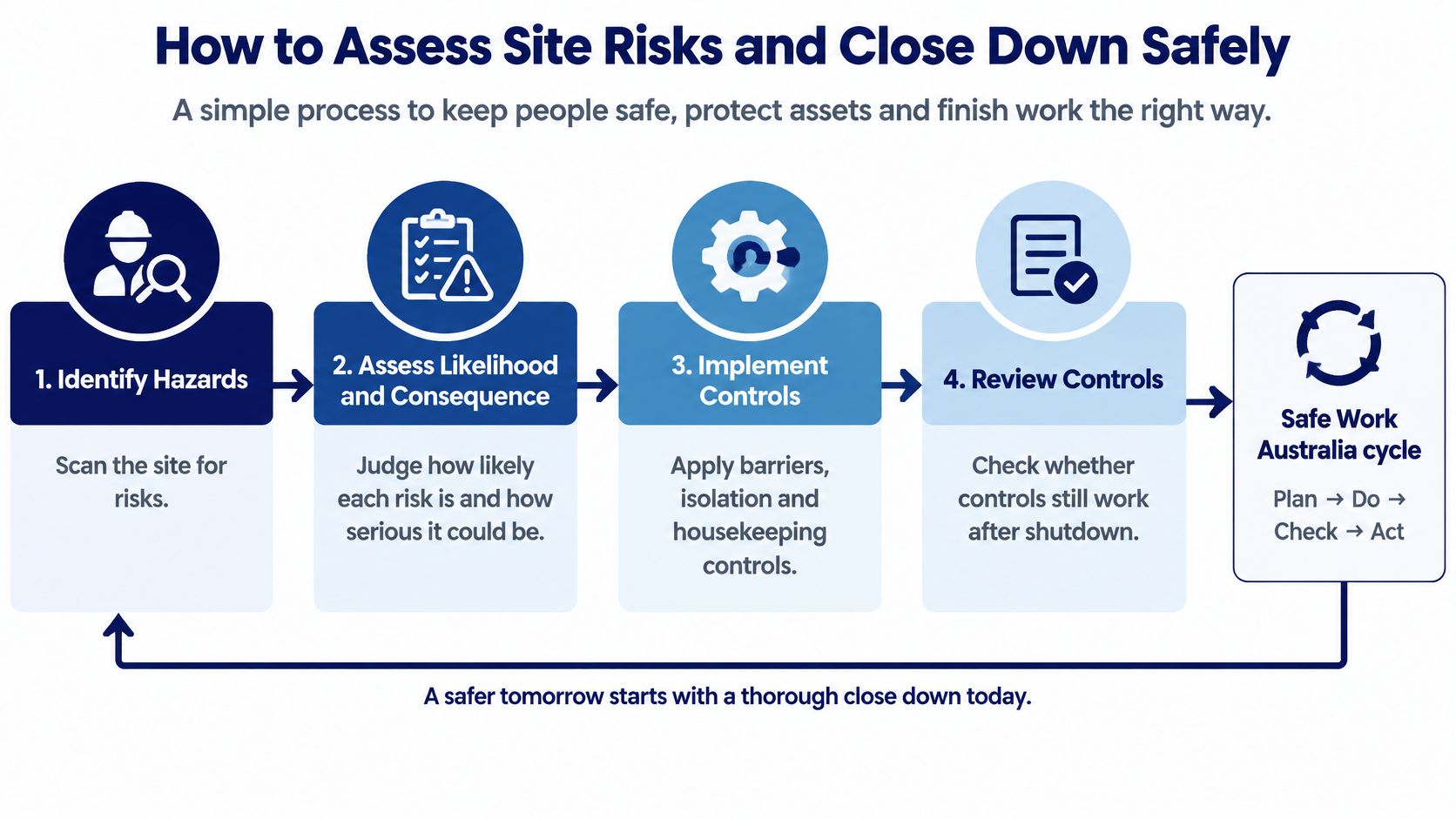
Use the risk-management cycle described by Safe Work Australia's construction risk guidance: identify hazards, assess likelihood and consequence, implement controls, and review effectiveness. Start with the physical site, not last project's paperwork.
Build the asset and threat register
Identify hazards. Walk the boundary, storage areas and access routes with the site supervisor. Record plant, fuel, copper, tools, temporary services, hazardous openings, perimeter breaches, vandalism, trespass and potential confrontation.
Assess likelihood and consequence. Consider how someone could reach each hazard and what could happen if they did. An accessible excavation needs attention even when there's nothing nearby worth stealing.
Implement controls. Eliminate hazards where practicable, consider substitution, then isolate people from danger and apply engineering controls. Administrative procedures and PPE address remaining risks, but a patrol instruction isn't a substitute for a physical barrier.
Review effectiveness. Check the installed control rather than accepting a purchase order as proof. A locked gate doesn't solve access underneath an adjacent panel.
The cycle should remain visible in the working document.
TP Training's guide to site risk assessment for civil workers provides useful context for connecting the register to construction activities. A focused security vulnerability assessment can also help distinguish a boundary weakness from a surveillance or response problem.
Close down in a defined sequence
Make the following sequence a proposed site procedure, with a responsible person and completion record:
- Remove or secure ladders and mobile access equipment. Don't leave a route into incomplete structures.
- Lock buildings, containers, plant and fuel stores. Record keys and unresolved lock defects.
- Cover or fence excavations and openings. Have the responsible site person confirm the protection is suitable.
- Isolate temporary power where appropriate. Follow the site's electrical arrangements without disabling essential safety systems.
- Verify perimeter integrity. Walk the boundary rather than checking only the main entrance.
- Test alarms and CCTV. Confirm operation and receipt of signals, not just illuminated indicators.
- Record the final inspection. Include the inspector, completion time, photographs and outstanding actions.
- Escalate defects before leaving. Obtain a decision on repair, isolation or interim protection.
Our Scope of Work must include the exact addresses and areas secured, service hours, detailed duties, site-specific risks, and access and logistics details. “Check the warehouse” isn't sufficiently precise.
Say a Brisbane warehouse closes with a ladder against an incomplete mezzanine and a gas bottle left unsecured outdoors. The closer records both, removes the access opportunity and refers cylinder storage to the responsible supervisor before accepting shutdown.
Could someone unfamiliar with the site complete the close-down using the template alone? If not, add locations, instructions and decision owners.
Perimeter Fencing and Gate Standards
Appropriate temporary security fencing is the preferred control for unauthorised access under WorkSafe Victoria's construction site security fencing guidance. It recommends fencing at least 1.8 metres high, properly constructed, stable against anticipated forces, difficult to climb and designed to prevent access underneath.
The guidance generally reserves security personnel surveillance for short periods when fencing isn't reasonably practicable. Buying more patrol visits doesn't correct an accessible boundary.
A controlled entrance needs a secure boundary alongside it.
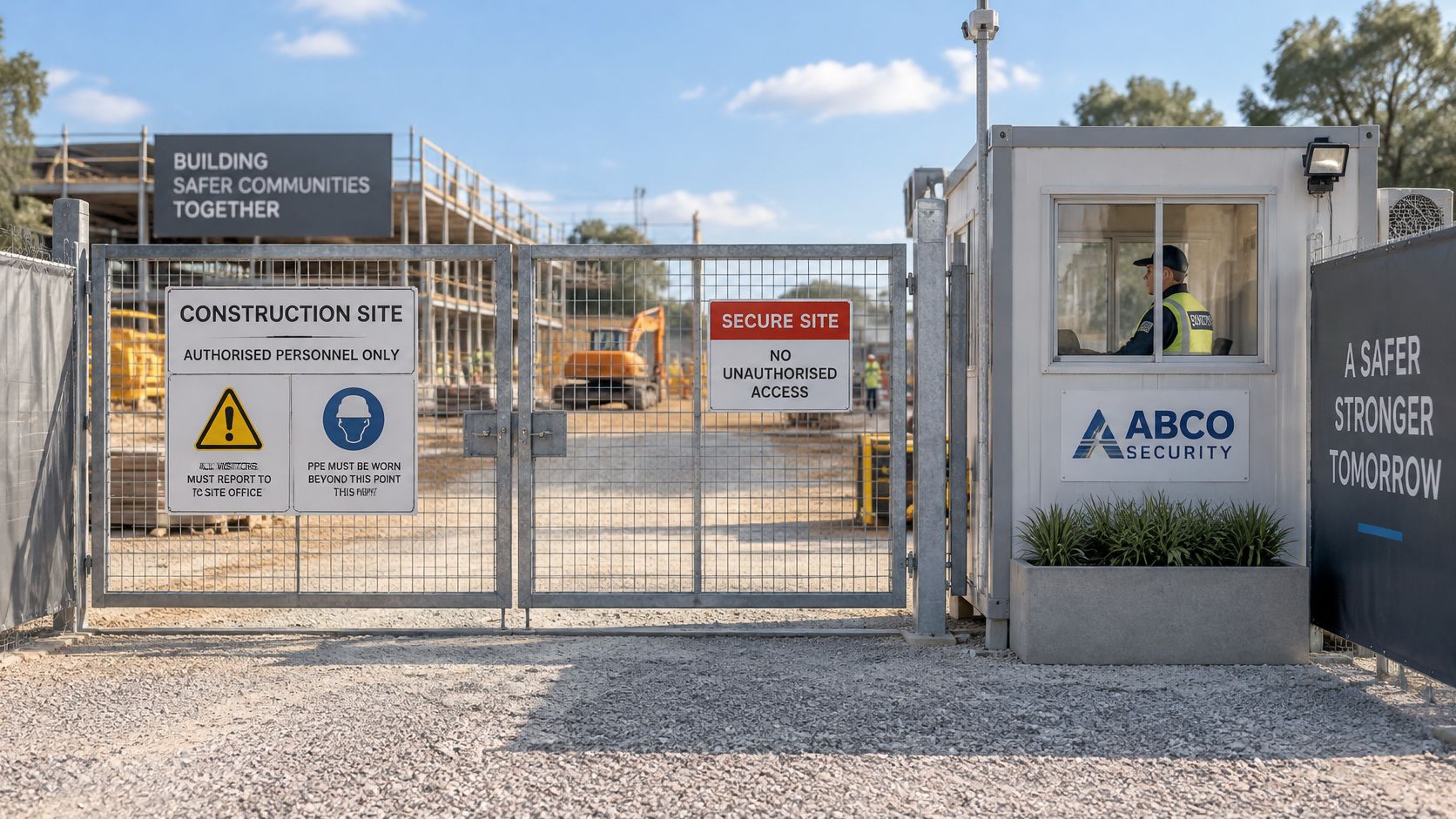
Perimeter specification and routine checks
The inspection intervals below are a proposed operating schedule, not universal statutory frequencies. Increase checks where site conditions warrant it.
| Element | Minimum requirement | When checked |
|---|---|---|
| Fence height | At least the height recommended above, taller where the site assessment requires | Each shift handover and end of day |
| Fence base | No gap allowing access underneath | End of each day |
| Gates | Security matching the fence, chained and locked | End of each day and after deliveries |
| Fence joints | Securely connected, no weak points | Weekly and after severe weather |
| Fence stability | Stable against strong winds, difficult to climb | After severe weather |
| Demolition or high-risk work | Taller fence where required by site-specific assessment | Before work starts and at each change |
Connect gates and joints securely and install proprietary systems to the manufacturer's specifications. Don't improvise bracing or add screening without checking how it affects wind loading and stability.
The choice between temporary fencing and hoarding should account for public exposure, visibility, wind conditions and the construction phase. A solid barrier can conceal activity from outside, so surveillance and inspection arrangements may need adjustment.
This video offers an additional visual reference for site-security planning.
Report defects before the site becomes unattended
Consider a Perth subdivision where a delivery crew lifts a panel beside the laydown area. If nobody records its reinstatement, the supervisor can mistakenly accept the boundary as secure over the weekend.
Gatehouse Security staff or patrol officers should report the panel location, defect, photograph and immediate exposure to the site supervisor. Set the escalation rule explicitly: an accessible breach requires a decision before unattended handover, with temporary protection recorded until repair is verified.
Complete the template's fence coverage, gate and joint schedule, inspection frequency and repair escalation fields. Include who can authorise an interim arrangement and who confirms the finished repair.
Access Control and Contractor Sign-In
Say a subcontractor reaches a Melbourne apartment project at 6.30 am and their name isn't on the authorised-access list. The guard holds them outside the controlled boundary, logs the attempt and calls the site supervisor. Recognising the company logo isn't approval to enter.
Nominate a named access-control owner and identify approved entry points on the map. Under WorkSafe Victoria's general duties guidance, the principal contractor's responsibilities include workplace security, lighting and safe entry and exit, including when work isn't taking place.
After-hours entry therefore needs an approval process, not an informal arrangement between a worker and whoever holds the keys. Check the relevant jurisdiction's duties for projects outside Victoria.
Record identity and authority separately
The visitor and contractor register should capture:
- Identity: Name and company.
- Host: The person accepting responsibility for the visit.
- Purpose: Work, inspection, delivery or another stated reason.
- Attendance: Time in and time out.
- Induction status: Completed, pending or restricted to an escorted visit.
An induction record doesn't automatically authorise access to every area. Link permissions to the task, location and approved work period.
Update the authorised-access list before a new subcontractor starts. Withdraw access when their work ends, and make the current version available at every operating gate.
Keep gate operations safe
Separate pedestrian entry from vehicle movements wherever practicable. Where routes intersect, use the approved traffic-management arrangement rather than expecting a guard to negotiate around reversing plant.
For deliveries outside working hours, record the booking, receiving person, unloading location and approval. If those arrangements aren't available, hold the delivery outside the site in a safe location or reschedule it.
Our client must provide safe, unobstructed access to the premises as outlined in the Scope of Work. That includes maintaining the agreed route when excavation, deliveries or temporary storage alter the layout.
Use the construction site access-control guide to develop gate instructions that match those arrangements. Emergency access must identify how fire services and ambulances enter, who holds the keys and who meets responders without obstructing evacuation.
Paste these fields into the template:
- Access owner and deputy: Names and contact details.
- Approved gates: Pedestrian, vehicle and emergency entry.
- Admission evidence: Register, identity check and induction verification.
- Exceptions: After-hours approvals and unlisted arrivals.
- Emergency entry: Key custody, responder route and meeting person.
CCTV, Alarm and Asset Tagging Benchmarks
Set complete visitor logging and high-value asset tagging as acceptance targets, alongside daily dispatch reconciliation and equipment checks at every shift handover. These convert broad recommendations about surveillance, controlled storage, lighting and sign-in in Safe Work Australia's construction security and violence-control guidance into auditable site procedures.
These are plan benchmarks, not measured crime-reduction rates. A completed register proves a record was made, not that theft became impossible.
Control benchmarks and evidence to keep
| Control | Benchmark | Evidence kept |
|---|---|---|
| Visitor sign-in | 100% of visitors logged with host, purpose, time in and out, induction status | Sign-in register |
| High-value asset tagging | 100% tagged with serial number, photograph and custodian | Asset register |
| Material dispatch | Daily reconciliation against delivery dockets | Signed reconciliation sheet |
| Alarm, CCTV and lighting | Checked at every shift handover | Handover log |
| Camera coverage | Views and lighting mapped against blind spots | Current site map |
| Footage retention | Retention period set in the template and confirmed at each review | Retention schedule and preserved-footage log |
Use these as proposed acceptance criteria, with exceptions recorded and assigned for correction.
The checklist makes those evidence requirements visible at handover.
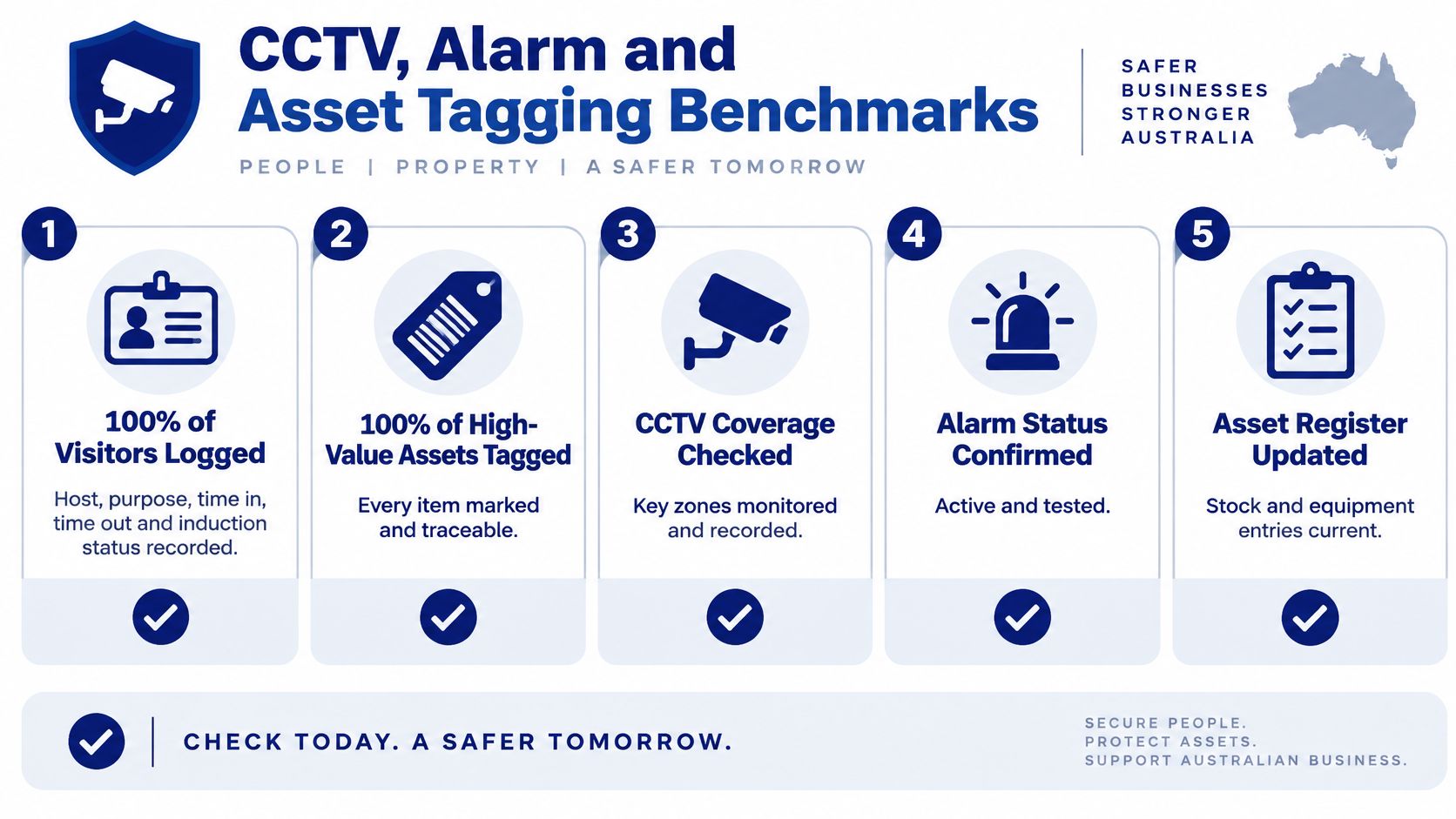
Map coverage before buying more cameras
Prioritise material stores, plant parking and hoarding corners that can't be seen from the gate. Check views after dark, with working lights operating, rather than relying on a daytime installation photograph.
Solar-powered camera towers with motion detection can suit locations without mains power. Confirm power autonomy, communications, image quality and alert routing for the actual installation.
Say an unmarked generator disappears from behind a Sydney site's material cage. A camera pointed at the entrance may show a vehicle arriving but miss the removal; an incomplete asset register may also leave the supervisor without a serial number.
Lock tools overnight in secured containers, use heavy-duty padlocks or chains, record equipment movements and apply a unique identifying mark. Tagging supports traceability; it doesn't replace secure storage.
A camera is a detection and evidence tool. Someone still needs authority and instructions to respond.
Set the footage-retention period in the template, restrict viewing permissions and preserve relevant footage after an incident. Record who exported it, when, and where the protected copy is held.
Route activated alerts to the gatehouse or monitoring provider. Require verification, a safe on-site check where appropriate, and a log showing time received, response time, action and outcome, including false alarms.
Staffing, Patrols and Emergency Response
Start the roster with coverage requirements: the personnel needed per shift, attendance hours, gatehouse and static posts, and patrol areas. Don't allocate one guard to simultaneous gate admission and a distant boundary inspection without an alternative arrangement.
Security Guarding provides continuous presence at assigned posts; Mobile Patrols provide periodic inspection. Choose the combination around exposure and tasks, not an assumption that either service covers everything.
The entrance post should have current instructions and a clear reporting path.
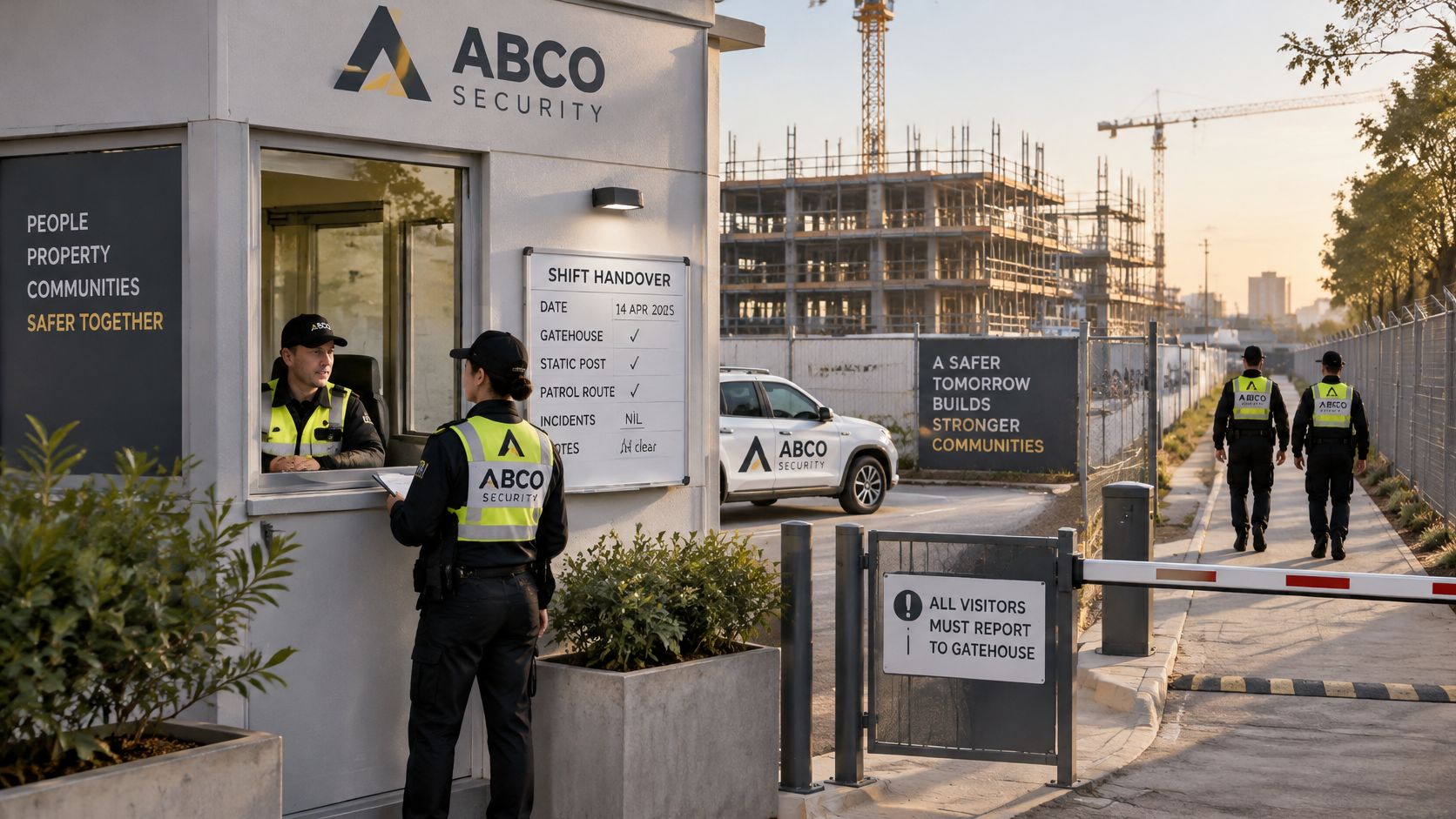
Connect patrol duties to safe escalation
Write scheduled and random patrols, lock-up and opening checks, alarm verification and after-hours inspection records into the roster. Define what happens if a patrol is missed, a route becomes unsafe or a gate must remain attended.
Our personnel act as a visible deterrent and follow the incident-response protocols agreed in the Statement of Work (SOW). Their role is to observe, record, communicate and act within those instructions, not confront an intruder alone.
A security plan doesn't replace a Safe Work Method Statement (SWMS). WorkSafe Victoria's SWMS guidance requires high-risk construction work to follow its SWMS and addresses stopping work when it doesn't comply.
If a guard identifies an uncontrolled exclusion-zone breach or an unauthorised person near high-risk work, they notify the site supervisor and record the event. They shouldn't independently direct hazardous construction activity.
Work through the trench scenario
Consider a hypothetical Friday-night patrol at a Brisbane civil project. The guard sees a trespasser beside an open trench and follows this sequence:
- On detection: Stay outside the hazard area, note the location and avoid pursuit.
- Immediately: Contact emergency services if there's immediate danger, injury or another emergency, then activate the agreed call tree.
- While awaiting assistance: Observe from a safe position and prevent further entry only where that can be done safely.
- At handover: Record detection, calls, acknowledgements, responder arrival and resolution using actual timestamps.
Don't promise a universal response time. Access, distance, hazard conditions and emergency-service availability affect what can happen.
The call tree needs notification thresholds for the principal contractor, emergency services and security provider, plus a deputy if the primary contact doesn't answer. Set a monthly contact test as a site procedure and record the result.
Handover question: Who makes the decision at 2 am?
Write that person's name, deputy and authority into the template.
Confirm Your Plan Before the Next Site Handover
Review the plan after a perimeter alteration, new subcontractor, changed delivery route, moved storage area, demobilisation, severe weather or security incident. A scheduled review alone won't catch a gate moved between scheduled inspections.
Assign the site supervisor to approve layout changes, the access owner to approve permissions and the nominated security contact to acknowledge revised instructions. Set the same shift as the proposed recording deadline, with safety-critical changes resolved before affected access or unattended handover.
Keep a usable change log
- Boundary or route change: Update the site map, patrol instructions and emergency route.
- Subcontractor change: Update authorised access and induction references.
- Storage relocation: Recheck camera coverage and asset locations.
- Incident or weather damage: Record corrective action, interim controls and verification.
Our client must keep the Scope of Work accurate and notify us in writing of material changes to site conditions or risks. A conversation at the gate isn't a controlled document update.
Use construction security shift-handover protocols to align the outgoing and incoming teams. Add a sign-off block containing date, reviewer, version number and reason for revision.
Before handover:
- Walk the site: Compare the document with actual conditions.
- Complete shutdown: Run the close-down sequence and record the result.
- Verify contacts: Confirm escalation contacts are current and reachable.
Version history helps an auditor establish what changed, when it changed and who approved it. Use Safe Work Australia's WHS guidance alongside the applicable state regulator's requirements.
For projects in Melbourne, Sydney, Brisbane, Perth, Adelaide and surrounding cities, record the actual service area and travel arrangements. Don't treat a nominal radius as a response-time commitment.
Compliance Checkpoints for Australian Construction Sites
Use these checkpoints before accepting the plan. Record a date, reviewer initials and supporting document reference for each item, and resolve jurisdiction-specific questions with the relevant regulator or qualified adviser.
Match each checkpoint to its record
WHS duty and perimeter controls: Confirm the workplace is secured so far as reasonably practicable, including unattended periods. Identify the applicable Work Health and Safety Act and regulations, or Victoria's Occupational Health and Safety Act 2004 and regulations, rather than applying another state's rules automatically.
SWMS and contractor management: Confirm relevant SWMS are prepared before high-risk construction work starts. Security instructions should identify the affected zones and the supervisor responsible for a breach.
Project coordination: In Victoria, a health and safety coordination plan is required where construction work costs more than $350,000, according to WorkSafe Victoria's construction safety pocket guide. Cross-reference the security arrangements to that plan.
Licensing and staffing: Verify each guard's and patrol operator's required state private-security licence. Record licence details and verification in the staffing register.
Electronic systems: Specify CCTV against the AS 4806 series and intruder alarms against the AS 2201 series, confirming current editions, applicability and contractual requirements with the supplier. Retain commissioning and test records.
Privacy and footage: Check obligations under the Privacy Act 1988 (Cth) and applicable state law where footage identifies people. Limit access and retention to justified site needs and document incident preservation.
The Australian construction site security regulations guide can support the review, but a generic template isn't proof of legal compliance. Keep evidence of implementation beside each checkpoint.
ABCO Security Services Australia offers after-hours guarding, access gate management, mobile patrol support, temporary CCTV and solar towers, and site safety inspections and reports. To review your construction site security plan template against your site's layout, hazards and handover arrangements, visit ABCO Security Services Australia and request a free on-site risk assessment.
about
avada factory
Sempery ultricies nibh at dolor cras urna eleifend nec. Atiam efficitur tempor.