Australia's critical infrastructure operators are being asked to plan for a scenario their IT teams rarely say out loud: being cut off from their own systems for up to three months. Australian Government cyber threat reporting states that critical infrastructure entities should be prepared to isolate systems and networks for up to three months.
Read that as a site manager and the meaning changes. Network isolation isn't an IT event. It's a boom gate that won't lift at 6am, an alarm panel nobody can silence, a card reader that stops recognising its own staff, and a CCTV feed that goes dark exactly when you need to know who's at the fence.
That's the seam this article works on. Critical infrastructure security gets written up as a cyber problem or a guarding problem. It's one problem, and it fails where the two meet: at the gatehouse, the loading dock, the plant room and the control room.
What follows covers what's being protected, what's attacking it, what the law requires, and how to build a defence that still works when the network doesn't.
What Critical Infrastructure Security Protects
Critical infrastructure security is the protection of the physical sites, digital systems and operational technology that keep essential services running: power, water, gas, transport, healthcare, communications, financial services and government services. It covers intrusion, sabotage, disruption and outright failure. Failure gets the least attention and causes the most outages.
A city water network is only as strong as its weakest valve. One failed pump station, or one supplier who can't deliver treatment chemicals on schedule, drops pressure across an entire district. Nobody owns the whole outcome, yet every organisation in the chain shapes it.
Here's how the layers stack up.
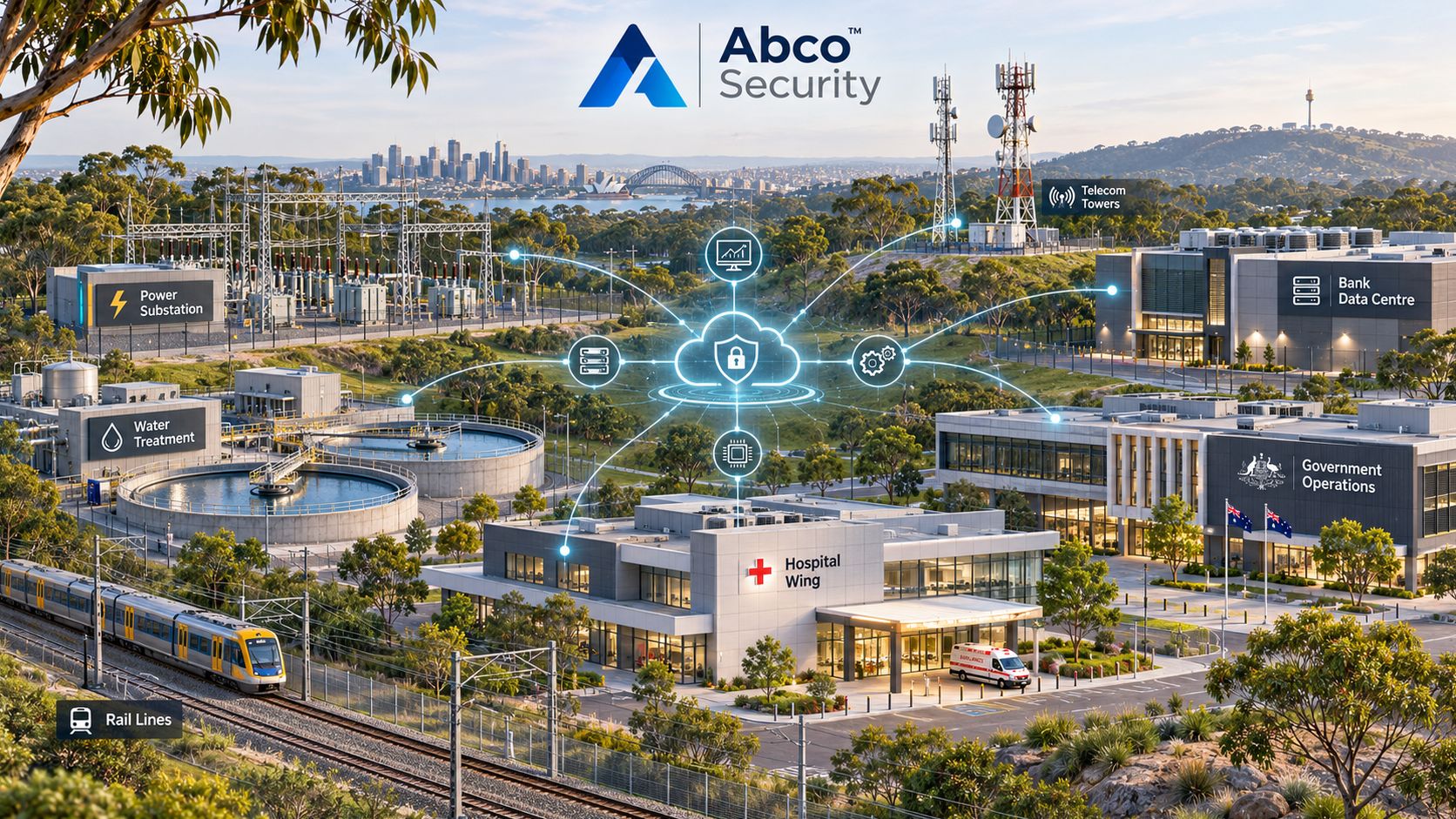
The three layers that must hold together
- Physical sites and people: fences, gates, bollards, control rooms, server rooms and plant rooms, plus the licensed officers who verify who walks in and the records they keep.
- Cyber systems and operational technology: identity systems, remote access, building management, access control, camera analytics, and the industrial control systems running pumps, valves and conveyors.
- Continuity arrangements: the manual procedures, backup communications, clean backups and on-site staffing that keep a site operating when either of the other two layers fails.
The examples are ordinary until you trace the dependencies. A substation gate answers to a facilities team, its cameras answer to a security provider, and the telemetry behind the gate answers to an OT engineer. A hospital plant room with controlled access holds equipment that cools operating theatres and stores vaccines.
A shopping centre makes the point best. Car park CCTV, lighting, tenant access and the building management system often share a network, so one compromised account can affect parking, power and tenancy records at once.
Commercial property, warehouses and event venues sit inside the chain even when they aren't formally regulated. They depend on utilities and transport for everything, and the businesses that depend on them depend on the venue in turn.
Three questions for your own site
- What stops if power, communications or access systems fail here, and for how long? Name the specific functions, not the whole building.
- Who depends on this site, and what happens to them in the first hour? Tenants, patients, passengers, students and cold-chain customers all answer differently.
- What does this site rely on that someone else runs? Utilities, cloud platforms, lift contractors, cleaning crews and alarm monitoring all count.
Answer those and you've mapped your exposure better than most compliance templates will.
Threats Facing Australian Critical Infrastructure
In financial year 2024-25, critical infrastructure incidents represented 13% of all cyber security incidents handled by the Australian Signals Directorate's Australian Cyber Security Centre, up two percentage points on the previous year, according to the ASD Annual Cyber Threat Report 2024-25.
The activity mix behind that number is more useful than the number itself, because each activity points at a different control.
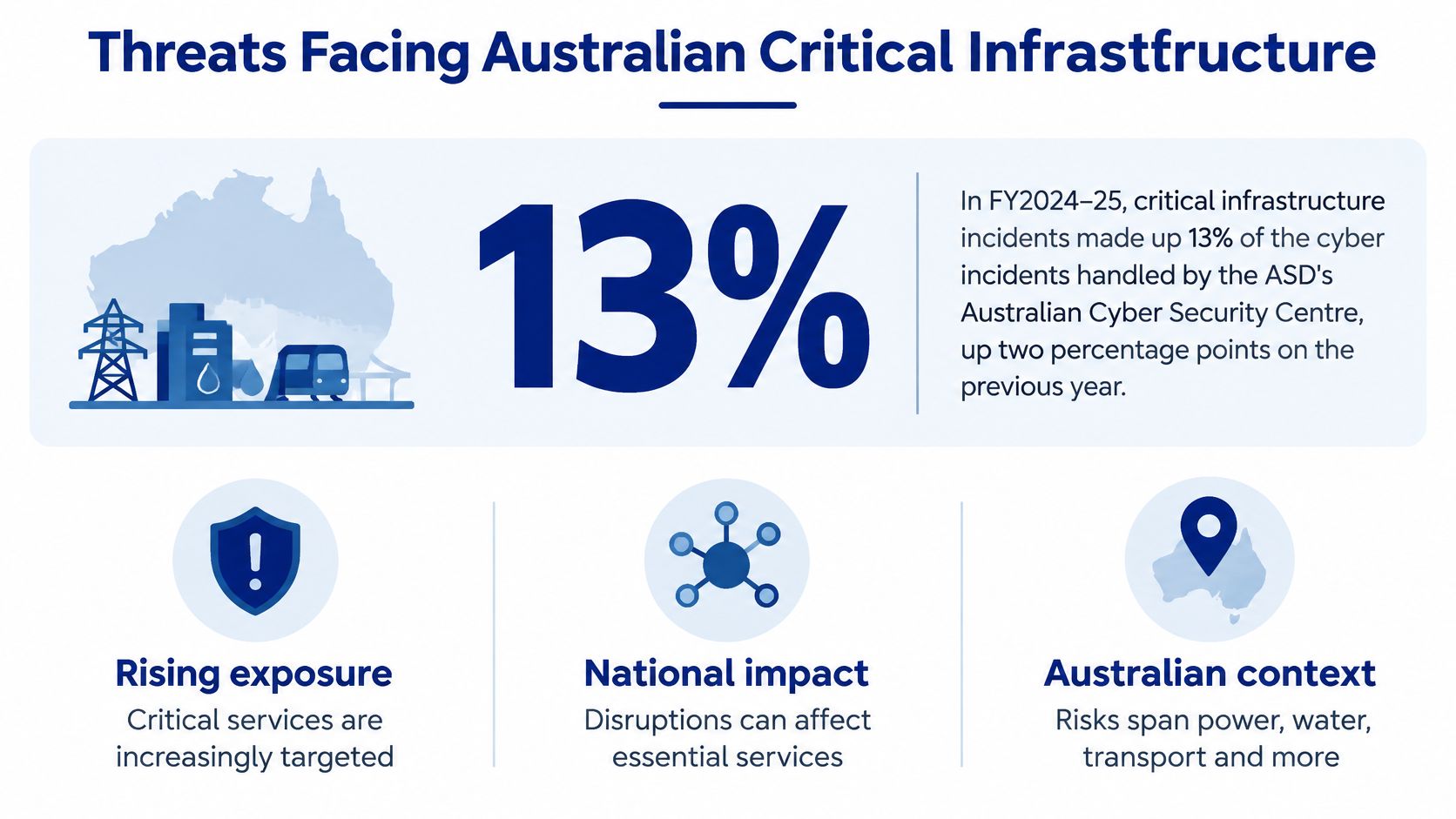
The three leading activity types were scanning or reconnaissance at 41%, denial-of-service or distributed denial-of-service attacks at 31%, and phishing at 20%, all from the same ASD report.
| Activity type | Share of CI incidents FY2024-25 | Practical control |
|---|---|---|
| Scanning or reconnaissance | 41% | Asset inventory and external attack surface monitoring |
| Denial-of-service or DDoS attacks | 31% | Pre-tested traffic filtering and failover procedures |
| Phishing | 20% | MFA on remote access and staff credential training |
What each activity looks like on site
Scanning is the quiet one. It maps internet-facing systems, remote access services and poorly segmented operational technology networks before anyone attacks them. To a site manager it looks like nothing: no alarm, no forced door, just a slow catalogue of what you've left exposed.
Denial-of-service is the loud one. ASD responded to more than 200 DoS or DDoS incidents involving Australian organisations, an increase of more than 280% year over year, and the critical infrastructure rate was nearly twice the 16% recorded across all incidents. The point is to interrupt public-facing services, which is why a ticketing system, customer portal or payment gateway can vanish at the worst possible moment.
Phishing captures staff credentials, and credentials are what open doors now. A stolen login for a building management console gets an attacker further than bolt cutters ever did.
An attack that started in an inbox ends at a boom gate. The barrier stays up, the alarms read clear, and the site has lost the two things it needs most: the ability to verify people and the ability to respond to a signal.
Most of this is opportunistic rather than targeted. Automated scanning finds exposed services for free, and phishing kits get sprayed at thousands of inboxes at a time. Smaller operators aren't exempt. They're often the easiest door into a larger supply chain.
The briefing below covers how the national picture translates into day-to-day operations.
Start with the row in the table that matches your exposure. A site with remote access to plant should fix its external attack surface first. A site with a public-facing booking or payment service should test failover and traffic filtering before it ever needs them.
Legal and Regulatory Duties Operators Must Know
The Security of Critical Infrastructure Act 2018 (Cth) is the legislative framework behind Australia's critical infrastructure cyber security incident arrangements. It sets out cyber security incident response powers and a regulatory framework covering critical infrastructure assets and the entities responsible for them.
The first question isn't how to comply. It's whether the Act captures your assets at all.
Coverage depends on what you operate
Capture turns on sector and asset criteria, not headcount. A small operator running a captured asset carries duties. A large business outside the captured categories may carry none under the Act, though contracts with regulated customers can impose near-identical obligations. Check the rules for your asset type rather than assuming size decides it.
The duties that turn into paperwork
- Named responsibility: one accountable person for incident preparation, not a committee that meets quarterly.
- Current contact and escalation records: numbers that work at 3am and a call order staff have rehearsed.
- Reliable incident information: times, observations, decisions and who authorised what, captured as they happen.
This is the point where cyber and physical duties stop being separate problems. When an attack takes a building system offline, the record that matters is produced at the gate and the control room, not the server rack. Patrol observations, access events, alarm activations, visitor movements and response times all become reviewable records, provided they're captured in a consistent format rather than a free-text scrawl.
Practical rule: a gatehouse entry reading "card fault, 02:14, identity verified by phone to site manager, access granted with escort, cleared 02:31" is evidence. "Door issue" is a note that helps nobody three weeks later.
That distinction matters because a card fault during a network outage can be routine, or it can be the first sign someone is testing the door while the cameras are blind. A gatehouse, control room or corporate reception procedure has to separate a routine fault from suspected sabotage, unauthorised entry or technology compromise, because the responses differ sharply. Gatehouse security and concierge security posts work when responsibilities, escalation paths and evidence handling rules are agreed before an incident rather than during one.
Sector programs make the same point in specific terms. Aviation and logistics operators, for instance, work to aviation security requirements that set out screening, access control and record keeping expectations.
Four documents to keep current
- Asset register: what you run, where it sits and which system controls it.
- Contact and escalation list: internal owners, IT, security provider, utilities and the regulator, with after-hours numbers.
- Visitor and access log standard: the fields every post records, every shift.
- Post-incident review template: what happened, what was decided, what changes.
Sector Vulnerabilities and Where to Focus Controls
A cyber outage at a water utility quickly stops being a cyber problem. On site it looks like a pump that will not start, an alarm that stays silent, or a gate that will not open or will not close. The same intrusion lands differently at a shopping centre or a hospital, so the first control worth funding depends on what the site physically does.
The table maps common exposures to the control that should come first.
| Sector | Typical exposure | Priority control |
|---|---|---|
| Energy, gas and water | Remote access to control systems and remote pump or substation sites | Segregated OT networks, MFA on remote access and manual override |
| Transport, postal and warehousing | Gates, loading docks and logistics platforms | Gatehouse security, access logs and dock visitor verification |
| Education and training | Large visitor flows and shared IT networks | Visitor verification, CCTV coverage and separated student and admin networks |
| Commercial property and financial services | Building management systems and cloud platforms | Concierge security and access control with offline fallback |
| Healthcare | Plant rooms, medical systems and restricted clinical areas | Controlled access, alarm escalation and tested backup procedures |
| Retail and shopping centres | Car park CCTV, tenant access and building systems | Shopping centre security and mobile patrols |
| Government and public venues | Public-facing services and high-visitor events | Event security planning and documented escalation |
National reporting puts utilities at the top of the list. ASD's cyber threat trends for critical infrastructure for 2023-24 shows electricity, gas, water and waste services accounted for the largest share of critical infrastructure reports, followed by education and training and transport, postal and warehousing. The pattern makes sense. Few sectors combine so much supplier remote access with so many physical sites nobody watches full time.
Energy, gas and water
Remote access is the pressure point, and most of it belongs to suppliers. Vendor support sessions, engineering workstations and cellular links to unmanned pump and substation sites accumulate over years and rarely get reviewed. Each one is a door into both the network and the physical plant. Segregating OT from IT, enforcing MFA on every remote path, and giving an operator a manual override they have used in a drill addresses most of it.
Healthcare
Plant rooms, medical systems and restricted clinical areas share corridors with high foot traffic. Cooling, power and access control matter more than data here, because a failed chiller can close a ward. Test backup procedures at night, when staffing is thinnest, and confirm who can open a plant room without a network.
Retail and shopping centres
Car park CCTV, tenant access, after-hours deliveries and shared building systems create a wide, low-friction surface. Shopping centre security depends on tenant onboarding and offboarding discipline as much as on patrols, because the weakest access card is usually one issued to a business that moved out.
Commercial property and financial services
Building management systems and cloud platforms run the lifts, cooling and access floors of whole towers. Where tenants keep their own racks in shared facilities, data centre security sits inside the same question, because tenant racks, shared cooling and remote hands all sit behind one access control layer, and a compromise there reaches every floor above it. The priority is an access control setup that still grants and logs entry when the cloud platform behind it is down.
Then run the small test. List the three most critical assets on your site, name the system that controls each, and write down who can physically reach them, including vendors holding remote sessions. Any answer that begins with "not sure" is your first project.
Layered Defence Across People, Processes and Technology
No single control survives a determined attacker and a tired night shift. Layering works because each layer assumes the one beneath it can fail: people at the base, processes in the middle, technology on top. Cyber and physical stop being separate problems the first time a network outage turns a card reader into a locked door.
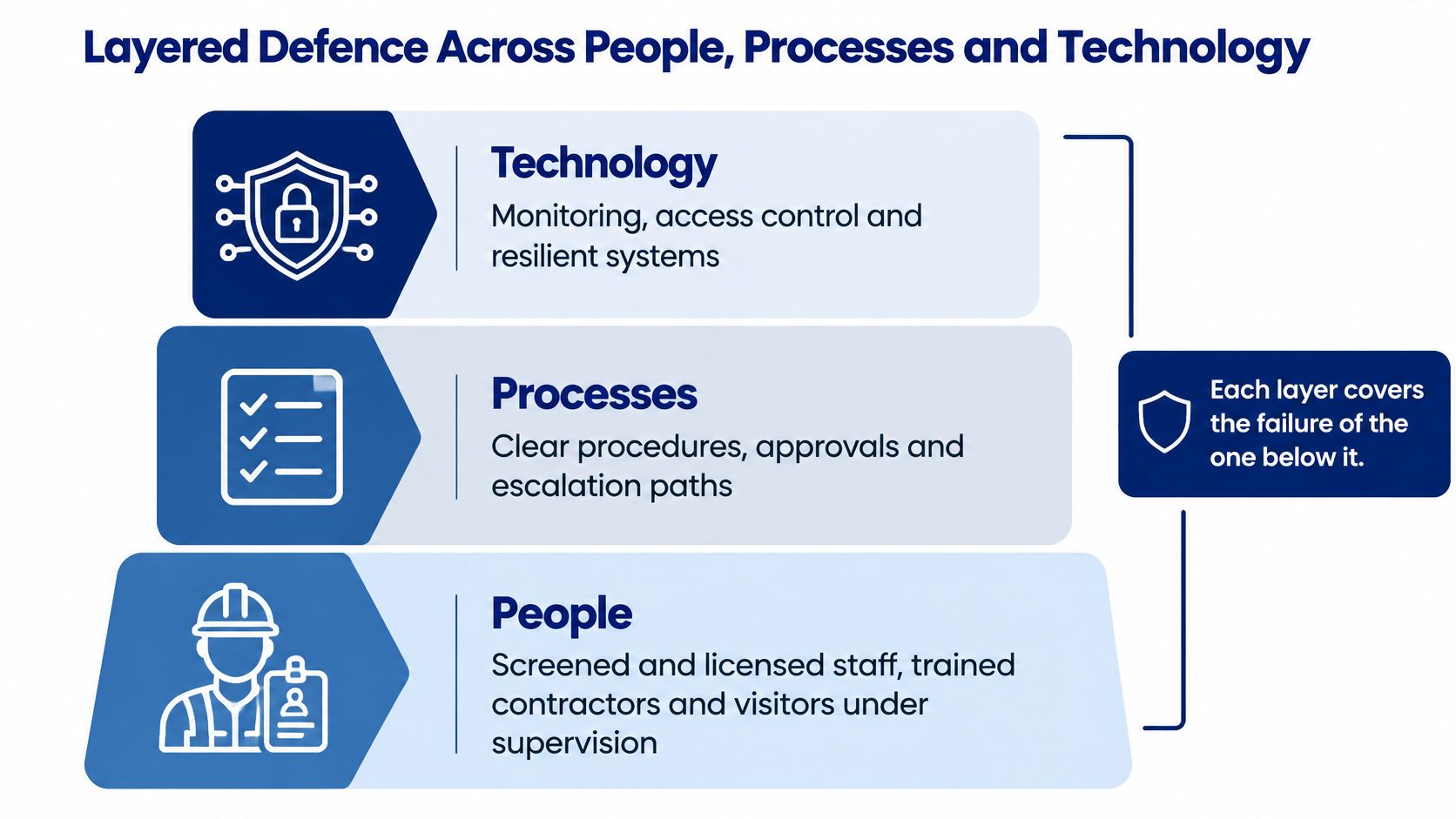
People
Screened, licensed staff, visitor verification at every entry point, and training on phishing and social engineering with a clear duty to report. Security guarding and mobile patrols put a trained person where identity gets checked, which is where credential abuse usually begins. ASD reported compromised accounts or credentials as the most frequent incident category, at 32% of critical infrastructure incidents in the 2023-24 annual cyber threat report. A guard holding a printed access list can also run a gate that a dead badge system cannot.
Processes
An asset inventory, written access rules per entry point, escalation thresholds in minutes, documented manual procedures, contractor offboarding, and an exercise run at least twice a year. In 2024, only 15% of Australian Government entities reached overall Maturity Level 2 across the Essential Eight mitigation strategies, down from 25% in 2023, according to ASD's Commonwealth cyber security posture report. A manual procedure only counts if it survives the failure it covers: one stored as a PDF on the network it replaces is useless when needed.
Technology
CCTV with defined coverage zones, access control with an offline fallback, alarm monitoring with an escalation path, MFA on remote access, segregated IT and OT networks, and centralised logging that someone reads. A cyber intrusion reaching an access controller or camera network blinds the site physically, so networked systems need 24/7 monitoring that escalates a detected threat for response in real time rather than leaving it in a log.
Eight controls to tick off
- Asset register: every device that controls something physical is listed with an owner.
- Access rules: written per entry point, including who can escort visitors.
- Escalation thresholds: stated in minutes, with a named contact at each step.
- Manual procedures: printed, stored off-network and practised.
- Contractor offboarding: access removed on a set day, with a record.
- Exercises: at least twice a year, with a written debrief.
- CCTV coverage zones: defined, tested and documented, including after-hours blind spots.
- MFA and network separation: enforced on remote access, with IT and OT kept apart.
A warehouse dock shows how the layers interlock. A guard verifies the driver against a booking list, CCTV covers the dock from two angles, and the badge log flags any after-hours entry to the control room. Remove one layer, or knock the badge system offline, and the remaining controls still hold.
ASIAL, the Australian Security Industry Association Limited, is the reference point for licensed and screened staff standards across the guarding industry.
Layering has a limit worth stating plainly. Security services are a deterrent and cannot guarantee the prevention of all theft, loss or damage, which is why the layers get tested together rather than assumed.
Incident Response Steps From First Alarm to Recovery
The hardest incident to handle is a blended one: a compromised access control account, a guard reporting someone at the fence, and a phone system that's down. The Australian Government's 2025 risk review identifies agentic artificial intelligence, sabotage, and skill and staffing shortages as developments operators must manage, as summarised in the Minister for Home Affairs release.
A blended incident needs a sequence a tired officer can follow at 2am. This one holds up.
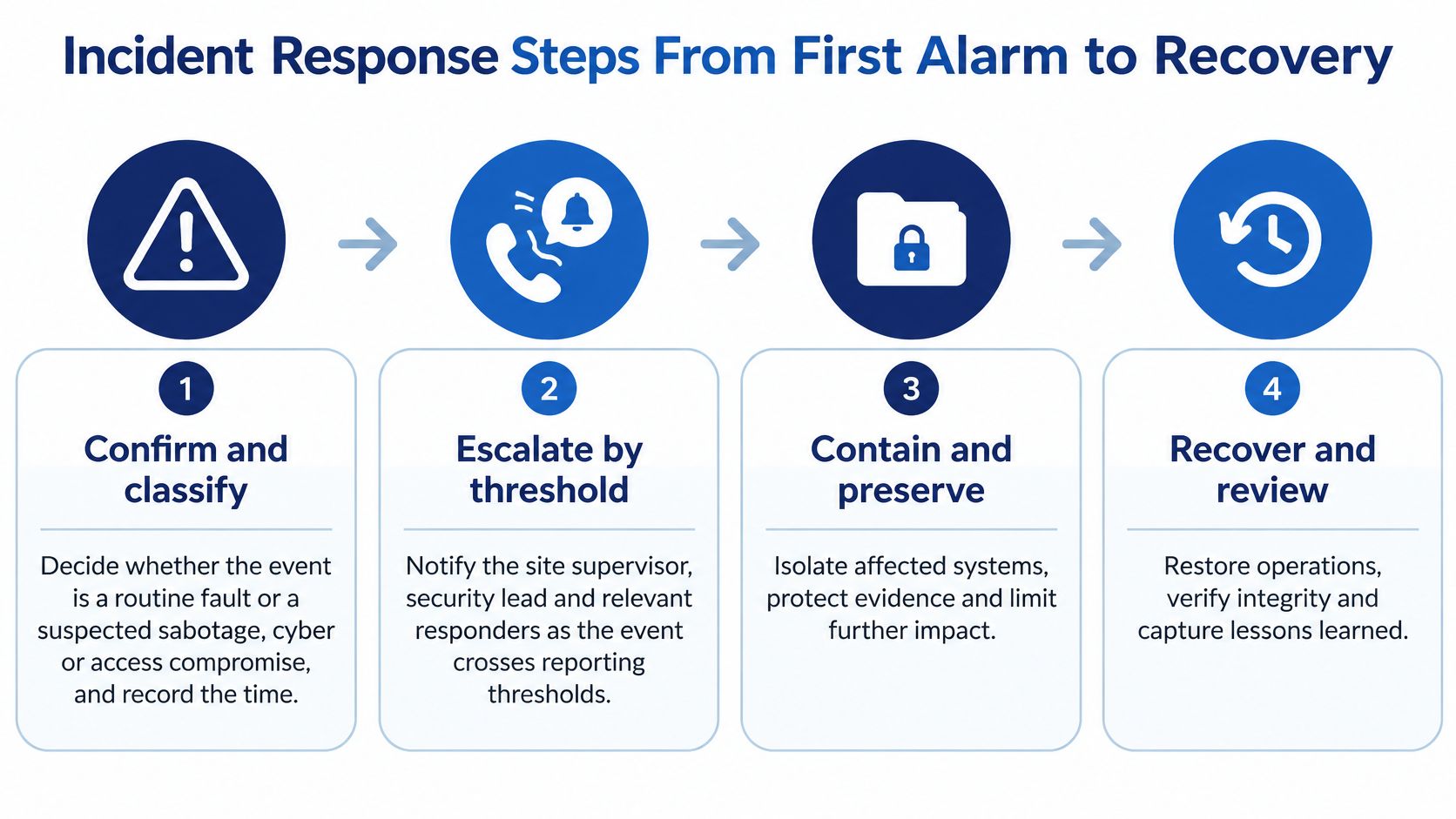
- Confirm and classify. Decide whether the event is a routine fault or a suspected sabotage, cyber or access compromise, and write the time down. The common mistake is treating every anomaly as a fault until someone senior arrives.
- Escalate by threshold. Notify the site supervisor, the control room and IT within the minutes your written thresholds set. Waiting for certainty burns the window when containment is still cheap.
- Verify identity before granting access. Check people against a central list, and use call-back to known numbers when systems are down. Never accept a verbal claim at the barrier just because the reader is offline.
- Secure the site. Hold or lock entry points, protect people first, and move to manual procedures. The usual error is keeping a gate open to avoid a queue.
- Preserve evidence. Export CCTV, access logs and alarm records, and don't wipe or restart devices to see if that fixes things. A restart can destroy the log that explains what happened.
- Communicate on fallback channels. Radios and mobile phones, with a nominated caller and a schedule. Silence gets filled with rumour.
- Isolate and run manually. Separate affected networks and run essential functions by hand for as long as needed, planning for a long disconnection rather than an hour.
- Recover and review. Restore from clean backups, verify what's working, debrief the team within a week and update the plan.
Steps two and six are the ones that break at night, because they depend on someone answering a phone. We keep 24-hour communication channels between site supervisors, security officers and our operations centre for exactly that reason. Our personnel act as a visible deterrent and follow the incident response protocols agreed in the Statement of Work.
A written plan is the starting point. A security incident response plan template gives you the sections to fill in before a real event, when nobody has time to design one.
Procurement and Vendor Checks Before You Sign
A supplier's cyber incident rarely stays inside their network. It reaches your site as a gate that will not open, an alarm panel that stops reporting, or an access control system that rejects every valid card. The Australian Government's Critical Infrastructure Annual Risk Review 2025 reports that data breaches affecting multiple critical infrastructure operators, and exposing millions of customers' personal information, were caused by attacks exploiting vulnerabilities in third-party platforms.
That finding changes how you read a compliance certificate. A certificate works like a roadworthy slip: it confirms the vehicle passed inspection on the day it was tested, not that the brakes still work. A regulated operator can meet every obligation it holds and still carry systemic risk, because the weak point sits with a smaller supplier, a shared platform or a contractor whose logins outlive the job.
The fix is contractual. Split responsibility in writing before an incident, across technology vendors, contractors, landlords, managed service providers and the frontline security team, then map who owns which control. When a vendor's platform drops offline overnight, the contract should already answer who calls whom and which checks run manually.
| Check | What to request | Why it matters |
|---|---|---|
| Access ownership | Named staff with individual accounts and no shared logins | Shared credentials are an easy route in |
| Privileged access | Approval, logging and time-limited admin rights | Admin accounts are high-value targets |
| Offboarding | Access removed within a stated period after staff or contract end | Former contractors often keep working access |
| Incident notification | A contractual timeframe for telling you about incidents | Late notice delays your response |
| Dependency inventory | A list of the vendor's own suppliers and platforms | Hidden subcontractors widen exposure |
| Joint exercise | An annual test of incident handling with the vendor | Untested contracts fail under pressure |
Ask for evidence, not assurances
Request documents rather than promises:
- Recent audit results, not a summary slide claiming certification.
- A current list of people with access, plus when it was last reviewed.
- A named incident contact with an after-hours number that reaches a human.
A security contractor whose former staff kept working logins after their contract ended is a common gap, and a monthly access review catches it in minutes.
Hardware belongs in the same schedule. Cameras, sensors and IoT devices bought for a site often come from offshore suppliers and outlive the contract that bought them, so compare NDAA compliant camera modules before a purchase order goes out, particularly where procurement rules restrict certain vendors.
Check standards the same way, and ask for the certificate rather than the claim. ABCO Security is fully committed to the international Risk Management Standards ISO 30000 and the Quality Management Systems standard ISO 9001, and evidence of that commitment belongs in the tender pack. The same discipline extends to guarding and monitoring providers, which is why supply chain security checks sit in the schedule beside the technology clauses. When the provider's platform degrades, it is your guard post and your alarm feed that feel it first.
Write each check into the contract with a review date. A control that lives in a conversation disappears when the account manager changes.
Assess Your Site Against These Layers
Run this assessment the way an incident would run: from the outermost control inward, and in order. A gate that fails because a network outage locked the access control panel counts as a missing control, not a partial one.
- Run a gap check. Work through the eight controls and the response sequence, marking each one in place, partial or missing. Be honest about the partials, because that's where incidents get through. For every partial, write down what would finish it: a roster change, a tested backup path, a second way to open the gate when the system behind it is down.
- Name an owner and a threshold. Every missing control gets a person, a date and an escalation threshold written in minutes. Minutes matter because a cyber outage that reaches a gate or alarm panel is already on the clock. Unowned controls stay missing.
- Get an on-site assessment. ABCO Security Services Australia provides a free on-site risk assessment and then develops a customised security plan to suit your environment, industry and budget.
The services covering these layers run from Security Guarding and Mobile Patrols through Gatehouse Security, Concierge Security, Construction Security, Retail Security, Shopping Centre Security and Event Security, alongside electronic security that includes end-to-end setup and integration of surveillance systems, access control, video analytics and remote-viewing technology. ABCO has offices in Melbourne, Sydney, Adelaide, Perth and Brisbane and provides security services across Australia.
Keep your picture of the threat current as well. ASD publishes national cyber threat reporting at cyber.gov.au, and the activity shares move year to year.
ABCO Security Services Australia brings licensed guarding, mobile patrols, gatehouse and concierge coverage together with electronic security spanning surveillance, access control, video analytics and remote viewing, built around the layers described here. If your site depends on systems you don't fully control, an on-site assessment will show you where it fails first and what to fix in what order. Visit ABCO Security Services Australia to arrange yours.
about
avada factory
Sempery ultricies nibh at dolor cras urna eleifend nec. Atiam efficitur tempor.