You've got an event, a construction start, or a busy retail weekend coming up, and someone has just said, "Order the fencing." That sounds simple until you're deciding where people queue, where trucks turn, which gates stay open for evacuation, and what happens if wind picks up or a crowd pushes forward.
That's where crowd control fencing stops being a hire item and becomes a safety system. The right barrier holds a line, shapes movement, and gives staff time to act. The wrong layout can trap people, block an exit, or transfer pressure to the exact point where someone gets hurt.
I would treat every fence run as load-bearing temporary work first, and as a boundary second.
Crowd Control Fencing Types and Their Uses
Crowd control fencing is a temporary or semi-permanent barrier system that holds, directs, or separates people. It doesn't work on its own. It works with staffing, entry control, signage, lighting, and an evacuation plan.
Start by separating two jobs that are often confused. Exclusion fencing keeps people out of a site, backstage area, plant zone, or closed precinct. Direction fencing lets people in, then shapes how they queue, turn, pause, and exit once they're inside.
Choosing by Job, Not by Panel
If you choose by job, the product choice gets easier. A perimeter panel won't manage stage pressure, and a light stanchion won't secure a construction boundary or stop someone stepping into a delivery lane.
Crowd control fencing types by use
| Type | Typical use | Key specification | Watch for |
|---|---|---|---|
| Temporary fence panels | Site and event perimeters, exclusion zones | At least 1.8 m high, stable and erect, installed by a competent, trained person | Scrim or signage adds wind load and may need bracing |
| Stage or crowd barrier | Separating the audience from the stage | Withstands high crowd pressure, raised platform for controllers, at least 1.5 m clear to stage | Non-slip pit surface, pit exits kept clear |
| Road or vehicle barrier | Separating pedestrians from vehicle routes | Must resist vehicle or mobile plant impact | Gaps that let pedestrians step onto vehicle paths |
| Queue barrier and stanchion | Ordered queuing at entries and ticket lines | Lane width and stanchion spacing that never narrow an exit or evacuation route | Queue lanes that block exits or evacuation routes |
| Gate and turnstile | Controlled entry and exit points | Width sized for evacuation and accessibility | Unstaffed gates that create bottlenecks |
Temporary panels suit perimeters because they create a clear, continuous line. They're the usual choice for event boundaries, works areas, and back-of-house exclusion, provided feet, couplers, bracing, and ballast suit the ground and exposure.
Stage barriers are different equipment. They're built for sustained push from the front rows, not just for marking where people should stand, and you shouldn't substitute a light pedestrian barrier in that position.
Road and vehicle barriers handle a different risk again. You use them where a person on foot could meet a car, forklift, delivery truck, or mobile plant, and the barrier has to do more than look closed.
Queue barriers and stanchions are for order, not resistance. Retractable belts and post-and-rope systems work well for ticket lines, entries, and service counters because staff can reconfigure them quickly. For industrial settings, pedestrian barriers for warehouse traffic management show the same principle, guiding people away from traffic routes rather than trying to stop a vehicle.
Gates and turnstiles are control points, not gaps in a fence. Each one needs a purpose, a staff position where required, and a clear answer for how it opens during an evacuation.
If a barrier only tells people where you'd like them to go, don't rely on it where you need to stop, hold, or separate them.
For a broader view of how barriers fit into layered protection, see our guide to a protective barrier in security planning. Then make the first decision in this order. Is the job exclusion, direction, stage separation, or vehicle separation? Match the type to that job before you discuss hire quantities.
How Wind and Structure Keep Fencing Standing
A fence that falls doesn't just open a boundary. It can injure people, block an emergency route, and create uncontrolled movement through the gap. That's why stability has to be specified, not assumed from the way panels look when they're first stood up.
The shift in Australian practice is substantial. According to South Australia's Department for Infrastructure and Transport safety guidance, earlier temporary fencing was commonly designed for 15 metres per second, or 54 kilometres per hour, while the AS 4687 series released in June 2022 uses a risk-based framework with design ranges as high as 39 metres per second, or 140 kilometres per hour.
That same guidance says panels must generally be at least 1.8 metres high, remain stable and erect, and be installed, moved, or altered by a competent and trained person following the supplier's instructions. It also notes simulated climbing tests, because climbing is foreseeable behaviour, not misuse you can ignore.
What the Benchmarks Mean on Site
Design wind-speed benchmarks for temporary fencing
| Benchmark | Wind speed | Equivalent |
|---|---|---|
| Earlier common design basis | 15 m/s | 54 km/h |
| AS 4687 upper design range (2022 series) | 39 m/s | 140 km/h |
| Sydney Olympic Park ultimate-limit-state gust | 37 m/s | 133 km/h |
| Bicentennial Park ultimate-limit-state gust | 43 m/s | 155 km/h |
Venue requirements can sit above a generic hire specification. The Sydney Olympic Park guidance summarised in WorkSafe Tasmania's security fencing advice sets an ultimate-limit-state gust of 37 m/s, rising to 43 m/s in Bicentennial Park, and requires engineering certification for certain open temporary fences over 1.5 m high when a straight, covered run exceeds 25 m without a substantial direction change.
Don't read those figures as permission to leave any fence up in those winds. They're design and certification benchmarks. Your site still needs operational weather limits, monitoring, and a decision point for removing coverings, closing areas, or stopping the event.
Loads People Forget to Add
Scrim, shade cloth, banners, and sponsor signage turn an open mesh panel into a sail. A run that was stable in the morning can become the weakest part of the site after signage goes on, and it may need E-frame or equivalent bracing.
People add load too. A person climbing, a dense crowd leaning, or a surge moving sideways can transfer force through couplers into adjoining panels. Vehicles and mobile plant add impact risk, so keep pedestrian fencing segregated from vehicle paths wherever the site allows it.
- Inspect at first erection: Check feet, ballast, couplers, bracing intervals, gates, and changes of direction before opening.
- Record the system: Note panel type, connection method, ballast, run lengths, nearby vehicle routes, expected density, and weather limits in the risk assessment.
- Reassess after change: Recheck after severe weather, a crowd surge, an impact, or any alteration to scrim and signage.
- Treat movement as compromise: Leaning panels, shifted bases, open couplers, or pressure transferring across sections mean you close, repair, or replace that run.
I would never accept "it's stood there all week" as evidence. Conditions change, and the fence has to be checked against the conditions in front of you.
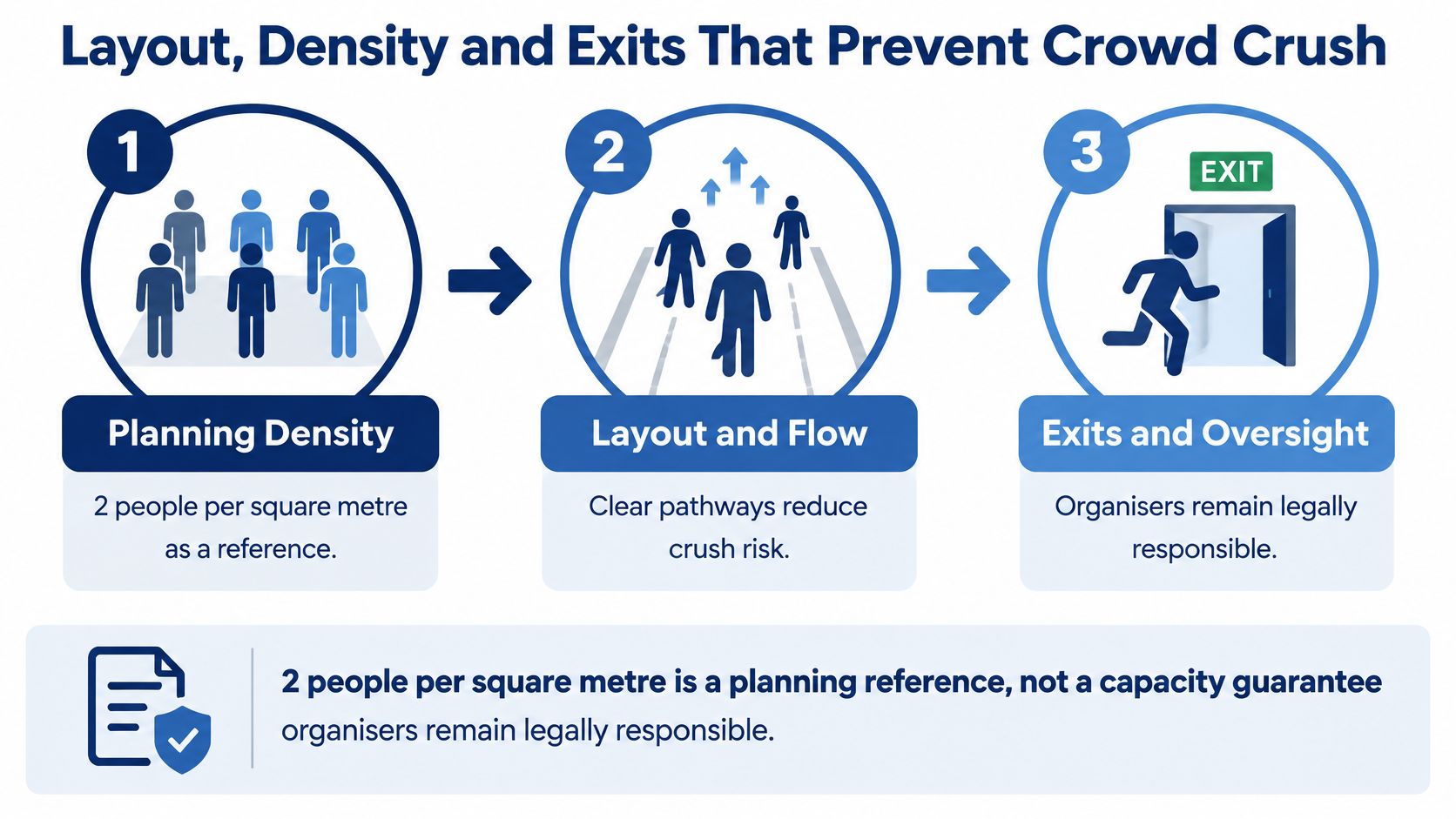
Layout, Density and Exits That Prevent Crowd Crush
Most serious crowd problems aren't caused by a weak panel. They're caused by too many people reaching a narrow place at the same time, with nowhere for pressure to release.
The City of Darebin event-planning guide identifies a general planning benchmark of 2 people per square metre, while stressing that organisers remain legally responsible for an appropriate crowd-management plan and for updating it as hazards change. Treat that figure as a planning reference, not a capacity guarantee for every space, audience, or layout.
The same guide says entry and exit widths for fenced sites must support efficient evacuation and accessibility, with access points arranged for supervision, marshalling, and directional control. In practice, a wide gate without staff, counting, and a clear route beyond it isn't a control.
Three Layout Failures to Design Out
Dead ends trap people who've followed a fence line expecting an exit. Pinch points compress a surge where a queue, gate, food stall, and exit flow meet. Blocked emergency routes delay help and force evacuees back into the crowd they're trying to leave.
Local rules can make those ideas measurable. The Safe and Healthy Crowded Places Handbook notes Rockingham requires dual-direction lanes to be at least 2.5 metres wide, while a single-exit enclosed event is limited to 50 people. Your council may set different figures, and you need those figures before you draw the plan.
More fencing is not automatically safer. A poorly placed run can concentrate pressure, hide an exit, and slow evacuation.
Use breaks, turns, and staffed openings so people at the back can't push a solid column forward. Separate entering and leaving flows where you can, and keep staff to the side of movement rather than standing in the middle of it.
Our crowd management techniques guide expands on supervision and marshalling, but every fenced layout should pass this check first.
- Map expected routes: Draw arrivals, departures, toilets, food, stage viewing, accessible routes, and emergency vehicle access.
- Set entry and exit widths: Size them for evacuation and mass departure, not just for steady arrival.
- Staff each choke point: Put a named person at gates, merges, and queue turns, with authority to pause entry.
- Confirm emergency access: Walk the route an ambulance crew or fire appliance would use, and remove any fence conflict.
- Monitor density in real time: Count entries, watch compressed areas, and close entries when your limit is reached.
If the layout only works when everyone behaves calmly and arrives evenly, it doesn't work yet.
Event Security and Stage Barrier Requirements
At a stage front, separation is only part of the job. Controllers need to see distress early, reach the barrier, lift or guide someone out, and move them away without fighting through the crowd or the performers' working area.
The image below shows the staffed, visible presence that has to operate with the barrier, not behind it as an afterthought.
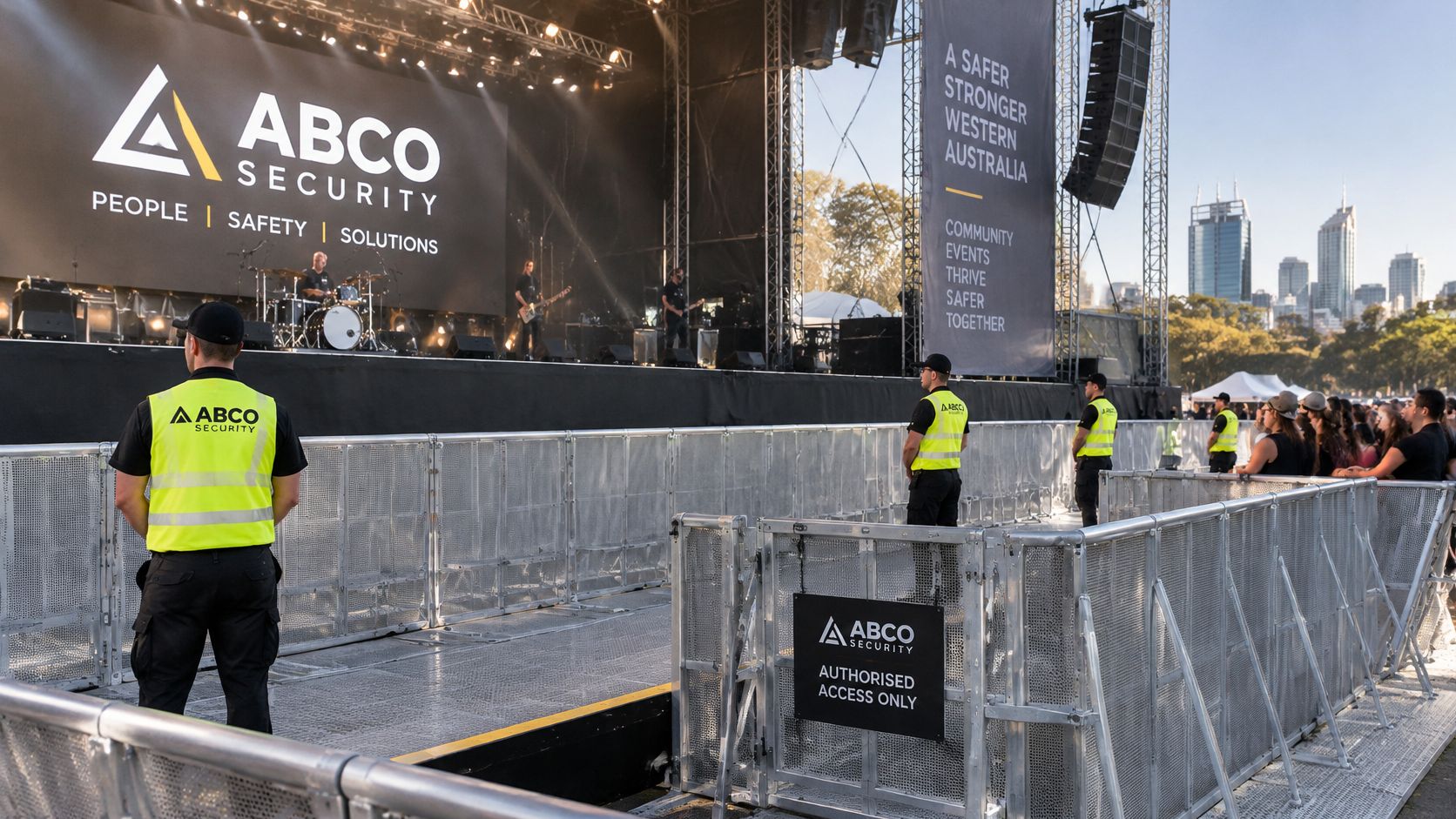
Western Australia's public-event guidance specifies that stage or crowd barriers must withstand high crowd pressure and include a raised platform so crowd controllers can observe the audience and assist distressed patrons. It recommends at least 1.5 metres between the stage front and the barrier, a non-slip pit surface, and any pit entrance or exit unobstructed and at least 1.1 metres wide.
Those dimensions support observation, extraction, and emergency movement. Narrow the pit and controllers can't work safely. Block a pit exit and a person you've just removed from the front row has nowhere to go.
Matching the Perimeter to the Event
Festivals, concerts, sporting matches, and private functions need different layouts because density, alcohol use, audience behaviour, and peak departure patterns differ. A family food festival may need wide, low-pressure circulation. A high-energy concert needs stronger stage separation, counted capacity, and faster intervention at the front.
Capacity decisions have to happen before the space feels full. The Age reported that Federation Square in Melbourne reached its stated event capacity of 10,000 people at 7:40 p.m. during a 2025 concert before entry was closed and temporary security fencing was used. The operational lesson is simple. Count people, brief gate staff, and close entries on time.
For a Security Company Melbourne teams, and for providers in Sydney, Brisbane, and Perth, Event Security staffing should cover entry and access control, ID and wristband checks, crowd behaviour monitoring, pit access, backstage control, and incident reporting. Our guide on how many security guards you need for an event helps you test whether the roster matches those tasks.
The video below is useful for briefing staff on how barrier position, observation, and communication work together during a live event.
Good perimeter planning also links physical barriers to access systems, communications, and incident escalation, a connection covered well in physical security planning for IT leaders. A fence that staff can't monitor, open, or report on quickly is only doing half its job.
Construction, Retail and Gatehouse Site Uses
Outside events, fencing usually protects an access system. The question isn't just whether the boundary is closed. It's who can enter, where vehicles and pedestrians meet, and who controls the gate when deliveries, workers, and visitors arrive together.
Construction Sites
Say a commercial build has one vehicle gate, early concrete deliveries, and workers arriving on foot. Temporary perimeter panels create the exclusion line, but Gatehouse Security makes it function by managing vehicle and personnel entry, monitoring delivery logs, and verifying work permits.
Our Construction Security model pairs that gate control with visitor and contractor log-in, fire watch duties, perimeter Mobile Patrols day and night, and temporary CCTV or solar-powered camera towers for remote coverage and recorded evidence. That combination matters after hours, when a fence alone can't tell you whether someone has climbed it or a gate has been left unsecured. If you're weighing the boundary itself, compare temporary fencing versus hoarding before you commit.
Retail and Shopping Centres
A shopping centre has the opposite problem. The public is meant to enter, but loading docks, service lanes, plant areas, and closed tenancies are not public routes. Barriers and queue systems manage sale-day lines and after-hours closure, while Retail Security and Shopping Centre Security staff control service access and respond when a temporary closure redirects shoppers.
Don't let a promotional queue spill across an exit or a dock crossover. Put the queue where staff can see its end, keep delivery routes separate, and brief centre staff on who can move barriers during trading.
Corporate, Residential and Strata Sites
For offices, residential towers, and strata precincts, fencing works best with Concierge Security and gatehouse staffing. Visitors are welcomed and logged, contractors are directed to the right entry, and vehicle gates don't become informal pedestrian shortcuts.
That visitor record also has a life-safety role. Accurate logs support roll calls, which is why keeping track of visitors during evacuations is a useful prompt when you review gate procedures. If your log can't tell you who is still on site, your evacuation control is weaker than the fence suggests.
Across Melbourne, Sydney, Brisbane, Perth, and surrounding areas, I would ask one question before installation. Where do vehicles and pedestrians meet, and who controls that point at the busiest ten minutes of the day?
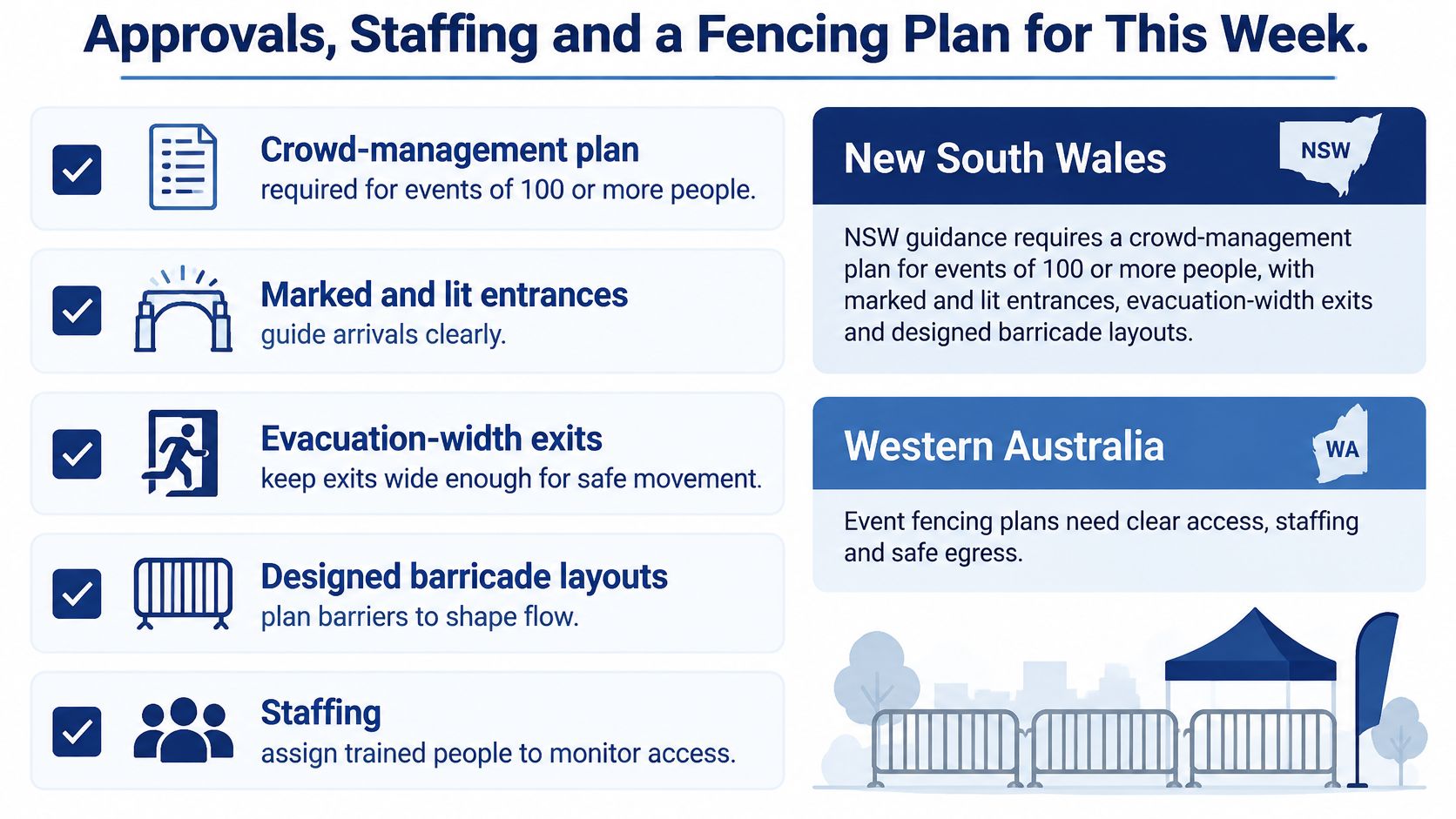
Approvals, Staffing and a Fencing Plan for This Week
Approvals come before installation, not after the truck arrives. Thresholds, licences, and council conditions change the fencing layout, the roster, and sometimes whether the event can be enclosed at all. A fence that locks in the wrong gate positions is a fence you pay to move twice.
A New South Wales local-government event-management guide states that crowd management is required for events involving 100 or more people, and recommends clearly marked and adequately lit entrances and exits, access large enough for evacuation or mass departure, and professional consideration of stage and barricade design. Treat that threshold as a starting point. Smaller crowds can still need licensed controllers when alcohol is served, a stage barrier separates the audience, or vehicles share ground with pedestrians.
Licensing rules for crowd controllers differ between states, so confirm with your council and state regulator who may legally work a gate and what conditions attach to an enclosed or fenced event before you order panels. Get this in writing where you can.
The guide also describes the "straight line rule", meaning people generally choose the quickest route and resist barriers or signs that redirect them. Design for desire lines first, then use signs to support the layout. A barrier run placed across a natural path concentrates pressure at its weakest point and turns a control measure into a sideways load the fence was never braced to carry.
Your Five-Step Plan This Week
- Classify every run: Label each fence as exclusion, direction, stage separation, or vehicle separation, and remove any run without a clear job.
- Confirm structure and wind: Record the design basis, bracing, ballast, run length, and whether scrim or signage adds load.
- Check approvals first: Confirm state and council thresholds, enclosed-event approval, traffic conditions, and where fencing is permitted to sit.
- Draw the operating layout: Show entries, exits, accessible routes, emergency access, queue turns, gate staff, and density monitoring points.
- Name the accountable people: Record the licensed crowd controller, competent installer, inspector, inspection times, and triggers for re-inspection in the risk assessment.
For larger public programs, align that work with your wider festival security planning so fencing, ticketing, alcohol controls, and emergency communication are built as one plan.
Bring in a licensed provider when the crowd reaches your local planning threshold, when a stage barrier is specified, where vehicles and pedestrians meet, and after any near miss. Security Guarding at an event means crowd-control-licensed personnel in the right roles; an unlicensed guard on a gate is a compliance gap the organiser owns.
Our event officers are RSA-qualified and crowd-control-licensed. We manage entry and access control, ID verification and wristband management, crowd behaviour monitoring, VIP protection and backstage management, and alcohol compliance and incident reporting. We also provide short-term security for special events, festivals, sporting matches, private functions, and emergency situations, with flexible and scalable coverage.
Practical rule: If nobody can name who owns a gate, who can close entry, and who re-inspects after wind or a surge, the plan isn't finished.
Start with the site drawing and the approval conditions, then specify the fence. That order prevents the common failure where panels are hired first and safety has to be fitted around them. Request a site-specific fencing and crowd-management review before you lock the layout, roster, or opening time.
ABCO Security Services Australia provides licensed, RSA-qualified event officers, site-specific crowd management, and 24/7 monitoring across Melbourne, Sydney, Adelaide, Perth, and Brisbane, so your fencing, gates, and staffing work as one accountable system. If you're planning an event, construction start, or busy public precinct, visit ABCO Security Services Australia to request a fencing and crowd-management review for your site.
about
avada factory
Sempery ultricies nibh at dolor cras urna eleifend nec. Atiam efficitur tempor.