Australia's electronic security systems market was estimated at about USD 1.3 billion in 2025 and is projected to reach roughly USD 2.054 billion by 2032, a compound annual growth rate of 6.75%, according to Ken Research's Australia electronic security market analysis. That's an increase of roughly USD 754 million, or about 58%, across seven years.
Read the figure against what buyers purchase, and a pattern appears. Growth in this market isn't driven by camera volume. It's driven by the service layer wrapped around the hardware: design, integration, monitoring, maintenance and response coordination.
That distinction decides whether a proposal is worth signing. A camera count tells you what's being installed. It tells you nothing about who verifies an alarm at 2am, how long footage takes to retrieve, or who holds the admin password once the installer's van leaves the car park.
What Electronic Security Sales Covers
Electronic security sales is the sale and delivery of a connected protection system, covering design, equipment, installation, integration, monitoring and the maintenance that keeps it running. A camera or an alarm panel on its own is a product sale. The system sale is a different job, because the buyer is purchasing an outcome: detection fast enough, and evidence clean enough, to change what happens next.
The clearest way to picture it is a nervous system. Cameras and sensors are the nerves, spread across entries, car parks, loading docks, fire exits and stockrooms. Monitoring is the brain, taking the signal, deciding whether it's real, and sending someone. Nerves without a brain register an event and do nothing about it.
The Parts of a Proposal That Matter
Six components turn up in almost every commercial scope. Each needs a specification written against it, not a brand name and a quantity.
| Component | What it does | What to specify |
|---|---|---|
| CCTV surveillance | Records and supports live viewing of entries, car parks and loading bays | Camera coverage, night performance and retention period |
| Access control | Controls doors, gates and credentials | Credential ownership, audit logs and offboarding process |
| Alarm systems | Detects intrusion and duress events | Verification steps before dispatch |
| Monitoring | Trained operators watch feeds and respond to alarms | Hours staffed, response times and escalation tiers |
| Video analytics | Flags defined events in footage | Event types, verified-alert rate and nuisance-alert rate |
| Remote viewing | Live access from a phone or browser | User permissions and secure login method |
Video surveillance is the largest and fastest-growing system category in the country, and the commercial segment accounted for 35.6% of Australia's security-market value in 2025, per ASIAL's Security 2030 report. The same report notes that AI-enabled CCTV increasingly handles real-time anomaly detection and behavioural analytics across retail, healthcare, transport and critical infrastructure. That explains why so many quotes arrive camera-heavy and thin everywhere else.
Camera count tells you very little about that performance. Detection quality depends on scene design, lighting, retention settings, analytics configuration and whether anyone acts on the alert. A 40-camera system with loose analytics rules and no verification step will bury a duty manager in alerts, and those alerts get muted within a fortnight.
The costly gaps sit between the first row of that table and the fourth. A site buys excellent cameras, then discovers nobody was contracted to watch them after hours, so the footage becomes a record of a theft that finished forty minutes earlier. Access control without credential offboarding produces the same result: a contractor who left in March still opens the loading dock door in July.
If you want to see how monitoring tiers and equipment bundles get packaged in the wider market, this rundown of residential security systems ranked by equipment, app access and contract length shows how much of the offer sits outside the box. Commercial scopes add integration and escalation obligations, but the packaging logic travels.
The completeness test: a quote that lists cameras and a recorder, with no monitoring, no escalation path and no retention policy, isn't a security system. It's a hardware delivery.
How the Sales Process Runs From Brief to Handover
A clean electronic security purchase follows eight stages, and most of the risk sits in the first two. Skip them and you'll spend the rest of the project comparing quotes that were never answering the same question.
The buyer's job at the start isn't to choose equipment. It's to describe the site, the hours it operates and the incidents that worry you most, in writing, before a single proposal lands.
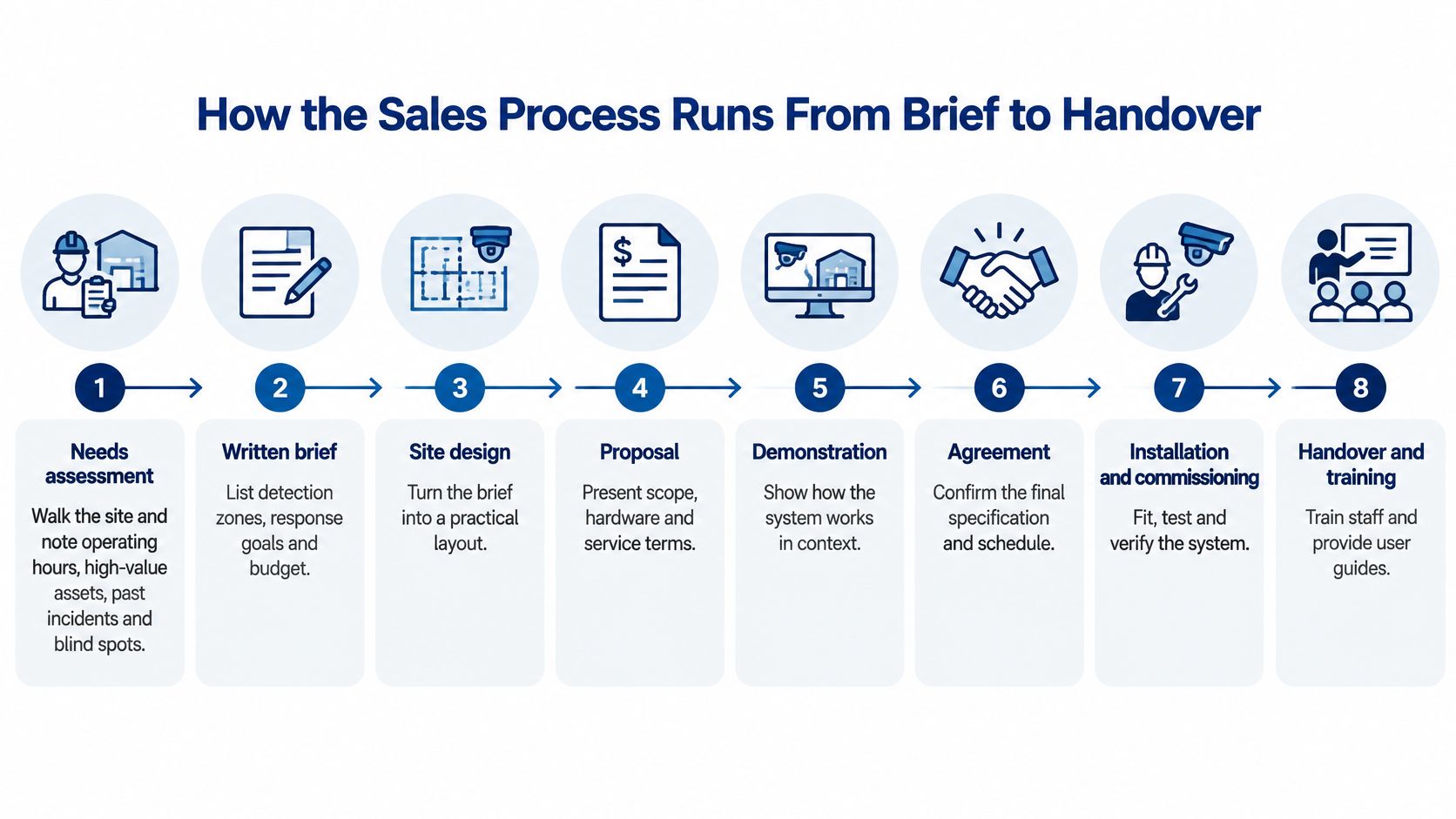
Needs assessment. Walk the site rather than describing it over the phone. Note operating hours, high-value assets, past incident patterns, blind spots and the places people gather. The common mistake is accepting a verbal brief from someone who hasn't stood on the site after dark.
Written brief. List the detection targets that matter, such as after-hours entry, contractor access, loss at dispatch points or vehicles in the car park, and write the response you expect for each. "CCTV coverage of the warehouse" isn't a brief. "Detect any person entering bay four between 7pm and 5am and have an operator verify within three minutes" is.
Site survey and design. Camera placement, lighting, network paths, power and storage all get resolved here. Size the storage against the retention policy, not the other way around, because retention requirements set capacity and capacity sets cost.
Itemised proposal. Hardware, installation, integration, monitoring and maintenance should appear as separate lines. A single lump sum can't be compared to anything, and it hides whether monitoring is included or quoted later as an extra.
Approvals and contract. Get service levels, response times and licence numbers in writing before signing. Anything promised verbally about guard response should be repeated in the agreement or treated as marketing.
Supply and installation. Most cameras, recorders and controllers are imported, and China supplies an estimated 60-70% of Australian camera units, according to IndexBox's Australia intelligent security system analysis. Distributor stock, freight and firmware availability move delivery dates, so get lead times in writing and hold the schedule to them. Installation itself should be carried out by licensed installers.
Commissioning. Test every alarm and duress device, check footage quality at night rather than at 2pm, confirm the retention settings apply, and verify that an alert reaches the monitoring centre with the site details attached.
Handover and review. Train the people who'll use the system daily, hand over asset documentation and admin credentials, and agree the metrics for a first-quarter review. A system nobody was trained on becomes a screensaver.
Follow-up is where a lot of good proposals die. Buyers collect three quotes, get busy, and let the decision drift for a month. Service businesses that run systematic follow-up for Australian service businesses through their pipeline close more of this work for the simple reason that nothing sits unanswered in an inbox.
Ask for the written brief at stage two and hold every provider to it. When three proposals answer the same document, the comparison takes twenty minutes instead of three weeks.
Evaluation Criteria That Separate Providers
Camera count is the easiest thing to compare and the least useful. Two quotes can list the same 24 cameras, and one of them comes with a written response commitment while the other comes with a phone number that rings out on a Sunday.
Score providers on what happens after an alarm, not on what's bolted to the wall.
Score the Response, Not the Device Count
| Criterion | What good looks like | Question to ask |
|---|---|---|
| Service levels | Uptime and response commitments written into the contract | What is guaranteed, and what happens when it fails? |
| Monitoring | Live monitoring staffed around the clock by trained operators | Where is the monitoring centre and who staffs it overnight? |
| Response | Documented dispatch times and escalation tiers | What is the average time from alarm to human verification? |
| Compliance | Licensed installers and licensed guards with documented risk plans | Which licences apply to this scope and who holds them? |
| Integration | Works with existing access control and building systems | Which systems will be integrated and who maintains them? |
| Reporting | Monthly incident, alarm and verification reports | Which KPIs will you report and in what format? |
Two rows carry more weight than the rest. Response and reporting decide whether the system earns its keep, because a detection nobody measures is a detection nobody improves. A provider who can't tell you the verified-alert rate on a live site is guessing about your site too.
Red Flags Worth Walking Away From
Most weak proposals fail on the same four points. Check for them before you get anywhere near price.
No written service levels. If response times, uptime and escalation tiers aren't in the document, they don't exist. Verbal assurances vanish at the first outage.
No licence details on the proposal. Ask for the installer's licence number and, where guarding is part of the scope, the licence numbers for the officers rostered to your site. An unlicensed installer creates a compliance problem the client inherits.
Promises of total prevention. No system prevents every incident. A provider who claims it either hasn't read your site properly or plans to blame the equipment later.
No sample monthly report. Ask for a redacted example from a live site. If reporting doesn't exist yet, it won't exist after you sign.
One question that sorts providers quickly: "What's your average time from alarm to human verification, and who measures it?" A real monitoring operation answers with a number and a report format. A reseller changes the subject.
The layers only work when the contract connects them. Electronic detection and monitoring trigger on-site response from mobile patrols, gatehouse teams or concierge officers, and the handoff between the two is where response times are won or lost. The service delivery standards we work to set out how that handoff should run, and they make a reasonable benchmark for judging any provider's commitments.
Give every provider the same written brief and score the answers side by side, criterion by criterion. A provider who scores well on monitoring and reporting but poorly on integration is a different risk from one who fails on licensing, and the scoring shows you which trade you're making.
Pricing Models and What Drives the Quote
Six variables move an electronic security quote more than anything else: site size and layout, device count, analytics licences, storage and retention depth, monitoring tier, and guard or patrol hours. Change one and the total shifts. That's why comparing two quotes without a shared scope tells you almost nothing.
Where the Money Actually Goes
Hardware is usually the one-off cost. Monitoring, maintenance, storage and analytics subscriptions recur every month for as long as the system runs, and those are the lines buyers underestimate at the proposal stage.
| Pricing model | How it is charged | Best fit | Watch for |
|---|---|---|---|
| Outright purchase | Upfront hardware and installation | Owners who want asset control | Separate monitoring and maintenance fees |
| Lease or finance | Fixed monthly payments over a set term | Businesses preserving capital | Term length and ownership at lease end |
| Monitoring subscription | Monthly fee per site or per camera | Sites needing verified 24/7 response | Fee escalators and contract exit terms |
| Managed service | One monthly fee covering devices, monitoring and maintenance | Multi-site portfolios | Items excluded from the fee |
| Guard and patrol call-outs | Hourly or per-visit rates | Events, construction and after-hours cover | Minimum call-out hours |
| Per-camera pricing | Priced by device count | Small, defined sites | Costs rise quickly as coverage expands |
Five-Year Cost of Ownership
Add up five years before you decide. A low upfront price paired with a high monitoring fee can overtake a more expensive proposal by year three once maintenance is bundled into the second one.
Two sites show how differently the same budget behaves. A retail premises with fixed cameras, a defined camera schedule and after-hours monitoring should budget the recurring lines first, then see what the capital budget buys in hardware and analytics. A construction project running for 12 months needs temporary CCTV on solar towers, night patrols and scalable guard packages, so the sensible budget shape is a monthly rate for the project term rather than a capital purchase nobody recovers at practical completion.
Door hardware, readers and credentials vary more than camera equipment does, so get a separate access control cost breakdown for Australian sites before accepting a combined figure that blends the two.
Budget rule: settle the recurring figure first. Monitoring, maintenance and storage will outlive three hardware refreshes, so they deserve more scrutiny than the device list.
Put every provider on the same scope, the same operating hours and the same response tier before you compare totals.
Integration and Ownership After Installation
Every connected device adds a way into the network, and most proposals don't say who's responsible for it afterwards. Australian evidence puts a number on the gap: 60% of Australian security leaders surveyed in 2025 reported incidents caused by unknown or unmanaged assets, and 87% said attack-surface management was connected to organisational business risk, per Trend Micro's Australian security survey release.
Assign these seven items before handover, in writing.
- Asset inventory. Every camera, controller, intercom, cloud portal and mobile app, listed with a location and a named owner.
- Firmware schedule. A named person and a cadence for updates, not "as needed".
- Admin credentials. Held by a named role, with multi-factor authentication on every portal and app.
- Network segmentation. Devices on their own segment, away from finance and email systems.
- Vendor access. Remote access requires approval and leaves a log.
- Offboarding. Badges, app accounts and portal logins removed the same day someone leaves, contractors included.
- Escalation contacts. A current list of who gets called, in what order, for a security incident.
Ownership is usually shared between facilities, IT, the property manager and the security provider, which is exactly why it drifts. In corporate offices, warehouses, manufacturing sites, healthcare campuses and multi-tenant buildings, nobody wakes up wanting to own the camera firmware. Ask how new devices will connect to existing access control integrations and get the answer in writing with a named maintainer attached.
The contrarian point is uncomfortable for anyone selling hardware. More cameras can mean more exposure when the extra devices are unmanaged. Value comes from lifecycle governance and a falling count of unmanaged devices, not from a bigger number on the quote.
Run one test this week. Ask who holds the admin password for every connected device in the building. If the answer takes a day to find, you've located the gap.
Retail, Property and Event Cases With Measurable Outcomes
Australia recorded 595,660 victims of other theft in 2024, an increase of 6%, or 34,706 victims, compared with the previous year, according to the Australian Bureau of Statistics recorded crime victims release. That's a national baseline, not a forecast for your site. Use it to justify planning, then size the controls against your own incident history, trading hours, concealment points, asset value and the realistic speed of police response in your area.
Layering is the part that works, and the layers are usually cheaper together than one oversized system on its own.
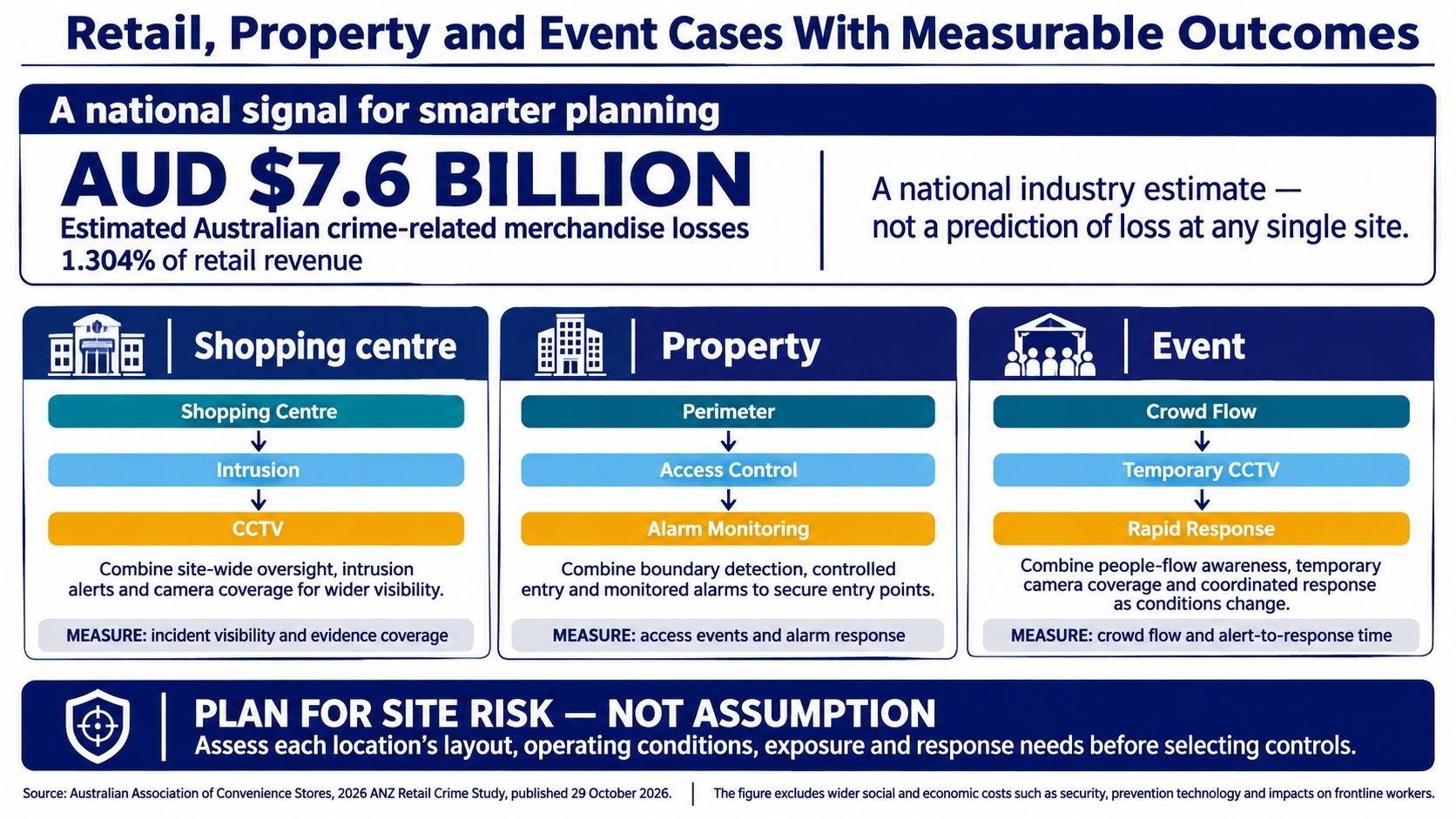
Three Scenarios That Show the Layers Working
Shopping centre. Visible guards during peak trading, monitored CCTV on service corridors and loading docks, mobile patrols after closing. The guard handles presence and intervention, the cameras handle evidence and the corridor nobody patrols, and the patrol handles the hours when the centre is empty and an alarm still needs a physical check.
Event. Entry control, ID verification and wristband checks at the gate, crowd monitoring inside, and a documented escalation path to the venue manager. The value is clear, as crowd behaviour at 9pm looks nothing like it did at 5pm when the gates opened.
Strata complex. Gated access with credentials rather than shared codes, remote viewing for the strata manager, and a written escalation path for after-hours incidents. Shared codes are the most common failure in residential buildings, because nobody can revoke them.
Construction site. A 12-month build uses temporary CCTV on solar towers, patrols at night and gatehouse officers for vehicle and contractor sign-in. Track gate-log completeness, after-hours alarm verification rate and monthly theft-report count against the pre-installation baseline.
The electronic layer doesn't replace trained personnel. It gives officers earlier detection, better evidence and a reliable way to check an alarm or a suspicious vehicle before they arrive.
The Metrics That Prove It Worked
Define the outcome measures before installation, not after. The set that matters usually includes verified-alert rate, time from alert to human review, dispatch time, footage retrieval time, repeat-incident rate and avoided downtime.
Measure a 90-day baseline first, covering incident counts by area, alarm volumes and how long retrieval currently takes. Then run the same measurement after handover and compare like with like.
The contrarian conclusion holds. Poorly positioned cameras, excessive false alerts and unclear escalation rules add cost without reducing loss. A camera pointed at a ceiling or a retention window too short to catch a stocktake discrepancy is an expense, not a control. For retail sites specifically, retail security systems built around verified response work better than coverage added zone by zone without a plan.
Risk also differs by city. Trading hours, local crime patterns and police response times vary enough between Melbourne, Sydney, Brisbane and Perth that a template copied from one market should be re-tested in another, including sites within a 200km radius of each.
Buy the detection your response model can actually act on. An alert nobody answers is a subscription, not a control.
Privacy and Compliance Obligations to Plan For
Privacy and licensing rules shape the design of a system, not just the paperwork at the end. Get the signage, permissions and retention schedule wrong and the footage you needed for an incident becomes the evidence in a complaint about your organisation.
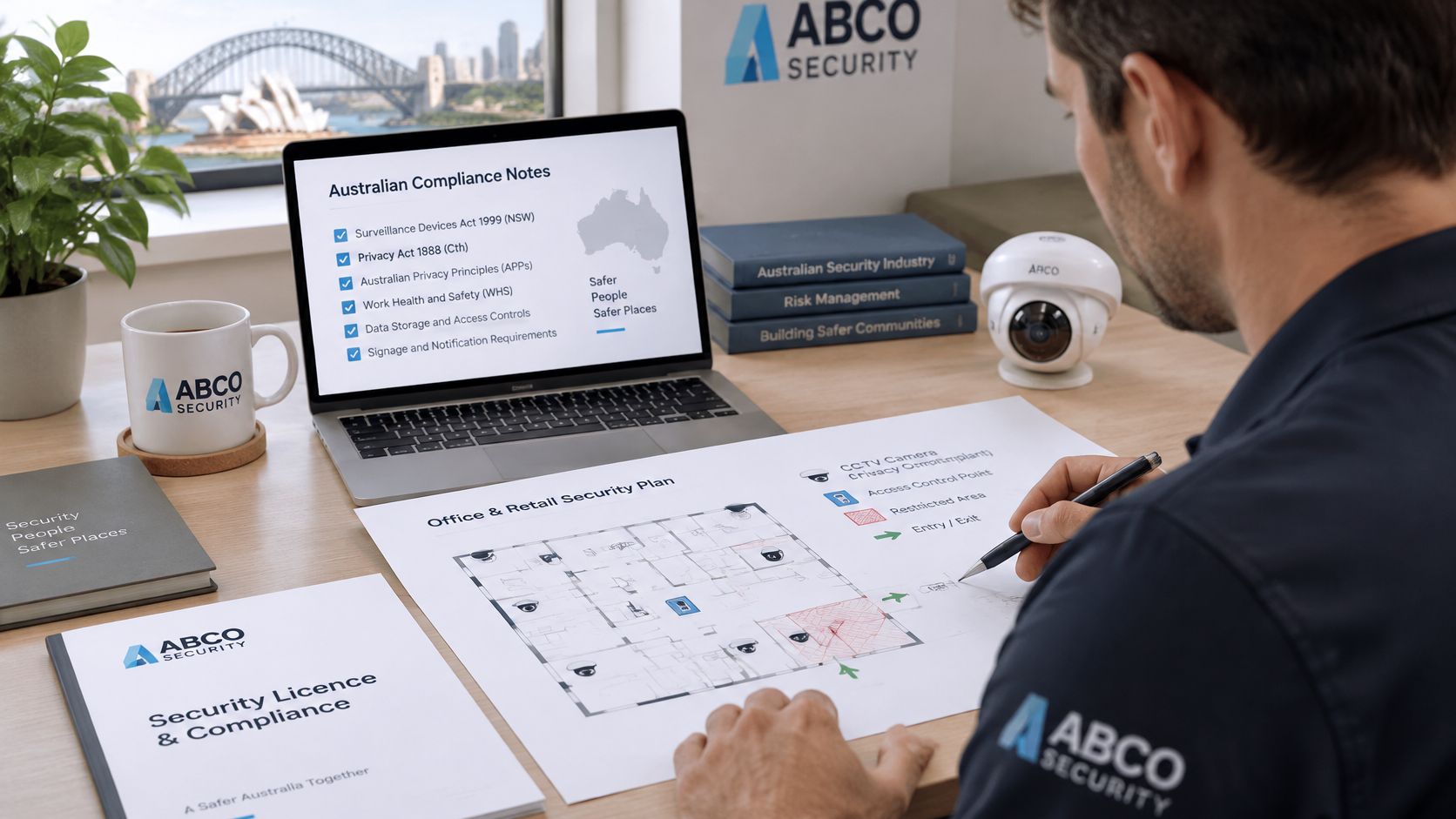
The Office of the Australian Information Commissioner states that organisations covered by the Privacy Act 1988 must comply with the Australian Privacy Principles when surveillance cameras collect personal information, which means telling people their image may be captured before recording occurs, keeping that information secure, and destroying or de-identifying it when it's no longer needed, as the OAIC's security camera guidance sets out.
Translate that into five controls: clear signage at monitored entrances, defined user permissions so recordings stay with authorised staff, protected storage with a retention schedule tied to operational and legal needs, a plain answer on whether analytics features process identifiable information, and controlled exports with a logged reason. A concierge or gatehouse officer reviewing access incident footage should work under the organisation's privacy procedure, not a shared login. The CCTV laws in Australia that catch operators out most often are the retention and access ones.
State rules add hard design requirements. In Victoria, sections 136A and 136B of the Private Security Act 2004 require a client engaging licensed private security personnel to complete a Risk Management Plan and provide it to the licence holder at least one day before the activity begins, as Victoria Police's licensing guidance explains, and installers working with CCTV, cameras or alarms must hold the appropriate licence.
In Western Australia, certain premises trading beyond 1am must operate CCTV from 8pm, or from opening time where the premises opens later, until one hour after trading ends. The Western Australian security licensing conditions require a licensed installer, metadata covering date, time, camera location and camera identifier with tamper safeguards, footage made available to police within 24 hours, and retention for 28 days.
Those requirements change the specification, not the covering letter. Time synchronisation, export format, storage capacity and fault alerts all need to be designed in from the start.
If your organisation already runs an information security framework, security framework selection for enterprises explains how to map physical security controls into it rather than running two governance processes in parallel. Before signing, confirm that every installer and guard holds the licence for the scope, and use ASIAL for training and industry standards guidance.
Confirm Your Scope and Request a Free Quote
Write the scope before you ring anyone. One page is enough. It should carry six things:
- Every site and address
- Operating hours, including after-hours access patterns
- Your top three risks, ranked
- The detection and response times you expect
- The footage retention period
- The compliance obligations that apply to your sites
Then ask every provider for the same written brief, the name of the operator watching your alarms, service levels in writing and a sample monthly report. Put the ownership questions in the brief as well: who holds admin access to the cameras and access control, who owns the recordings, and what happens to both if you change providers. A system you cannot administer or export from is a system you rent, whatever the invoice says.
Match each risk to the right service before you ask for pricing. Retail floors, shopping centre common areas and car parks sit with Retail Security and Mobile Patrols. Stockrooms and distribution sites sit with Warehouse Security. Empty sites and after-hours alarm checks sit with Mobile Patrols and Security Guard. Events and crowd conditions sit with Event Security. Active building sites sit with Construction Security, including gatehouse control for vehicles and contractors. Lobbies, front desks and tenant-facing buildings sit with Commercial Property Security and concierge coverage.
ABCO Security Services Australia brings 15+ years of security experience and 24/7 security operations across Australia, with offices in Melbourne, Sydney, Adelaide, Perth and Brisbane, so national coverage still comes with local knowledge. Quotes are free through the quote request form.
Send the written scope this week and ask for a proposal that lists hardware, monitoring, integration and compliance as separate line items. A provider who can't break it down that way hasn't planned the job.
Electronic security sales works best when the proposal reads like an operating system: hardware, monitoring, response, reporting and ownership, each with a name against it. ABCO Security Services Australia designs, installs and integrates CCTV, access control, video analytics and remote viewing, backed by A1 Grade 24/7 monitoring and licensed guards, patrols and concierge teams across Melbourne, Sydney, Brisbane, Perth, Adelaide and the surrounding regions. Start with your written scope and request a free quote from ABCO Security Services Australia through the quote request form, by phone on (03) 9001 0024, or by email at info@abcosecurity.com.au.
about
avada factory
Sempery ultricies nibh at dolor cras urna eleifend nec. Atiam efficitur tempor.