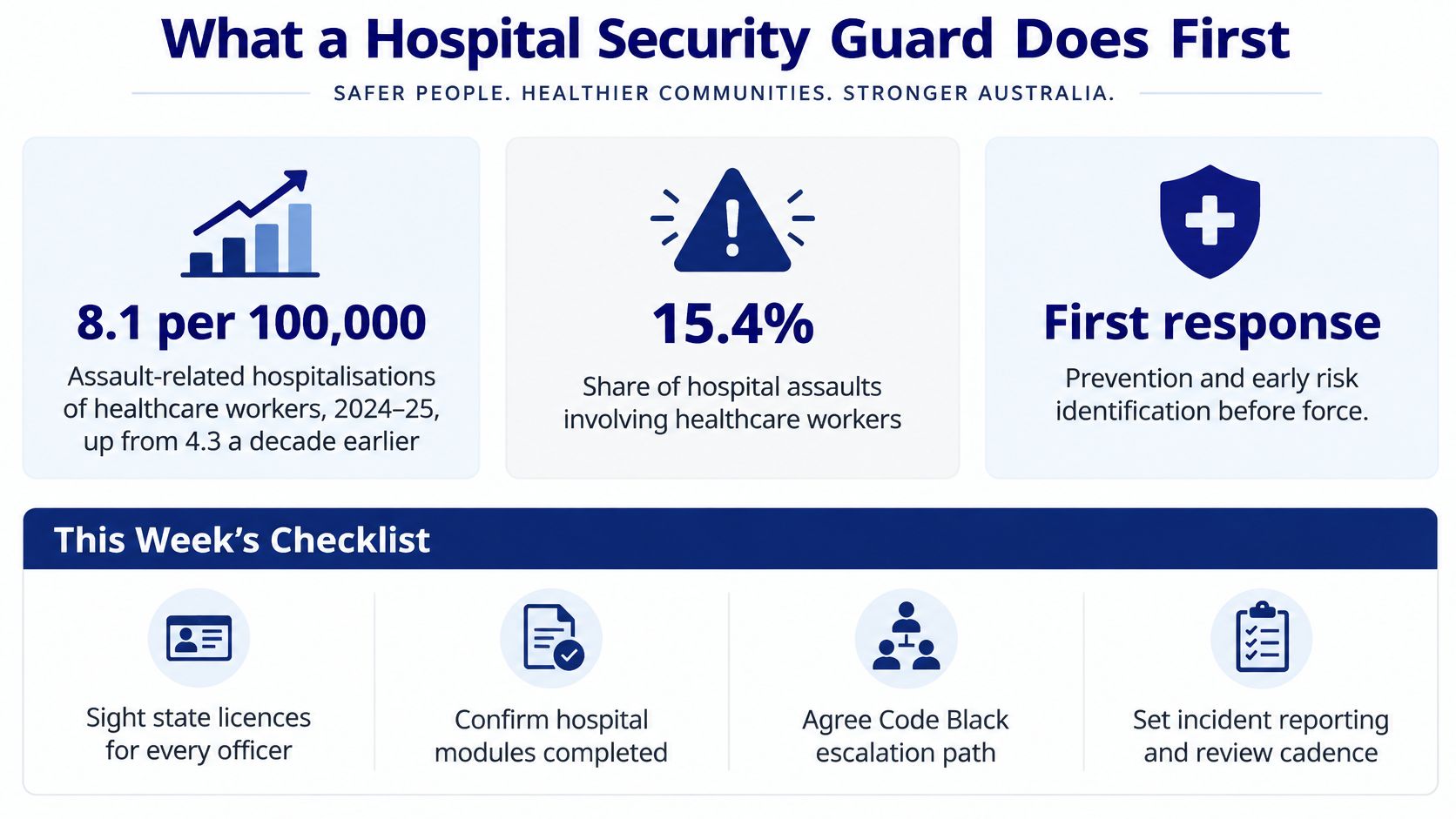
Assaults account for 15.4 per cent of injuries to healthcare workers, against 3.8 per cent across the general working population, and assault-related hospitalisations of healthcare workers more than doubled over the decade to 2024-25, according to Australian Institute of Health and Welfare figures reported by the Brisbane Times.
Most hospitals read a number like that and ask for more guards. That's the wrong first question.
The hospitals that reduce violence design the role first, train for de-escalation second, measure outcomes third, and only then work out how many officers to roster. This is a practitioner's guide to doing it in that order, across Melbourne, Sydney, Brisbane, Perth and the regional hospitals within reach of each.
What a Hospital Security Guard Does First
A hospital security guard's first job is to create time and space for care to continue. The officer observes, keeps a safe distance, uses clear language, manages access and calls for support early. Visible presence alone does not make a hospital safer.
Clinical staff should be able to call security before a situation becomes physical. Post orders should make that expectation explicit and define how officers respond, so staff are supported rather than questioned for calling early.
The first ten minutes by zone
Use this table as a starting point for post orders. Adapt each action to the hospital's procedures and the needs of the clinical team.
| Zone | Default guard action | Hand to the nurse in charge when |
|---|---|---|
| Emergency waiting room | Maintain a visible presence, observe behaviour and use early verbal de-escalation | Behaviour escalates, a weapon is suspected, or staff ask for help |
| Triage | Observe the queue and approach the desk calmly | A person refuses to wait or threatens the triage clinician |
| Mental-health unit | Use a calm presence, follow access procedures and speak in a trauma-informed manner | The clinical team calls a Code Black or equivalent |
| Maternity after hours | Check visitor access and escort distressed relatives when requested | Access is refused or a protection concern is raised |
| Ambulance bay | Keep the bay clear and support safe transfer | An arriving person is aggressive or a weapon is reported |
| Main public entrance | Give directions and follow the site's identification and access procedures | Someone attempts unauthorised entry or a duress alarm sounds |
A guard should support clinical decisions, not replace them. Clear post orders distinguish the officer's role in observation, communication and access control from the clinical team's responsibility for patient care. More guards do not automatically improve safety: role design, trauma-informed communication and a reliable call-for-help process matter more than presence without a defined purpose.
The order of work matters. Use hospital incident records to identify where guard actions and call procedures need to be clearer, then set post orders to match. Security guarding in Melbourne, Sydney, Brisbane and Perth should reflect each hospital's patient flow and operating procedures, rather than copy another site's staffing pattern.
Risk Assessment and Hotspot Ranking
Ranking beats arguing. Two executives can debate whether the emergency department or the car park is riskier for a week; twelve months of logs settles it in an afternoon.
Sort before you score. Pull every incident from every zone for the past year and drop each entry into one of four buckets: verbal threat, attempted unauthorised entry, weapon find, completed assault. The first two matter most, because they show where risk is building before anyone is injured.
Score likelihood against consequence. Rate each zone from 1 to 5 for how often an incident is likely, and 1 to 5 for how bad it would be, then multiply. A triage area with 40 verbal threats and two assaults in a year outranks a car park with a single weapon find, and it gets guard hours first.
Keep repeat people separate. Flag repeat-person alerts as their own list, tied to the patient flag process and checked against the privacy officer's rules. Don't let a name sit in a spreadsheet that only the day shift can see.
Name an owner for every zone. The nurse unit manager and the security supervisor share it. A ranking with no owner becomes a document nobody acts on.
Practical rule: A zone with a named owner gets fixed. A zone with no owner gets another report.
The exercise isn't optional housekeeping. Work health and safety law requires the hospital to identify the risk of violence, put controls in place, and review those controls after an incident. The ranking is the evidence that step happened.
Re-score every quarter, and again after any layout change, roster change or shift in patient flow, such as a new triage model or a ward closure that pushes presentations into a different corridor. The output is a ranked zone list with an owner against each line, which feeds directly into the staffing decision. Our healthcare security risk assessment service follows this method on site, and you can run the same scoring in a spreadsheet before anyone quotes you a rate.
Licences Training and Post Orders
Australian security licensing is state and territory based. A Melbourne hospital needs officers with the relevant Victorian licence, while a Sydney site needs officers licensed for New South Wales. Check each officer's licence for the jurisdiction and role they will work in.
A Certificate II or III in Security Operations provides the relevant foundation for licensed work. Officers can complete a recognised security guard training course before hospital-specific induction. Before a first shift, check evidence of:
- Conflict de-escalation, including practical assessment.
- Current first aid, including defibrillator use.
- Work health and safety, covering hazard reporting and the officer's duties.
- Customer service and communication, for clear, respectful contact with patients and visitors.
- Radio procedure, including concise location and description details.
- Emergency response, covering fire, evacuation and lockdown procedures.
The Australian Security Industry Association Limited publishes industry standards that can inform training. Industry membership does not replace the relevant state or territory licence.
What every post order must contain
A post order turns a licensed officer's general skills into clear site instructions. It should identify each zone and its default actions, duress alarm locations, and the nurse in charge by role for each ward. It should also set out when to call police, the decisions guards must leave to clinical staff, and the incident details required before handover.
Be explicit about boundaries. Guards do not provide clinical treatment, administer medication, make discharge decisions or use restraint for clinical reasons. Clear limits help staff and officers coordinate without confusing security duties with clinical authority.
Reporting also needs a consistent process. AIHW reported that an unspecified person was recorded as the perpetrator in 57 per cent of hospitalised interpersonal violence cases, according to its analysis of hospitalised interpersonal violence coding. Record who was involved while details are fresh, and follow the hospital's process for identifying people whose details are unknown.
When agency staff fill a shift
Agency cover can fill a roster gap, but a company induction alone does not prepare an officer for a hospital site. Before the shift starts, the relieving officer should review the campus post order, locate the alarms and know how to contact the nurse in charge.
ABCO states that its guards are licensed under relevant Australian state regulations and receive ongoing training in conflict resolution, first aid, work health and safety, customer service and emergency response. Site-specific instructions still need to be covered at induction.
How a Code Black Response Should Run
A Code Black is a clinical-security system, not a restraint skill with a radio call attached. NSW Health requires agencies to maintain a Code Black or equivalent emergency response team, and to use prevention, early risk identification, risk management and de-escalation before violence escalates, as set out in its protecting people and property manual. SafeWork NSW expects the same practice: facility-wide training, communication and de-escalation training, joint training and live exercises for the Code Black team, incident reporting and patient flagging.
Adding another officer at the doorway does not make the response safer if roles are unclear. Competence is coordination: who arrives, who holds the exit, who speaks, and who stops when the clinical lead says stop. An officer who arrives fast, takes the right position and keeps the corridor clear does more good than one who arrives fast and grabs a patient. Behaviour that sits just below a full Code Black is often handled as a Code Grey response, with the same sequence: talk first, move people clear, and treat physical contact as the last step.
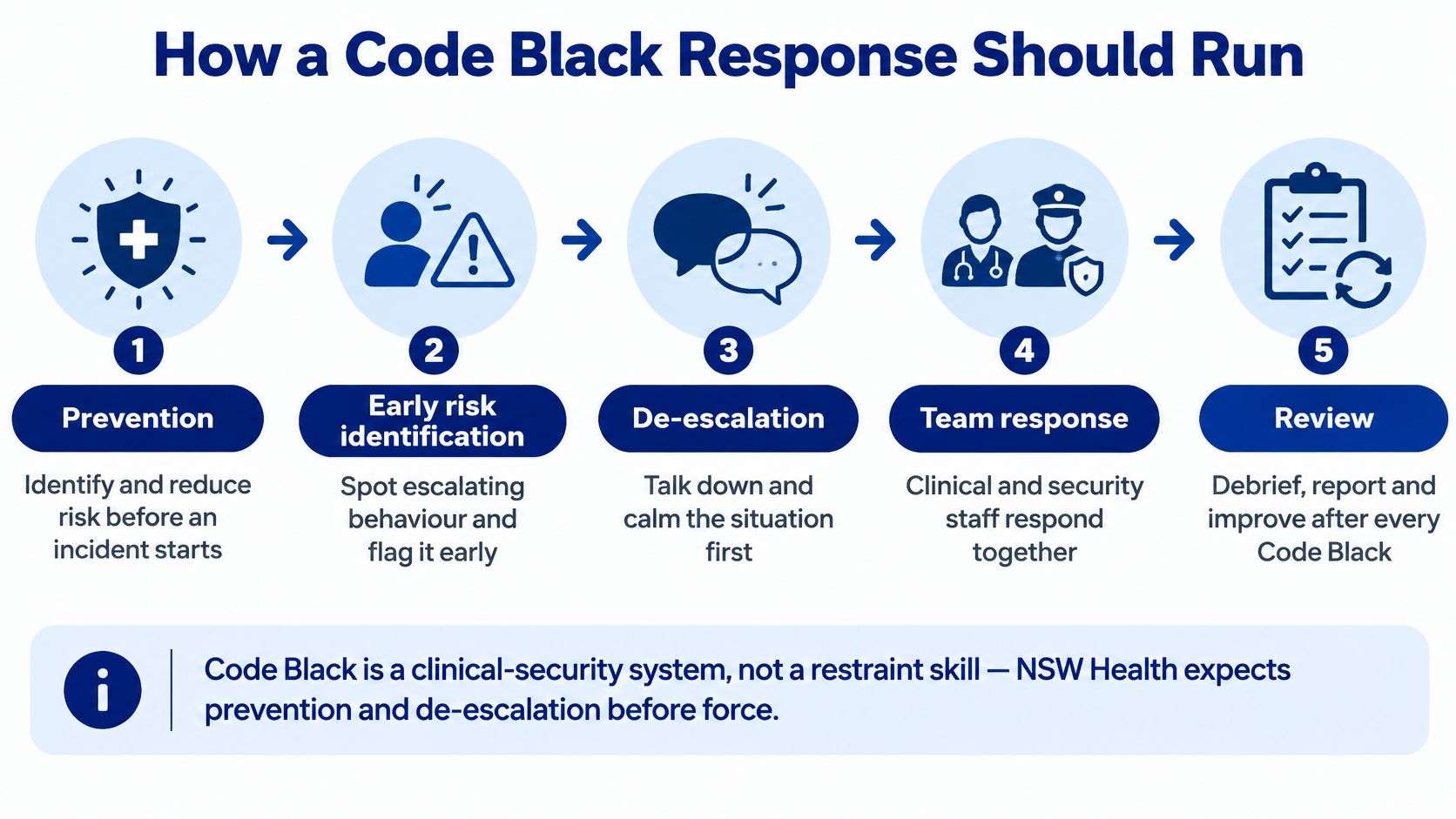
The response, step by step
- Activation. A staff member presses a duress pendant or calls the code on the radio. Location first, description second, names never.
- Acknowledgement. The control point repeats the location and the responding officer's call sign. An unacknowledged code is a code nobody is attending.
- Approach. The nearest trained guard moves to that point while a second officer covers the exit and the waiting public. Sending both to the same doorway leaves the flank open.
- Space and sight. The nurse in charge directs care. The guard creates distance, watches hands, and supports the safe withdrawal of staff and other patients. Clinical decisions stay with the clinical lead, including treatment, medication and any restraint ordered for clinical reasons.
- Intervention as a last step. Physical intervention happens only when the clinical lead requests it or there is an immediate threat, and it stops as soon as the person is safe. Trauma-informed de-escalation means a calm voice, a clear exit for the person, and no audience if you can move one.
- Police escalation. Weapons, serious assault, or a person who will not stay contained. Set that trigger in the post order before the shift, not in the middle of the incident.
- Handback and log. The scene returns to normal operations, witnesses are noted, and the incident is documented before the next patient movement.
Drills are where those steps stop being a document. Run the sequence live at least once per roster cycle. Watch for the two failures that recur: nobody covers the exit, and nobody can say who is in charge while the nurse is treating a patient at the same time.
What to record in a drill
Time the alarm acknowledgement, the arrival at location, the time to containment, whether the escalation path was correct, and whether documentation was finished before handover. Repeat the drill after a layout change, a roster change or a new patient-flow pattern. A route that worked last quarter may now run past a full waiting room.
Say an argument starts in the emergency waiting room with raised voices and hard eye contact. The officer closes the distance slowly, keeps furniture between them, and calls for a second pair of hands when the person stands. Police are not the first call unless a weapon is seen. That judgement is the skill, and it is what you score the drill on.
Competence in a Code Black is measured by coordination: who arrived, who covered the exit, who spoke to the family, and who wrote it down.
Staffing Models That Match the Risk
One Australian emergency department recorded 1,853 violent episodes involving 1,224 adult patients from January 2013 to December 2015, according to a peer-reviewed emergency medicine study. The findings point to a practical rostering principle: match coverage to when and where incidents occur, and to the response each post must provide.
Of those episodes, 916 (49 per cent) involved someone who had already been violent at least twice. 1,057 episodes (57 per cent) occurred without police present, while 144 cases (7.8 per cent) were resolved by presence alone. A visible officer can deter or reassure, but presence alone is not a response plan.
Four staffing models and their failure modes
| Model | When it fits | Typical pattern | Main limit |
|---|---|---|---|
| 24-hour emergency static post | High and repeat emergency violence | At least two officers at peak, one overnight with backup | Costly if incidents cluster in only part of the day |
| Peak-only emergency cover | Violence concentrated in evenings | Two officers in evening peak hours only | Gaps at shift change and early morning |
| Static plus mobile patrols | Campus with car parks and outlying clinics | Static at the front, vehicle or foot patrols elsewhere | Patrols arrive after an alarm and do not replace a duress team |
| Gatehouse or concierge plus response pair | Controlled public entry and towers | One officer on access, two available to move | A single gate officer cannot leave the entry during an incident |
The model fails when one officer is assigned incompatible duties. A lone night officer cannot reliably hold a door and answer a duress alarm at the same time. If the post order requires the entrance to remain secure, assign cover or use a remote locking system.
Event security can add temporary capacity for a major incident, a public gathering near the campus, or a construction handover. It should supplement the core roster, not substitute for routine coverage.
Fatigue, breaks and handover
Fatigue can blunt attention to early signs of aggression, including changes in voice and posture. Build paid breaks into the roster, rotate static posts every two hours, and require a written handover at shift change that records flagged patients and live concerns.
For example, a Brisbane tertiary hospital might roster two officers in the emergency department from 14:00 to 02:00, one at the main entrance overnight, and mobile patrols for car parks and outlying clinics. That pattern follows incident concentration rather than floor area. The same discipline applies to any roster that must cover every hour: publish shifts in advance and name a cover officer for each gap before the phone rings. A documented weekly scheduling help for restaurant managers page is a useful reference for publishing shifts and identifying gaps.
Budget discussions should account for the coverage model and the duties assigned to each post. The guide to security guard costs in Australia explains common cost drivers.
Cameras Alarms and Patient Trust
A camera can document violence without preventing it. For hospitals, the test is whether each device supports a faster response, usable evidence or a safer environment without undermining patient trust.

Four tests before you buy
Apply the same four questions to each tool: does it help staff respond sooner, preserve useful evidence, make its purpose clear to patients, and allow misuse to be audited?
| Tool | Response | Evidence | Patient trust | Misuse audit |
|---|---|---|---|---|
| Duress alarm | Shows location and acknowledgement time | Timestamped event log | No patient monitoring involved | Log reviewed monthly |
| Access control | Supports zone lockdown without trapping clinical staff | Door event log | Clear signage at public entries | Access rights reviewed quarterly |
| CCTV | Covers entries and waiting areas | Retention schedule agreed with privacy officer | No treatment rooms or bathrooms | Footage access logged and audited |
| Body-worn video | Activated for a defined threat only | Activation and retention rules recorded | Explain recording in a culturally safe way | Review complaints about intimidation |
A camera that only helps prove an assault after someone is injured has not reduced the immediate risk. If footage does not support a faster response or a better investigation, its privacy costs may outweigh its value.
Patients need to feel protected, not watched as suspects. Use plain-language signage and agree a retention schedule with the privacy officer. Limit access to footage and record who views it.
The 90-day evaluation
Set review measures before installation: response time, investigations completed with usable footage, complaints about intimidation or unequal monitoring, and data access breaches. Review them at 90 days, then change or switch off a tool if it is not reducing harm without damaging patient trust.
For multi-site campuses, camera system planning for multi-site offices offers relevant principles for mapping coverage and setting retention rules without overspecifying hardware.
Technology supports a response; it does not replace one. Officer coverage works best alongside alarm monitoring and mobile patrol response. Hospitals considering nurse duress alarms should assess how alerts connect to their response procedures and whether staff can get help promptly.
Measures That Show Safety Is Improving
A security programme should be judged by what changes for patients and staff, not by the number of guards on the roster. More visible presence can help at an exposed entry point, but role design, trauma-informed de-escalation and reliable response matter more than headcount alone.
Assault-related hospitalisations among healthcare and social assistance workers rose from 49 in 2015-16 to 126 in 2024-25, a 157 per cent increase over the decade, according to AIHW data reported by PerthNow. Useful indicators include physical assault and workers' compensation data, training completion, and duress-response drill records. Pair them with measures that reflect ward staff and patient experience.
Six indicators worth reviewing
| Indicator | A good signal | Review |
|---|---|---|
| Duress arrival time | Acknowledgement and arrival within the drilled benchmark | Weekly |
| De-escalation before injury | Incidents closed without injury to staff or patients | Monthly |
| Repeat-person alerts | Relevant alerts available before a person's next presentation | Weekly |
| Training and drill completion | Code Black team and department drills current after any layout change | Quarterly |
| Staff confidence | Staff know who to call and feel supported after a response | Quarterly |
| Patient trust complaints | Few complaints about intimidation or unequal monitoring | Monthly |
Track threats and other early-warning events separately from completed assaults. A rise in verbal threats in triage may signal a developing hotspot, even if no one has been injured.
A lower incident count does not always mean a safer ward. Staff may be reporting less because they see no value in it. Pair incident data with a short staff survey: do staff know who to call, and did the last response help?
Audit ten incidents
Review ten incidents from the quarter against four checks: whether the post order was followed, whether the clinical lead was named in the record, whether police contact was justified, and whether the report was complete before handover. This tests how the security role works in practice, rather than relying on training records alone.
Use the same reporting format across metropolitan and regional sites, scaled to incident volume. Compare trends over time, and check whether changes to staffing or technology reduce harm without undermining patient trust.
Decision rule: If arrival time and repeat incidents have not improved after a roster or camera change, redesign the role before adding more guards or equipment.
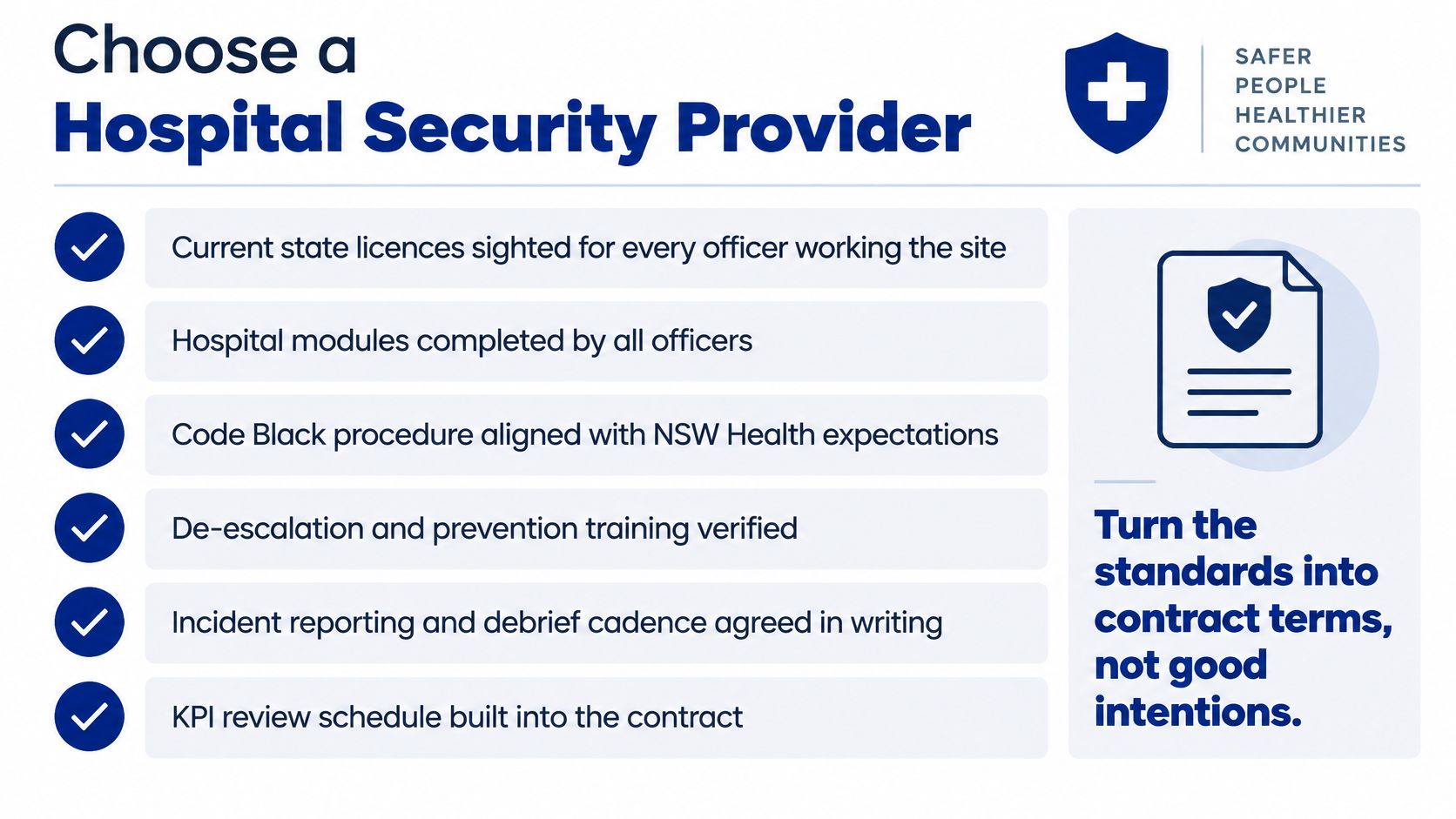
Choose a Hospital Security Provider
A hospital security contract should define each role, its authority and how performance will be assessed. Check that the provider can document the requirements before service begins.
- Current licences for every officer rostered to the site, valid under the relevant state regulations.
- Training records covering conflict resolution, first aid, OH&S, customer service and emergency response.
- Site-specific post orders that set out duties, escalation paths and communication with clinical staff.
- A named supervisor and a clear contact route for hospital staff.
- Sample incident reports with personal information removed, so you can assess their clarity and completeness.
- A written privacy position covering CCTV, access to footage, retention and complaints.
- Clear response roles for Code Black incidents, including how security and clinical leadership coordinate.
For a multi-campus service, confirm which sites are covered and whether mobile patrols are available after hours. ABCO serves hospitals and healthcare facilities and offers security guarding and mobile patrols.
A pilot can test whether the agreed roles suit the site. Set its scope and review measures in the contract, then assess outcomes against the indicators established for the service.
Send ABCO Security Services Australia your ranked zone list, staffing preferences and required officer numbers to request a site-specific roster. ABCO's guards are fully licensed under relevant Australian state regulations. More guards do not automatically make a hospital safer: agree on the duties, escalation paths and measures first.
about
avada factory
Sempery ultricies nibh at dolor cras urna eleifend nec. Atiam efficitur tempor.