You're finalising the roster for a Darwin festival. One worker will watch the perimeter fence, another will screen patrons at the entrance, and a contractor says everyone has a security licence. Before you approve the shift, you need to know whether each person's authority covers their assigned duties.
An NT security licence isn't a blanket permission to perform every security task. For applicants, the starting point is choosing the right class and assembling the evidence. For employers, it's matching the task, the individual's authority and the supplying firm before anyone starts work.
NT Security Licence Classes and Who Needs One
NT private security licence classes
| Class | What it authorises | Typical work | Do not assume it covers |
|---|---|---|---|
| Combined security officer and crowd controller | Guarding or patrolling property and crowd-control functions | Mixed event, retail and venue shifts | Anything beyond the authorised functions and conditions |
| Security officer only | Guarding or patrolling another person's property | Gatehouse, construction compound, static post, mobile patrol | Screening entrants, queue control or removing patrons |
| Crowd controller only | Controlling behaviour, screening entrants or removing people | Licensed-venue doors and entertainment queues | Static guarding or patrols of property |
| Provisional | A limited individual authority where NT grants it | Work permitted by the conditions on the current NT application and licence | A full unrestricted security officer or crowd controller licence |
| Security firm | An individual, partnership or company supplying officer and crowd-controller services | Contracting Security Guarding to a client | The personal authority of each deployed worker |
The Private Security Act 1995 establishes the Territory's licensing framework for security officers, crowd controllers and security firms, as outlined in Licensing NT's annual report. That report recorded 2,107 private-security licences in force at 30 June 2020, up 74, or approximately 3.6%, from 2,033 the previous year.
The total comprised 1,708 combined licences, 229 security-officer-only licences, 75 crowd-controller-only licences and 95 security-firm licences. These are historical licences-in-force figures, not approval odds or a measure of today's available workforce.
Match the authority to the actual shift
Say a construction operator needs someone to check vehicle access, watch stored materials and patrol the compound. Those property-protection duties fit the security-officer side of the framework.
Move that same worker to a festival entrance to screen patrons or remove disruptive attendees, and the assignment has changed. An officer-only licence shouldn't be treated as authority for crowd-control work just because the roster still calls the person a guard.
A useful security officer work description helps identify duties, but the licence and its conditions determine what the individual may perform. Write the duties in concrete terms rather than relying on labels such as event staff or site security.
Check the business as well as the worker
A security-firm licence permits an individual, partnership or company to supply security-officer and crowd-controller services. It doesn't replace the personal authority of the people deployed.
For procurement, keep the checks separate:
- Supplier authority: Confirm the contracting entity can supply the services.
- Individual authority: Match each worker's class and conditions to the post.
- Assignment scope: Identify whether the shift involves property protection, crowd control or both.
Before paying for training, lock the intended class to the work you want to perform. Before accepting a contractor's roster, do the same exercise for every post.
When a Liquor Licence Does Not Cover the Door
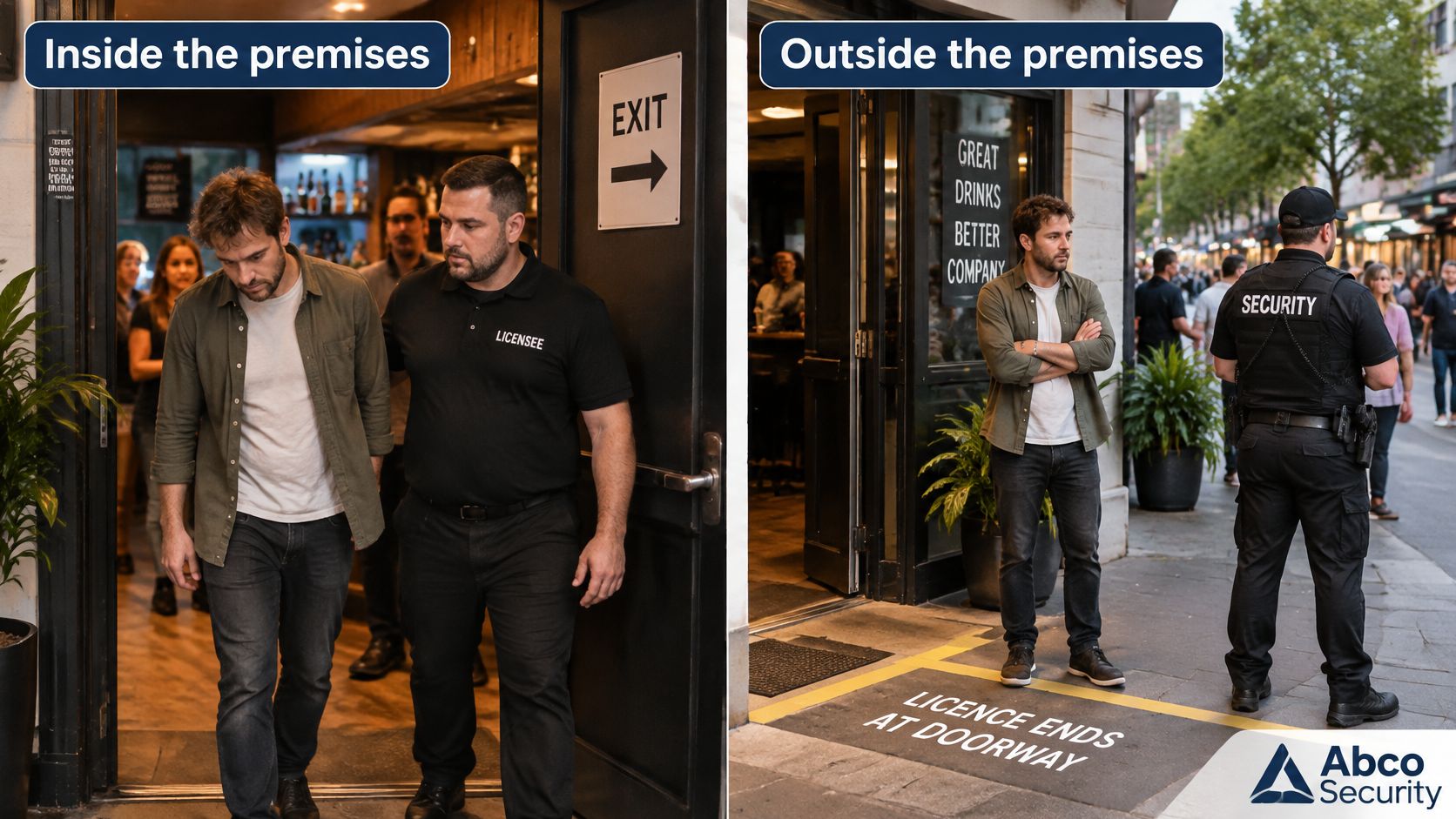
A pub's liquor licensee personally escorts a disorderly patron out of their own premises. That situation is different from hiring staff to screen entrants, manage the queue and monitor behaviour throughout the evening.
The doorway may look the same, but the person's legal capacity and assigned functions matter.
The licensee's exception is narrow
The NT Government's security-licensing guidance recognises that a person holding a liquor licence doesn't need a security licence to remove disorderly people from their own premises. Don't extend that exception to every employee, contractor or manager working at the venue.
A manager who is also the liquor licensee presents a different case from a manager who is just an employee. Confirm who holds the liquor licence before relying on the exception.
Now consider contracted door staff. They screen entrants, control a growing queue and watch patrons' behaviour inside the venue. Those broader security functions generally require the appropriate individual security licence.
The practical distinction is between the licensee exercising that specific exception and staff being assigned regulated security duties. A liquor licence isn't a substitute security credential for the whole door team.
Licensing follows the work people are assigned, not the job title printed on the roster.
Mixed duties need a deliberate class check
Suppose a shopping-centre assignment includes patrolling the car park, then helping at an entertainment venue's entrance. Property patrols and patron screening aren't interchangeable functions.
A security-officer-only licence may cover the property-protection component without covering crowd control. A combined security-officer and crowd-controller licence can be relevant when the assignment includes both functions, subject to the holder's conditions.
For Event Security, the same distinction applies. Checking patrons' bags and handling ejections at a licensed event isn't the same assignment as protecting property at a static corporate-foyer post.
Use the video alongside a written discussion of the duties your venue requires.
Write the task before choosing the person
The Territory publishes crowd-controller, combined, provisional and security-firm categories, but employers still need to translate their operation into specific assignments. A written crowd-control security plan helps make those boundaries visible.
Record:
- Entrance duties: Specify whether staff check tickets only or screen and control patrons.
- Floor duties: Separate customer assistance from behaviour monitoring and intervention.
- Property duties: Identify patrol areas, access-control posts and asset-protection responsibilities.
- Escalation duties: State who handles refusals, removals and incident reporting.
Incorrect role allocation can complicate insurance enquiries, incident reports and the venue's ability to demonstrate lawful staffing. Don't assume a combined licence resolves every issue either. Staff still need clear instructions, suitable supervision and a safe escalation process.
Eligibility Training and the Evidence Pack
A course completion email is useful, but it isn't a complete application file. Treat eligibility, training and supporting evidence as separate checks, with a named person responsible for confirming each one.
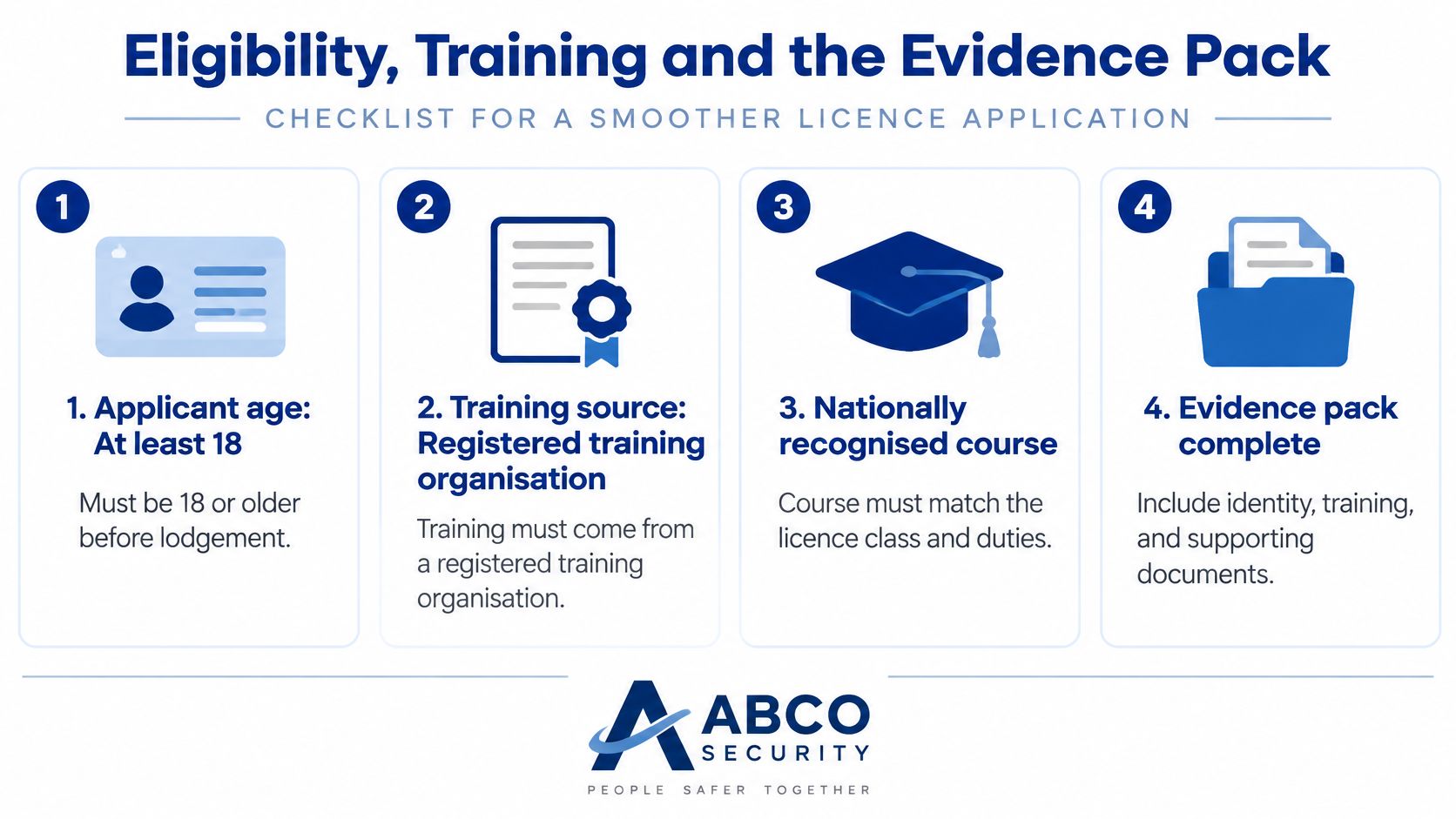
The checklist gives applicants a practical way to organise those checks before preparing their application.
Establish eligibility before committing to a start date
The applicant must be at least 18. Training must come from a registered training organisation, and the required pathway covers all 14 units of CPP20218 Certificate II in Security Operations, including current first-aid competency under HLTAID011 or HLTAID003.
Ask the training organisation for the full unit list in writing before enrolling. Compare the proposed course with the current NT application requirements rather than assuming that any course advertised as security training will meet them.
A guide to the Certificate II in Security Operations can help explain the qualification. The training organisation should still confirm precisely what it will deliver and what evidence you'll receive.
For a legacy CPP20212 qualification, check the specified accepted units individually. Don't assume the older certificate's title establishes equivalence for every current requirement.
Keep separate records for separate requirements
Identity evidence, criminal-history checks and police fingerprints aren't interchangeable. Completing one doesn't remove the need to satisfy the others.
Build an individual file containing:
- Training transcript: Retain the unit-level record, not just a congratulatory email.
- First-aid certificate: Record currency and set a reminder before it needs attention.
- Identity documents: Check that names and other details align across the application.
- Criminal-history evidence: Keep the required material with the applicant's file.
- Fingerprint evidence: Retain the receipt or confirmation, while distinguishing attendance from completion of the licensing process.
Say a new starter finishes training on Friday and expects to work a construction gate on Monday. Their identity evidence isn't ready and fingerprint requirements remain outstanding, so the course certificate doesn't make them ready to deploy.
Practical rule: A training record proves training. It doesn't prove that the regulator has issued the required authority.
Employers should store these records against the individual, with controlled access to sensitive information. A shared inbox full of attachments makes it too easy to confuse someone's submitted documents with a complete, verified personnel file.
How to Lodge the Application
A submitted application does not authorise a shift. Before choosing a start date, check that the worker has the right class for the duties and that the required evidence is ready. Use the current requirements on the NT Government's security-licence application page.
Applicants must be at least 18, complete the required 14 CPP20218 units, hold current HLTAID011 or HLTAID003 first aid, and provide separate identity, criminal-history and fingerprint evidence. Follow the steps in order so a missing document or class mismatch does not hold up the application.
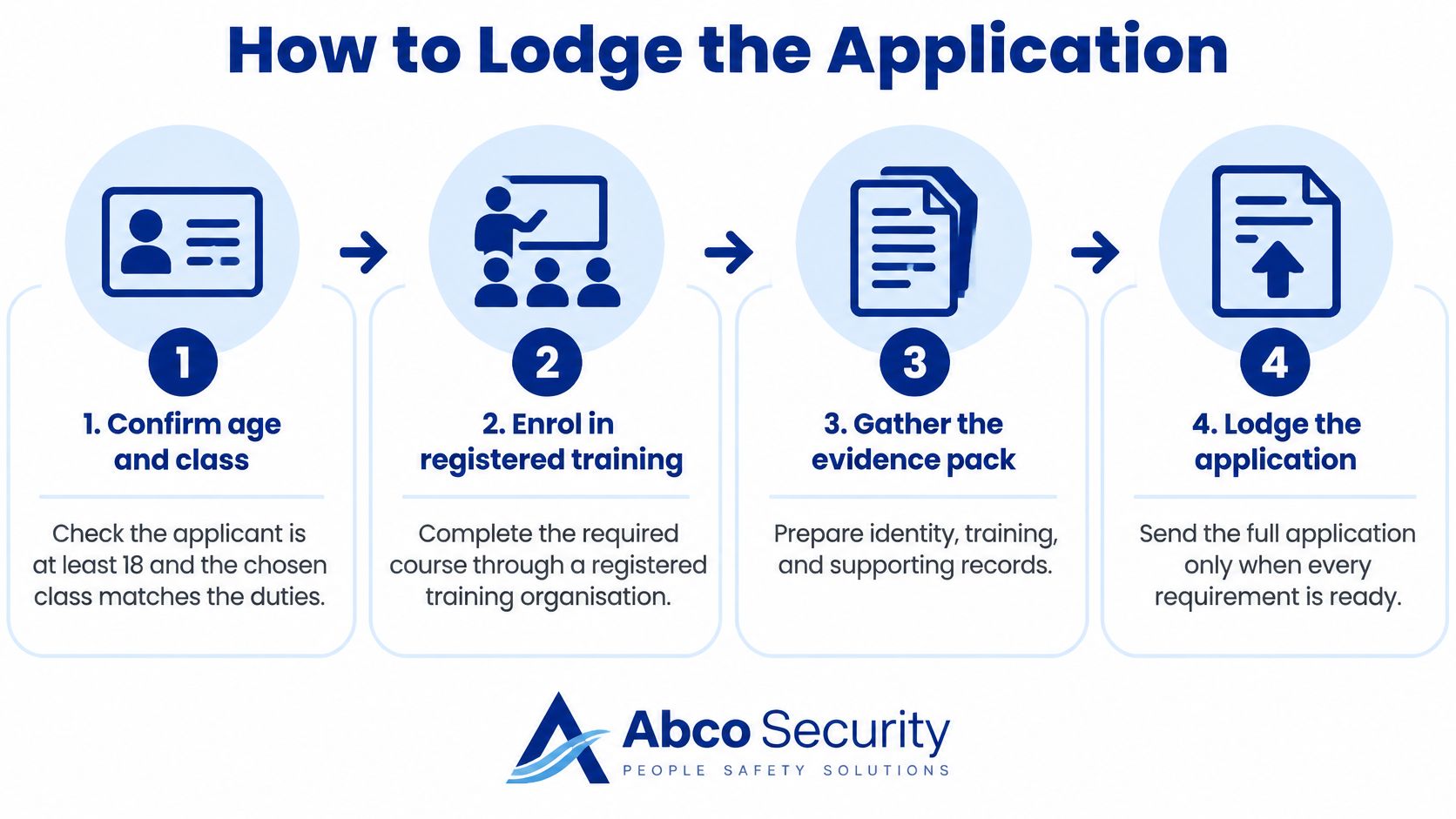
Follow the application workflow
Confirm age and licence class.
Check eligibility and match the class to the intended duties. A class that does not cover the work can leave a worker unready for the proposed deployment.Enrol with a registered training organisation.
Confirm the provider's registration and the qualification being delivered. A short course from an unregistered provider is not a substitute for the prescribed training.Complete the required competencies and first aid.
Obtain the transcript and first-aid evidence. If relying on CPP20212, check that the units meet current requirements before treating the qualification as sufficient.Obtain the criminal-history check and police fingerprints.
Follow the application directions for both requirements. A police check arranged for another employer may not satisfy this process.Complete the prescribed private-security application.
Use the form for the correct applicant and class. If a business will supply security services, handle the security-firm application separately from applications for individual personnel.Attach the supporting evidence as a complete pack.
Check the training, identity, criminal-history and other requested documents against the form. A genuine training certificate alone does not make an incomplete application ready to lodge.Lodge and pay at a Territory Business Centre.
Pay the applicable fee at lodgement and keep the receipt and application reference. Check the government page for the current amount rather than relying on an old blog or course advertisement.
The visual workflow summarises the preparation and submission stages.
Confirm fees and timing rather than guessing
Lodgement fee, timing and renewal rules
| Item | Rule |
|---|---|
| Lodgement fee | Paid at lodgement at a Territory Business Centre. Confirm the current amount on the NT Government security-licence page. |
| Processing time | Obtain current advice from Licensing NT. Do not assume a guaranteed turnaround. |
| Renewal window | Renew a non-provisional licence within the three months before expiry. |
| Expired licence | Apply as a new applicant. |
| Licence transfer | Confirm the applicable process with Licensing NT before changing the deployment. |
Historical processing volumes do not indicate approval rates or how long an application will take. Rely on current advice from Licensing NT.
Track each person's application as lodged, under assessment or issued. An application receipt confirms lodgement, not that the worker holds authority to perform the proposed duties.
Before visiting the Territory Business Centre, check signatures, document legibility and consistency of names. Keep a copy of the submitted pack so you can respond accurately if Licensing NT requests clarification. After lodgement, retain the reference and monitor correspondence.
Renew, Transfer and Avoid Penalties
A non-provisional NT security licence must be renewed within the three months before expiry, and an expired licence requires a new application, according to the NT individual private-security licence renewal form. Experience, an ongoing employment contract and a familiar site don't extend a lapsed authority.
The operational risk is straightforward. A gatehouse officer's licence expires before a public-holiday weekend, but the roster still includes them because nobody checked the card against the shift dates.
Make renewal a roster control
For a continuously staffed site, checking only at recruitment isn't enough. The supervisor needs to know whether the worker remains authorised throughout the assignment, including overnight shifts and multi-day events.
Keep a compliance register with a row for each worker and these fields:
- Licence category: Include relevant conditions and the duties the person is approved to perform.
- Expiry date: Compare it with upcoming shifts, not just today's date.
- First-aid currency: Record the supporting certificate and the next review date.
- Training evidence: Store the transcript where authorised staff can retrieve it.
- Renewal status: Distinguish preparation, submission and verified current authority.
Set the first follow-up for the opening of the permitted renewal window. Assign responsibility to a named administrator and escalate unresolved records to the roster manager.
For Mobile Patrols, build the same check into relief coverage. Replacing an unavailable patrol officer with someone whose file is incomplete merely moves the compliance problem.
Don't treat a receipt as proof of continuing authority
If a worker says renewal has been lodged, verify what authority remains current before rostering them. Don't assume that submitting paperwork automatically resolves expiry or permits work during an administrative gap.
Roster control: An unresolved licence record should stop that assignment until someone verifies the worker's authority.
The register should show who checked the record and when. That makes a handover between operations staff more reliable than a verbal assurance that someone has sorted it out.
Confirm transfers and penalties directly
Ask Licensing NT which process applies to the proposed transfer or change. Clarify whether you mean interstate recognition, a change to an individual's authority or a change involving the supplying business.
Confirm current offences and penalty amounts through the NT Government security-licensing guidance. Don't rely on an old fine quoted in an induction document.
As an internal deployment rule, require a verified current class, a future expiry date and current first-aid evidence before approving the roster line. Treat missing evidence as a problem to resolve, not a reason to guess.
Check Interstate Licences Before the Shift
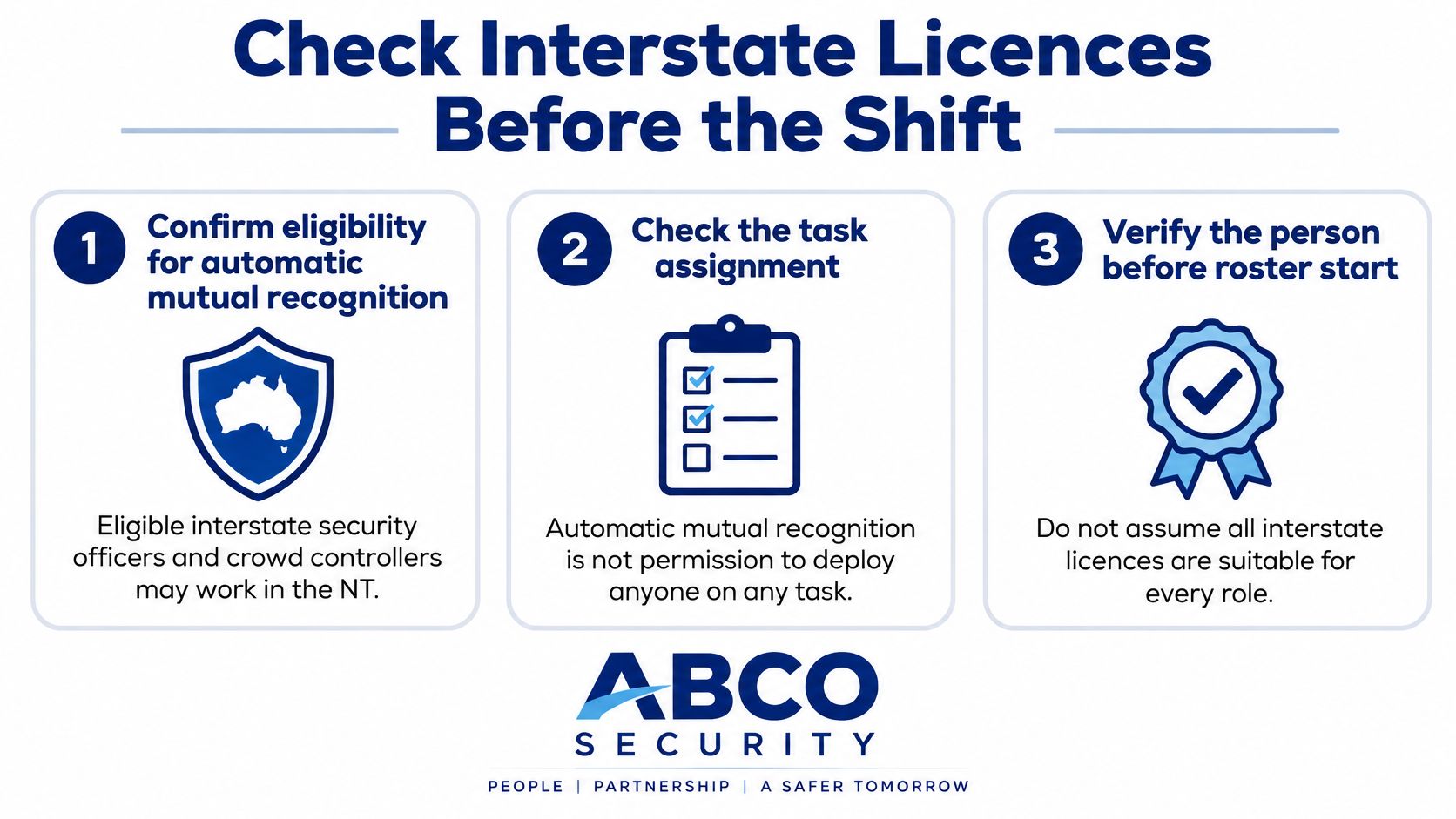
A security officer arriving for a Darwin venue shift may hold a current interstate card, yet still lack authority for the duties on that roster. Automatic mutual recognition (AMR) provides a pathway for eligible interstate security officers and crowd controllers to work in the Territory, but the duties must fit their authority. Check the NT Government's interstate security guidance against the proposed assignment.
Complete a site-level mobilisation check
Use the same six checks for a worker travelling from Melbourne, Sydney, Brisbane, Perth or elsewhere. The home office's location does not determine which Territory duties the person may perform.
- Verify identity: Match the arriving person to their licence and mobilisation records.
- Check the class: Compare the specific site duties with the worker's authorised activities and conditions.
- Confirm AMR eligibility: Establish that the person can use the AMR pathway for the proposed work.
- Check the supplying firm: Search the NT public register for the relevant individual or firm, and review the interstate-provider guidance.
- Record the result: Keep the register check and its date on the site file.
- Reassess changed duties: Repeat the scope check if, for example, a worker moves from construction-perimeter work to patron screening.
A principal contractor should retain the verification record, not leave it solely with the labour supplier. For a mining shutdown, check the supplier and match each worker's authority to their assignment before the first patrol.
Use the Territory's verification routes
Use the NT public register as the central route for checking an individual's or firm's licence status. Record the result and resolve any discrepancy before the supervisor releases the roster.
An interstate card is not automatically an NT-issued card. Local rules also differ, so check the Territory's requirements rather than copying Victorian or Western Australian training and renewal settings into an NT file.
Personnel who need background on the application process can read this guide to getting a security licence. For interstate deployment, the worker's eligibility, authorised class and site duties all need to line up.
Roster Only People You Can Prove Are Licensed
A roster is only as reliable as the records behind it. Applicants should select the appropriate class before training, prepare the evidence pack and lodge through the Territory process. Once a licence is issued, set a renewal reminder.
For employers and venue managers, match the assigned work to the worker's authority and keep the relevant records with the roster. A licence alone does not establish that every task is covered.
Turn the checks into usable records
- Before appointment: Record the proposed duties and the authority they require.
- Before deployment: Resolve missing or inconsistent documents.
- During the contract: Track expiry dates and review records if duties change.
Keep regulatory compliance documentation accessible so an authorised manager can see what was checked and which work the officer was assigned.
For overnight and weekend coverage, use the applicable classifications and penalties in the Security Services Industry Award pay guide. A single weekday rate may not reflect every shift.
The Australian Security Industry Association's research and statistics provides national industry context. National licence-holder information does not show whether a particular worker is authorised for an NT assignment.
ABCO Security Services Australia provides static security guarding, event security and construction security. Visit ABCO Security Services Australia to discuss your duty list, location and verification requirements before deployment. Independently check the supplying firm and each assigned officer through the relevant NT verification routes.
about
avada factory
Sempery ultricies nibh at dolor cras urna eleifend nec. Atiam efficitur tempor.