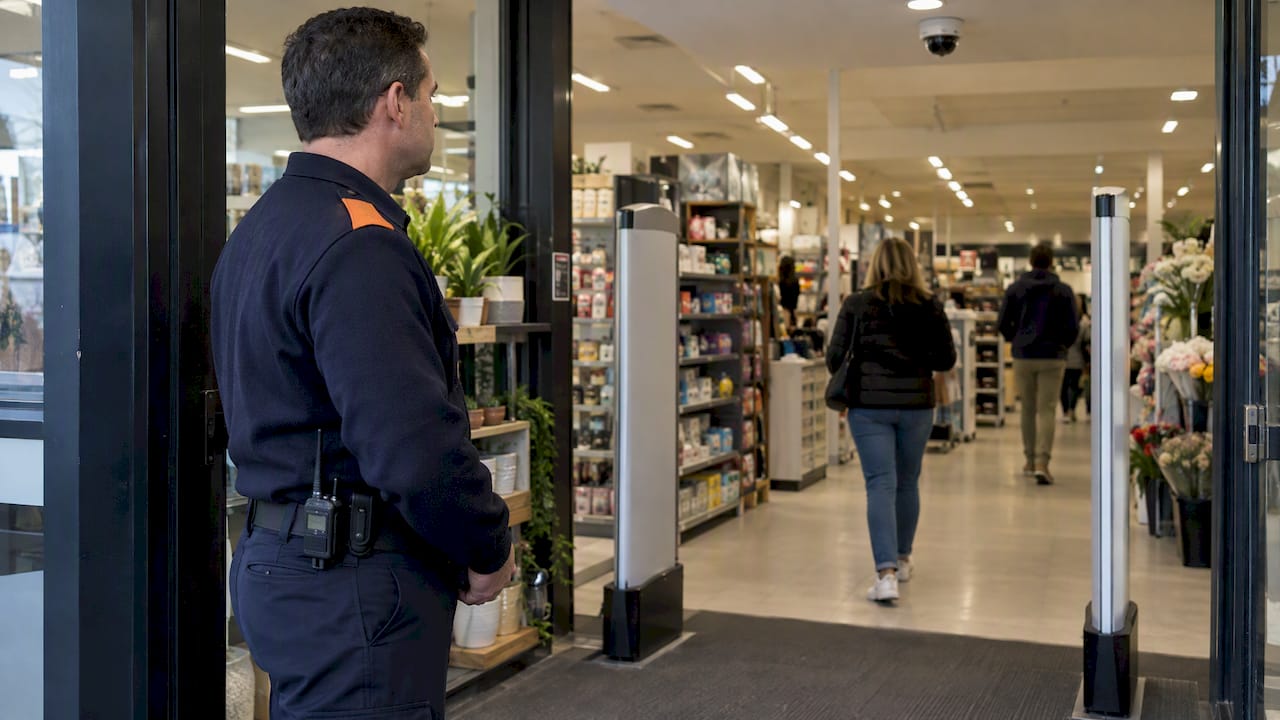
The fastest way to cut shoplifting is a layered approach: attentive staff who greet and patrol the floor, clear sightlines through basic CPTED changes, and visible surveillance or tagging. Start all three within 72 hours. Staff must never physically detain anyone or force a bag search; the goal is deterrence and documentation, not confrontation.
TL;DR:
- Lower shelves and clear entrance clutter; move small valuables one aisle from exits, and use convex mirrors to cover camera blind spots.
- Match protection to merchandise: use electronic tags for general goods, hard tags or wraps for awkward electronics, and locked cabinets for small valuables.
- Use weekly counts for high risk categories, point of sale alerts for clustered voids and refunds, and delivery checks against goods received.
- Reserve facial recognition for last resort after a documented Privacy Impact Assessment; visible cameras, signage, and tags usually avoid that privacy exposure.
- Staff should record the time, description, and movements, preserve footage, and notify police; bag checks must remain voluntary, and employees must never pursue suspects.
Table of Contents
- Store layout and CPTED: quick fixes and practical design choices
- Staff practices and training: daily behaviours that act as guardians
- Surveillance and physical security: CCTV, EAS tags and sensible tech choices
- Inventory and operational controls that reduce shrink
- Policy, incident response and staff safety: what to write into store procedures
- A concise, implementable prevention plan: a 7-step checklist managers can start today
- How ABCO Security’s prevention playbooks turn these measures into a managed program
- What a retail security partner actually offers
- How ABCO Security can help: services and next steps
- FAQ
- Sources
Store layout and CPTED: quick fixes and practical design choices
Crime Prevention Through Environmental Design treats theft as an opportunity problem. Improve sightlines, lighting, and a sense of ownership over the space, and opportunistic theft drops because the perceived risk of getting caught rises. NSW Police’s Safer by Design guidance frames this as reducing opportunity rather than reacting after the fact, and our own breakdown of CPTED principles applies the same logic to retail floors.
Most fixes cost little. Lower shelving below eye level opens sightlines from the counter to the back wall. Removing promotional clutter near entrances stops it becoming a blind spot. Moving high-value, easily pocketed stock away from exits and toward staffed areas makes a grab-and-run harder to pull off cleanly. Convex mirrors in corners cover angles cameras miss.
Run a five-minute audit during a quiet hour or staff meeting:
- Stand at the counter and check whether you can see every aisle end.
- Walk the perimeter and note any stock blocking a window or doorway.
- Check that high-value items sit at least one aisle away from the nearest exit.
Pro Tip: Do the audit at closing time, when lighting gaps and dead zones are easiest to spot.
Staff practices and training: daily behaviours that act as guardians
A staff member who greets every customer and moves through the floor is doing more than good service. It signals capable guardianship, the idea that someone is watching and would notice if something went missing. ACT Policing’s shoplifting guidance lists greeting, floor presence, and visible attentiveness as core deterrents, and Griffith University research on retail crime and loss prevention found that visible greeters reduced opportunistic theft during pandemic-era restrictions.
Build this into daily routine:
- Set a minimum floor headcount for every trading hour, not just peak periods.
- Rotate staff through aisles rather than parking everyone at the counter.
- Run a two-minute briefing at shift start covering any known theft patterns or flagged items.
- Have a supervisor do an unscheduled floor check mid-shift.
De-escalation matters as much as presence. Staff should never chase, grab, or block an exit; the role is to observe, describe, and report. Our guide to security guard de-escalation covers the same principles that apply to retail staff facing a tense moment.
Pro Tip: Train staff to say “I noticed you haven’t paid for that” rather than an accusation. It opens a conversation instead of a confrontation.
Surveillance and physical security: CCTV, EAS tags and sensible tech choices
Cameras deter theft only when people know they’re there and someone is actually watching the feed. QPS guidance on shoplifting and stealing recommends visible signage alongside working cameras, placed to cover entrances, high-value shelving, and the point of sale.
Match the device to the risk:
- Electronic article surveillance (EAS) tags suit mid-value apparel and general merchandise moved through a standard gate.
- Hard tags and spider wraps work for electronics and items with awkward shapes that defeat a simple clip.
- Locked display cabinets belong around anything small, expensive, and easy to palm, like fragrances or premium accessories.
Live monitoring catches an incident as it happens; post-event review is useful for building a case afterwards but does nothing to stop the theft in progress. A monitored system, like our camera monitoring services, covers both.
In 2025, theft victims in Australia fell slightly, yet a significant portion of these thefts occurred at retail locations, according to the Australian Bureau of Statistics. Retail remains the single biggest setting for theft even as the national rate drops.
Facial recognition is a separate question entirely. The OAIC’s updated guidance treats FRT as highly privacy-invasive and recommends it only as a last resort after a documented Privacy Impact Assessment. For most stores, visible cameras, clear signage, and tagging do the job without that exposure.
Inventory and operational controls that reduce shrink
Layout and staffing handle opportunistic theft on the floor. Shrink also comes from gaps in how stock moves through the back of house, and those gaps are often cheaper to close than any camera system.
- Run short-cycle stocktakes on high-risk categories weekly rather than waiting for a full quarterly count.
- Set up point-of-sale exception reporting to flag voids, no-sale scans, and refunds that cluster around particular staff or shifts.
- Lock away portable, high-value goods on receiving day rather than leaving them on a loading dock trolley.
- Reconcile delivery dockets against what actually lands on the shelf, not just what the supplier invoices.
These checks take a manager twenty minutes a week and tend to surface problems that cameras never catch, including internal theft. Our guide on loss prevention in retail stores walks through a fuller version of this routine, and a separate playbook on stopping employee theft covers the internal-control side in more depth.
Policy, incident response and staff safety: what to write into store procedures
A written policy keeps staff consistent and protects the business legally. It needs to cover four things clearly.
- Conditions of entry and bag checks: state that bag checks are voluntary, backed by visible signage, so staff never imply a legal right to search that doesn’t exist.
- Incident response: record time, description, and movements, preserve any CCTV footage, and notify police rather than pursuing the person.
- Reporting: keep a short incident report template so details aren’t lost between shift handovers.
- Staff safety: make clear that no one is expected to physically apprehend a suspect, in line with workplace safety obligations under guidance such as WorkSafe Queensland’s work-related violence material.
Both ACT Policing and QPS are explicit on this last point: staff safety comes before recovering stock.
A concise, implementable prevention plan: a 7-step checklist managers can start today
Turn the above into a sequence rather than a list of good ideas sitting unused.
- Day 1: brief staff on greeting and floor presence.
- Day 1: audit sightlines and fix the worst blind spot.
- Week 1: set floor rotation and minimum staffing by hour.
- Week 1: tag or lock the highest-risk items.
- Week 1: confirm CCTV coverage and refresh signage.
- Month 1: run a full stocktake on high-risk categories.
- Month 1: review and sign off the incident response procedure.
Our integrated security solutions guide covers how these layers reinforce each other once all seven are running.
How ABCO Security’s prevention playbooks turn these measures into a managed program
We build these same steps into structured retail playbooks: a shrink analysis to find where loss is concentrated, staff-facing controls, and rapid fixes for the highest-risk gaps first. Our retail shrink analysis sets out a 90-day version of this, aligned with ISO 9001 and ISO 30000 standards, aimed at measurable change within the first month rather than a slow policy rewrite.
What a retail security partner actually offers

Shoplifting prevention isn’t a project with an end date. It’s a set of habits, staff presence, clean sightlines, working cameras, that have to hold up every single shift, including the quiet Tuesday afternoon nobody’s watching closely. The stores that struggle aren’t usually missing technology; they’re missing consistency.
Start with the cheapest, highest-impact steps: greet people, fix the obvious blind spot, lock the cabinet that’s been bothering you for months. Scale up to policy and monitored tech once those habits are running. When a store wants that consistency built and maintained professionally, retail playbooks are a sensible next step.
— Abco
How ABCO Security can help: services and next steps
This layered approach can be run as a managed service rather than a one-off fix. Security guarding places trained staff on your floor for an attentive presence that deters opportunistic theft. Mobile patrol services cover your perimeter after hours, when a store is otherwise unwatched. CCTV & alarm monitoring keeps cameras actively watched rather than just recording for later, and retail loss prevention services tie layout, staff controls, and tech into a single plan.
A consult starts with a rapid assessment of your current gaps, followed by a tailored plan with measurable outcomes rather than a generic checklist. For ongoing monitoring support, our Night Owl Service starts from $5.45 a day. Get in touch through our security guarding page to arrange an assessment.
FAQ
What is the most effective tool to prevent shoplifting?
No single tool works alone. Police guidance from ACT Policing points to a layered combination of attentive staff, clear sightlines, and visible CCTV or tagging as the most reliable approach, rather than any one device.
How can staff safely intervene when they spot a shoplifter?
Staff should never physically apprehend or chase anyone. The safest approach is to observe, describe what you saw, and notify a supervisor or police, following the de-escalation and safety guidance set out by QPS.
Do stores actually keep track of shoplifting incidents?
Most retailers log incidents through CCTV footage, point-of-sale exception reports, and written incident reports rather than tracking individuals directly. Retail locations account for 43% of theft victims nationally, according to the Australian Bureau of Statistics, which is part of why consistent reporting matters.
What do shoplifters steal the most?
Shoplifters typically target small, high-value, easy-to-conceal items such as cosmetics, electronics accessories, and premium clothing or accessories. These are exactly the categories that benefit most from EAS tags, locked cabinets, or placement away from exits.
Is it legal to search a customer’s bag if I suspect theft?
No, retail staff generally cannot force a bag search. Best practice, as outlined by ACT Policing, is a voluntary bag-check policy backed by clear signage at the entrance, never a mandatory check.
Sources
- First drop in theft and robbery since COVID-19 | Australian Bureau of Statistics
- Shoplifting prevention and detection | ACT Policing
- Shoplifting and stealing | QPS
- Privacy commissioner publishes updated guidance on facial recognition in retail spaces | OAIC
Recommended
about
avada factory
Sempery ultricies nibh at dolor cras urna eleifend nec. Atiam efficitur tempor.