
The most popular advice in security buying is simple and wrong: pick the provider who promises the fastest arrival. A fast arrival isn't a service delivery standard. It's one link in a chain, and a chain fails at its weakest link, not its fastest one.
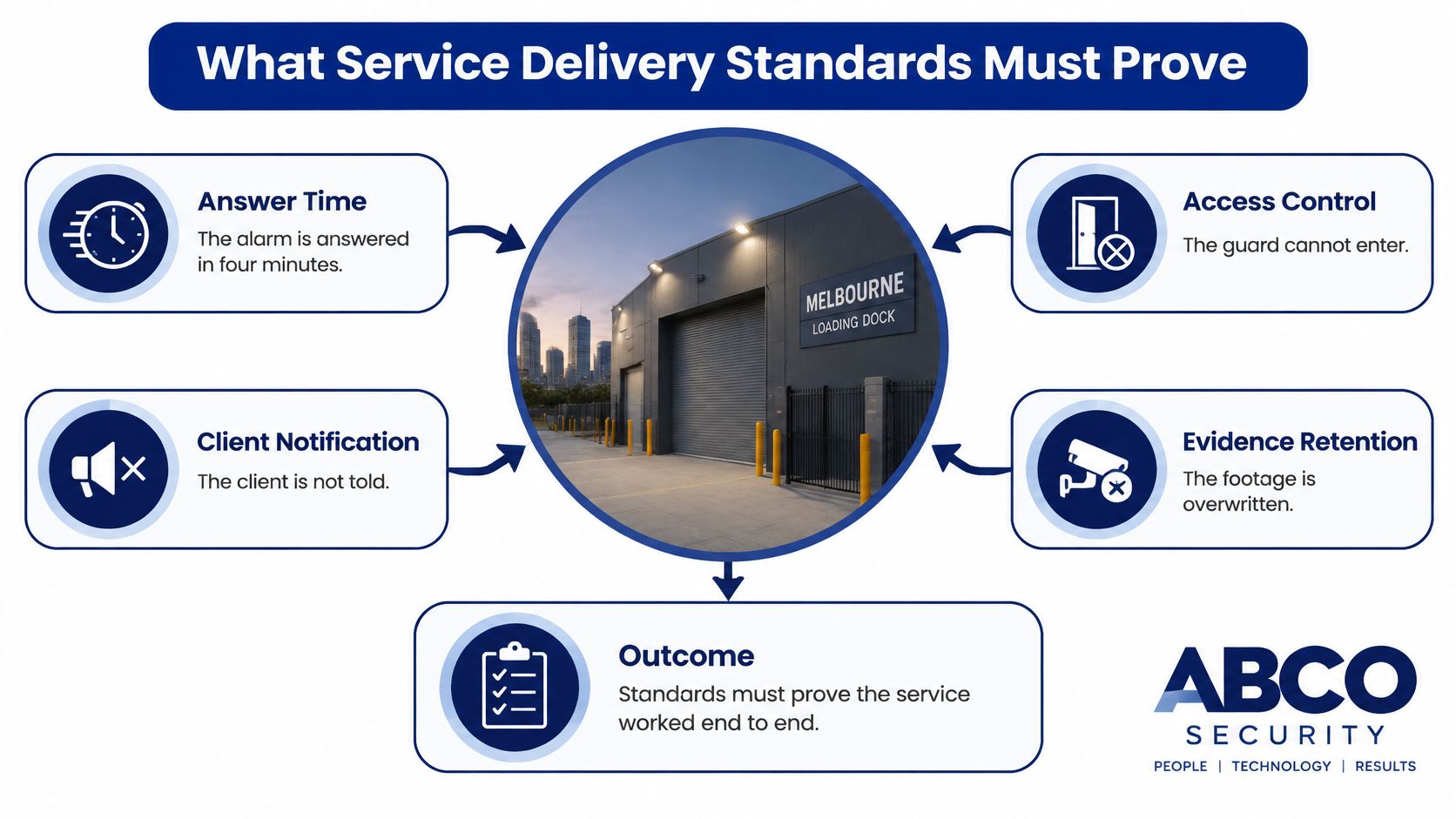
If the alarm wasn't verified, the guard can't get in, nobody told you, and the footage is gone, the four-minute arrival proved nothing. Real service delivery standards prove the whole job worked, end to end, for a named site.
What Service Delivery Standards Must Prove
Say it's 2 a.m. at a Melbourne loading dock. The alarm is answered in four minutes, which looks impressive on a proposal. Then the detail unravels.
The attending guard has no access code for the roller door. The control room doesn't call the duty manager because nobody agreed who owns that call. By morning, the camera system has overwritten the footage the insurer wants.
Nothing was stolen, so the month gets reported as quiet. That's exactly the trap. Incidents are rare, so property managers, event organisers and strata committees can't judge a provider by whether nothing happened.
From Slogan to Standard
"Professional service" is a slogan. A standard names the user, the outcome, the measure, the threshold and the review date. If any one of those is missing, you can't audit it.
The Australian Government Digital Service Standard sets 10 criteria for designing and delivering digital services and requires teams to measure services, gather feedback and improve continuously. It isn't a security rule, but its lesson transfers directly to a Security Company Melbourne buyers might engage. Quality is demonstrated through accessibility, reliability, transparency, responsiveness and evidence of ongoing improvement, not through a written procedure sitting in a folder.
On a security post, those five ideas mean this. Authorised people can get in, the post is covered when rostered, you can see the evidence, alarms move to a named person quickly, and misses change next month's roster or procedure.
That definition gives you a test for every claim a provider makes. The scorecard below turns the test into numbers you can copy into a scope.
A Scorecard for Accuracy Time and Experience
A fast arrival is not a complete service standard. A scorecard must show what was done accurately, whether each task met its time window, and how people experienced the service. Public performance frameworks provide a useful model: they measure outcomes such as accuracy, waiting times and timeliness, as shown in the Productivity Commission's Report on Government Services performance framework. These measures are a benchmark for structuring security standards, not security rules.
Service Delivery Scorecard Adapted for Security Sites
| Dimension | Security metric | Starting threshold | Evidence |
|---|---|---|---|
| Accuracy | Incident and occurrence reports correct first time | At least 98 percent | Monthly closed-report audit |
| Timeliness of access | Gatehouse or concierge visitors served within 15 minutes | At least 70 percent | Entry log sample |
| Task timeliness | Agreed patrols, alarms and access tasks inside the window | At least 90 percent | Checkpoint and alarm system export |
| Experience | Post-contact client satisfaction | At least 85 out of 100 | Quarterly survey |
| Queue time | Average face-to-face wait at reception or gate | No more than 15 minutes | Concierge or gatehouse log |
Treat these as starting thresholds for a city corporate site, not universal promises. The figures are proposed security benchmarks in this scorecard, not targets attributed to the Productivity Commission.
How to Read Each Dimension
Accuracy means a report records the right time and location, and includes the relevant evidence reference. If any of those details are wrong or missing, the record may not support a later review. A first-time-correct target gives supervisors a reason to check reports before closing them.
Timeliness covers distinct tasks. Serving a visitor within a set time measures a queue; completing a patrol or alarm task within its agreed window measures whether coverage happened as scheduled. Keep the measures separate so a smooth reception does not conceal a missed patrol.
Experience captures what logs cannot: whether site contacts receive clear communication and understandable handovers. A quarterly survey can track that experience alongside the average wait, so a positive rating does not obscure a slow gate.
The Productivity Commission framework considers equity, effectiveness and efficiency. Applied to a security scorecard, that means checking whether the service reaches the people who need it, completes the agreed work, and uses resources sensibly. A low-cost patrol that misses checkpoints has not met its purpose.
ABCO Security reports performance against client-agreed thresholds. Service details are available from ABCO Security services.
Standards for Each Security Service
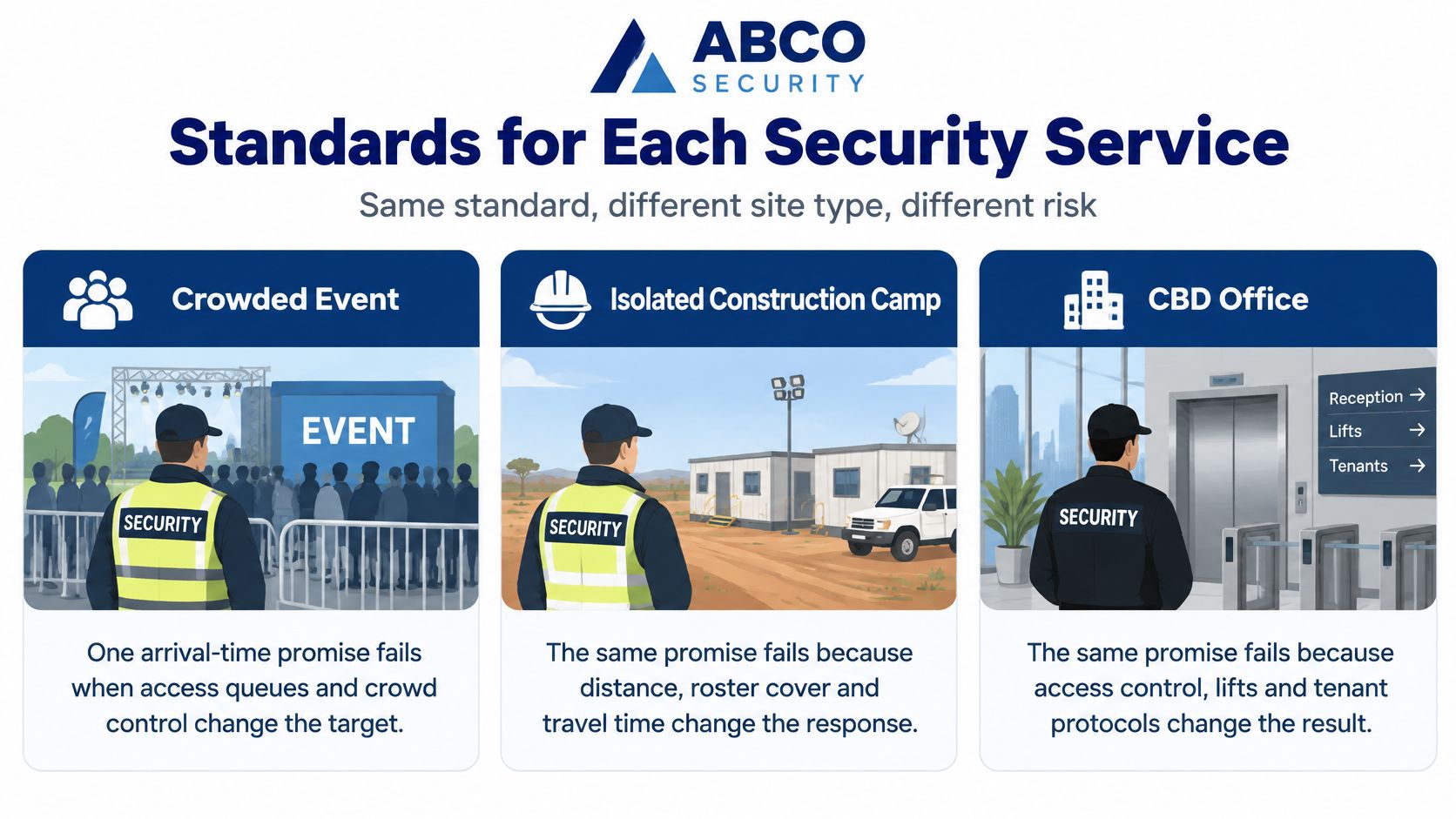
One arrival-time promise fails three sites for three different reasons. A crowded event is limited by queues and crowd movement, an isolated construction camp by distance and roster cover, and a CBD office by lifts, access control and tenant protocols.
Use the same five-link chain for every service, then set the target for the site in front of you.
- Detection to verification: Someone confirms the alarm, report or camera event is real.
- Verification to escalation: A named owner decides who attends and who gets told.
- Dispatch to arrival: Travel time is measured for that suburb or region.
- Arrival to stabilisation: The responder secures people first, then property and evidence.
- Incident to written report: The record lands while times, names and footage references are still accurate.
Service Standards by Security Duty
| Service | Proof of delivery | Sample target | Changes when |
|---|---|---|---|
| Static security guarding | Post covered and handover complete | No unmanned gap in the rostered window | The post is a gate, retail floor or construction entry |
| Mobile patrols | Checkpoints and lock checks done | 100 percent of scheduled hits logged | The site is regional or outside the metro ring |
| Alarm and CCTV monitoring | Alarm verified then escalated to a named owner | Verification started inside the agreed minutes | The system is part of a wider site network |
| Event security | Density, entry and medical handover managed | Triggers and headcount logged per zone | The crowd, weather or medical risk rises |
| Retail and shopping centre | Conflict handled and lockup confirmed | After-hours close signed off each night | Trading hours or centre rules differ |
| Construction security | Perimeter, deliveries and plant checked | After-hours breach logged before shift end | The site is remote or multi-stage |
| Concierge and gatehouse | Identity and induction recorded | Queue handled against the agreed wait | Visitor volume spikes at start of day |
| Residential and strata | Monitoring linked to a tasked patrol | Resident or manager told the outcome | After-hours access is limited |
What Good Looks Like by Duty
Security Guarding needs continuous post coverage and a complete handover, not just a name on a roster. Mobile Patrols need completed checkpoints and lock-and-leave checks, with an outer response time stated for the local area. Copying a CBD minute onto a regional site helps nobody, and the practical gains are explained in ABCO's guide to mobile patrol benefits.
Event Security needs entry throughput, crowd-density triggers, medical handover and a post-event debrief. Retail Security and Shopping Centre Security need clear theft observation rules, calm de-escalation and a signed after-hours lockup. Construction Security needs perimeter control, delivery gate discipline and plant-yard checks.
Distance across the roughly 200-kilometre ring around Melbourne, Sydney, Brisbane and Perth changes arrival times. It doesn't change the duty to verify, escalate and report. You can match each duty to a provider's actual offer through ABCO Security's service pages.
ISO Duties and Licence Checks
A management-system certificate and a site KPI answer different questions. ISO 9001 addresses how an organisation manages quality; ISO 31000 provides risk-management guidance that can support consistent security decisions. ABCO Security Services Australia also states a commitment to ISO 30000. Check what each cited standard covers and how the provider applies it to the services in your scope.
Check the System, Then Check the People
Start with the current certificate scope. Ask which sites and services it covers, which controlled procedure supports the work, and where the audit trail is kept. A certificate covering head-office monitoring does not automatically cover every guard post. ABCO's approach is described in its ISO 9001 quality management overview, with industry context from ASIAL.
Then compare each person's licence activities with the rostered duty. The Victoria Police private security eligibility and training requirements state that applicants must complete approved training through an approved Registered Training Organisation for each private-security activity on their licence application. The training must be valid within 12 months of the application being received. For unarmed guarding, crowd control and control-room operations, the requirements specify CPP20218 Certificate II in Security Operations at 130 hours.
A construction guard and an event crowd controller may need different licence activities. Check three details for each person on the roster:
- Licence activities: Do the listed activities match the duty?
- Training provider: Which Registered Training Organisation delivered the training?
- Currency date: When does the training or first-aid evidence lapse?
State Licence and Training Checks
| State | Training and first-aid rule | Currency or licence limit |
|---|---|---|
| Victoria | Approved training for each licence activity, delivered by an approved RTO; CPP20218 specified at 130 hours | Valid within 12 months of the licence application |
| Queensland | Complete all Certificate II in Security Operations modules through an RTO; HLTAID011 first aid required | HLTAID009 CPR every 12 months; restricted licence limited to six months and not extendable |
| Western Australia | Approved course plus written examination; crowd controllers also need Certificate II and current first aid | Written examination passed before the licence application is submitted |
How to Build Standards into the Contract
A facilities or venue manager can build an auditable scope in one working session. Keep each step short, and attach evidence to it as you go.
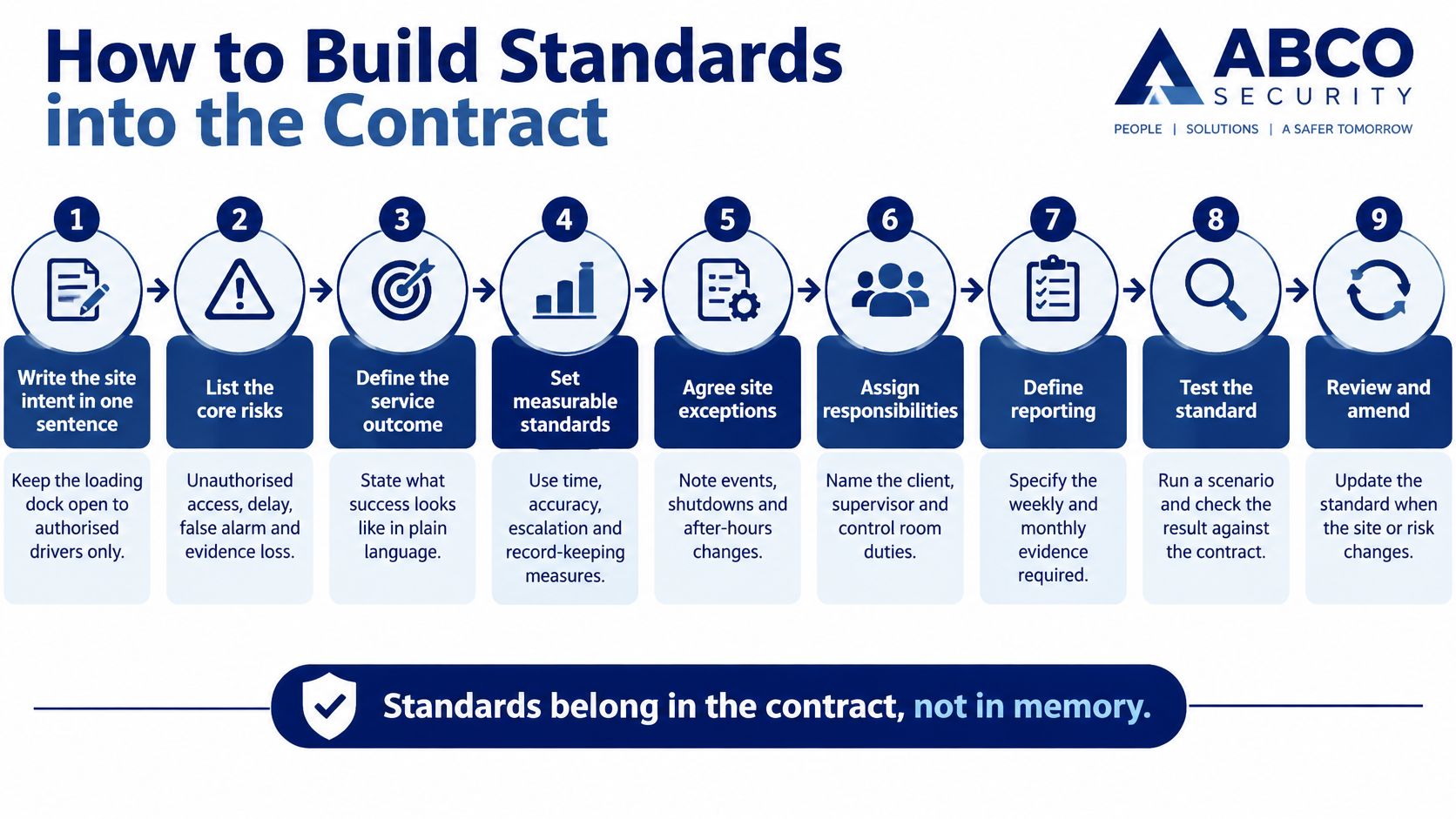
Nine Steps from Intent to Review
- Write the site intent. One sentence, such as keep the loading dock open to authorised drivers only.
- List the users. Staff, visitors, contractors, residents and emergency services all interact with the post differently.
- Record hazards and hours. Include after-hours, shutdown and public-holiday cover, not just business hours.
- Choose metrics and thresholds. Take them from the scorecard and service table, then set the number for this site.
- Name the evidence. Checkpoint export, radio log, CCTV retention, access-change log and the incident report.
- Split escalation. Who verifies, who attends, who calls police or ambulance, and who tells the client.
- Set licence and training gates. Activity match and first-aid currency get confirmed before the first shift.
- Fix the review rhythm. Weekly exceptions, a monthly KPI pack and a quarterly outcome review.
- Agree the consequence of a miss. Retraining, an extra patrol or a documented corrective action. Not a verbal apology.
When you're comparing suppliers for an event, the same discipline applies to every vendor, and criteria for choosing event vendors gives a useful cross-check for how you score capability, evidence and fit.
Two Edge Cases Worth Writing Down
A technically advanced alarm with no named escalation owner increases risk. The system detects more, but nobody owns the decision, so events sit in a queue.
A remote industrial site needs the opposite adjustment. Accept a longer arrival target that reflects real travel, then strengthen verification, site intelligence and client notification so the longer drive doesn't become dead time.
Standards belong in the contract, not in memory. If it isn't in the schedule of services, it won't survive a staff change.
Finish with a one-page schedule you can paste into the scope. ABCO builds these schedules into guarding, patrol and monitoring work, and the contract structure is explained in ABCO's security service contract terms and on the ABCO Security website.
Leading Indicators and the Monthly Report
Prevention is a standard, not a hope. The Safe Work Australia work-related violence and aggression report records that the ABS Personal Safety Survey identified more than 1 million work-related violence incidents over the lifetime reference period, including 176,100 incidents occurring in workplaces during the previous 10 years. The same analysis recorded 53,139 accepted workers' compensation claims for assault by a person or persons and 12,721 accepted claims involving exposure to workplace or occupational violence.
Figures at that scale say incident prevention, escalation and reporting belong in your service delivery standards, measured like any other commitment.
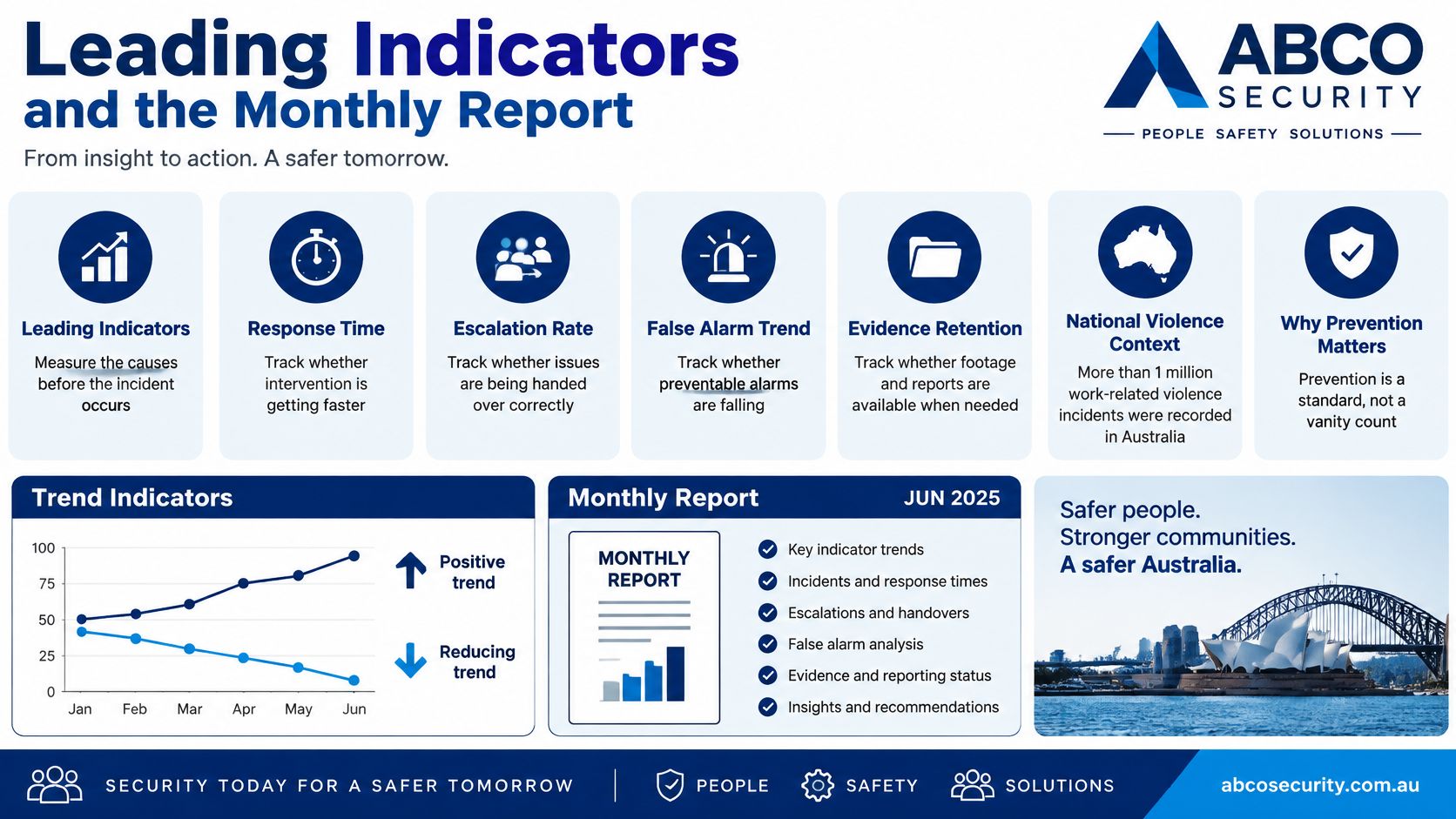
Causes You Can See Early
Leading indicators are the causes a supervisor can spot before someone is hurt. Track unresolved access breaches, alarm-response delays, incomplete patrol checkpoints and repeated aggressive-behaviour reports at the same door or tenancy.
Lagging indicators are what the organisation failed to prevent. Assaults, injuries and property loss confirm the earlier warnings were missed or ignored. By the time they move, the damage is done.
Review leading indicators weekly on retail, construction and corporate sites. Waiting for an injury report is too late, and a repeated aggression report at one entry point usually needs a roster, lighting or access fix, not a sterner memo.
What the Monthly Pack Should Contain
Keep it to a format you'll read. Four parts are enough.
- Thresholds versus actuals: One page, every agreed metric, no cherry-picking.
- Exception list: Each miss named plainly, with the site, time and link in the chain that failed.
- Evidence samples: A checkpoint export, a radio log extract and a saved footage reference.
- Corrective actions: An owner and a date for each fix, carried forward until closed.
Add four reporting rules and the pack stays honest. Classify every incident consistently, preserve CCTV and notes, record the client notification time, and review false alarms so a fast but useless dispatch is visible. A single minutes-to-arrival figure hides misses on verification and stabilisation, which is why the chain matters more than the headline. The reporting discipline behind the pack is covered in ABCO's security incident reporting guide.
Templates for Rosters Events and Handover
A roster can be filled and still fail as a control. Use these three templates to check pay and fatigue, confirm site readiness, and leave a clear record for the next shift.
Example One: Fatigue and Pay Check
The Fair Work Commission Security Services Industry Award pay guide lists a Level 1 officer at $42.63 per hour for the first two weekday overtime hours, $56.84 after two hours, $56.84 on Sunday, $71.05 on a public holiday and $56.84 where there is less than an eight-hour break between shifts. For the same pattern, it lists Level 2 rates of $43.86, $58.48, $58.48, $73.10 and $58.48.
Suppose an officer finishes overnight Mobile Patrols in Sydney at 5 a.m. and is rostered for Gatehouse Security at 10 a.m. The five-hour gap prompts two checks: apply the relevant pay rule and assess whether the officer is fit for the next shift. Record both decisions against the roster, so the pay check and fatigue check are visible rather than assumed.
Example Two: Event and Interstate Pre-Start
For Brisbane Event Security, use a pre-start check to confirm each crowd controller's required licence, training and first-aid credentials are current for the assigned duties. Record what was checked, who checked it and whether the person is cleared to start.
For Perth, apply the same discipline to local requirements. Check the relevant licence and qualifications before rostering, and record any restriction that affects the duties the person can perform. A pre-start record should make the decision clear: cleared for the assigned role, or not cleared.
Example Three: Half-Page Handover
- Site and time: Location, shift window and officer handing over.
- Posts and checkpoints: Posts covered, checkpoints missed and why.
- Alarms and refusals: Each alarm and each person refused entry, with times.
- Injuries and evidence: Any injury, footage saved and where it is stored.
- Notifications and next action: Who was told, when they were told and what happens next.
At a Shopping Centre Security lockup, this record shows whether the centre was checked and secured. For a residential after-hours alarm, it records who attended and what the resident was told. The construction site shift handover protocol shows how to make the changeover record useful for the incoming officer.
Confirm the Standard Before You Sign
A fast arrival is not a service standard on its own. The contract should set separate targets for detection, verification, dispatch, arrival and written reporting, since travel conditions differ between city, remote and crowd sites.
Before signing, make sure the scope records each threshold, the evidence that proves it, and the licence or roster requirements. Use the monthly exception report to track missed targets. Then run a one-week trial, comparing checkpoint records, alarm verification and client notifications with the agreed thresholds. Put any changes in writing.
Apply the same care to the region. Across Melbourne, Sydney, Brisbane, Perth and nearby centres, account for local licence rules and realistic travel time rather than relying on one national response target. For static guarding, event cover, patrols, retail, construction or residential monitoring, request a scoped review from ABCO Security. Bring the site hours, recent incidents and required duties, and agree on thresholds that can be audited.
ABCO Security Services Australia provides licensed guarding, event and crowd services, mobile patrols, retail and construction security, concierge and gatehouse cover, and monitored alarm and CCTV response. These services can be set against site-specific thresholds and checked in a monthly report. If your current scope promises presence but does not prove performance, visit ABCO Security Services Australia to arrange a scoped review of your site hours, duties and incident history.
For any service contract, you can also compare Orange County mobile bar companies by checking what is included and how delivery is demonstrated.
about
avada factory
Sempery ultricies nibh at dolor cras urna eleifend nec. Atiam efficitur tempor.