
You have three quotes on the desk for a Sunshine Coast site and they don't line up. One prices a nightly patrol, one prices a guard on a gate, and the third bundles cameras with an alarm response and a line that says "monitoring included". The totals differ by thousands, and none of them tells you which Queensland licence class covers the work, who answers the phone at 2am, or what "response" means in writing.
That's normal in this market. The security companies Sunshine Coast buyers shortlist range from sole-trader installers to national firms with their own monitoring centres, and they all sell different things under the same word. Comparing them is a matter of knowing what each service is, which licence the task needs, and what a contract has to state before the numbers mean anything.
Work through this in order. Match services to your site, read the local demand picture by sector, plan around incidents rather than a headline crime rate, verify licensing, ask the questions that expose a weak provider, then compare contract terms line by line.
Which Security Service Fits Your Sunshine Coast Site
Start with the table, not the quote. It matches each service to the site that buys it and to the licence class the person doing the work must hold.
| Service | Typical Sunshine Coast use | Queensland licence class needed |
|---|---|---|
| Static guarding and concierge | Office towers, gatehouses and reception desks | Unarmed security officer |
| Mobile patrols | Construction zones, industrial estates and retail precincts | Unarmed security officer |
| CCTV and alarm monitoring | After-hours alarm response for sites and homes | Monitoring security officer |
| Event security | Festivals, markets and sporting events | Crowd controller and unarmed security officer |
| Construction site security | Gate management, temporary towers and after-hours guarding | Unarmed security officer; monitoring officer where CCTV is monitored |
| Electronic security installation | Access control, surveillance and video analytics | Security equipment installer (Class 2) |
| Shopping centre and retail security | Loss prevention, customer incidents and opening and closing | Unarmed security officer |
| Residential and strata security | Gated estates, patrols and after-hours response | Unarmed security officer or monitoring security officer |
Most contracts cover more than one row. A site usually buys three or four services together, so the cheaper quote often covers less work.
Static presence, ground coverage and monitoring solve different problems
Static guarding and concierge put a person at a fixed point. That person handles access, visitor sign-in, delivery checks and the deterrent effect of a uniform at a gate or a lobby desk. Mobile patrols cover the ground between fixed posts: a lock-up check, a car park sweep, a construction laydown yard at 1am. Monitoring answers alarms and camera feeds, and it is the layer that decides whether anyone gets sent at all.
Each one deters in a different way. A guard deters by being seen. A patrol deters by being unpredictable. Monitoring deters by making a response certain. The price gaps between them reflect that different work, and substituting one for another leaves a gap your site still has.
One contract can need three licence classes
Queensland separates operational security functions into licence categories, including unarmed security officer, monitoring security officer, crowd controller, dog patrol officer, security adviser and security equipment installer, as the Queensland security industry licensing guidance sets out. Individual applicants must complete approved training for the relevant function, and equipment installers and advisers sit under Class 2 technical licensing. One integrated agreement can therefore require several authorisations across the roster and the subcontractors behind it.
A worked example: a Maroochydore shopping centre wants shopfloor loss prevention at close, a monitored camera network across its car park, and a crowd controller for a Friday night market. That is three licence classes under one agreement. If the contract lists one class and a blanket hourly rate, ask who holds the other two.
Dispatch and escalation structures vary just as much between providers. Before you set your own response target, it helps to browse leading incident response providers and see how differently dispatch and escalation tiers are organised and documented.
If you are still deciding between a fixed post and a patrol run, this comparison of mobile patrol and guard options for after-hours cover sets out the trade-offs in plain terms.
Write your list before you request estimates. For each service the site needs, put the licence class beside it, then send the same list to every provider you are considering. Two quotes only compare fairly when scope, hours and response standards match.
Security Needs by Sector on the Sunshine Coast
Security demand here tracks the shape of the local economy, and construction sets that shape. The Sunshine Coast Council's construction economics briefing reports that construction contributed approximately 12% of the region's total industry value added and 12.3% of all local employment in 2023, equivalent to 21,272 jobs, within a business community of about 36,000 enterprises, of which roughly 8,000 are construction businesses.
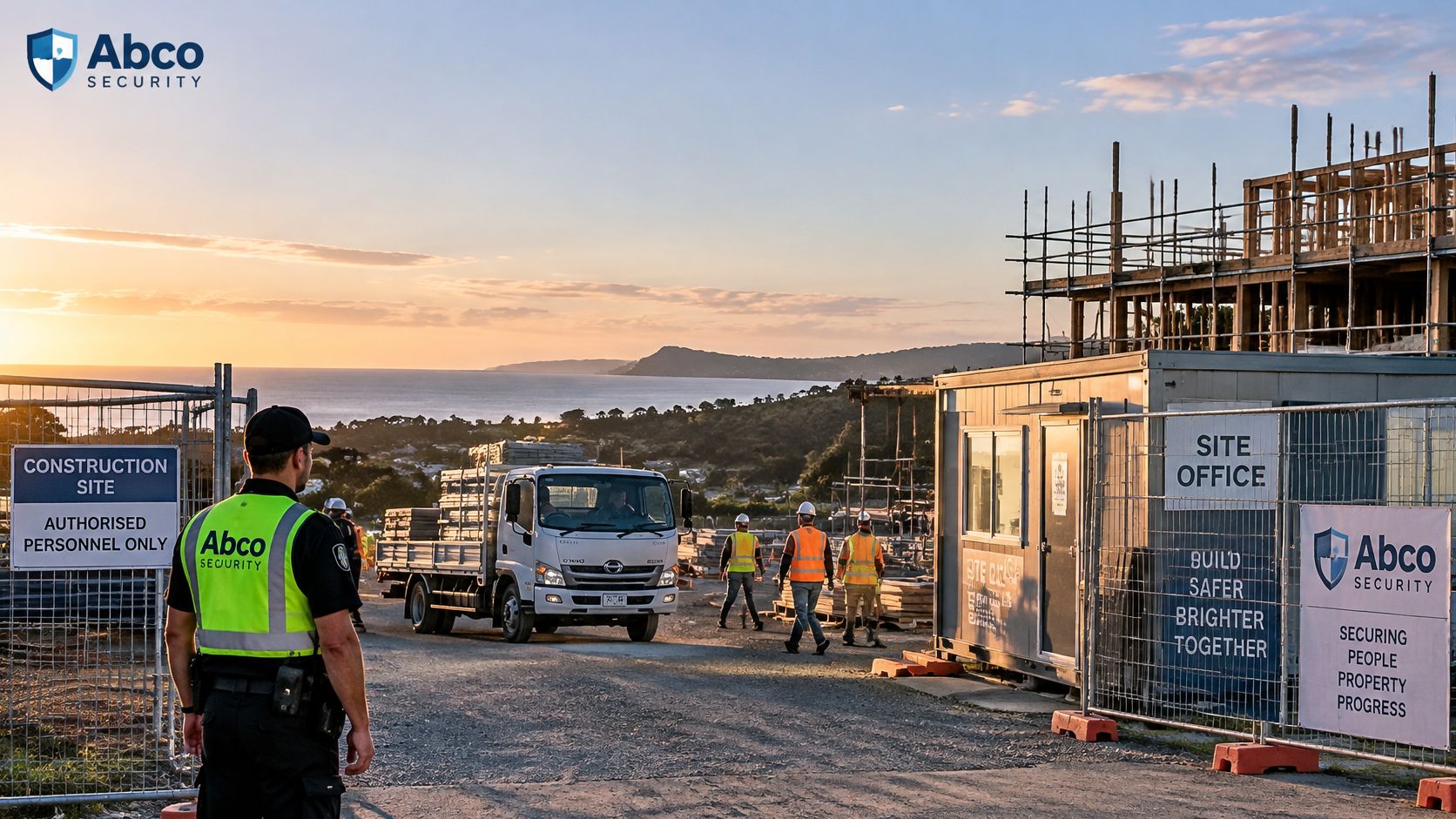
That concentration explains why so much local contract work sits around building sites. A construction site hands a provider exposed plant, stacked materials, temporary fencing and gates that move as phases change, so the controls that earn their fee are after-hours guarding, gate management, patrol support and temporary camera towers. ABCO Security's construction coverage runs onsite guarding after hours, access gate management, mobile patrol support, temporary CCTV and solar towers, plus site safety inspections and reports.
Five sector reads and the service each one needs
- Construction: the risk is plant and material sitting behind a fence line that shifts weekly. Buy after-hours guarding, gate control, mobile patrols and temporary CCTV. Security staff check authorisations at the gate, and that's where the job ends. Scaffolding and rigging, cranes and forklifts, asbestos removal, dangerous goods, explosives and fireworks, and registered plant remain the principal contractor's responsibility under Queensland work health and safety law, so confirm those licences are in place before the security roster starts.
- Retail: theft, aggression at the counter, and the vulnerable minutes around opening and closing. Buy floor coverage plus a patrol at lock-up. A camera records the walkout; a guard at close-down prevents it.
- Events: crowd flow, queues and emergency access decide the plan. Require pedestrian routes, a protected emergency corridor, controller induction, and a written surge or evacuation procedure. Queensland work health and safety law splits duties between host and supplier, so the contract should state who owns each item on that list before the gates open.
- Offices: visitor traffic, after-hours entry and reception resilience. Concierge or gatehouse cover plus access control carries most of the load.
- Strata: shared amenities, night disturbance and gated entry. Mobile patrols and monitored cameras cover more ground per dollar than a static post.
Practical rule: if the principal contractor hasn't confirmed the high-risk licences on site, that isn't a security task. Controlling access is.
Crowd behaviour is the part of event planning most often left to a guard count alone. The short walkthrough below shows how site and crowd risk get managed in practice.
Rank your top two risks and mark the services that answer them. Everything else stays optional until those two are covered.
Plan for the Incident Not a Headline Crime Rate
Buying guards or cameras off a single regional crime rate is the most common mistake in this market. A rate describes an area. It says nothing about what happens at your gate on a Saturday night or who responds when the alarm trips at 2am.
The pattern that matters is the incident mix. Queensland Police Service Sunshine Coast crime statistics recorded 2,005 other-theft offences between 1 March and 1 June 2025, equivalent to 449.1 offences per 100,000 people, up from 1,448 offences at 324.3 per 100,000 between 1 January and 1 March 2025. Read that as a signal for retail close-down, car parks and construction laydown yards. It isn't a case for putting the same roster on every site.
Local reporting points the same way, with Sunshine Coast robbery incidents at 40 in 2015 and 104 in 2025, and trespass and vagrancy incidents rising from 242 to 458 across the same decade, according to My Weekly Preview. Falling break-in numbers statewide don't make static guarding unnecessary either. Theft, trespass and slow response remain operational risks even when a headline trend improves.
Four standing orders for the site file
- Observe and log. Time, place, behaviour, and whether anyone is in immediate danger. That record is the product of the shift.
- Report rather than intervene when the person isn't threatening staff, stock or a controlled entry point.
- Call Queensland Police or emergency services for violence, a break-in in progress, or an immediate safety threat.
- Handle welfare concerns through the site manager and the agreed homelessness or health service, rather than treating presence alone as an offence.
The distinction to write into the orders: presence alone is not an offence. Trespass, threat, damage and emergency are the triggers for action.
A Maroochydore strata complex makes the split concrete. A complaint about noise and someone in the pool area after hours is a patrol and a written report. A forced storeroom door the same night is a police call, a secured entry and an incident file.
A written risk assessment is what turns those orders into something a guard can follow at 3am, and our risk assessment process explains how a site review feeds the shift brief. The provider should write both paths into the site orders, and the site manager should sign them off, before the first shift.
Licence and Compliance Checks Before You Engage a Provider
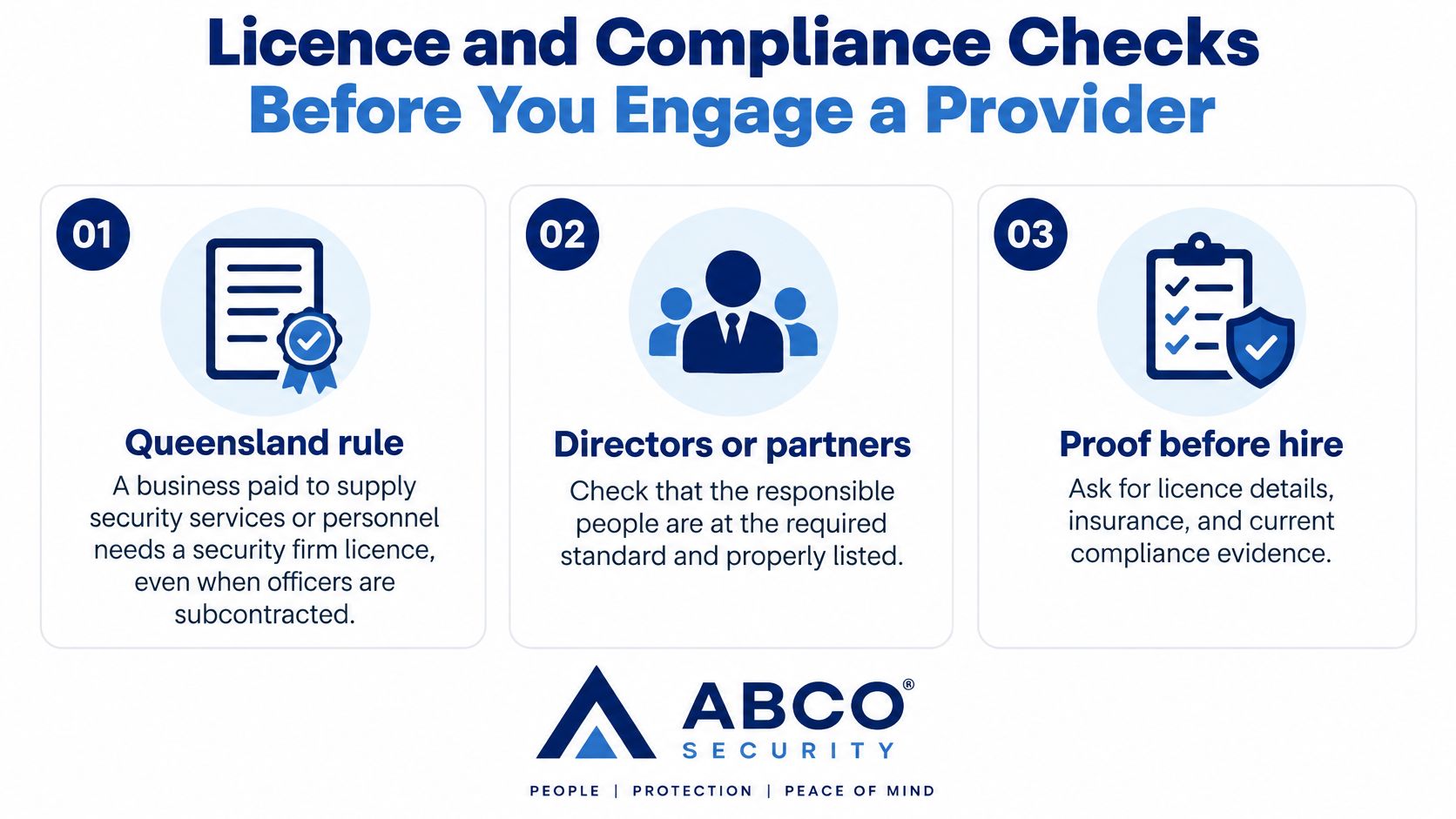
Licensing in Queensland works like a chain, and the buyer's job is to check every link before the first shift. A business paid to supply security services or personnel needs a security firm licence, even when the officers on the ground are subcontracted. The firm's directors or partners must be at least 18, meet public-safety eligibility requirements, and have no specified disqualifying conviction in the previous 10 years, as the Queensland security firm licence requirements state.
The five checks that actually close the gap
- Firm licence. Ask for the licence itself and confirm the legal name on it is your contracting entity. A trading name on a website can sit on top of a different legal entity, and a contract is only as strong as the name on it.
- Roster class. Match each worker's licence class to the duty they will perform: unarmed security officer for guarding and patrol work, monitoring security officer for control-room duties, crowd controller where the role covers licensed premises or event entry points.
- Subcontractors. Collect identical evidence for every subcontracted officer, because the firm licence requirement follows the supply of labour and payroll arrangements change nothing about that obligation.
- Audit record. Ask for the outcome of the provider's most recent compliance audit and note the date on it. A document you can read outweighs any assurance spoken on a call.
- Fingerprinting. Confirm police fingerprinting has been completed for every staff member deployed to your site, and ask for confirmation again whenever the roster changes.
A Caloundra builder shows how the gap opens. The firm licence gets filed with the contract documents, nobody checks the class held by the subcontracted night-patrol officer, and the problem surfaces only after an incident, when the insurer asks who was authorised to do what.
The Australian Security Industry Association Limited, ASIAL, is the industry body worth naming in your procurement file, and the Queensland licensing register is where you confirm the firm itself. Our own guards are fully licensed under the relevant Australian state regulations and receive ongoing training in conflict resolution, first aid, OH&S, customer service and emergency response, the standard to hold every provider on your shortlist to. This guide to licensed security guards in Australia sets out what those licences cover.
Get the firm licence and a staff licence matrix before the site walk. Keep the training records with it. A certificate supports a licence check and cannot replace one.
Questions to Ask Before You Choose a Provider
A provider that can perform and a provider that sells presence can sound identical on a first call. Six questions separate them, and each one has an answer that either satisfies you or doesn't.
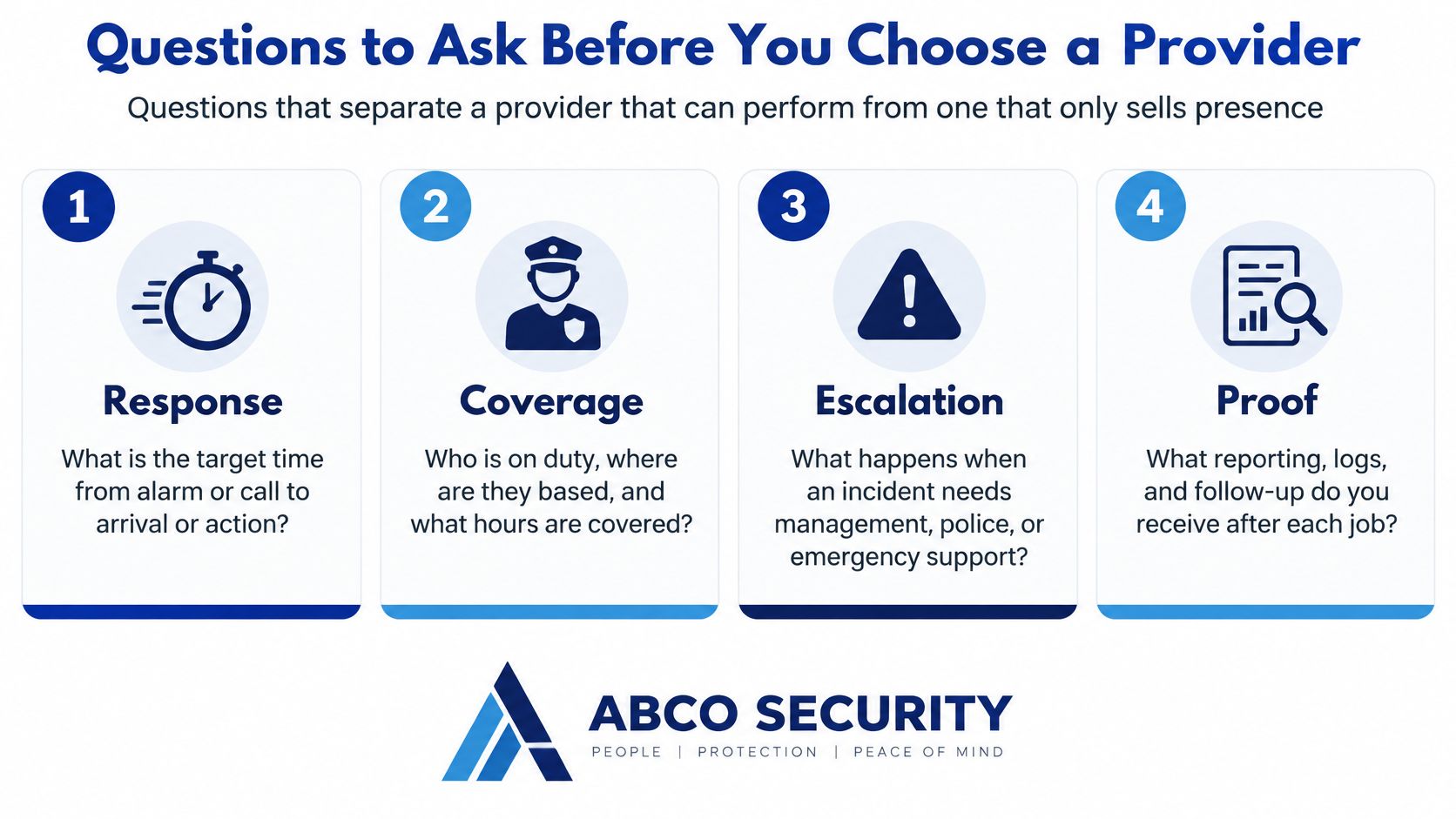
- Response time. What is the target time from alarm or call to an officer arriving, and is it written into the agreement? A good answer names minutes and a clause. A weak one says "we're local, so fast".
- Escalation. Which events go to police, emergency services or the site manager, and who takes the call at 2am? You want a named role and a phone number, not a call centre script.
- Reporting. What does an incident report contain, how soon is it delivered, and are photos and logs retained? Ask to see a redacted example.
- Coverage. How many patrols run each night, which hours are covered, and what happens when a guard calls in sick? Relief arrangements are where thin rosters show.
- Scope change. Can the service move from temporary guarding to ongoing patrols or a full surveillance system without re-tendering? Customers can request temporary guarding, ongoing patrols or a complete surveillance system, and the contract should let you move between them.
- Sector experience. Which comparable Sunshine Coast or south-east Queensland sites does the provider cover, and can it give a reference you can call?
Red flags worth walking away from
- Guarantees that nothing will happen. No provider controls who turns up at your gate.
- No written escalation steps. Verbal procedures evaporate at handover between shifts.
- Vague response times. "As soon as possible" can't be measured, so it can't be managed.
- One licence class quoted for a multi-task contract. It means the roster hasn't been mapped.
A provider who guarantees crime won't happen has told you they don't understand the job.
Put the answers on one page, in the same order, and ask every provider the same six questions. The comparison does the persuading for you.
How Technology Changes the Value of a Security Service
A smoke alarm nobody answers doesn't protect the house. Security technology works the same way, which is why the hardware matters less than the chain behind it: something detects, someone verifies, someone responds, and something gets recorded.
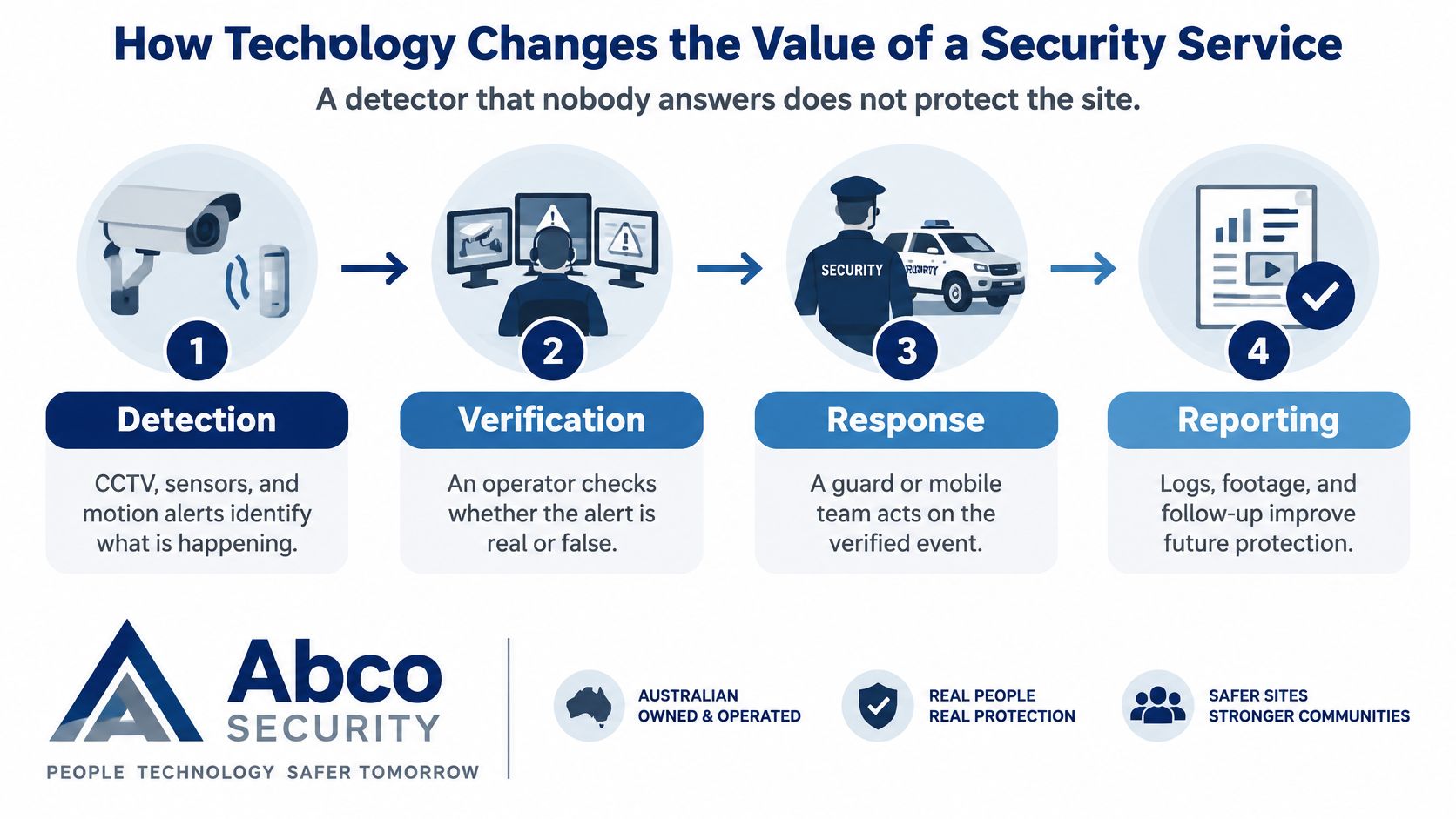
The four layers, with one example each
Detection covers cameras, sensors and motion alerts. On a construction site with no mains power, a solar camera tower watching the laydown yard is the practical version, and motion alerts push an event to a monitoring centre rather than a recording nobody watches.
Verification is an operator viewing the feed before anyone is dispatched. This is the layer that stops a fox, a stray cat or a swinging sign from generating a wasted patrol at 3am.
Response means a patrol, a guard or a dispatch from the monitoring centre. A camera alert should be able to trigger the mobile-patrol network directly, which is how our CCTV monitoring is integrated, and our monitoring centre can dispatch patrols or security officers within minutes.
Record is time-stamped logs, retained footage and a written incident report. It's what you hand to an insurer or a tenant when a claim arrives.
Access control changes the economics of a gatehouse, because fewer people need to stand at a boom gate when credentials and scheduled access do the checking. Video analytics do the same for camera review, filtering thousands of hours down to the alerts that need a human decision. Our electronic security work covers end-to-end setup and integration of surveillance, access control, video analytics and remote viewing, which is the part that determines whether the other three layers hold together.
What the local numbers do and don't tell you
For context, the Queensland Government Statistician's Office crime report records 10,939 reported offences against property on the Sunshine Coast in 2024–25. That confirms property offending is a large share of recorded crime locally, and it supports layered controls: monitored CCTV, controlled entry, visible patrols, trained guards and documented escalation. It does not prove that private security prevents crime.
For each layer, ask who responds and how quickly. Remote guarding only pays off when the answer is a person, a time and a written standard, and this explanation of remote guarding services shows how the monitoring centre and the patrol network connect.
Pricing and Contract Terms to Compare
Two quotes for the same site rarely describe the same job. Until the scope matches, the totals aren't comparable, and picking the lower number is guesswork dressed up as procurement.
Cost is driven by a short list of variables: officers per shift and hours covered, patrol frequency, whether equipment is installed, leased or monitored, event duration, and the response standard you've asked for. A six-week temporary guarding contract for a construction site prices differently from ongoing overnight patrols, and adding parking and traffic management to a patrol run changes the scope again. Parking and traffic management sits as an optional add-on to mobile patrol services, and it's priced as an add-on because it's different work.
We provide estimates rather than quotations or binding indications of cost, and all amounts stated, orally or in writing, are exclusive of GST. Ask every provider which of those two categories their figure falls into before you build a comparison.
| Term | Why it matters | What to request in writing |
|---|---|---|
| Scope of services | Prevents disputes over what is covered | Itemised service list, including add-ons such as parking and traffic management |
| Hours and staffing | Drives cost more than any other term | Officers per shift, operating hours and public holiday cover |
| Response standard | Defines what the fee actually buys | Target dispatch time and escalation steps |
| Equipment | Installed, leased or monitored changes the total | Ownership, maintenance and removal terms |
| Pricing basis | Estimates are not binding quotations | Whether the figure is an estimate or fixed, and whether GST is included |
| Term and exit | Site phases change | Notice period, minimum term and how temporary guarding ends |
Exit terms deserve their own line in your notes. Building phases end, tenants move out and event seasons finish, and the notice period decides how much a changed plan costs you. Our guide to security service contract terms walks through the clauses that cause the most trouble.
Comparison rule: never compare totals until both providers are pricing the same hours, the same response standard and the same equipment ownership.
Send every provider the same scope brief. Ask whether each figure is an estimate or a fixed price, check GST and add-ons, then compare totals.
Shortlist Providers and Request a Scoped Estimate
Apply one shortlist test and the field narrows fast. Keep a provider only if the firm licence and roster classes check out, the operational questions were answered against the same brief, and a single contract can cover every service the site needs.
ABCO Security Services Australia runs 24/7 security operations across Australia and combines licensed guards with electronic security. The service list covers security guarding, the Night Owl special night patrol service for homes, event security, mobile patrols, electronic security, CCTV and alarm installation and monitoring, plus construction security.
There's a coverage detail worth checking before you rely on a response time. The listed Brisbane office is at 80 Ann Street, Brisbane QLD 4000, roughly 100 km south of the Sunshine Coast, and no Sunshine Coast office is listed. Confirm your site falls inside the patrol area, and get the target response time for your postcode in writing, before you compare it to anyone else's.
Three actions to finish with
- Write a one-page brief. Sites, hours, services needed, the licence class for each task, and your response target. One page forces the decisions you've been avoiding.
- Send it to three providers. Ask each whether the figure is an estimate or a fixed price, and whether GST is included.
- Compare licence evidence against the contract-terms table. If a provider can't produce the matrix, the price is irrelevant.
A scoped estimate beats a brochure every time, because it's the only document you can hold a provider to later.
ABCO Security Services Australia delivers integrated, 24/7 protection for people, property and critical operations, combining licensed guards, mobile patrols, construction security, event security and monitored electronic security across Australia. If you've mapped your services to licence classes and set a response standard, we can quote against that brief rather than a sales script. Visit ABCO Security Services Australia to request a scoped estimate for your Sunshine Coast site.
about
avada factory
Sempery ultricies nibh at dolor cras urna eleifend nec. Atiam efficitur tempor.