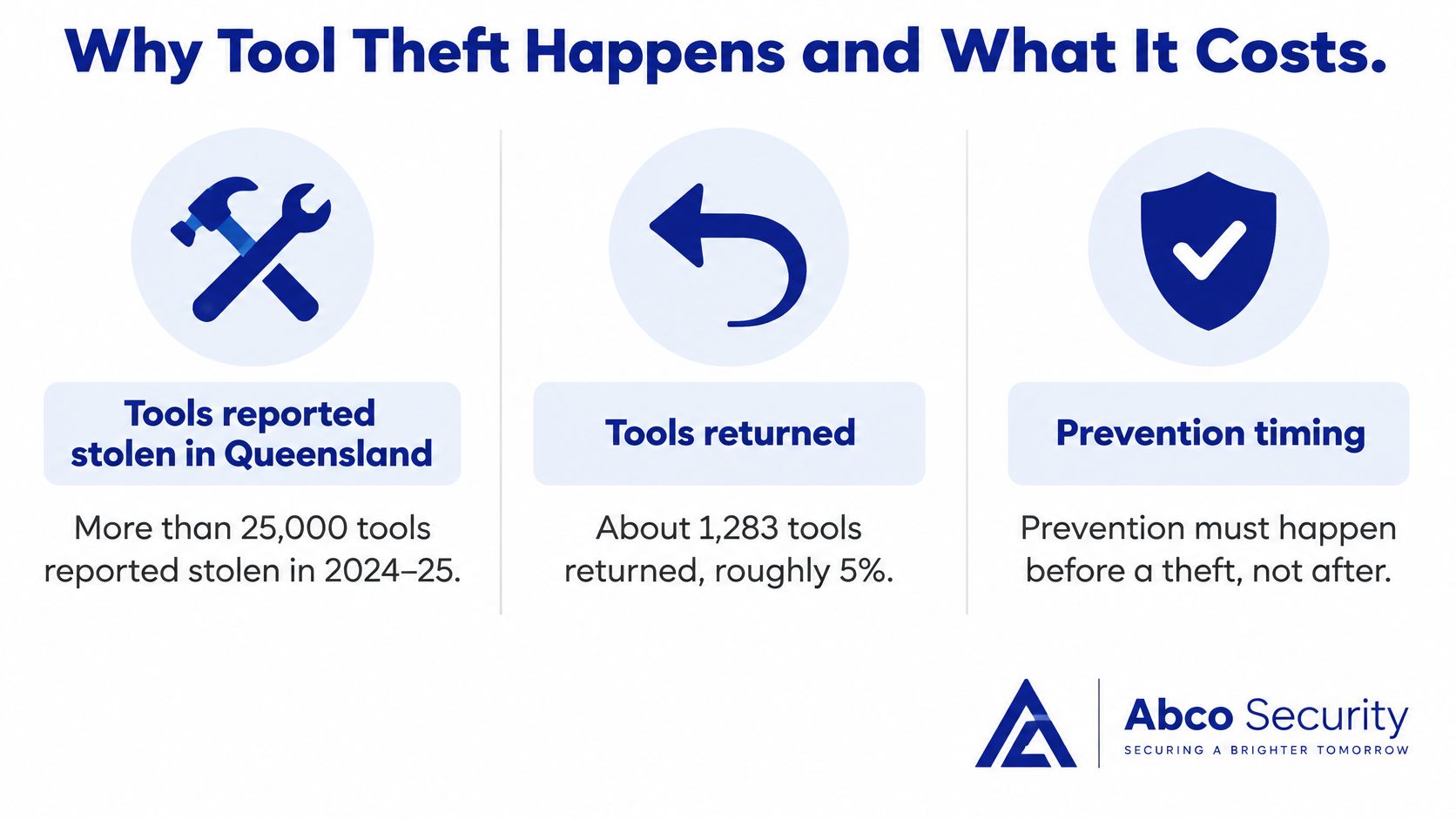
More than 25,000 tools were reported stolen across Queensland in 2024–25, but only about 1,283, roughly 5%, were returned, according to Queensland Police's tool theft prevention guidance. For a business that needs its equipment tomorrow morning, recovery isn't a dependable operating plan.
Effective tool theft prevention starts with a different question: not how many incidents occurred, but how much equipment, productive time and uninsured expense the business could lose. A missing drill is inconvenient. A missing kit that stops an electrical crew, delays commissioning or leaves a maintenance team without specialist equipment needs a different security response.
Why Tool Theft Happens and What It Costs
Tools suit offenders because they're portable and readily moved between vehicles, properties and work areas. When equipment has no visible ownership mark or recorded serial number, identifying the rightful owner becomes harder. An open van beside a loading dock can expose just as much critical equipment as an unattended construction compound.
The financial exposure is substantial. Crime Statistics Agency figures cited by RACV put Victorian losses at 36,708 hand and power tools worth approximately AU$40.8 million from vehicles and worksites in the year ending June 2025, as reported in MapTrack's Australian equipment loss analysis.
Tool theft benchmarks in Australia
These are separate state and industry measures, not a combined national total.
| Source | Period | Volume | Loss or recovery |
|---|---|---|---|
| Queensland Police | 2024–25 | More than 25,000 tools reported stolen | About 1,283 returned, roughly 5% |
| Victoria, RACV and Crime Statistics Agency | Year to June 2025 | 36,708 hand and power tools, with theft volume up 7.5% | Estimated AU$40.8 million, according to RACV analysis reproduced by MapTrack |
| Victorian reported incidents | 2017 to 2026 | 56,918 falling to 29,529, down 48.1% | Average reported value AU$550 rising to AU$1,293, up 135%, according to Tradie Magazine's analysis |
The distinction matters: the Victorian increase in theft volume belongs to the tools measure, not the estimated dollar loss. Likewise, average reported value shouldn't automatically be treated as the replacement price of an individual tool.
The recovery gap makes prevention the priority.
Measure severity, not just frequency
Falling incident counts don't justify automatically reducing security budgets. A business can suffer fewer thefts while losing more expensive battery platforms, specialist testing instruments or plant.
That pattern doesn't prove offenders have changed targets. It does justify assessing loss severity alongside frequency, rather than congratulating a site because its incident log is shorter.
Budget rule: Protect the equipment whose absence stops work, not just the equipment with the highest purchase price.
For example, losing a readily available grinder may be easier to absorb than losing a calibrated instrument needed for a scheduled handover. Replacement lead time and access to hire equipment change the operational consequence.
Add up replacement value, idle time while work waits, and insurance excess. Include project delay where it creates a separate cost, but avoid counting the same labour or replacement expense twice.
Matching Each Risk to the Right First Control
Deter first, then delay, detect and respond. Start by removing the fast, unseen opportunity before buying a more complicated monitoring system.
Opportunistic theft is the practical starting point for routine controls. A toolbox left open during unloading doesn't need advanced surveillance to become vulnerable. Equally, a high-value compound with repeated forced entry needs more than a reminder to lock up.
Exposure points and first controls
| Exposure point | Typical loss path | First control | Escalation if losses repeat |
|---|---|---|---|
| Vehicles and trailers overnight | Tools lifted from ute trays or open vans | Fixed toolbox anchored to tray or floor, visible lock | Lit, CCTV-covered parking and mobile patrol checks |
| Unattended construction site | Cut fences, forced containers, removed tools | Locked containers, perimeter lighting, CCTV | Guard service with alarm-monitored response |
| Workshop or tool room | Tools removed during shifts without records | Key or card access and tool-out register | Access logs and periodic stocktake audits |
| Retail backroom or loading dock | Unrecorded removals by staff or contractors | Controlled service entry and staff reporting | Visible patrols and CCTV review of the dock |
| Strata car park or common area | Contractor tools left in shared spaces | Contractor sign-in and lockable storage bays | Gatehouse or concierge checks |
Use the sequence below to check whether your proposed controls work together, rather than buying unrelated products.
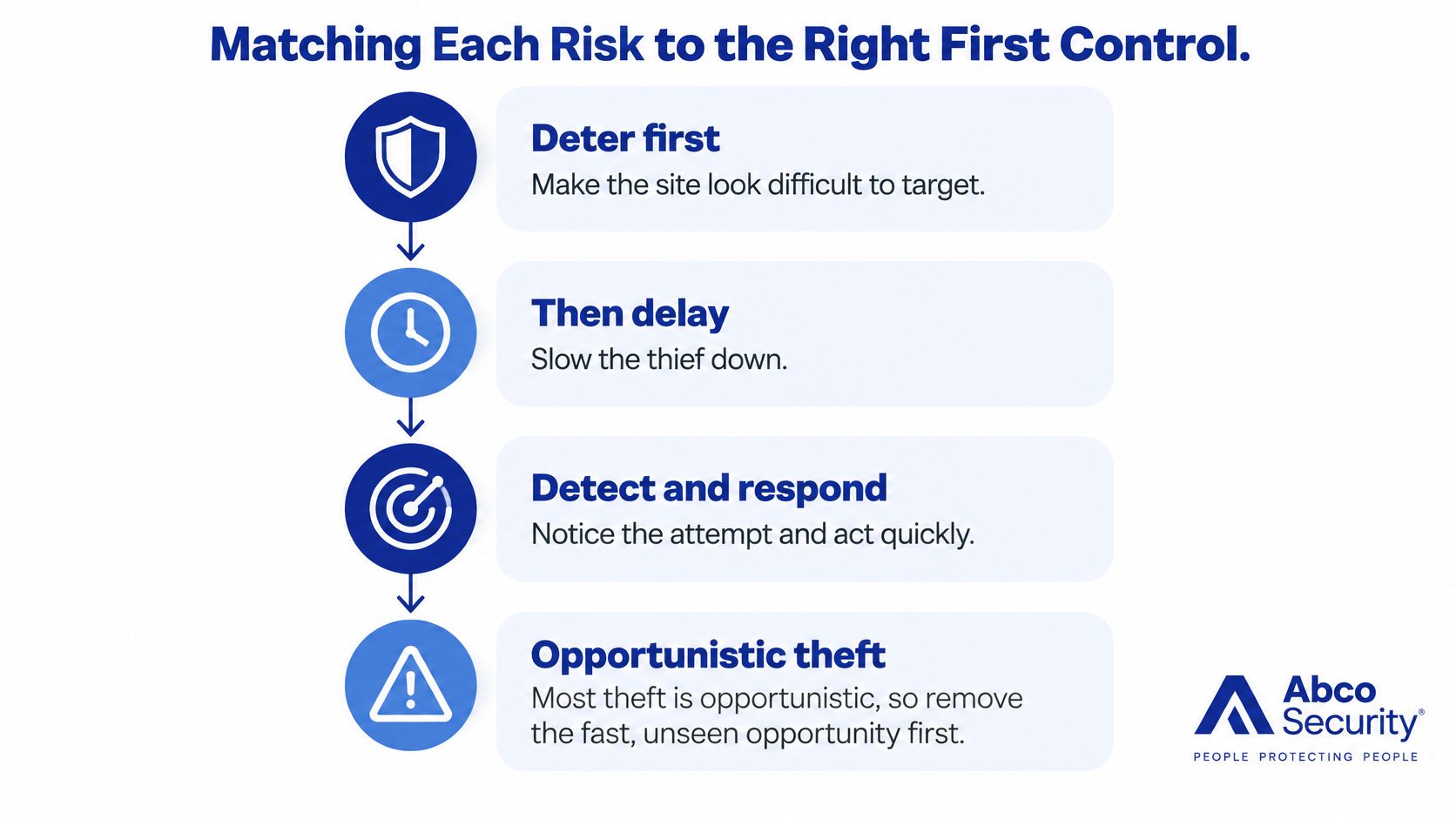
Choose the first control by the actual loss path
Say a workshop loses tools during normal operating hours. More perimeter lighting won't identify which shared kit left with a contractor. Controlled issue and return, supported by named authorisation, addresses that exposure more directly.
Conversely, a register won't physically stop someone loading an entire unsecured box into a vehicle. Hardware and accountability solve different problems, and neither replaces the other.
Use a security risk assessment checklist to walk the actual route from public access to equipment storage. Check pedestrian shortcuts, delivery gates, temporary fence joins and the area where workers leave kits while waiting for access.
- Prioritise critical equipment: Identify tools that have no practical substitute on the next shift.
- Check changing conditions: Reassess after scaffolding moves, a tenancy changes or a new loading area opens.
- Assign ownership: Give a named supervisor responsibility for closing each identified gap.
Keep emergency exits and safe access routes clear. A security arrangement that blocks evacuation or encourages workers to climb around locked barriers creates a separate safety problem.
Apply a simple challenge at each exposure point: could someone take this item in under a minute without being seen? Treat that as an inspection test, not a guarantee about offender behaviour.
Asset Records, Marking and Site Policies
A recovered tool is difficult to return when nobody can establish ownership. A purchase invoice helps, but a serial number tied to a photograph gives police and insurers a much clearer identification record.
Victoria Police's secure-your-tools guidance recommends recording model and serial numbers, photographing equipment, and engraving or painting a driver's licence number or another unique mark. For businesses, a consistent asset identifier can avoid placing personal details on shared equipment.
Build a register people will maintain
- List every tool. Record its model, purchase date, value, usual location and responsible team. This establishes what the business owns and where it belongs.
- Capture serial and model numbers. Transcribe them carefully and verify the entry against the equipment, not just the packaging.
- Apply a unique mark. Use an engraved or painted business identifier where suitable. Don't mark electrical insulation, safety labels or components where alteration could affect safe use.
- Photograph the item. Include an overall view and a readable serial-number image, stored against the same asset entry.
- Record issue and return. Shared equipment needs names, dates and a destination, so supervisors can distinguish authorised movement from missing property.
- Assign keys and permissions. State who holds codes, who approves off-site use and who can authorise equipment disposal.
- Review the register quarterly. Also update it after purchases, transfers and resignations, rather than waiting for a scheduled review.
For larger maintenance operations, CMMS insights from Forge Reliability provide useful context for connecting asset records with maintenance responsibilities. The useful system is the one supervisors will update, whether that's a controlled spreadsheet or maintenance software.
Turn records into a working policy
Consider a hypothetical 12-person electrical crew that discovers three drills have no traceable allocation after a theft. The immediate problem isn't just missing equipment: the supervisor can't separate stolen tools from kits already transferred to another job.
The practical change is named custody, signed transfers and supervisor reconciliation before crews move sites. A comparison of access control versus keys can help determine how permissions should change when workers leave.
Marking may affect resale presentation, and registers fail when entries become stale. Choose a method that balances identification, safe equipment use and future disposal.
After theft, provide police with serial numbers and photographs, then give the insurer the register and purchase records. If a second-hand listing matches your equipment, preserve the listing and contact police rather than confronting the seller or arranging a private recovery.
Locks, Anchoring and Overnight Storage
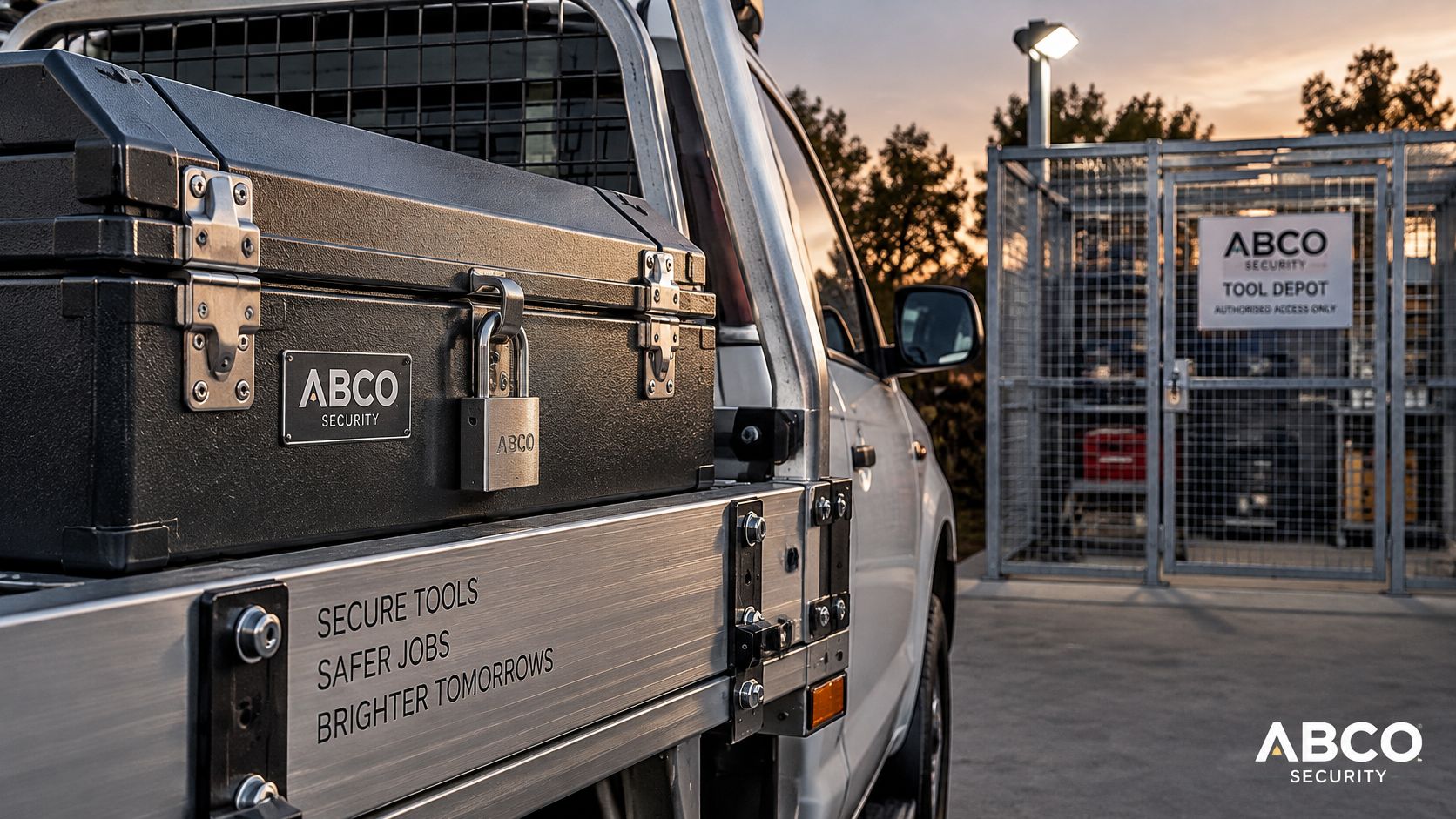
A padlock cannot compensate for a weak box or an easy-to-remove mounting. Choose a heavy-duty container with reinforced hinges and a protected locking point, then check the full path a thief would need to defeat or remove it.
Inspect the complete removal path
Bunnings Trade's tool theft guidance recommends fixed heavy-duty toolboxes, solid padlocks, reinforced hinges, battery removal and chains for larger assets. It also highlights well-lit parking covered by CCTV.
Fit the hardware as a system:
- Toolbox: Choose a hardened-shackle padlock with a documented security rating. An exposed shackle or weak hasp can undermine a substantial box.
- Vehicle mounting: Use suitable bolts and a backing plate. Check for wiring, fuel lines and structural restrictions before drilling, and consult the vehicle or body installer if mounting requirements are unclear.
- Ute-tray storage: Consider a toolbox alarm and concealed mounting hardware. A vehicle's cabin alarm may not cover an external box.
- Larger assets: Chain generators and trailers to a suitable fixed anchor, not a movable fence panel or another portable item.
Cheap padlocks can be cut. Avoid relying on a promised resistance time: the result depends on access, tools and the strength of the surrounding hardware.
Make overnight storage workable
Remove cordless-tool batteries where practical, but store them safely. Use charging equipment and cabinets suited to the battery system and heat conditions, and follow the manufacturer's requirements.
For shared kits, assign someone to return charged batteries before the next shift. A charge-and-lock cabinet with authorised or timed access can support that routine, provided it allows safe charging.
The following video accompanies these storage measures.
Inside compounds, secure valuable items independently rather than relying on the outer door alone. A shipping container security assessment should examine door hardware, internal anchors and access around the container.
Close-down check: Lock the storage, remove batteries where practical, chain larger equipment and log anything left outside normal storage.
CCTV, Alarms and Patrols That Respond, Not Just Record
Recorded footage helps explain a loss. Monitored detection with an agreed escalation process gives someone an opportunity to act while an incident is developing.
Victoria Police's construction-site theft guidance recommends a layered approach combining locked buildings and containers, CCTV, audible alarms, adequate lighting and consideration of a guard service. None of those measures should be treated as a complete solution on its own.
Detection and response options compared
| Control | What it detects | How it responds | Main limit |
|---|---|---|---|
| CCTV, recorded only | Footage of entry and removal | Reviewed after the event | Records but doesn't stop the theft |
| CCTV with video analytics | Motion or line crossing in set zones | Alert to monitoring operator | False alerts unless zones are tuned |
| Alarm with monitored escalation | Forced entry, fence or door breach | Immediate escalation to response officer | Response time and verified alarm triggers determine effectiveness |
| Access control logs | Who opened which door or gate, and when | Audit trail and alerts for out-of-hours entry | Doesn't detect removal through open or unsecured areas |
| Mobile patrols | Visible presence and site condition | Checks at randomised times and reports | Gaps between visits |
| Static guarding | Continuous presence at a fixed point | Direct intervention and reporting | Higher cost, best suited to high-value compounds |
Specify what happens after an alert
Start with camera coverage of gates, loading docks, compounds and vehicle parking. Use a CCTV placement guide to assess approach routes, lighting, obstructions and whether footage will show useful identifying detail rather than distant movement.
Then configure analytics around meaningful boundaries. A detection zone across a secured gate is more useful than unrestricted motion alerts from a tree-lined perimeter.
- Monitoring instructions: Identify authorised after-hours activity and the circumstances requiring escalation.
- Response arrangements: Provide safe access instructions, current contacts and a clear procedure for suspected forced entry.
- Access records: Reconcile relevant door or gate activity with the alert, rather than assuming every credential use is legitimate.
- Patrol scope: Specify which locks, fences and storage points officers must inspect and how exceptions are reported.
ABCO's CCTV and alarm monitoring, remote viewing and coordinated response are an option for this monitored layer. Confirm immediate escalation arrangements in the service scope, while recognising that escalation isn't the same as immediate arrival.
Use licensed security personnel for guarding and patrols. Give officers instructions that prioritise observation, reporting and safe intervention within their authority, not pursuit or unnecessary confrontation.
A camera is only part of the response plan. Someone must receive the alert, assess it and know what to do next.
Notify people of CCTV through appropriate signage, restrict cameras to lawful areas and manage access to footage under applicable privacy requirements. Test the system after site layouts change, not only when equipment is first installed.
Sector Examples for Construction, Workshops, Retail and Strata
A missing tool creates different exposure depending on where it is used. On construction sites, access through a changing perimeter can be the weak point. In commercial buildings, a contractor may move equipment through a service entrance without anyone confirming they are authorised to remove it.
Construction sites and trade operations
SiteView's analysis recorded 2,720 theft offences at construction-site locations in 2025, as reported in its construction-site theft analysis. That supports treating construction sites as a distinct equipment-risk setting, while recognising that offence counts do not measure the value of tools lost or the resulting downtime.
During a staged fit-out, position the secure store where supervisors can control access without making workers leave kits unattended along a long route. Record equipment moving through the gate, and review access arrangements when fencing or delivery routes change.
Match Security Guarding or Mobile Patrols to the project phase and exposure. A high-value delivery awaiting installation may warrant guarding; a quieter site may suit patrols when suitable detection and response arrangements are in place.
For workshops and trade vans, focus on custody between jobs. Assign complete kits to vehicles or crews, set a depot return point, and identify who checks vehicles parked away from the depot. In mining and manufacturing, flag equipment whose loss could interrupt maintenance or delay a restart. The operational consequence matters more than the number of tools stored.
Retail backrooms and shopping centres
The Australian Bureau of Statistics reported 595,660 victims of theft excluding motor-vehicle theft in 2024, the highest number in 21 years. Retail locations accounted for 45% of thefts, compared with 32% in 2010. These figures cover theft generally, not tool theft specifically.
For tools used by maintenance staff and fit-out contractors, focus on backrooms, service corridors and loading docks rather than only the shop floor.
- Separate incident categories: Distinguish shop-floor losses, dock removals and storage access.
- Verify collections: Check who authorised a contractor to remove equipment.
- Plan around construction: Separate temporary work areas and delivery routes from uncontrolled public access.
During refurbishment, practical tips for retail space construction provide context for planning work areas. Coordinate that planning with retail security systems in Australia so temporary access does not become an unmanaged route.
Static Security Guarding can help manage access during busy installations, while Event Security teams need clear responsibility for equipment handovers. Coordinate procedures with tenancy managers and contractors.
Strata and commercial buildings
Shared areas should not become informal contractor storage. Set approved storage bays and sign-in procedures, and check authority before equipment leaves through vehicle access points.
Corporate Building Concierge and Reception Coverage can support contractor verification and building access procedures. Familiarity with a person is not sufficient authority to approve equipment removal.
For a property manager engaging a Security Company Melbourne, local knowledge should include the building's delivery patterns, contractor access arrangements and escalation contacts, not just familiarity with the suburb.
Weigh the Costs and Act This Week
A tool-theft plan should be judged by the value exposed, work interrupted and insurance excess, not incident count alone. A practical estimate is annual exposure = loss per event × expected events per year + downtime + insurance excess. Use it to compare controls, not to imply precision when incident records are incomplete.
For an uninsured loss, include the full replacement cost. For an insured loss, separate the covered amount from the excess and excluded expenses to avoid counting the same cost twice.
Compare a realistic loss with the proposed control
Tradie Magazine's analysis puts the average reported value of stolen tools in Victoria at AU$1,293. At that average, a hypothetical loss of ten tools totals about AU$12,930 before downtime and insurance excess.
Treat that as an illustration, not a valuation of your kit. Use current replacement quotes for the actual tools, including chargers, cases, accessories and any calibration required before replacement equipment can be used.
Price anchored storage, identification and a reliable close-down routine first. These controls address routine exposure without an immediate commitment to continuous guarding. Consider higher-cost protection when:
- Replacement is difficult: Specialist equipment cannot be sourced or hired promptly.
- Exposure persists: Equipment remains unattended at a location throughout a long project.
- Access is shared: Multiple contractors use the same compound or service route.
- Work could be disrupted: A loss could delay commissioning, maintenance or a contractual milestone.
Ask providers to itemise installation, monitoring, patrol attendance and guarding charges. Clarify what triggers extra charges and who can authorise a change in coverage.
Use this checklist to assign actions. Base financial decisions on your equipment schedule and current quotes.
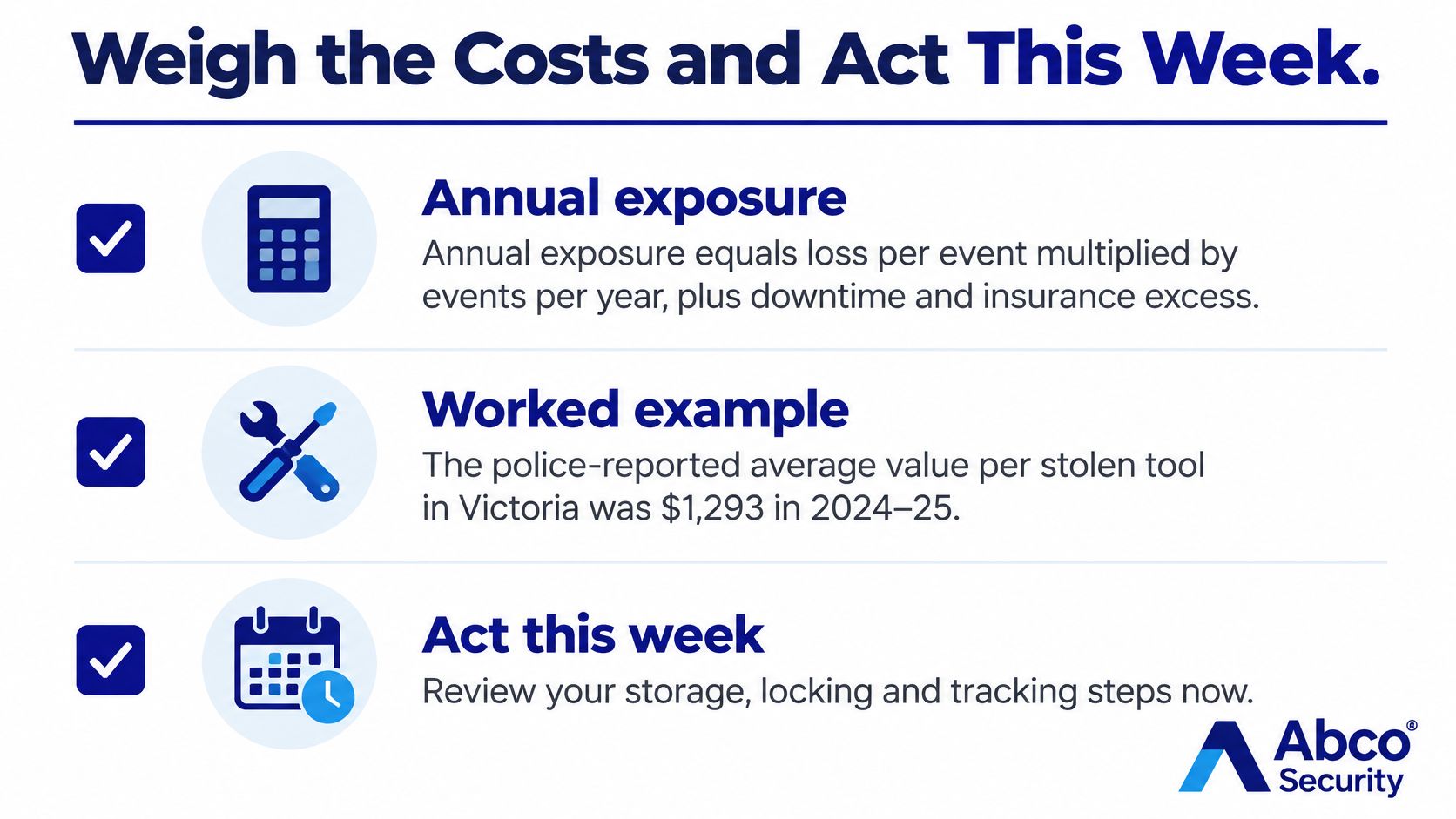
Close the practical gaps this week
- Identify the assets: Register and photograph every tool, starting with equipment needed for the next shift.
- Inspect vehicle storage: Anchor or lock every vehicle toolbox.
- Assign close-down responsibility: Remove batteries where practical and secure tools overnight.
- Check the compound: Secure containers and larger assets, then test lighting and response arrangements.
- Control permission: Maintain a tool-out register and key-holder list.
- Review patterns monthly: Separate losses by location and operating context.
Track the value of equipment exposed, work interrupted and uninsured costs. Give each action an owner, then record unresolved gaps before the next close-down.
ABCO Security Services Australia provides site-level reviews and customised protection plans using licensed personnel, physical security and electronic monitoring. The company operates nationwide, with offices in Melbourne, Sydney, Adelaide, Perth and Brisbane. Confirm local coverage for the relevant office location and arrange a review of tool storage, access and response arrangements. Visit ABCO Security Services Australia to book a site review.
about
avada factory
Sempery ultricies nibh at dolor cras urna eleifend nec. Atiam efficitur tempor.