
Multi-day event security fails between shifts, not in the plan on paper. If you contract guards for a long-form event, specify the operating routine that connects every shift.
I’ve found that buyers often fixate on guard numbers and post orders, while the real risk sits in the handover gaps: an incident half-reported, a missing-person note never passed on, or two supervisors giving different radio instructions. It also covers what to put in the contract when comparing headcount against operating routine, and it flags the pitfall that quietly breaks coverage.
What Actually Keeps a Multi-Day Event Safe
That routine has four parts: a written briefing pack per shift, a structured handover, one radio protocol, and one named escalation authority.
Hiring event security guard services is buying a rhythm that repeats four, six or ten times over a weekend, not a headcount to be filled.
Multi-day events don’t reset overnight. What event security guards do shifts with the crowd: fatigue, cumulative alcohol load, weather and incidents carried forward from earlier days.
I’ve found the day two and day three risk profile almost never matches the assumptions written into the day one plan. That is where the seams open.
Specify the routine and the reporting it produces in the contract and you get accountability; specify headcount alone and you get attendance.
The Per-Shift Briefing Pack: Written, Versioned, Signed For
A briefing pack costs a supervisor’s preparation time, not another guard.
Every shift’s pack should carry the day’s run sheet, expected crowd peaks and gate loads, weather and wind, incidents carried from previous days, the current ejected persons list, open missing person reports, medical status, the radio channel plan and that shift’s escalation contact. Where guards hold keys or sign-in sheets, fold in the after-hours records access brief.
Make it a dated, versioned document, signed for by the incoming supervisor and retained on the event file. I’ve found a verbal briefing at the gate evaporates the moment supervisors change, so day three staff work off day one information.
Contract it plainly: the provider must issue a written briefing pack before every shift and keep copies for the event record.
Structured Handovers: Incidents, Ejections and Missing Persons
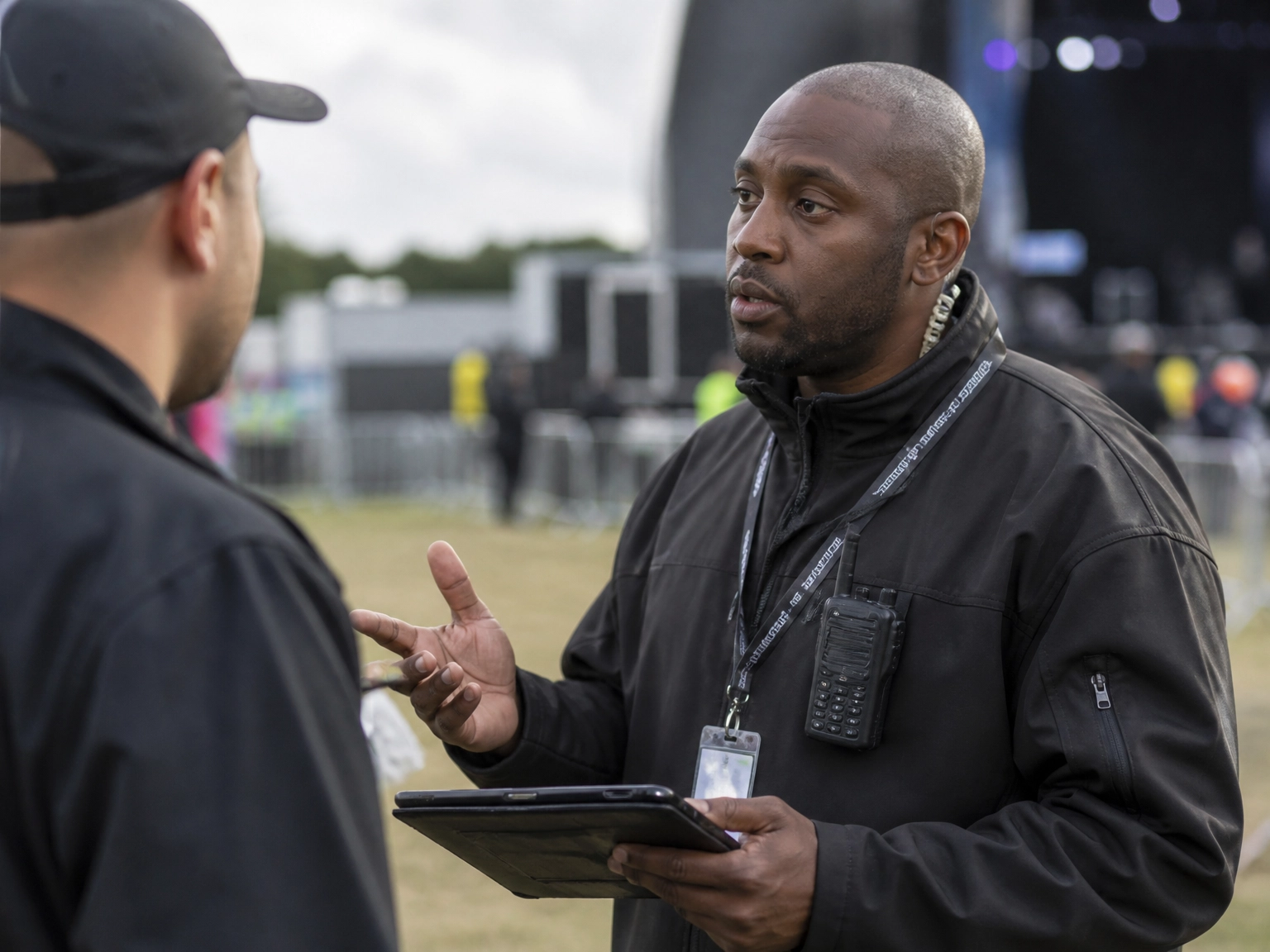
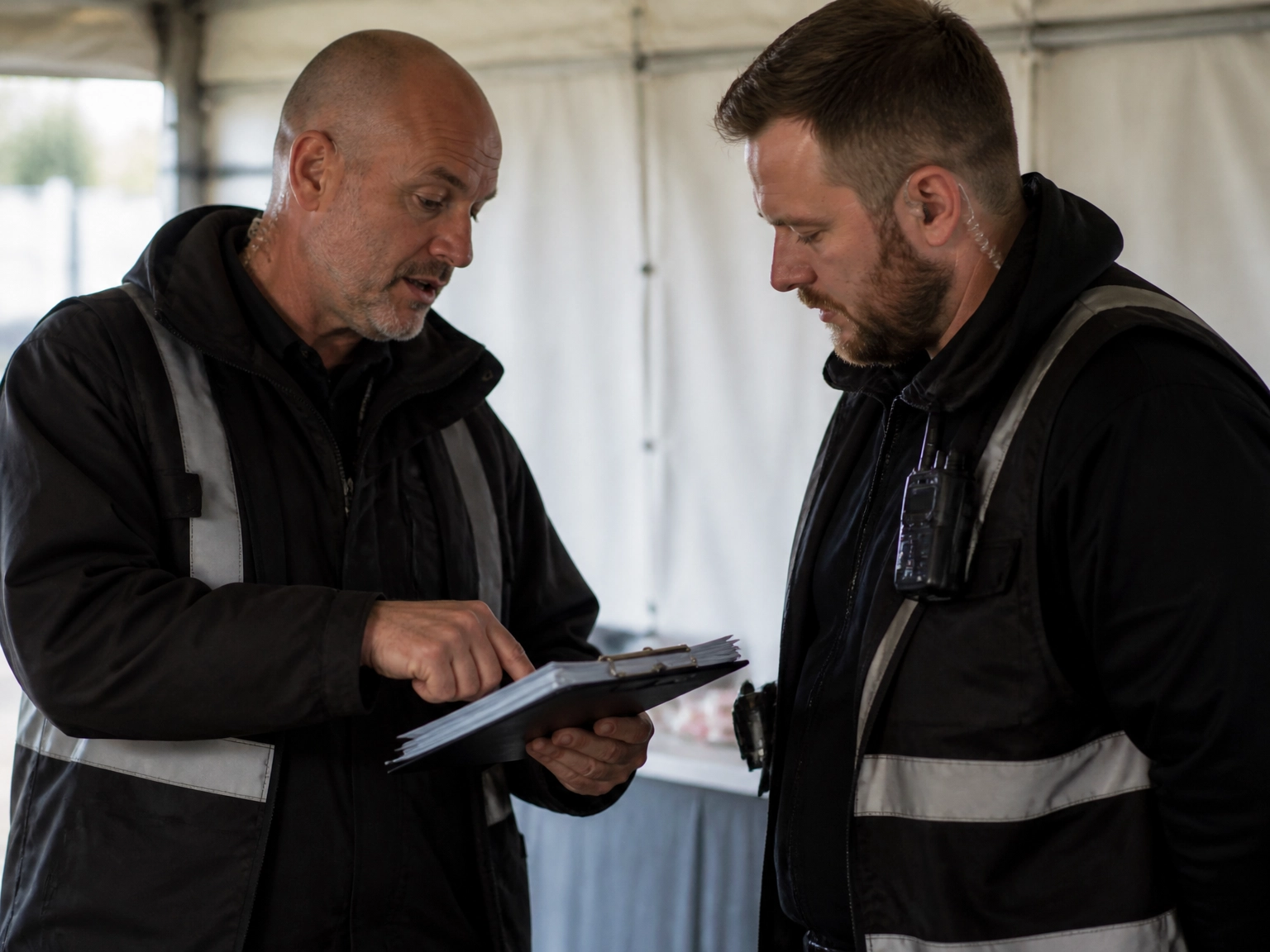
Insist on paid overlap so outgoing and incoming supervisors meet face to face in a fixed window, not a gap. Face-to-face, two-way handover with joint responsibility is standard practice in high-risk industries (HSE guidance).
Each handover must carry incidents, ejections and refusals, missing person reports, medical responses, property damage, equipment and radio faults, and every unresolved item. Unresolved items matter most. Carry-forward rule: an ejection from day one, a vulnerable person flagged on day two, and an open missing person report do not reset at 7am. Every open item gets a named owner on the incoming shift, never “the day shift.” This mirrors the single-provider governance model behind integrated security services.
Both supervisors sign; entries are time-stamped, referenced to the incident register, with photos or CCTV links attached. Most overlook how easily an open item is lost when nobody owns it. Only a persistent, carried-forward list catches it.
One Radio Protocol and One Named Escalation Authority
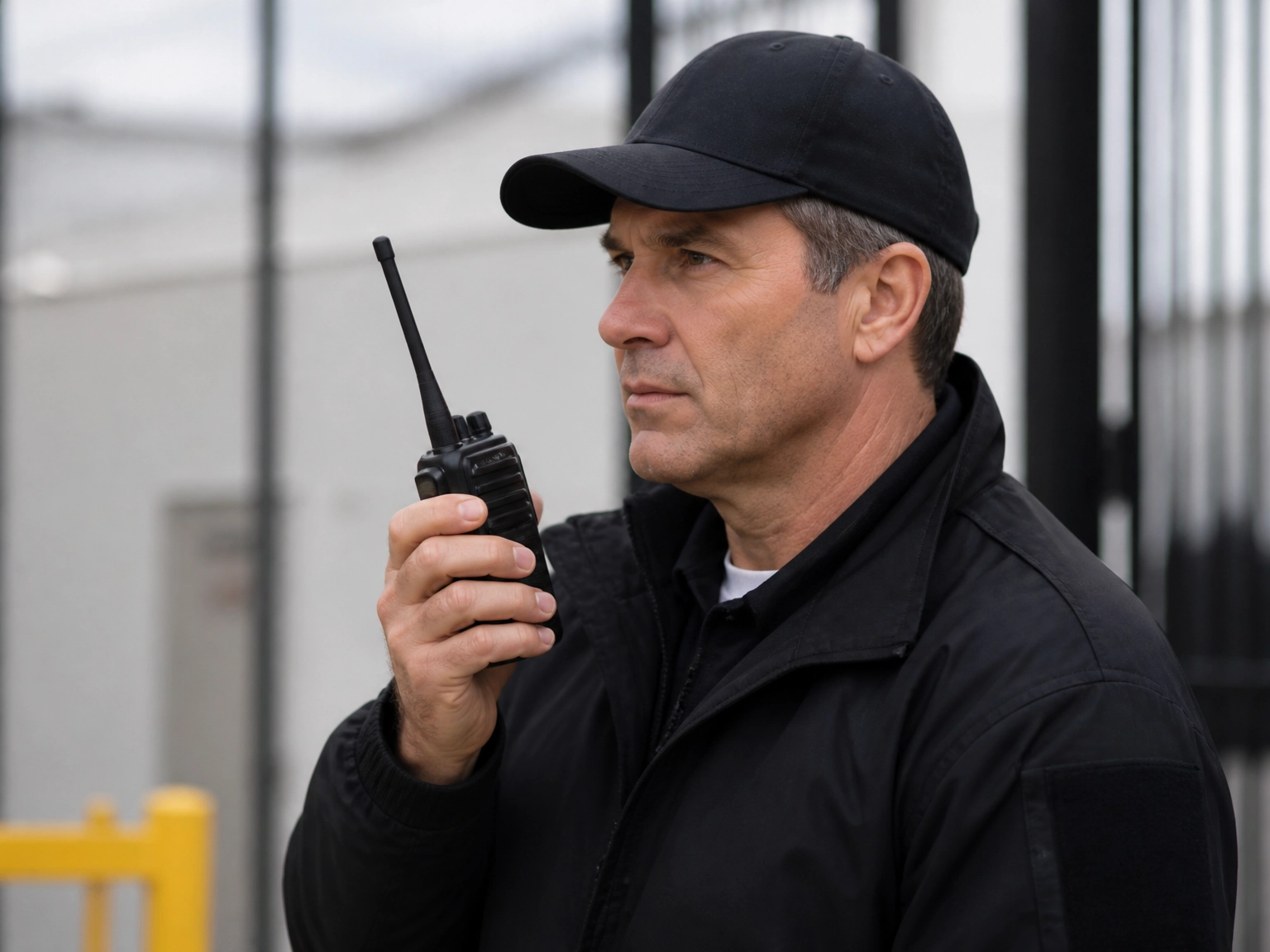
A single channel plan by function: control, gates, internal patrol, medical liaison. Fixed call signs, plain language, no cross-channel conversation. The failures I see on site are always the same. Unlogged radio traffic. Personal calls replacing radio, erasing the record. Channel changes between shifts that nobody documents. Per the Purple Guide, its Communications chapter republished 26 January 2026, radio users must be briefed on their use and code words kept simple.
One escalation authority then, named for the whole event, the same person every day, with a deputy and a short decision matrix covering ejection, medical escalation, police contact and gate closure. That name goes in the contract, with every escalation logged by time, decision and outcome. A logged decision holds up at review. Agree the escalation and notification rules before signing.
Headcount vs Operating Routine: What to Put in the Contract
Splitting responsibility at contract stage means specifying outputs, not bodies.
| Headcount model | Operating routine model |
|---|---|
| Scope: guard numbers, hours, supervisor ratio | Written briefing pack per shift, signed handover, logged escalation chain |
| Outputs: an invoice | Briefing record, handover log, incident register, ejection record, missing person log, escalation log, end-of-event report |
| Accountability: were the posts filled? | What happened, who decided, and how was it passed on? |
Add three clauses: mandatory reporting outputs, a retention period, and one point of contact for the whole event. Overnight or perimeter coverage between event days is a separate line item, but it sits under the same escalation authority.
Multi-Day Event Security: Common Buyer Questions
From the contract clauses above, buyers keep returning to five operational questions.
Briefing pack: Read the current version.
Escalation owner: One person, named in the contract, for the whole event.
Handover: time-stamped, signed entry per open item, referenced to incident register, carried forward until named person closes it. Fixed guard counts without scaling logic are a separate trap; see scaling guard numbers as headcount grows.
Reporting: All logs above, retained.
Does more security hire for events fix a bad roster? No. Crowd management services fail at the seams; extra bodies multiply confusion.
The Pitfall to Avoid, and the Clause That Fixes It
The contract decides whether the routine survives.
Pitfall: sign an agreement that specifies headcount, hours and supervisor ratios, and by day three no one can say which incidents are still open.
Fix: apply the same named escalation authority clause to every event day, and make the handover log a deliverable at close, not a courtesy.
Stipulate five items in writing:
- Written briefing pack per shift.
- Signed handover with a paid overlap.
- One radio protocol, call signs, channel plan.
- One escalation authority for the full event.
- Named reporting outputs.
If a provider cannot describe all five in writing, the roster is all you are buying. Shift handover protocols for guards show how to close the same gap without adding headcount.
Conclusion
Multi-day event security fails at the seams, not at the front gate. The takeaways are straightforward. First, every shift needs a written, versioned briefing that guards sign. Second, handovers need paid overlap, a signed log, and open incident, ejection and missing person actions carried forward until named closure. Third, one radio protocol and one named escalation authority must govern the whole event. Fourth, reporting is a contract deliverable, not a courtesy. Extra bodies do not fix a bad roster; they multiply confusion.
Next step: review ABC Security’s event security services and require all five written items before signing. Ask the provider to walk through a real handover log and escalation path. If they cannot, you are buying headcount only. Common pitfall to avoid: signing on headcount alone. Build the routine first, and day three runs as cleanly as day one.
about
avada factory
Sempery ultricies nibh at dolor cras urna eleifend nec. Atiam efficitur tempor.