Most workplace violence programs are written for the incident that makes the news. A weapon at the door, a lockdown, a call to triple zero. Work a reception desk or a late-night counter for a month and a different pattern emerges: the same customer, the same raised voice, the same staff member absorbing it because nobody has written down where the line sits.
Six Phases of a Prevention Program at a Glance
Safe Work Australia found that serious workers' compensation claims for assault or exposure to workplace violence rose by 56% over five years (Safe Work Australia's analysis of work-related violence and aggression). Claims involving physical violence rose 73% among women over the decade, compared with 33% among men. Across 2017–18 to 2021–22p, women recorded 12,260 serious claims involving assault or workplace violence, against 8,485 for men. Health care and social assistance faces substantial exposure: almost 40% of respondents in an Australian survey cited in the analysis had experienced violent or traumatic events at work.
These figures point to a program built for repeated exposure across a shift. Repeated shouting, swearing and intimidation need clear controls and escalation steps, alongside procedures for more serious threats.
| Phase | Core action | Output to file | Review trigger |
|---|---|---|---|
| Assess risk | Map sites, roles, times and exposure factors | Risk register | New site, new role or a serious incident |
| Set controls | Select controls using the hierarchy of control | Control plan | Gaps found in the risk register |
| Write policy | Define behaviour expectations, roles and reporting | Workplace violence policy and procedures | Annual review or a change in WHS law |
| Train staff | Rehearse de-escalation, escalation and reporting | Training record for each worker | New starter, new duties or new site |
| Respond to incidents | Protect people, escalate and document | Incident report | Every incident and near miss |
| Measure trends | Review incidents by location, shift, aggressor type and outcome | Quarterly trend review | A shift in trend or a cluster of similar events |
Build it as a cycle, not a purchase
Each phase should leave a document that an inspector, insurer or new site manager can follow. Set an owner and a review trigger for every record. A control that is not reviewed can fall out of use as site conditions and work practices change.
Training needs rehearsal. A slide deck and a sign-off record cannot show whether workers can respond calmly, report repeated abuse or escalate when behaviour crosses a defined line. If you are developing video materials, planning a safety training video can help structure the content; workers still need to practise the response.
This week, assign an owner for the program and its quarterly review. Choose the first two sites or shifts for assessment, prioritising public access and lone work. Define what staff must report, including verbal abuse, so recurring low-level incidents can inform the program rather than disappear from its records.
How to Run a Risk Assessment for Each Site
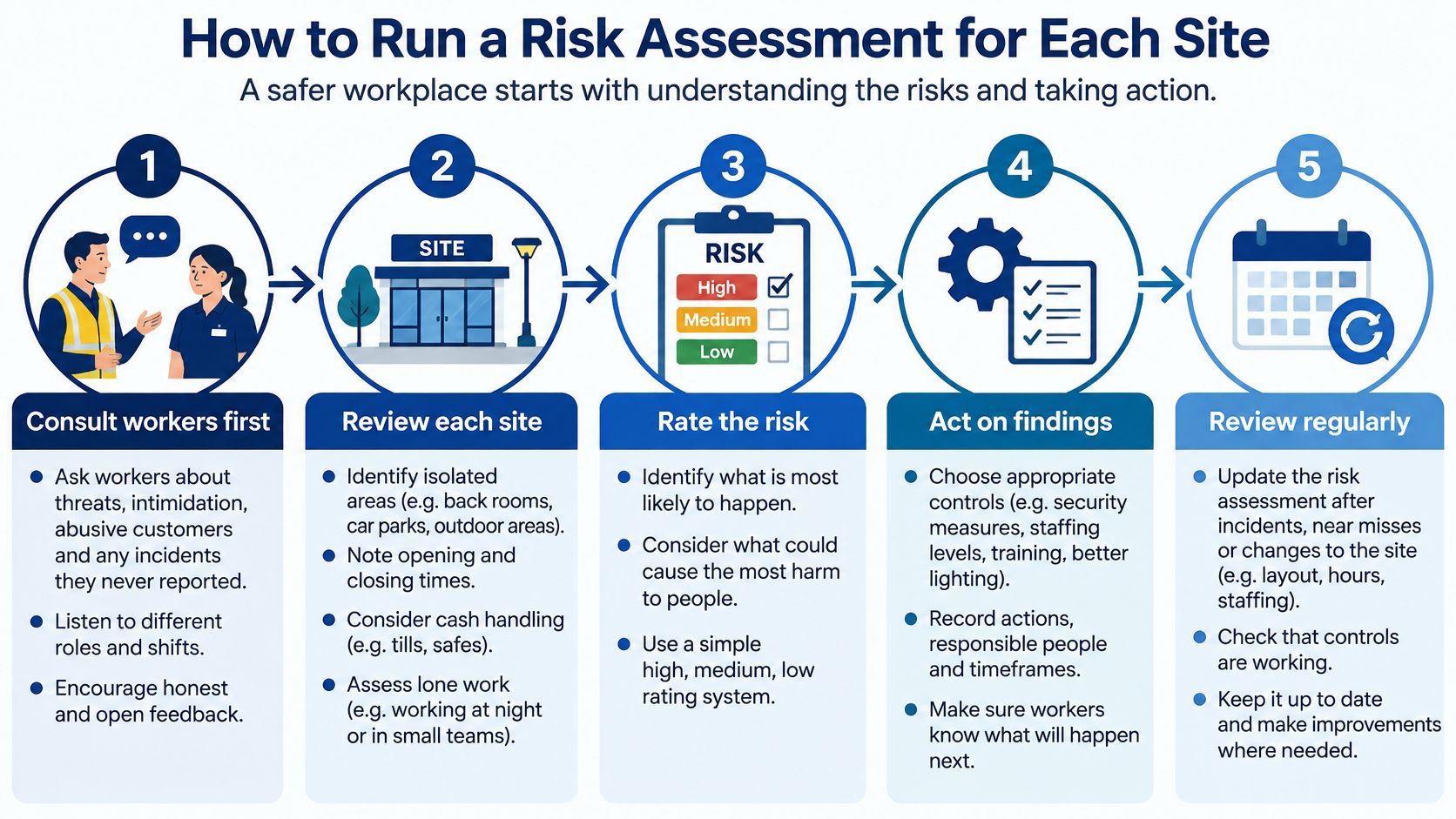
At a late-night convenience store, one worker, an intoxicated customer and a blocked exit can turn routine shouting into a serious risk. Assess each site with the workers who know its shifts and layout, then record controls that can be put into practice.
The same six stages, in order:
Six steps in the order that matters
- Talk with workers before reviewing reports. Ask about threats, intimidation, abusive customers and repeated shouting or swearing, including incidents workers dismissed as part of the job. Workers may describe the same hazard differently, and informal accounts can reveal incidents missing from formal records.
- Map where and when aggression occurs. Mark cash-handling points, reception areas, loading docks, car parks, queues and routes to amenities. Record higher-risk periods, such as closing time, late trading and shift changes.
- Identify exposure factors. Check for lone work, uncontrolled public access, intoxication, poor lighting, restricted exits, cash on site and limited visibility between colleagues.
- Review the records available. Compare incident and hazard reports, workers' compensation claims and relevant local crime information. The Safe Work Australia guide to preventing workplace violence and aggression recommends recording frequent, lower-impact events and classifying incidents consistently. That makes recurring precursors easier to identify, even when no serious injury has occurred.
- Rate likelihood and consequence separately. Use the scales below, then consider the combined risk. Separate ratings help distinguish a frequent, lower-impact pattern from a less common event with severe consequences.
- Apply the hierarchy of controls. Remove the exposure where practicable, then consider engineering changes, administrative controls and protective measures. For example, redesigning a queue may reduce contact and last longer than relying on a guard post alone.
| Score | Likelihood | Consequence |
|---|---|---|
| 1 | Rare: no reports at this site | Negligible: no injury or distress |
| 2 | Unlikely: isolated reports | Minor: first aid or short-term distress |
| 3 | Possible: reports in most months | Moderate: medical treatment or time off work |
| 4 | Likely: repeated reports at the site | Major: serious injury or lost time |
| 5 | Almost certain: weekly or daily events | Severe: permanent harm or fatality |
One site, worked through
Consider a convenience store closing at 11pm with one worker on shift, a single front exit and two failed car-park lights. Intoxicated customers, lone work and poor sightlines increase the risk together: if a confrontation starts, the worker may have limited room to withdraw or call for help. Assess the combination, not just each factor in isolation.
Pair the internal review with a site vulnerability assessment to examine access, sightlines and exit routes from another perspective.
Write the findings into a register
Record the site's highest-priority hazards, who owns each action and when it will be reviewed. Keep the register short enough to use, and include everyday aggression as well as serious threats. Review it when an incident, near miss or change to the site alters the risk.
What Australian WHS Law Requires of Your Business
Under Australia's model work health and safety laws, violence and aggression are recognised as psychosocial hazards. A person conducting a business or undertaking (PCBU) must eliminate the risk so far as is reasonably practicable, or minimise it where elimination isn't reasonably practicable (Safe Work Australia).
That duty is more specific than buying cameras and hiring guards. The PCBU has to identify reasonably foreseeable hazards, put controls in place, then maintain and review those controls to confirm they still work. Assessment has to weigh the duration, frequency and severity of exposure, and how hazards combine.
The written policy checklist
- Scope: employees, contractors, volunteers, customers and visitors, with the site addresses listed.
- Behaviour expectations: unacceptable conduct defined in plain language, including shouting, swearing and intimidation.
- Named roles: who owns the program, who receives reports, who reviews them and how often.
- Reporting channels: written protection from retaliation for anyone who reports.
- Escalation and records: the steps, the contacts and the retention period.
- Review triggers: incidents, near misses, layout or trading hour changes, and new guidance.
WHS duties are set by each jurisdiction, so a site in Melbourne, Sydney, Brisbane or Perth has to be checked against its own framework rather than a national summary.
A security provider carries a duty to perform its services with the care and skill reasonably expected of that role. ABCO performs its services with the duty of care and skill reasonably expected of a professional security service provider in Victoria. That doesn't transfer your obligations: the policy, the register and the review cycle stay with the business.
If your register still covers physical hazards only, add the psychosocial layer using this psychosocial hazards assessment approach, which works through exposure patterns rather than incident counts alone. Sign a one-page compliance checklist against it once a year and keep the signed copy.
Controls That Deter, Detect and Respond
No single control covers a site. The useful question isn't which one to buy, it's which combination closes the exposure recorded in your register.
| Control | What it does | Limitation | Typical use |
|---|---|---|---|
| CCTV with monitored response | Deters and records incidents | Does not stop an attack on its own without a response | Entries, car parks and cash areas |
| Access control (ID, badges, gates) | Keeps unauthorised people out | Does not address customers already inside | Staff areas, construction sites and reception |
| Lighting and sightlines | Reduces concealment and hiding places | Needs regular maintenance | Car parks, loading areas and back of house |
| Duress and personal alarms | Gives a fast call for help | Depends on a tested response time | Lone workers and cash handling |
| Mobile Patrols | Provides random presence and checks | Leaves gaps between patrols | Sites, shopping centres and after-hours premises |
| Static guarding | Gives a visible deterrent and immediate response | Costs more per post | Reception, gatehouses and high-risk entries |
State the limits before you buy. Security services are a deterrent and cannot guarantee the prevention of all theft, loss or damage. A control that only records an incident is not the same as a control that interrupts one.
Pairings that work
- Recording plus response. Recording-only CCTV documents the assault; it rarely prevents it. Link cameras to a monitored response with a target time written into the Scope of Work.
- Duress plus a timed drill. A duress alarm system is only as good as what answers it, so run a drill and time the gap between the button and an officer at the door.
- Patrols plus maintenance. Mobile Patrols add random presence in car parks and centres after hours, but two failed lights between visits cancel most of the benefit.
- Guarding plus communication. Security Guarding at reception or a gatehouse gives immediate visible presence, and it only works if the officer can reach someone. ABCO maintains 24-hour communication channels between site supervisors, security officers and its operations centre.
Start with the cheapest fix. If a queue design change removes the confrontation, you have bought a control that needs no roster, no battery and no monthly invoice.
Choose in that order every time: remove the exposure, add monitoring and response, then add presence. Buying presence first is the most expensive way to discover you still have the same problem.
Report, De-escalate and Escalate Incidents
The event most likely to hurt your staff this year isn't a person with a weapon. It's a customer who shouts, swears, leans over the counter and refuses to leave, then does it again next Tuesday. Safe Work Australia's national report found that clients and customers are the most common source of work-related violence, and that angry or hostile behaviour, shouting and swearing, and intimidation or insults generate the highest number of reports (Safe Work Australia).
Each event looks minor on its own. Prolonged or frequent exposure is where the psychological and safety damage accumulates, which is why an escalation framework has to start at Level 1 rather than at the point where someone is pushed.
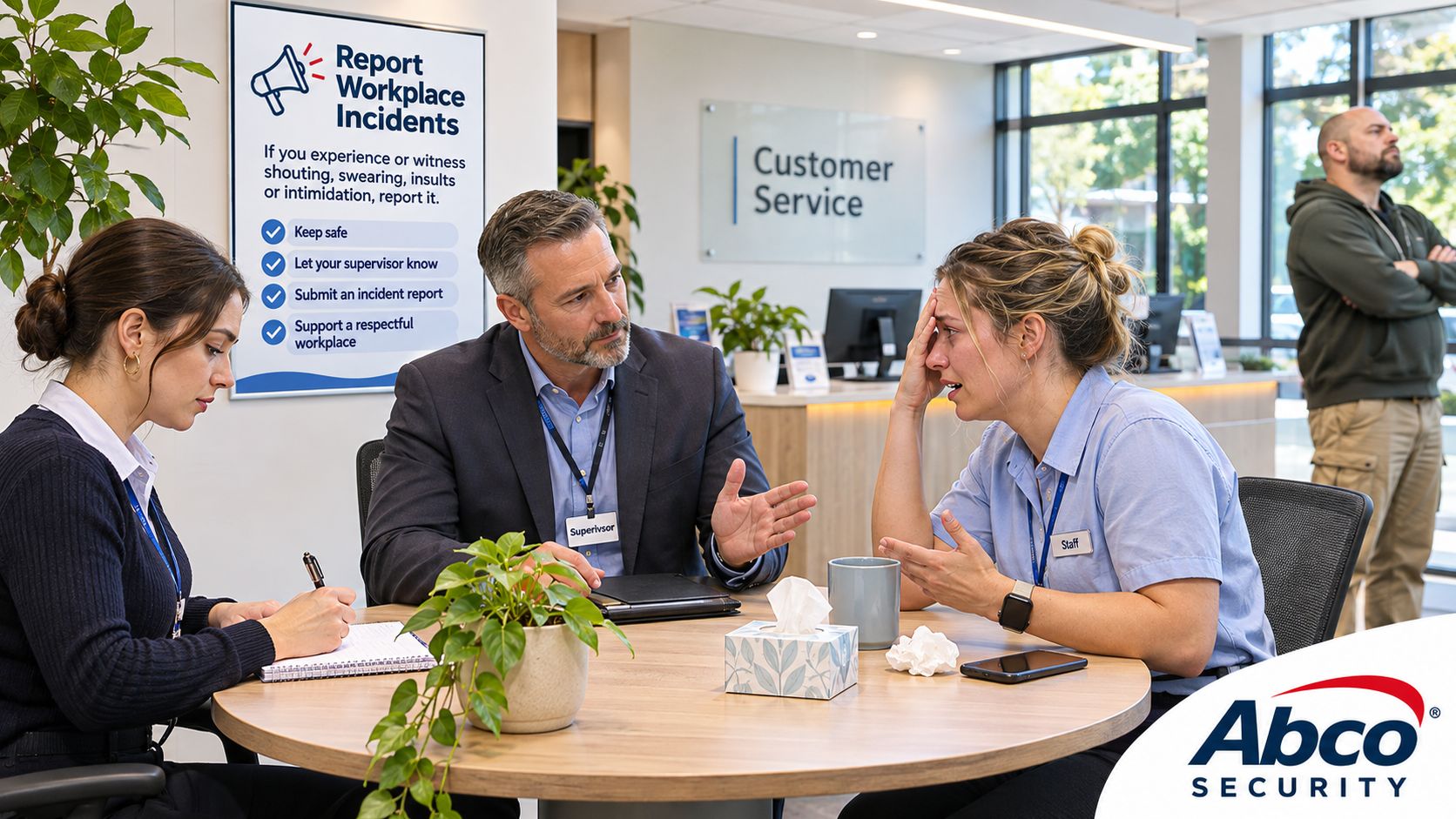
The conversation after the incident is where most of the learning sits:
| Level | Example | Immediate action | Who to notify |
|---|---|---|---|
| Level 1: everyday hostility | Shouting, swearing or insults | Set a calm boundary and offer to continue later | Supervisor and the incident log |
| Level 2: repeated intimidation | Repeated threats or following a worker | Withdraw to a safe area, restrict access and document | Site manager and WHS lead |
| Level 3: physical threat | Assault, a weapon or threat of violence | Call triple zero, evacuate the area and preserve the scene | Police, emergency services, senior management and the WHS regulator where the incident is notifiable |
Five steps staff can remember under pressure
- Recognise the early warning signs. Raised voice, repeated demands, someone standing over a seated worker, a blocked exit, pacing, intoxication climbing. Naming them matters because recognition can't be done from a procedure document.
- Set a calm, specific boundary. Say what will happen and what won't, once, in a normal voice. Vague appeals to calm escalate faster than a clear limit.
- Withdraw toward an exit or a safe room. Position matters more than words, so never let a counter or a doorway end up behind you.
- Call for help before it escalates. Asking early isn't an overreaction, and it's the step most staff delay because they don't want to look like they couldn't cope.
- Document while it's fresh. Time, location, what was said, who else saw it, what ended it.
Reporting channels that suit the worker
Four channels, all open at once. A verbal report to a supervisor for anything happening now. A written incident form for the formal record. An anonymous option for someone who fears being identified. A confidential contact with HR or the WHS lead for sensitive or repeated issues. Safe Work Australia identifies worker consultation as a core part of managing harmful behaviours and recommends informal, formal, anonymous and confidential channels, with protection from retaliation (Safe Work Australia).
Feed outcomes back to the reporter. A channel that never answers closes within a month. If you're briefing a team on this, these de-escalation techniques give staff a sequence to rehearse, which lands better than a written procedure.
Escalation on real sites
On a construction site, the induction covers unacceptable behaviour, names an escalation contact, controls gate access and logs threats from visitors or members of the public. At an event, Event Security officers with visible identification and radio contact manage crowd incidents and escalate to venue management or police when required. ABCO's personnel act as a visible deterrent and follow the incident response protocols agreed in the Statement of Work, and our guards receive ongoing training in conflict resolution, first aid, OH&S, customer service and emergency response.
Close every report with three questions. Did staffing, queue design, access rules or communication contribute? Did the controls in place work? Does the training need a rewrite? Safe Work Australia recommends addressing harmful behaviour early, because unaddressed aggression and incivility escalate and make workers less willing to report the serious conduct that follows.
Measure Trends and Prove Results
Phase six turns a pile of incident records into something a manager can act on. Four measures, reviewed quarterly and broken down by location, shift, aggressor type and outcome: security calls or duress alarms, incident reports, near misses, and a two-question staff survey on whether people see violence as a workplace issue.
Record a baseline before you change anything, then compare during and after. A Queensland University of Technology pilot across three metropolitan hospital surgical wards ran a three-month Ambassador program and measured exactly those signals: security calls fell from 111 to 44, a 60% reduction, incident reports fell from 20 to 6, a 70% reduction, and staff who saw occupational violence as a workplace issue rose from 60% to 82% (QUT ePrints).
Worked example. A cluster of Level 1 reports appears on Friday nights in one car park. The response isn't a memo: it's two extra lights, a patrol visit at 9pm and a rostering check on who is walking out alone. Log each action in the risk register with an owner and a date, so next quarter's data shows whether it worked.
Interpret the data with care. Reporting behaviour moves before incident rates do, so read the numbers alongside exposure levels and reporting participation rather than as a straight body count. Contract service delivery standards should set what gets reported back to you, in what format and by when.
Check Your Sector Controls and Book a Site Review
Controls that suit a hospital corridor rarely suit a shopping centre loading dock. Work through your sector list, then confirm the site matches it.
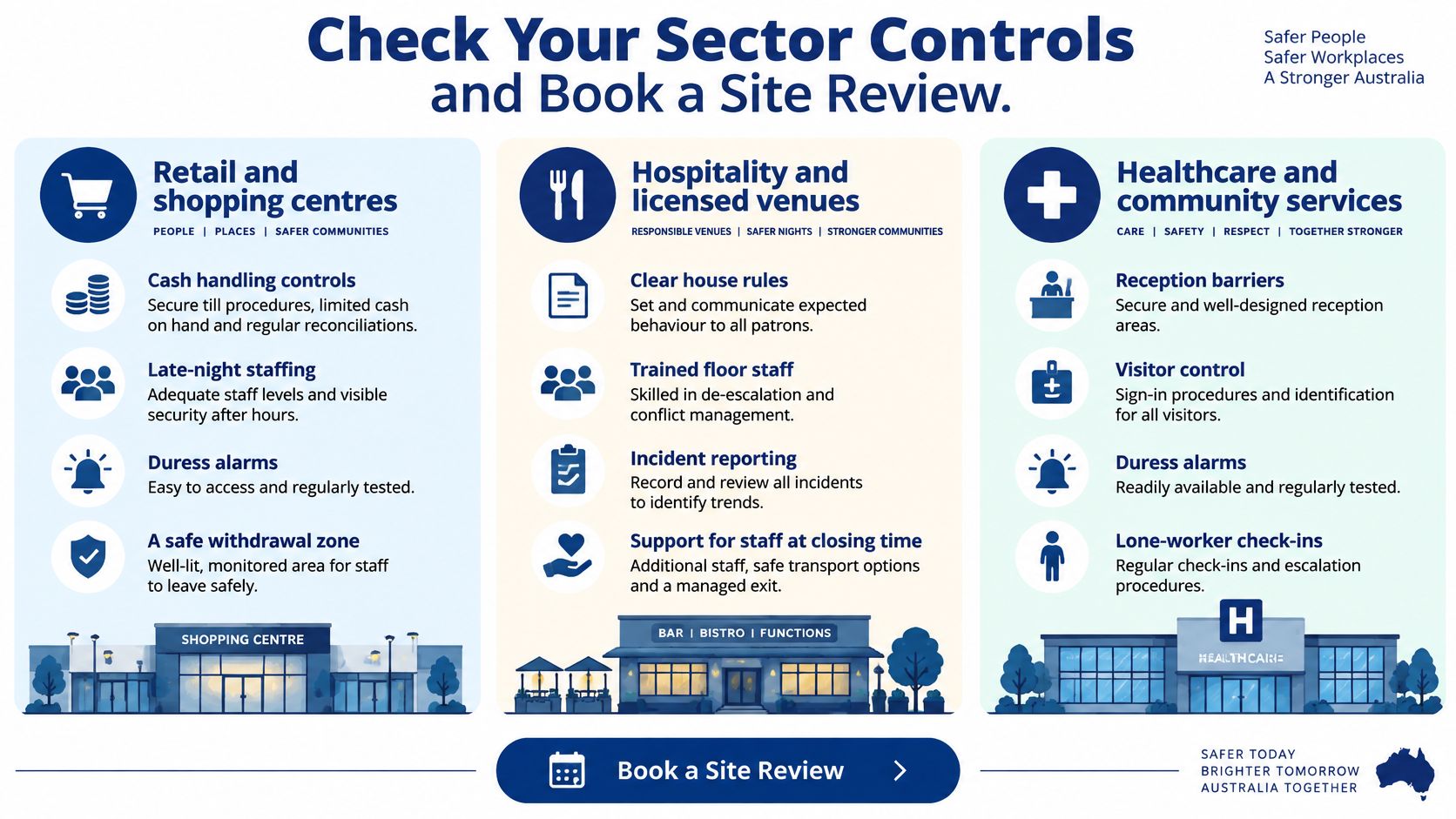
- Retail and shopping centres. Cash handling controls, late-night staffing, duress alarms, a safe withdrawal zone and Retail Security or Shopping Centre Security cover at close.
- Construction sites. Construction Security with Gatehouse Security for visitor logs and gate control, a check-in routine for lone or after-hours workers, and Mobile Patrols for perimeter checks.
- Event venues. Event Security with entry control, ID checks, licensed crowd controllers, RSA-qualified staff, crowd monitoring and alcohol incident reporting.
- Commercial offices, strata and residential. Concierge Security or reception cover, after-hours access control and monitored CCTV.
- Healthcare and community services. Reception barriers, visitor control, duress alarms and lone-worker check-ins. Our healthcare security systems work is built around the public-access and after-hours risk that comes with the sector.
Workplace health and safety is our number one operational priority, and it starts before a quote. ABCO provides a free on-site risk assessment, then develops a customised security plan to suit the environment, industry and budget.
Before you engage anyone, write the Scope of Work. It must include the exact addresses and specific areas to be secured, service hours, detailed duties, site-specific risks, and access and logistics details. Any security company in Melbourne, Sydney, Brisbane or Perth can quote a guard. Fewer can show you the register, the training record and the quarterly review that sit behind it.
ABCO Security Services Australia delivers licensed guarding, mobile patrols, monitored CCTV and site-specific workplace violence prevention support across Melbourne, Sydney, Brisbane, Perth and surrounding areas within 200km. A free on-site risk assessment is the first step: we walk the site with you, test your exposure points against the register and build a Scope of Work that matches your hours and duties. Visit ABCO Security Services Australia to book a site review.
about
avada factory
Sempery ultricies nibh at dolor cras urna eleifend nec. Atiam efficitur tempor.