

By 2024, New South Wales operated more than 90 long-term monitoring stations, according to the NSW air quality reporting history. That scale tells you something simple. Dust, smoke and pollution don't wait for a patrol to walk past. Environmental monitoring sensors watch continuously, but a number is only useful when you know how far you can trust it, where it was taken, and who acts on it.
What Environmental Monitoring Sensors Are
A guard's observation of dust at a Perth construction boundary captures one moment. A sensor records conditions over time, including changes between patrols.
An environmental monitoring sensor measures a condition and converts it into a reading or alarm, often with a time-stamped record. It works like a continuous watch: the device tracks changes, while a guard or site team supplies context and decides what to do.
New South Wales has a long-running air-quality monitoring network, with stations using both reference and indicative methods. Together, they monitor conditions such as particles, gases, visibility, wind, temperature and humidity. The distinction between methods matters: wider coverage can help flag local changes, but more readings do not automatically mean greater accuracy.
Two Classes You Must Keep Apart
- Compliance-grade reference instruments: high-accuracy equipment that can support regulatory decisions and licence reporting.
- Lower-cost indicative sensors: less costly nodes that extend coverage and flag local changes, but do not replace reference equipment.
For example, indicative sensors at a Melbourne warehouse might flag a dust trend near a roller door. A Sydney office might track temperature at its concierge desk, while a Brisbane shopping centre monitors basement air. These readings help teams decide where to investigate; they do not automatically count as compliance evidence.
A useful network pairs indicative readings with a reference check. Place nodes where exposure varies across the site, then confirm alerts against CCTV, access records and patrol logs. A sensor can show that a condition changed. It cannot, by itself, establish what caused the change or whether a standard was breached.
For indoor monitoring, indoor air monitoring in Tucson is presented as an ongoing service rather than a one-off reading.
Sensor Types and What Each One Detects
| Sensor | What it measures | Typical site use | Decision limit |
|---|---|---|---|
| Temperature | Air or surface temperature | Warehouses, cold stores, plant rooms | Alarm and trend, not process certification |
| Humidity | Relative humidity | Archives, strata plant rooms, dust sites | Pair with particles; moisture can inflate optical PM |
| VOCs | Volatile organic compounds as a group | Workshops, fit-outs, loading docks | Screening only unless a named-gas method is specified |
| Particulate matter | PM2.5 and PM10 | Construction boundaries, smoke, car parks | Optical nodes need a reference check; compliance often uses beta attenuation |
| Carbon dioxide | CO2 concentration | Offices, venues, enclosed plant | Ventilation clue, not a full indoor-air legal suite |
| Water and leak | Moisture or leak presence | Basements, risers, strata plant | Threshold alarm, then a physical inspection |
| Sound | Noise level | Events, night construction, urban edges | Shows disturbance, not who or what caused it |
| Vibration | Ground or structure movement | Construction, industrial perimeters | Activity flag; confirm with CCTV or a patrol |
| Radiation | Ionising radiation or dose rate | Specialist medical or industrial sites | Specialist compliance instruments only |
| Gas detection | Named gases such as CO, NOx or BTEX | Car parks, combustion, specified stations | Match gas and method; low-cost cells drift |
| Thermal imaging | Surface heat pattern | Electrical plant, after-hours perimeters | Heat anomaly only, not gas or particles |
Heat, Moisture and General Air Screens
Temperature suits plant rooms, archives, cold stores and strata basements, where a rising trend warns you before stock, records or equipment suffer. It's an alarm and trend tool, not process certification.
Humidity matters twice. It protects stored goods directly, and it changes optical particle readings, because moist particles grow and can look heavier than they are. If you buy a particle sensor without humidity data, you'll misread damp days as dusty days.
Volatile organic compounds, or VOCs, give you a group reading for workshops, fit-outs and loading docks. That's a screen. It won't name a single chemical for a prosecution, because the sensor responds to many compounds at once. Resources such as EcoQuest Purifiers air quality monitors from EcoQuest Purifiers illustrate the consumer end of this screening idea, where a general air reading prompts action rather than proving a specific exposure.
Particles and Ventilation Clues
Particulate matter, usually PM2.5 and PM10, is your construction dust and bushfire smoke row. It's the sensor a Construction Security boundary in Melbourne or Perth relies on most, and the one most likely to be oversold as compliance evidence.
Carbon dioxide is a ventilation clue in offices and venues. Rising CO2 suggests air isn't refreshing for the number of people present. It doesn't certify that indoor air meets every legal requirement.
Alarms That Answer Yes or No
Water and leak sensors are mostly yes-or-no alarms for plant rooms, risers and basements. They don't measure damage. They buy you time to shut off water and inspect.
Sound sensors matter at events and night works, where they show disturbance building. They can't identify who made the noise. Vibration flags plant or perimeter activity, but it still needs eyes on it before you escalate.
Specialist and Named-Gas Devices
Radiation belongs only on specialist medical or industrial sites, with the correct instrument and trained staff. Don't improvise here.
Gas detection must name the gas. Carbon monoxide in car parks, nitrogen oxides or BTEX where a construction station specifies them. A generic gas sensor that won't name its target is a red flag.
Thermal imaging shows hot surfaces, electrical faults and after-hours heat. It doesn't detect gas or dust, whatever a sales brochure implies.
Pick the risk first: choose two or three risks your site actually faces, not eleven sensors because a catalogue lists them.
Trusting a Low-Cost Reading
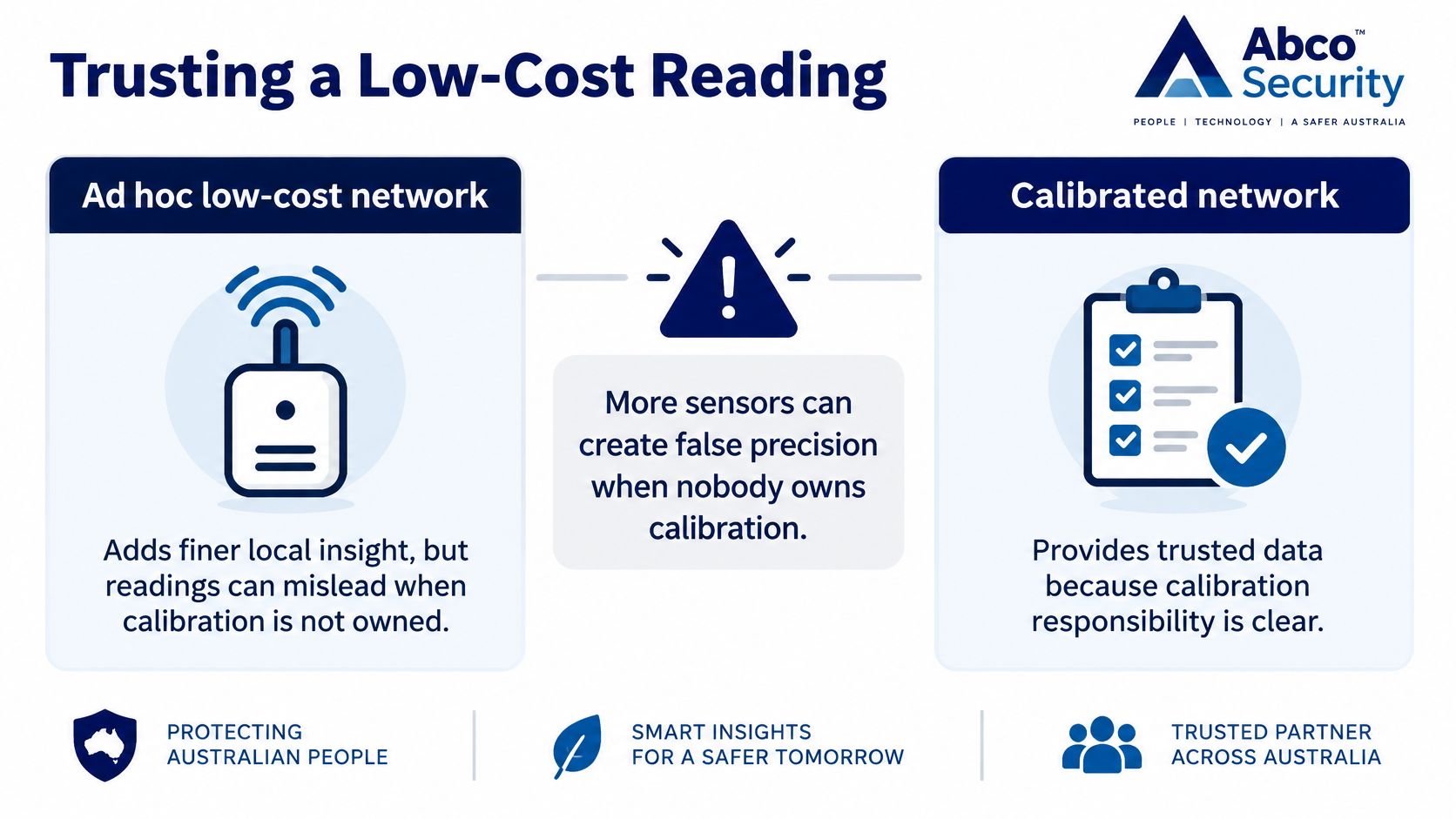
More sensors can create false precision when nobody owns calibration. Ten uncalibrated nodes give you ten confident-looking numbers and no reliable answer. That's the trap this topic sets for busy managers.
Australia's National Environmental Science Program report notes low-cost sensor networks are increasingly being deployed in an ad hoc manner, and overseas experience indicates they provide finer-grained insight only when integrated with reference-station data. Melbourne's air-quality pilot is explicitly comparing two sensors beside an EPA monitoring station for calibration. Co-location, not simple installation, makes a number interpretable.
The Co-location Rule
At commissioning, place at least one representative node beside a reference or hired instrument. Derive a site correction factor from that comparison. Repeat it after a season change or a sensor swap, because summer dust and winter smoke don't behave the same way.
Failure Modes to Plan For
- Humidity bias: moisture grows particles and inflates optical readings.
- Temperature effects: heat shifts how low-cost cells respond.
- Ageing: sensing elements drift as they get older.
- Blocked inlets: dust and insects choke airflow to the sensor.
- Dead-air placement: a sheltered corner reads its corner, not your site.
- Communications drops: lost data looks like clean air if nobody flags the gap.
Flag gaps as missing data. Don't fill them with a tidy average, because an invented number hides exactly the failure you need to see. That discipline is central to false alarm reduction, where unflagged suspect data triggers call-outs nobody can verify.
Three Labels for Every Report
- Screening: a quick local indication that something changed.
- Operational trend: a corrected pattern you can act on day to day.
- Compliance measurement: a reference method you can defend to a regulator.
A cheap sensor can detect a change quickly. It can't prove one.
Selection Criteria for Environmental Monitoring Sensors
Start with the decision the reading must support. If you can't state that decision in one sentence, you don't know which device to buy yet.
| Criterion | What to check | Red flag |
|---|---|---|
| Measurement class | Screening, operational trend or compliance measurement | Screening node offered as licence evidence |
| Detection and reporting interval | Minute-level data for alarms, hourly data for reviews | Interval too coarse for the alarm you need |
| Environmental compensation | Humidity and temperature correction for optical particles | Particle readings with no humidity data |
| Calibration support | Documented co-location, correction factor and recalibration interval | No correction factor on record |
| Connectivity and power | Redundant link or battery backup | Silent data loss treated as clean air |
| Alarm integration | Output carrying camera preset and timestamp | Bare number with no link to CCTV or access logs |
| Service and licensing | Installer and attending staff hold the required state licence | Unlicensed attendance on security-related devices |
Working Through the Checks
Measurement class comes first. Never let a screening node stand in as licence evidence, however neat its dashboard looks. A structured risk assessment process helps you fix the class before a vendor fixes it for you.
Reporting interval must match the alarm. A dust alarm needs minute-level data, because a boundary breach unfolds in minutes. A monthly ventilation review doesn't, and paying for minute data there wastes money.
Compensation and calibration protect the number. Optical particle sensors need humidity and temperature data, or readings inflate on moist days. Your vendor must document co-location, correction factors and recalibration intervals in writing.
Connectivity, power and integration protect the response. Specify a redundant link or battery backup, so silent data loss raises a flag instead of reading as clean air. Require an alarm output that carries a camera preset and timestamp, not a bare number.
Finally, check service and licensing. Installers and staff who attend security-related devices must hold the required state licence and training. A cheap device attended by unlicensed staff creates a compliance problem while solving an air problem.
How to Place Sensors Across an Uneven Site
| Placement role | Question it answers | Common mistake |
|---|---|---|
| Downwind boundary near receptors | Is dust, smoke or noise leaving the site? | Mounting on the office because power is easy |
| Upwind baseline | Is the rise from our site or from outside? | Skipping the baseline during bushfire smoke |
| Same-height wind sensors | Where will the plume travel? | Anemometer on a different roof from the inlet |
| Indoor and outdoor pair | Is the problem outside air or our ventilation? | One foyer sensor for a whole centre |
| Source node at dock, plant or stockpile | Which activity caused the spike? | Averaging the spike away before anyone looks |
| Redundant comms path | Did the sensor fail or did the network fail? | Treating missing data as a safe reading |
Australian exposure is uneven. Long distances, bushfire smoke, regional industry, urban heat and fast-changing microclimates mean one sensor rarely describes a whole site.
CSIRO's 2025 Smoke Observation Network planned to deploy more than 100 low-cost particle sensors in data-sparse, smoke-affected Australian regions, combining them with state monitoring networks and satellite observations to reduce model bias. The lesson for your site is the same logic at smaller scale. Roles matter more than device counts.
Give Each Node a Job
Place a downwind node at the boundary nearest homes, a school or a shopping-centre neighbour. That's where complaints and exposure occur. Place an upwind node as your baseline, so you can separate your dust from regional smoke rolling in.
Mount wind sensors at the same height as the particle inlet, because wind speed and direction decide where dust travels. A rooftop anemometer describing different air from your inlet produces confident, wrong conclusions.
Indoors, Compare Real Spaces
Compare a loading dock, a car park and an occupied floor, not just the foyer. Pair indoor and outdoor nodes so you can tell outside smoke from a ventilation fault. The same thinking behind a CCTV placement guide applies here, because coverage follows risk, not convenience.
Keep inlets in the breathing zone, clear of exhausts, sprinklers and dead corners. And don't treat a single Gatehouse Security entrance reading as the whole project. The gate is one microclimate among many.
Linking Sensors to CCTV Alarms and Patrols
A sensor alert shouldn't send a patrol running on its own. It should start a short verify-then-escalate chain, where each step adds evidence before people move.
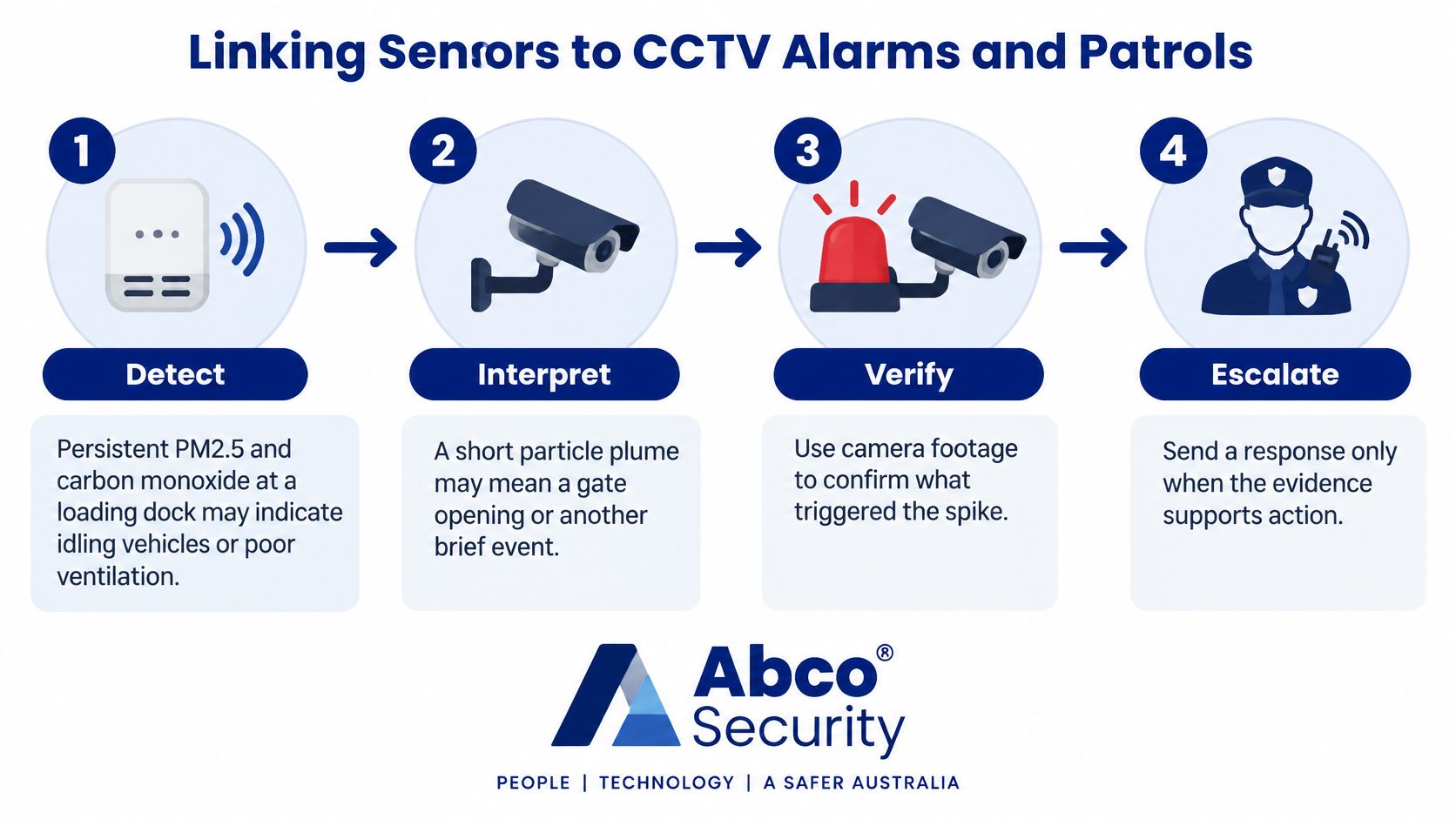
The Five-Step Chain
- Alarm on persistence: trigger on a rolling average plus a persistence time, and quality-flag the point if humidity, calibration or communications are suspect.
- Attach one timestamp: link the CCTV view, the access-control event and the wind reading to the same moment.
- Send context, not a number: the monitoring operator receives the camera preset with the alert.
- Escalate on agreement: send Mobile Patrols or the site supervisor when the camera, access log or a second sensor agrees, or when the reading stays high after the obvious source has left.
- Log the outcome: record what caused it, so thresholds reflect real nuisance alarms rather than guesswork.
Clear communication protocols keep that chain fast, because the operator, guard and supervisor are reading the same timestamped picture.
Why the Chain Works
The UTS Technology for Urban Liveability Program case study describes QUT's KOALA platform combining a Plantower PMS1003 particle sensor with an Alphasense CO-B4 sensor, providing real-time PM2.5 and carbon-monoxide observations. It also notes a persistent PM2.5 and CO increase near a loading dock may indicate idling vehicles or poor ventilation, while a localised transient particle plume may indicate a construction or access-control event.
That's the teaching point. Persistence plus a second gas suggests a real source. A brief plume suggests a passing event. Your alarm logic should treat them differently.
Four Sites, Same Logic
At a Melbourne construction boundary, a sustained dust rise triggers a water-cart check, and the haul-road camera shows whether one truck caused it. Construction Security staff then deal with a control failure, not a mystery spike.
At a Brisbane shopping centre, a basement leak alarm or car-park carbon monoxide rise opens cameras and calls Retail Security or centre management. Shopping Centre Security teams get a verified location instead of a vague alert.
In a Sydney lobby, carbon dioxide and temperature guide Concierge Security on ventilation complaints, with a thermal camera watching the switch room after hours. The concierge answers tenants with a record, not an opinion.
At a Perth event, a sound sensor cues Event Security to move crowds early, while licensed crowd controllers still do the people work. Sensors cue. People decide.
Escalate when two independent signals agree, or when one signal stays high after its obvious cause has gone.
For a Security Company Melbourne managers can audit, that chain matters more than the sensor brand. It turns readings into defensible Security Guarding decisions.
Deploying Maintaining and Reporting the Network
A field check keeps sensor claims honest, as this site inspection shows.
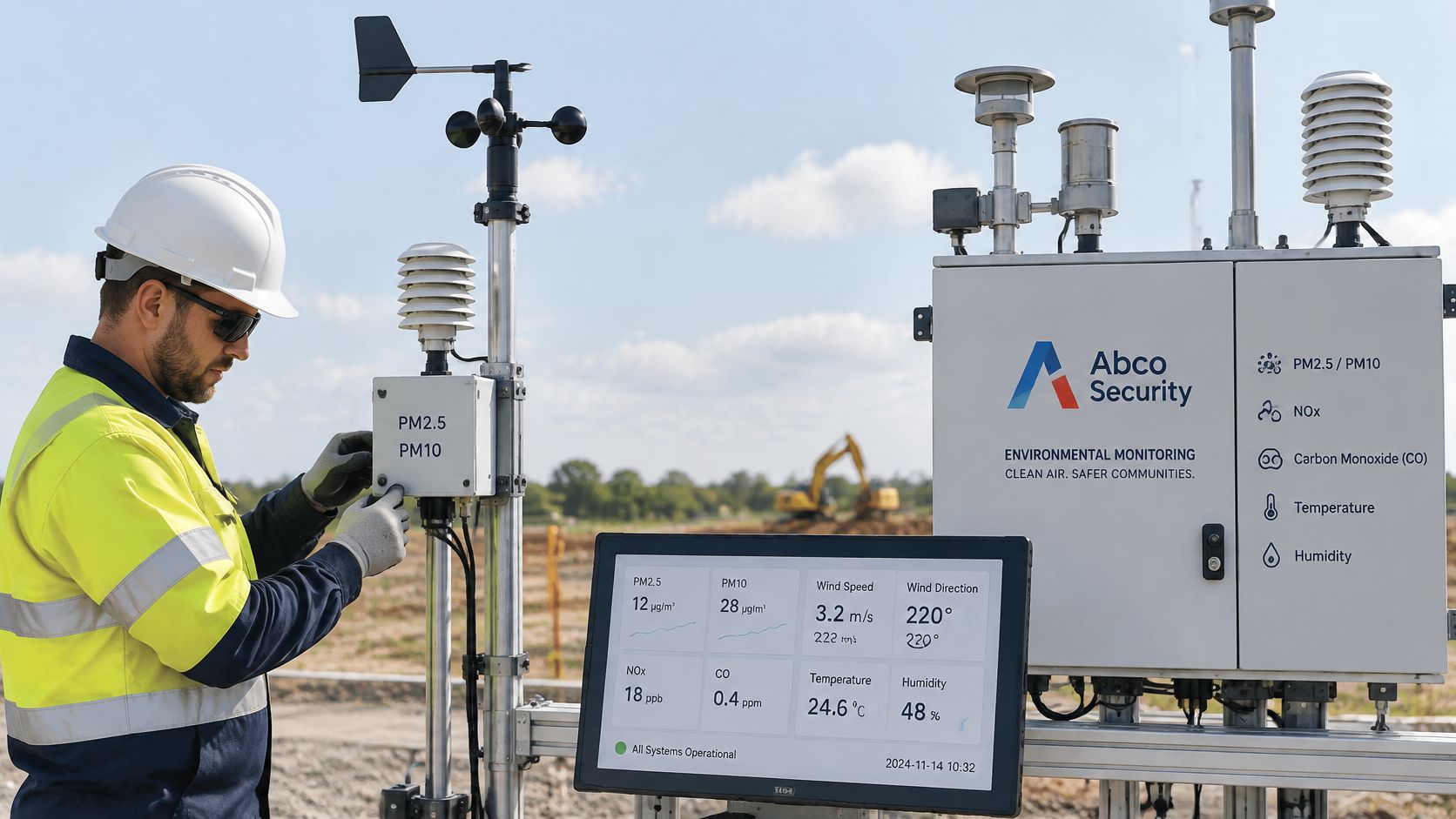
A Victorian ambient air quality monitoring report specifies continuous PM2.5 and PM10 measurement together with wind speed and wind direction, while a more expanded station also measures NOx, carbon monoxide, temperature, relative humidity and BTEX compounds. Its reference system uses beta-attenuation monitors for PM2.5 and PM10, chemiluminescence for NOx, infrared gas-filter correlation for CO, platinum-resistance temperature sensing and capacitive thin-film humidity sensing. Your business site needs the same logic, combining particles, wind and humidity, at a smaller scale.
Keep a One-Page Register
- Sensor ID and location: including mounting height and install date.
- Calibration record: last co-location date and correction factor.
- Power source: mains, battery or both, with backup status.
- Authorised attendant: the licensed person permitted to attend the device.
Service quarterly, and again after dust storms, bushfire weeks or sensor swaps. Clean inlets, check clocks, confirm camera presets and note drift. A clock that's wrong by minutes breaks every CCTV comparison you rely on.
Report Without Overclaiming
Separate client updates from compliance reports. State the instrument class, averaging period and action taken in every report, and never imply a screening node meets a licence condition. Tidy regulatory compliance documentation makes that boundary easy to defend later.
This short video walkthrough shows how live readings are reviewed during a site check.
Budget the Response Honestly
The return comes from earlier water shut-off, fewer false call-outs and a record of what staff knew and when. It doesn't come from a fixed saving anyone can promise you.
Staff costs matter too. The Fair Work Commission's Security Services Industry Award summary lists a level-1 security officer at $28.42 per hour, before penalty loadings for nights, weekends and public holidays. Budget patrol attendance at real award rates, or your sensor network will generate alerts nobody is rostered to answer.
Next Step One-Page Site Brief and Contact ABCO
Before buying sensors, put the site plan on one page. A guard, contractor and manager should be able to see what each alert means and who responds.
What the Brief Lists
- Your top two or three risks: dust at the boundary, leaks in the basement or carbon monoxide in the car park.
- The sensor role for each risk: downwind reading, upwind baseline, source check or indoor pair.
- Who checks the camera: name the monitoring operator or on-site guard by role.
- Who attends: specify the static guard, patrol or site supervisor.
- The reading's role: screening, operational trend or compliance measurement.
Three Questions for Each Risk
- Which control does the sensor support? It might prompt water suppression, ventilation, a shut-off or crowd movement.
- Who acts on the alert? Name the person or role. Without an assigned responder, the alert is like a fire bell with nobody listening.
- How is the outcome recorded? Log the response against the timestamp and note the cause.
Use the answers to decide whether security guarding, mobile patrols or alarm monitoring should cover the response gap. A sensor alert at 3 am is of little use if nobody is rostered to act.
ABCO Security Services Australia can bring static guarding, mobile patrols, retail security, and A1 Grade CCTV and alarm monitoring into one plan. Its offices are in Melbourne, Sydney, Adelaide, Perth and Brisbane. Bring a draft brief, even a rough one, to discuss how it fits your site before sensors are installed.
Request a site review and a plan linking readings to CCTV, access records and rostered patrol attendance. Visit ABCO Security Services Australia to arrange an assessment for your property, construction site, retail centre or venue.
about
avada factory
Sempery ultricies nibh at dolor cras urna eleifend nec. Atiam efficitur tempor.