The Australian CCTV camera market was valued at AUD$869.52 million in 2025 (Research and Markets), and almost none of that spend answers the only question that matters at your gate: can the recorded footage identify a person at 2am in February rain?
Security cameras in Mackay are usually specified against the wrong criteria. Buyers compare megapixels and camera counts, then discover in the first wet season that water tracked into a connector, that the dome facing west is blind at 4pm, and that the camera overlooking the fitting room corridor should never have been installed.
Three things belong in the selection criteria alongside resolution: a genuine outdoor enclosure rating, a privacy position you can defend if someone complains, and enough pixel density at the target to produce evidence rather than a grey blur. None of the three appears on a typical quote, and each one costs far less than the mistake it prevents.
One more principle holds across every site type below. Cameras support guards, lighting and access control. They don't replace any of them.
Camera Options for Mackay Properties at a Glance
Most buyers arrive at this decision holding a quote with a camera count on it. The count is the least useful number in the document. Five camera types cover almost every Mackay property; the table is the short version, and the notes underneath explain where each trade-off bites in this climate.
| Camera type | Best placement | Main strength | Main limit |
|---|---|---|---|
| Fixed bullet | Entrances, car parks, loading docks | Clear identification at short range | Narrow field of view; needs lighting |
| Dome | Shopfloors, lobbies, corridors | Discreet and vandal resistant | Lower zoom; fewer fine details at distance |
| PTZ (pan, tilt, zoom) | Yards, perimeters, large car parks | Follows movement on demand | Cannot watch everything at once; needs an operator or patrol logic |
| Thermal | Remote or unlit boundaries, rural-edge sites | Detects people in total darkness | Costs more; limited facial or plate identification |
| Solar 4G camera tower | Construction and temporary sites without mains power | Deploys without trenching or grid power | Bandwidth limits video quality; site placement depends on sun exposure |
Fixed bullet cameras do the work that ends up in an incident report: a face at the front door, a plate at the vehicle gate, a person at the dock. Specify the lens for the distance you have, because a wide-angle lens at 15 metres records a broad scene and a very small person. The limit is honest: one narrow view per camera, and no usable image at all without light.
Dome cameras belong indoors at head height, where discretion and vandal resistance matter more than reach. Sealed housings and small optics mean lower zoom, so a dome over a shopfloor works and a dome pointed across a car park at 30 metres gives you a shape, not an identity.
PTZ cameras suit yards, perimeters and large car parks where one person needs to follow activity on demand. They cannot watch everything at once, and a PTZ is only as good as the preset tour and patrol logic behind it. Two units with disciplined presets beat six that nobody drives.
Thermal cameras detect in total darkness and through light rain haze, which suits remote boundaries where the question is whether someone is there, not who they are. Pair them with a colour camera on the likely route so detection becomes identification.
Solar 4G camera towers solve the temporary site problem where there's no mains power and no trenching budget. Cellular bandwidth constrains video quality, so record on board and stream events only, and check the sun exposure of the proposed position before signing.
None of the five fixes bad lighting or a blocked sightline. A camera that must identify a face at 20 metres needs a different lens, and often a different illuminator, from one watching a whole yard, which is why night vision cameras should be specified by illuminator range and beam angle rather than by a resolution figure.
Why Mackay Properties Need Monitored Cameras
Local offence data gives you a reason to spend, not a specification. Queensland Police Service publishes Mackay-area figures through its Queensland Crime Statistics system, and the displayed reporting period shows 353 theft offences against 387 in the comparison period, a decrease of about 8.8 per cent (Queensland Police Service). The same dashboard reports assault up 23.8 per cent and drug offences up 6.9 per cent across that comparison.
Read the three together and the takeaway isn't that crime is falling. Two categories are rising while theft eases slightly, and all three generate the kind of incident a camera system gets asked to explain after the fact: who was at the counter, who walked the yard, what happened outside the bottle shop at closing.
Treat the numbers as a snapshot of the period the dashboard displays, not a permanent annual rate. Quote the dates with them in any business case, because a figure lifted without its reporting window reads as an invitation to argue.
The scale argument is separate and stronger. Mackay Regional Council's economic profile estimates 129,253 residents in the region in 2025 and projects that by 2046 the area becomes Queensland's 11th most-populated local government area, the ninth fastest growing of the state's 78 LGAs (Mackay Regional Council). More residents means more premises, longer trading hours, more car parks and more shared facilities that someone has to monitor.
Design for the premises you'll have in ten years, not the fence line you have today. Spare conduit, two free ports on the switch and a recorder sized above current headcount cost a fraction of a second installation.
Match the camera plan to the risk that actually applies
Work out which risk is largest on your site before anyone quotes hardware. The answer changes the layout, not just the camera.
- Theft from stock, plant or cash: narrow views on the till, the stockroom door, the fuel bay and the gate, with tight identification density rather than wide coverage.
- Assault or anti-social behaviour at the frontage: overview cameras on the queue and the entrance apron, plus lighting designed to make faces visible at night rather than just bright.
- After-hours access: gate and door cameras on event-linked recording, so a forced entry triggers a reviewable sequence across several views.
- Property damage: perimeter and blind-side coverage, where the camera's job is to record the approach route and the vehicle, not the damage itself.
Once the risk is named, most of the remaining decisions follow. Footage supports identification, investigation and post-incident analysis. The guarding, the lighting, the access control and the police response are the parts that prevent the incident.
Where to Place Cameras for Each Mackay Site Type
Take a shopping centre car park with three entry points, a loading dock and a trolley bay. The instinct is to blanket the apron with four wide-angle cameras and call it covered. That layout records a great deal of asphalt and nothing you can hand to police.
Coverage that works starts from the approach routes and works inward. The infographic below sets out the same worked example.
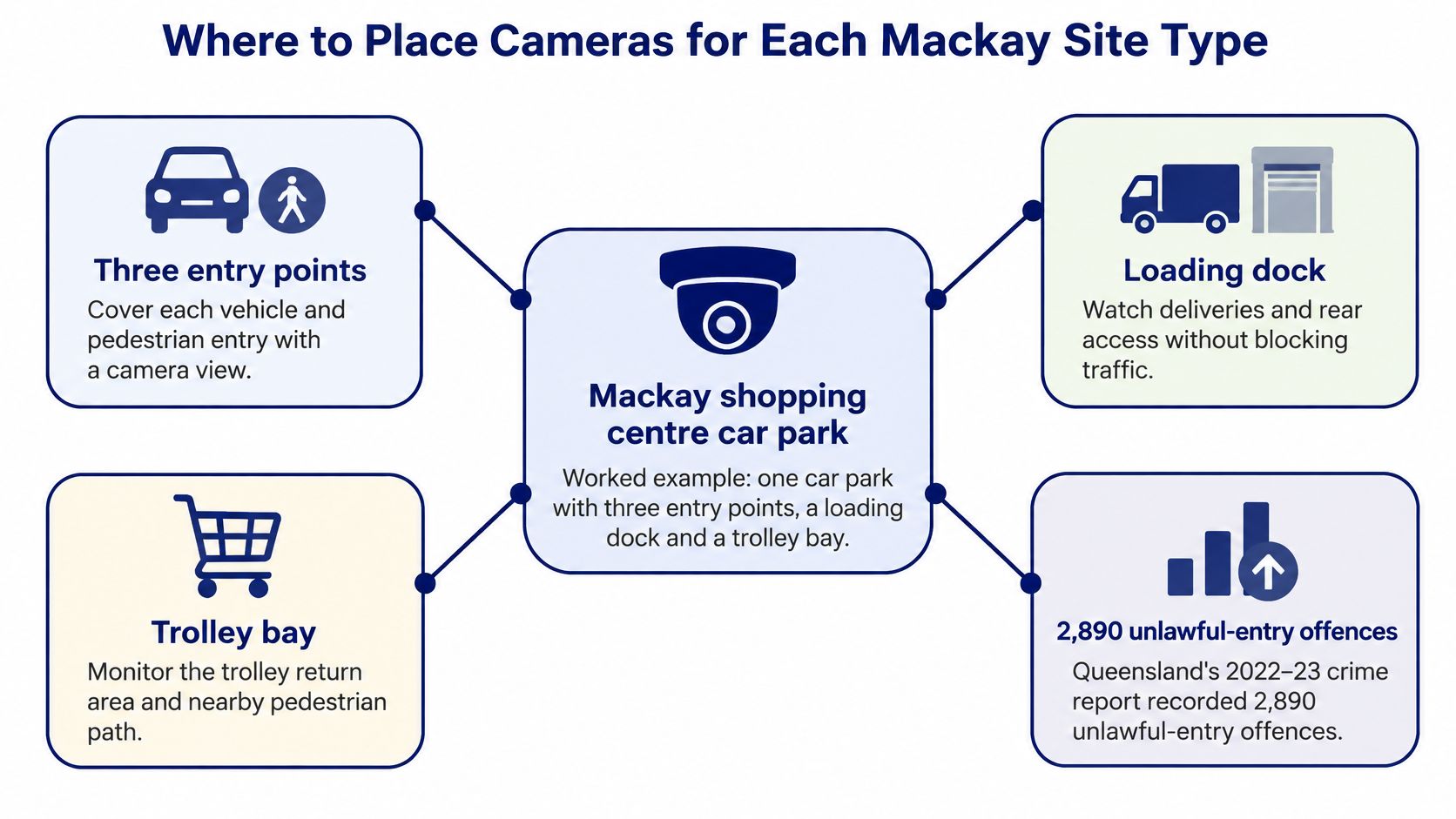
The local numbers explain why layout matters more than camera count. Queensland's 2022–23 crime report recorded 2,890 unlawful-entry offences in the Mackay–Whitsunday District, including 1,749 unlawful entry with intent involving dwellings, plus 2,472 cases of other property damage and 5,944 other-theft offences excluding unlawful entry (Queensland Government Statistician's Office). Those categories are event-and-person offences, so the layout has to reconstruct a sequence and identify someone at the end of it.
Set a density target, then walk the site after dark
Resolution alone proves nothing. The working rule I specify to is roughly 250 pixels per metre across the subject for identification at a door or gate, and about half that for recognition across a yard. A camera that produces 60 pixels per metre at the entry is a detection device wearing an identification label.
The check is physical, not theoretical. Stand someone at the gate at the expected distance after dark, take a still in the actual lighting, and confirm a face or number plate is readable. If it isn't, the answer is a tighter lens or more light, not a higher megapixel number on the same lens.
Event-linked recording and synchronised timestamps matter just as much. When a dock door is forced at 1:40 a.m. and you have a gate camera, a yard camera and a dock camera, those three views must line up to the second without manual arithmetic. Set network time synchronisation, record on alarm across zones, and export with the original timestamps intact.
Coverage priorities by site type
| Site type | Priority zones | Common risk |
|---|---|---|
| Single-family home | Front door, driveway, side gate | Unlawful entry through side access and garages |
| Strata or body corporate complex | Car park entries, lobby, bin store, gate | Vehicle access and damage in shared areas |
| Retail or shopping centre | Entrances, trolley bays, loading dock, cash office | Theft and dock access after trading hours |
| Warehouse or logistics | Gates, dock doors, yard perimeter | Unauthorised vehicle movement and cargo loss |
| Construction site | Site gate, plant and materials storage, temporary access | Theft of plant, fuel and tools after hours |
| Event venue | Entry points, queuing areas, asset storage | Crowd incidents and unauthorised access to restricted areas |
Retail and shopping centre rows are where Retail Security and Shopping Centre Security planning earns its keep, because the layout determines whether a loss-prevention team can act on what the camera saw. Construction compounds need Construction Security thinking around plant storage and after-hours access, and venue entry and queuing zones belong with Event Security, where crowd movement is the design driver. Our CCTV placement guide steps through the zones row by row if you're building the schedule yourself.
Weatherproofing Cameras for Mackay's Tropical Climate
Cameras don't fail here because they're cheap. They fail because they were specified for a temperate climate and installed without a thought for water.
Bureau of Meteorology climate normals for Mackay report about 1,597.3 mm of mean annual rainfall, monthly means reaching about 279.9 mm, and mean relative humidity of roughly 74 per cent at 9am and 68 per cent at 3pm (Bureau of Meteorology). That combination drives condensation inside housings, corrosion on fixings and connectors, and image degradation that builds over a couple of seasons rather than over one storm.
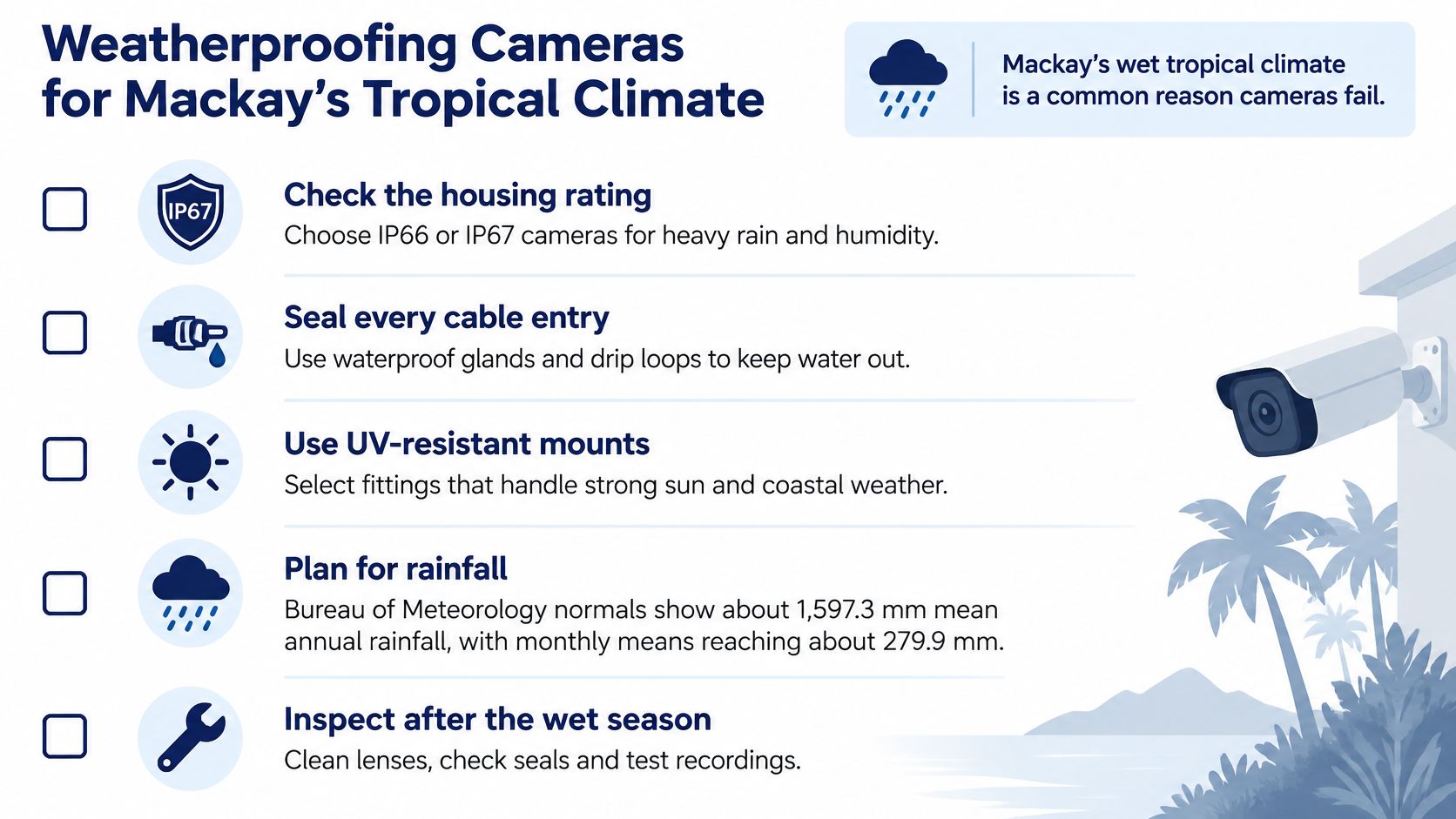
The specification checklist I work to
- Demand a real enclosure rating. IP66 or IP67 on every outdoor camera, verified on the datasheet rather than on the box artwork.
- Check the housing material for UV and salt. UV-resistant housings and corrosion-resistant fixings, because a coastal site will find every mild steel bracket you install.
- Seal every cable entry. Sealed cable glands plus drip loops, so water tracks down the cable and off it instead of into the connector.
- Choose the right lens window and clean it. Hydrophilic or hydrophobic protective windows reduce droplet build-up, and a scheduled clean removes the salt film that reduces contrast.
- Fit sun shields. Low-angle glare at dawn and dusk washes out number plates long before the sensor struggles.
- Protect the equipment room, not just the camera. PoE switches and recorders go in ventilated cabinets with surge protection and thermal margin, because a hot cabinet in January takes down the whole system.
- Test in the worst conditions you get. Verify usable identification imagery during heavy rain and backlighting, not at nominal resolution on a dry afternoon.
The sign-off test is simple. A night still of the entry point, taken in rain, that shows a readable face or number plate. If it doesn't, the system isn't finished.
Where tropical installs go wrong
Three shortcuts account for most failures on tropical installs: a gland fitted without a drip loop, a recorder mounted in a sealed cupboard with no airflow, and a dome installed pointing east into the morning sun. Each one is a five minute fix at installation and a full callout later. Budget for an inspection after the wet season as well, cleaning lenses, checking seals and re-testing recordings before the next summer.
Privacy and Recording Rules to Confirm First
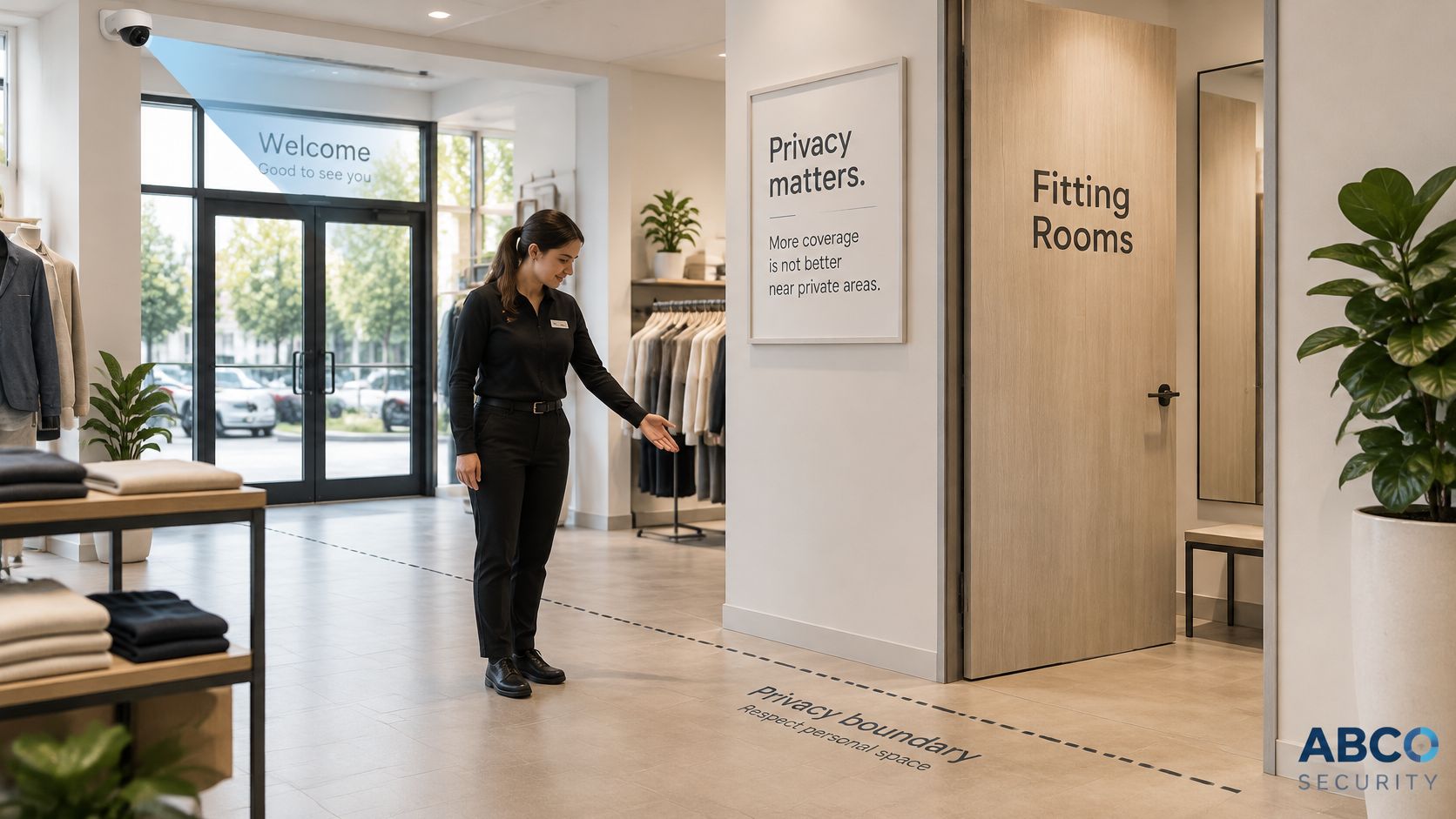
More coverage is not automatically better security. A camera over a fitting room corridor, audio enabled because it was on by default, and footage nobody has ever deleted adds legal and industrial exposure without adding a single deterrent. In Mackay, the practical test is narrower: does each camera solve a named problem without watching more people than the job requires?
Queensland's Criminal Code prohibits recording people in places where they reasonably expect privacy, including bathrooms and change rooms, so those spaces are excluded from any layout rather than covered discreetly (Office of the Information Commissioner Queensland). Cameras serve a defined safety or security purpose. They aren't general observation tools.
Where the Privacy Act 1988 applies, which generally means Australian Government agencies, organisations with annual turnover above $3 million and certain other entities, captured images are personal information handled under the Australian Privacy Principles (OAIC). Before recording starts, people need clear notice that they may be filmed and why, footage must be secured against unauthorised access, and it must be destroyed or de-identified when it's no longer needed. Workplace surveillance can also attract state requirements, so a national operator has to check the local rules before deployment. That check belongs at design stage, when camera angles, audio settings and retention rules can still be changed cheaply.
Controls to write down before the first camera goes up
- Audio off by default. Enable it only where there's a defined purpose and you can explain that purpose in writing.
- A stated retention period. Something you can defend, applied automatically, with a documented reason for anything kept longer.
- Access logs. Who viewed which footage, when, and why. Role-based permissions rather than shared logins.
- Named remote-viewing roles. Two or three people with mobile access, not everyone with a manager's title.
- A disclosure procedure. A written path for police and insurer requests, with one person accountable for the response.
- Signage that matches the practice. Notice at entrances stating that filming occurs, in wording that reflects what you record.
A camera that captures personal information you don't need is a cost with no security benefit. Cut the zone and you cut the liability.
Strata and body corporate managers should consult owners before adding cameras to shared areas, and document the decision. For any operator of scale, the same discipline holds: state the purpose, assess the intrusion, record the outcome. The Office of the Information Commissioner Queensland is the regulator to consult when that assessment is done. For the broader Australian picture, our CCTV laws in Australia overview covers how state and federal obligations interact.
Monitoring Models, Guarding and Licence Checks
Who watches the footage decides the response, and the response decides which model you're buying. Hardware is the constant across all five.
| Model | Who watches | Response | Best fit |
|---|---|---|---|
| Recorded only | Nobody live; footage reviewed after an incident | Review after the event | Low-risk premises needing evidence |
| Live CCTV monitoring | Operator watches feeds around the clock | Two-way audio warnings and dispatch | Sites with frequent after-hours activity |
| Alarm with CCTV verification | Monitoring centre checks video before dispatch | Officer or patrol attends a confirmed alarm | Homes, strata and commercial premises |
| Mobile patrols | Patrol officers on scheduled rounds | Attend on schedule and on alarm | Estates, construction zones and retail precincts |
| Static guarding | Licensed guard on site | Immediate presence, access control and reporting | Sites where people must be screened or controlled |
The sequence most premises follow is recording plus alarm verification first, patrols where out-of-hours access is a real exposure, and static guarding where people have to be screened or controlled. Adding operators to a site with nothing worth watching wastes money; adding patrols to a site with no verified alarm wastes fuel.
Licence categories are part of the design
Security work in Australia is regulated state by state, and the permitted activity has to match the duty. Victoria Police identifies security guard, crowd controller, investigator and bodyguard as separate private-security activities, and its guard definition includes monitoring through CCTV, radio or another alarm device (Victoria Police). Western Australia similarly separates a security-officer licence for watching and guarding property from crowd-control authority used to screen entrants and remove people.
In Queensland, confirm the category with the state licensing regulator for guarding, crowd control and CCTV monitoring before anyone is rostered. A crowd controller who screens entrants and removes people holds different authority from a guard patrolling a yard, and a deployment plan that treats the roles as interchangeable is a compliance problem waiting for a Saturday night.
Ask for the licence category in writing next to each role in the deployment plan, along with escalation authority and the incident reporting line.
The same logic applies to Mobile Patrols, Static Guarding, Gatehouse Security, Concierge Security and Event Security across the region, from Sarina, Walkerston, Marian and Mirani through to the Bowen Basin towns and Proserpine within roughly 200 km of Mackay. Providers with offices in Melbourne, Sydney, Brisbane or Perth must still confirm Queensland licensing before assigning staff, because a licence held interstate doesn't transfer. Our remote video monitoring model pairs operator review with patrol dispatch, which is where the licence question becomes practical rather than theoretical.
Confirm Your Camera Plan Before You Book
Three questions settle the plan. Which risk is largest on this site: theft, assault, after-hours access or property damage? Which zones need identification-grade images rather than overview? And which response model does the site need on a Tuesday at 3am?
Then confirm the three items most often skipped: an IP66 or IP67 enclosure on every outdoor camera, a privacy notice with a defined retention period and access log, and a licence category recorded against every role that touches the system.
Price the labour, not just the hardware. The Security Services Industry Award 2020 covers patrolling, protecting, screening and guarding by physical or electronic means, and the Fair Work pay guide lists adult full-time hourly minimums from $28.42 at Security Officer Level 1 to $31.20 at Level 5, before penalty rates, allowances and other conditions (Fair Work Commission). Nights, weekends, public holidays and overtime push the cost of a 24/7 monitoring model or patrol roster well above those base rates, and a quote that ignores them isn't a quote. For a line-by-line view of what drives project cost, see our CCTV installation cost breakdown.
ABCO Security Services Australia assesses the site, designs the camera and monitoring plan, and quotes CCTV and alarm monitoring, mobile patrols, static guarding, construction security and event security, with 24/7 operations nationally. Reach the team on (03) 9001 0024 or at info@abcosecurity.com.au to start a site review.
ABCO Security Services Australia designs and installs camera systems for Mackay conditions, from IP66 and IP67 outdoor housings to alarm verification, remote video monitoring and patrol dispatch, so footage holds up when it's tested after an incident. The team pairs 24/7 monitoring with licensed guarding and mobile patrols across the region, which means the camera supports a response rather than sitting on a shelf. Visit ABCO Security Services Australia to arrange a site assessment and a written plan before you buy any hardware.
about
avada factory
Sempery ultricies nibh at dolor cras urna eleifend nec. Atiam efficitur tempor.