
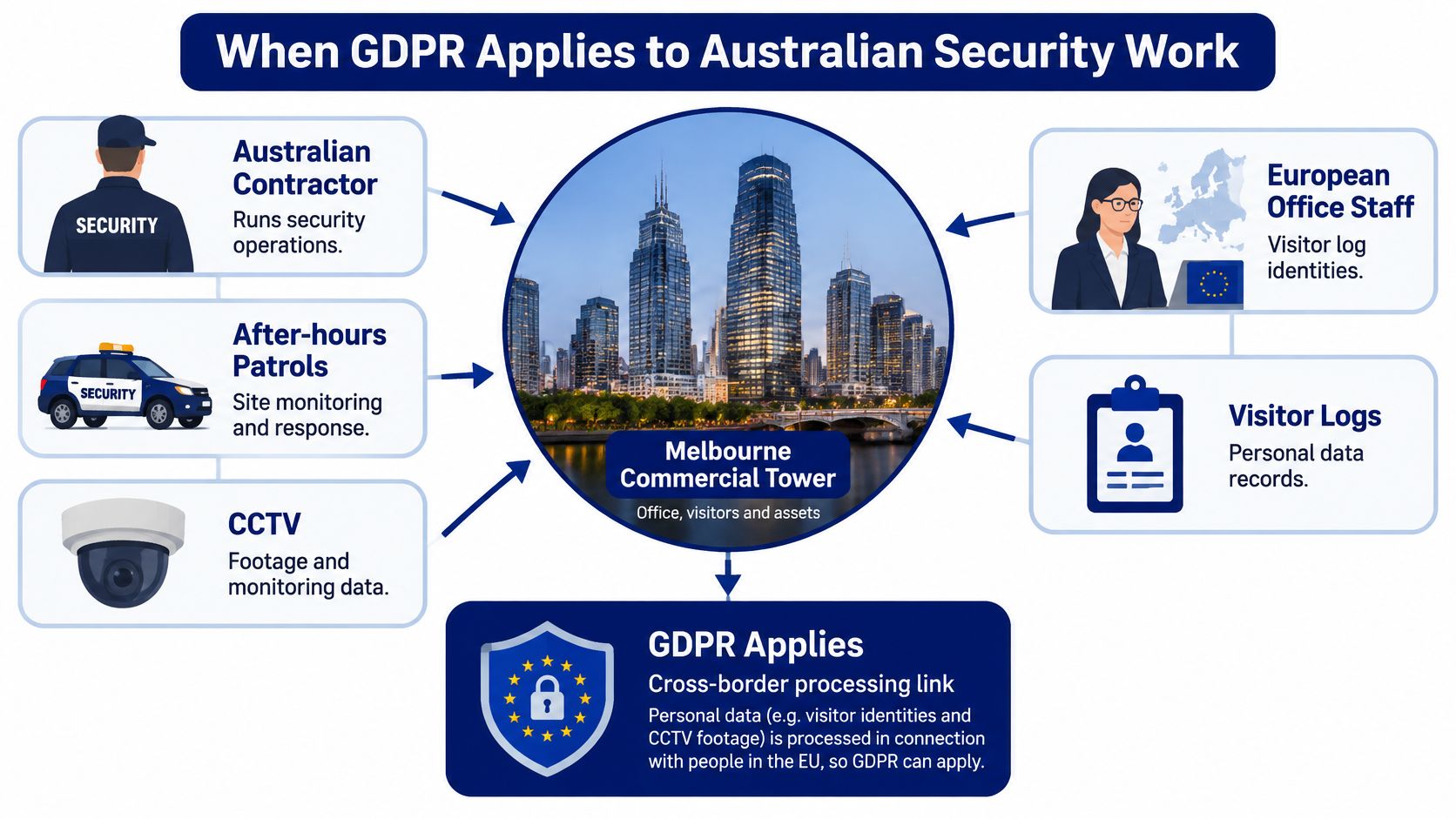
You're the facility manager for a Melbourne commercial tower. Your Australian contractor runs the CCTV, after-hours Mobile Patrols, and visitor system, but the building owner has staff in Europe and a tenant has just sent you a GDPR questionnaire. Does GDPR Compliance Australia work mean you need a European policy, an Australian one, or both? The answer depends on the asset, not on the company name on the contract.
When GDPR Applies to Australian Security Work
A Melbourne control room can manage cameras, door readers and visitor records for a building with European connections. That fact alone does not bring every security record under GDPR. The key question is what each asset does, who decides its purpose, and whether the people or activity involved connect to the EEA.
GDPR may apply when an Australian organisation offers goods or services to people in the European Economic Area, monitors their behaviour there, or processes data through an EU establishment. A camera used for safety at an Australian site is not enough on its own.
Run Four Tests for Each Flow
Map each asset separately: CCTV, alarms, credentials, visitor records and incident reports can have different roles and rules.
- Who decides why data is collected? If the client sets the purpose and retention period for footage, the provider is likely a processor for that flow. If the provider decides the purpose, it may be a controller.
- Where are the people being monitored? Monitoring EEA-based staff in the EEA differs from recording an EEA citizen entering a Sydney lobby.
- Where are systems hosted or accessed? Cloud storage or remote viewing outside Australia can raise transfer duties when the data is in GDPR scope.
- Is there EU-targeted activity? An EU establishment, direction from an EU parent, or services aimed at people in the EEA can change the analysis.
Does GDPR Apply to This Security Flow
| Situation | GDPR role | Australian overlay | First action |
|---|---|---|---|
| Goods or monitoring offered to people in the EEA | Controller if you set the purposes | Privacy Act if you are an APP entity | Map EEA individuals and choose a lawful basis |
| Footage or access logs handled only on the client's instructions | Processor | Contract plus APP 8 if data leaves Australia | Sign a processor agreement before go-live |
| EU establishment or marketing aimed at the EU | Controller, and possibly an EU representative | Privacy Act still covers Australian handling | Confirm establishment, targeting, and representative duty |
| Australian sites only, no EEA people in the data | Usually outside GDPR | Privacy Act, APPs, and state or territory surveillance laws | Do not copy an EU policy over local rules |
| Cloud hosting or remote viewing outside Australia | Transfer rules if the data is in GDPR scope | APP 8 overseas disclosure | Record the host location and the safeguard |
| Monitoring of EU-based staff or contractors | Controller for that HR data | Employee-records exemption is narrow | Run a separate workforce assessment |
For example, a security company may guard a European exhibitor at a Sydney event and send incident footage to the exhibitor's EU head office. For that flow, the provider may be a processor for an EU controller. Remote viewing of a Brisbane warehouse for an EU parent can raise similar questions. A Perth retail site with no EEA link will usually sit under Australian law alone.
Staying outside GDPR does not remove local privacy concerns. The OAIC Australian Community Attitudes to Privacy Survey reports that 89% of Australians support privacy obligations for businesses collecting employee data, including through monitoring or surveillance.
Practical rule: List each camera, reader, log and report. For every asset, record whether the provider is controller, processor, both, or handling data outside GDPR's scope. Then set the contract and operating instructions to match.
The same relationship-mapping question appears in business referral opportunities for Australian advisors. For security work, map each data flow before paperwork.
How GDPR Sits Beside the Privacy Act
A camera at a Sydney venue can record a visitor for an Australian client while sending incident footage to an EU head office. The same camera may therefore sit under more than one privacy regime. The paperwork alone does not settle the question: identify whether the provider acts as controller, processor, or both for each asset and purpose.
Australia's base statute is the Privacy Act 1988. It remains the central national framework for handling personal information. Parliament passed the Privacy and Other Legislation Amendment Act 2024 on 29 November 2024, and it received Royal Assent on 10 December 2024, strengthening enforcement and penalties for conduct after commencement.
GDPR Duties Beside the Australian Privacy Act
| Job | GDPR | Privacy Act and APPs | Stricter practical bar |
|---|---|---|---|
| Why you may collect | Named lawful basis such as contract or legitimate interests | Lawful, fair, and reasonably necessary under the APPs | Document the purpose before the camera goes live |
| People's rights | Access, correction, erasure, restriction, portability, objection | Access and correction, with complaint rights to the OAIC | A footage-retrieval and redaction process |
| High-risk monitoring | Data protection impact assessment | Privacy impact assessment expected for high-risk projects | Assess biometrics and systematic public monitoring first |
| Breach notice | Controller notifies the authority within 72 hours where risk is likely | Notifiable Data Breaches scheme if serious harm is likely | Run both clocks from the moment of suspicion |
| Accountability lead | Data protection officer in specified cases | Privacy officer or equivalent, not always mandated by title | Name one owner on the contract |
| Sending data overseas | Chapter V safeguards, including standard clauses | APP 8 overseas disclosure | Record host, recipient, and safeguard |
| Employee monitoring | No broad employee-records carve-out | Employee records exemption is limited | Do not rely on the exemption for workplace CCTV |
| Penalties | Turnover-based administrative fines | Civil penalties expanded by the 2024 amendments | Design to the rule you would rather defend |
The table compares obligations, but the role assigned to each asset determines who must carry them out. A provider may process footage for a client while acting as a controller for its own access logs. A shared platform can hold both types of records, so set the role for each use rather than labelling the whole service once.
Two rows often cause confusion. European turnover-based fines are not the Australian ceiling, so quoting a European figure in an Australian board paper misstates exposure. The employee-records exemption is limited; it is not a blanket answer for workplace CCTV, patrol tracking, or guard body-worn video.
Each site also sits under its state or territory surveillance statute. A Construction Security site in Brisbane, an event in Sydney, and a lobby in Perth may share a monitoring platform but face different local surveillance rules. Record the relevant statute against each site.
GDPR paperwork filed for an overseas project does not, by itself, establish Australian privacy compliance. The client and provider still need clear roles for access-control records, visitor details, and employee data.
Other sectors publish handling terms so partners can understand data sharing. A privacy policy for capture partners is one example. Security teams need the same clarity between client and provider: specify who decides why data is collected, who handles it, and who responds to requests or incidents.
A single control set can address the stricter practical requirement in each row. Separate manuals that conflict can leave a guard unsure which procedure to follow during a night shift. Set the roles in the contract, then align the control-room procedures with data privacy security measures.
Records Rights and Transfers Security Teams Keep
A control room doesn't need more legal theory. It needs a file it can produce when a client, visitor, or regulator asks why a camera recorded someone, who saw the footage, and when it was deleted.
Name a Lawful Basis for Each Purpose
Write one purpose and one basis per activity. Site safety, incident investigation, access management, and alarm response are different purposes, even when they use the same platform.
Consent is usually the wrong basis for mandatory Gatehouse Security. A visitor who must sign in to enter can't freely refuse. Contract, legitimate interests, or APP 3 necessity will usually fit better, provided you can explain why the collection is reasonably necessary.
- Access request: A guard should be able to pull one visitor's access events for a date range without exporting the whole register.
- Erasure request: Routine footage can be deleted on schedule, but footage tied to a police request or insurance claim may need to wait until that matter closes.
- Correction request: Fix the visitor record, note who changed it, and preserve the original entry.
- Disclosure to a third party: Redact other people in the frame before release, and log the recipient and reason.
When to Run an Impact Assessment
Assess before you install, not after a complaint. Common triggers in this sector include facial recognition, number-plate analytics, systematic monitoring of a shopping centre forecourt, and large-scale tracking of contractors across multiple sites. Each one increases the chance of identifying people who aren't involved in any incident.
Transfers need the same discipline. Record the hosting city, recipient, and safeguard for every system, and block casual remote viewing from personal devices overseas. A manager checking cameras from a holiday apartment is still an overseas disclosure if the data leaves Australia.
That discipline also reflects linked Australian reforms. The Cyber Security Act 2024, Act No. 98 of 2024, contains an interaction rule stating its information-handling authority does not permit recording, use, or disclosure where the Privacy Act 1988 prohibits or restricts that activity. Incident platforms must preserve evidence inside privacy limits, not around them.
Processing Register Fields
| Field | Example entry |
|---|---|
| Asset | Lobby CCTV or gatehouse access reader |
| Purpose | Site safety; one purpose recorded per asset |
| People | Staff, contractors, visitors, EEA exhibitors where in scope |
| Lawful basis or APP | Contract, legitimate interests, or APP 3 necessity |
| Retention | Routine lobby video kept shorter; investigation footage held until closed |
| Recipients | Client facility manager, police on request, insurer |
| Transfer | Hosting city, recipient, and safeguard (APP 8 or Chapter V clauses) |
| Owner | Named person accountable for the register line |
Keep the register living. When a camera moves, a sub-processor changes, or retention shifts, update the row that week. Teams that maintain regulatory compliance documentation as part of normal operations don't have to reconstruct decisions during an incident.
Footage Logs and Biometrics on Real Sites
Rules become clearer when you attach them to a gate, a mall entry, or a lobby desk. The asset changes, but the question stays the same. Can a person be identified, and is this collection reasonably necessary for the job?
On a Brisbane construction site, Security Guarding and patrol staff share a gatehouse log. Names, licence photos, vehicle plates, and entry times sit in one book or tablet. In a Melbourne shopping centre, Retail Security cameras cover entries and loading docks. At a Sydney event, Event Security teams film crowd movement. In a Perth lobby, Concierge Security staff issue access cards and can see who reached which floor.

What Counts as Personal Information
The OAIC security camera guidance defines collection broadly to include surveillance cameras and biometric technologies, and CCTV footage, access-control logs, and facial-recognition outputs can be personal information when an individual is identified or reasonably identifiable. Live viewing, searchable metadata, visitor logs, and analytics signals count. You don't avoid the rules by never exporting a file.
Under APP 3, collection must be lawful, fair, and reasonably necessary or directly related to the organisation's functions, with notice before recording. Biometric information is sensitive information, so facial or voice recognition carries a higher bar than ordinary video. If plain video does the job, use plain video.
The Control Set That Works on Site
- Purpose per camera: Write why each camera and analytic function exists in a camera register.
- Notice at the boundary: Put signage and privacy notices where people see them before recording starts.
- Shorter retention: Keep routine footage for a defined short period and hold investigation footage separately. Check your CCTV storage requirements against the site risk, not the size of the hard drive.
- Role-based export: Limit viewing and export rights, keep audit logs, and train guards in their first week before they handle footage.
- Contractor limits: State in the agreement that a patrol provider can't use client footage for its own marketing.
Storage failures test these controls. If a recorder fails during an investigation, you may need a specialist to recover data from a hard drive, and that recovery provider then handles personal information under your instructions. Name that possibility in the contract before you need it.
When one licensed provider holds both the guarding contract and the monitoring platform across Melbourne, Sydney, Brisbane, Perth, and Adelaide, controller and processor lines blur fastest. That's exactly when they must be written down, service by service, for Shopping Centre Security, gatehouse logs, and patrol reports.
Which Breach Clock Starts After an Incident
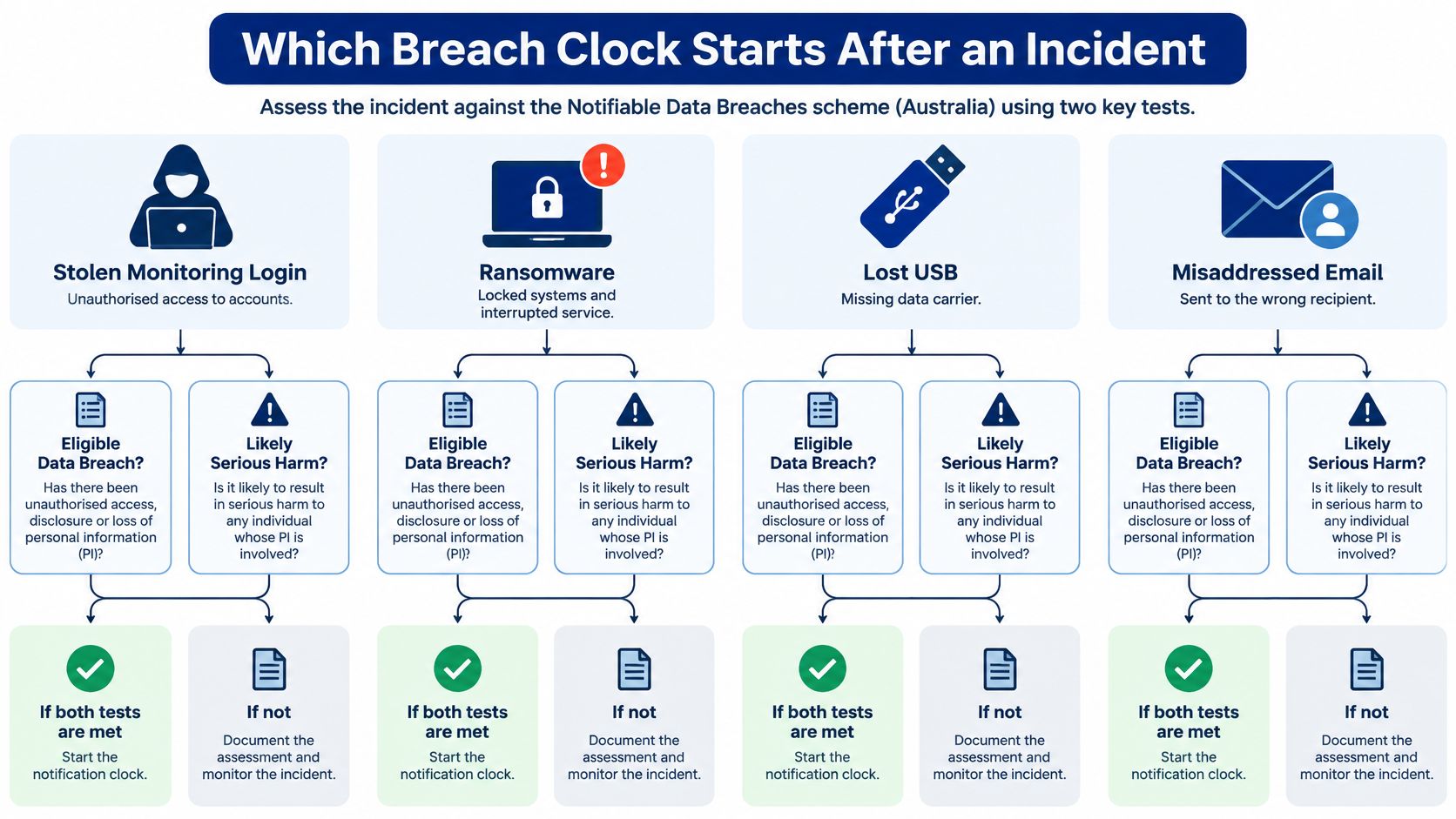
A monitoring login is stolen. Ransomware locks the CCTV server. A visitor register goes to the wrong recipient, or a guard posts incident footage to a private group. Each case calls for the same first question: does Australia's Notifiable Data Breaches scheme apply, does GDPR apply, do both apply, or neither?
The answer depends on the information involved, the people affected and the provider's role for that asset. A provider might process CCTV footage on a client's instructions, yet act as a controller for its own patrol records. Decide who assesses and reports each incident flow before one occurs.
Security Incident Escalation for Both Regimes
| Incident | Likely harm | NDB path | GDPR path | Who decides |
|---|---|---|---|---|
| Stolen monitoring or access-control login | Physical entry risk plus identity exposure | Assess whether serious harm is likely; the assessment period is up to 30 days | If GDPR applies, assess risk to people's rights and freedoms; notify the authority within 72 hours if the breach is notifiable | Client if controller; provider alerts the client promptly if processor |
| Ransomware on the CCTV or alarm platform | Loss or exposure of information, depending on access and recovery | Assess whether serious harm is likely and whether remedial action prevents it | If GDPR applies, assess risk to people's rights and freedoms and preserve evidence | Provider contains the incident; the controller decides on notices |
| Visitor register emailed to the wrong recipient | Contact details and information about site visits exposed | Assess the likelihood of serious harm, including physical or reputational harm | If GDPR applies, assess the risk to affected people and whether notification is required | The controller makes the reporting decision; the disclosing party follows the agreed escalation process |
| Guard or contractor posts incident footage | People may be identified in a sensitive context | Treat as an unauthorised disclosure and assess harm | If GDPR applies, a processor must tell the controller without undue delay | Provider limits further access; controller decides on notices |
| No personal information involved, or harm fully prevented | No remaining risk of harm | No NDB notification if the scheme's criteria are not met | No GDPR notification if the breach does not meet the applicable risk threshold | Privacy lead records the assessment |
For the NDB scheme, assess whether the breach is likely to result in serious harm. GDPR has a separate notification test and, where it applies, a 72-hour deadline for notifying the authority when a breach is likely to risk people's rights and freedoms. A processor's role is to alert the controller; the controller assesses its notification duties. Under the Australian scheme, assessment duties apply to covered entities.
A small access list can create more danger than a large marketing file. It may show who can enter, which doors their cards open and when a site is empty.
First hour: Disable compromised credentials, preserve the logs and alert the privacy lead. Record when the organisation became aware, then assess each applicable regime. Keep the reasoning if the assessment shows no notification is required.
A written security incident response plan should name the incident owner and the client's decision-maker, and set out how suspicion is escalated. Record the time awareness arose so the team can assess the applicable deadlines without waiting for the next business day.
A Ninety Day Plan for Providers and Clients
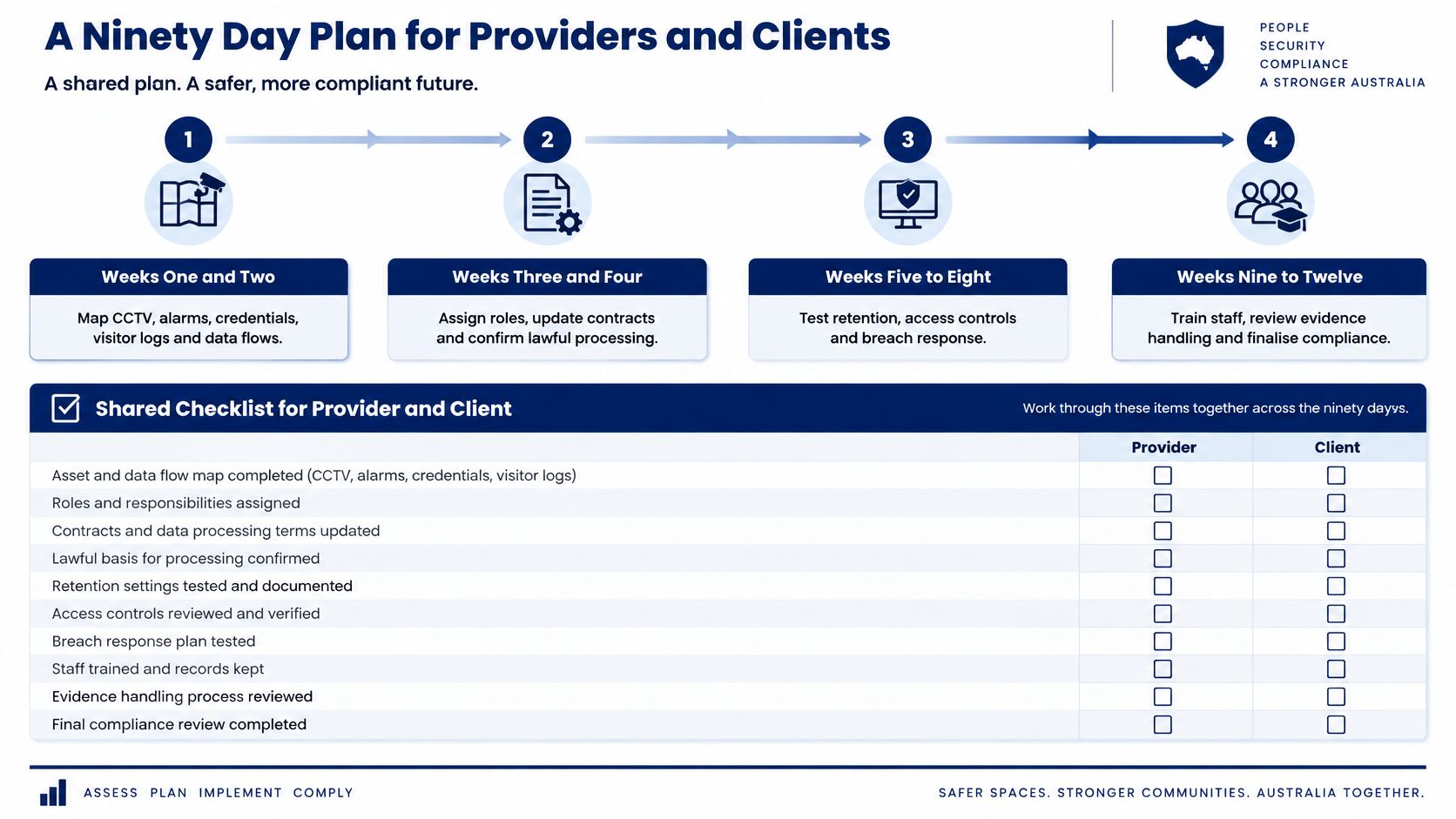
A joint plan works when each step has a day count and one owner. The provider holds platform security, log retention, and credential hygiene. The client holds purpose and signage. Shared steps need both signatures.
The Eight Moves in Order
- Weeks one and two, provider: Map CCTV, alarms, credentials, visitor records, and incident reports, including where each system is hosted.
- By day 14, provider: Train control-room staff, patrol officers, and facility managers on what may be viewed or exported. No guard views footage before training, and you keep an attendance record.
- Week three, both: Mark controller or processor on every flow and write that label into the contract.
- By day 40, client: Refresh boundary signage, collection notices, and guard scripts so people are told before recording.
- By day 50, provider: Execute contractor agreements covering instructions, sub-processors, security measures, breach notice timing, and deletion at contract end.
- By day 60, client: Set retention by asset, keeping routine lobby video for a shorter period than footage tied to an open investigation, and diary the deletion dates.
- By day 70, provider: Publish an access and correction playbook with redaction steps and a named responder.
- By day 80, both: Run a tabletop exercise on a stolen access-control export, timing both notification clocks and practising who calls the client.
Days 81 to 90 are for fixing what the exercise exposed. Close gaps in the register, reissue credentials that were shared between guards, and confirm deletion occurred on a sample of expired footage.
Site-Specific Checks
Add one extra check for each environment you operate. Construction hoardings move, so confirm signage still sits at the actual entry point after each stage change. Shopping centre malls are public-facing, so check that camera purposes don't drift into tenant disputes or marketing analytics. Short-term event overlays create temporary cameras and temporary staff, so confirm access is revoked and footage is transferred or deleted when the overlay comes down.
If a step has two owners, it has none. Put one name beside each date and review the list weekly until day 90.
Lock Roles Before the Next Site Goes Live
Mobilisation day is the wrong time to discover that nobody agreed who owns the footage. Three lines in the statement of work prevent most disputes, and each one should be answered before guards arrive on site.
The Three Contract Lines
- Purpose: Who decides why each camera, reader, and log exists?
- Export: Who may view, export, or release footage and visitor records, and who approves each release?
- Notification: Which party notifies regulators and affected people if an Australian duty and a European duty both fire?
If any line is blank, don't go live. A provider running guarding and the monitoring platform is often a processor for the client's site purposes and a controller for its own staff, rostering, and billing records. One label for the whole company is the usual mistake.
Write labels per service instead. Gatehouse and concierge work centres on access records. Shopping centre and retail work centres on camera footage. Event and construction work involves temporary overlays that end on a known date, so deletion and handover dates belong in the scope.
Read your security service contract terms against those three lines, and check the OAIC security camera guidance before you approve facial analytics on any site. If the contract can't answer who decides, who exports, and who notifies, the site isn't ready.
Compliance is a design choice about roles, retention, and response. It isn't a badge you add after the cameras are mounted, the cards are issued, and the first visitor has already been recorded.
If you're setting up guarding, patrols, event cover, or monitored CCTV across Melbourne, Sydney, Brisbane, Perth, or Adelaide, and you want controller and processor roles, retention, and breach duties written into the scope before mobilisation, talk to ABCO Security Services Australia. The team can review your site requirements, align licensed personnel with electronic security and monitoring, and help you lock the three contract lines before your next site goes live.
about
avada factory
Sempery ultricies nibh at dolor cras urna eleifend nec. Atiam efficitur tempor.